



When people ask what a club’s identity is, it can be a tough thing to work out, and even harder to verbalise. Sometimes you’re better off asking your enemies; they tend to know what you’re actually about. So ask them.
They’ll tell you that they associate Munster with brutality, toughness, grit, nastiness, hard work, being teak-tough at the set piece, and, in a general sense, being relentless c*nts from 1 to 23.
That’s who we are when our enemies really hate us.
Last season, it felt like what we were best at didn’t fit into that box. Of course we were hard-working and of course we showed grit throughout the season, but we lacked the focus to know what our focus should be, if that makes sense. At their best, a head coach is a lens that resolves the energy of the squad into a single laser beam. Last season, it felt like whatever lens we had was scattering the energy in different directions.
If head coaching were easy, every club would have an elite one, and the only thing that would determine your success is simply being named as such. Since 2018, Munster have had head coaches learning on the job, and I think both men would tell you that the pressure of being the Munster head coach, and everything that comes with it on and off the field, warped their vision for what they wanted out of the job.
Clayton McMillan comes into this role off the back of five really tough campaigns with the Chiefs. What does that experience give him? Focus. Head coaching is very rarely about walking into a building and changing absolutely everything. It’s about finding the right place to put that lens.
This win — and it is just one win — was incredibly refreshing, and not because it took us until the 20th December last season to win our first game on the road, but because of how the game was won.
It was about the core fundamentals.
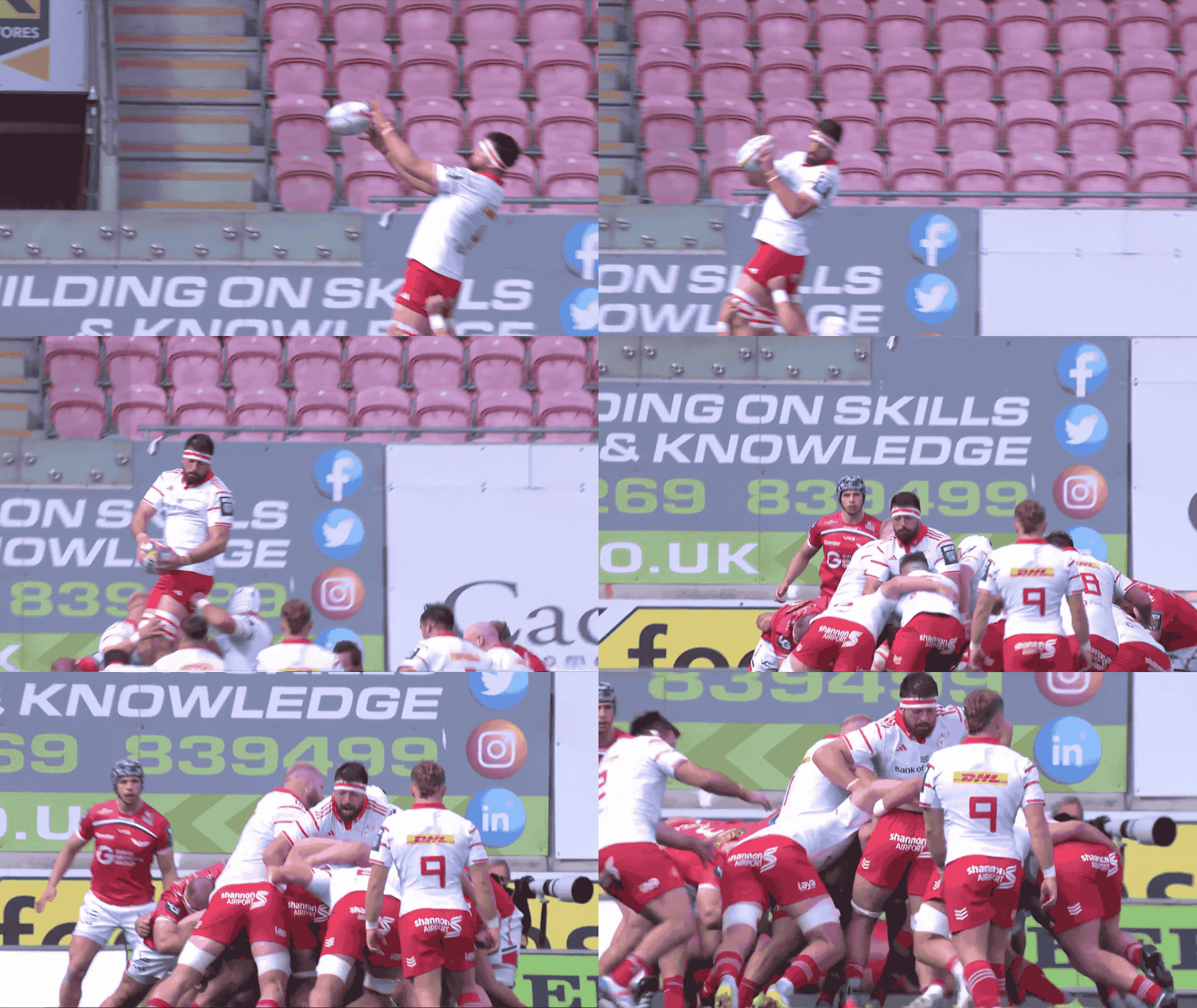
A solid lineout. A maul that ate up ground.
A dangerous scrum.
And playing like relentless See You Next Tuesdays.
***
When Clayton McMillan walked in the door of the HPC in early July, his focus was clear: our set-piece and everything radiating from it needed to be better. To be better at anything in this game — or in life, for that matter — you need to focus on it as a priority. So that’s what Munster have been doing. Intense sessions built around the set piece as a priority. Scrum, lineout, maul. On top of that, our forward shape was going to change. Not radically, not fundamentally, but enough to address an area of concern last season, in that we lost way too many collisions off the back of trying to avoid losing collisions.
These main points, along with a bunch of others, would be the template for what McMillan wanted to achieve here, which, at a base level, is fundamentally raising the floor of the performances this squad was capable of. What does this mean in a practical sense? On the face of it, it means making sure that dud performances like away to Zebre or at home to Edinburgh aren’t possible in the way we want to play. If the win over La Rochelle was a “9” and the loss away to Zebre — assisted by an airport sandwich the day before or not — was a “2”, then finding a way to make this squad’s baseline a 7 or above fundamentally raises the floor of what we’re capable of. Again, what does this mean in practice?
Removing most of the things that cause performances to fluctuate.
A stuttering set-piece. Losing momentum by having your forwards execute relatively complex passing and screening moves, instead of letting them focus on the set piece and winning collisions. Taking a relatively spread-out attacking system and narrowing it to help with ball retention.
We have a roster of forwards that is full of players whose primary skillset, when you break it down, is either at the set piece or over the ball at the offensive breakdown.
How do you maximise that?
By playing with less width amongst the forwards. This is a good example of a tapped free-kick after a scrum. Look at that narrow 1-3-3+1 shape.
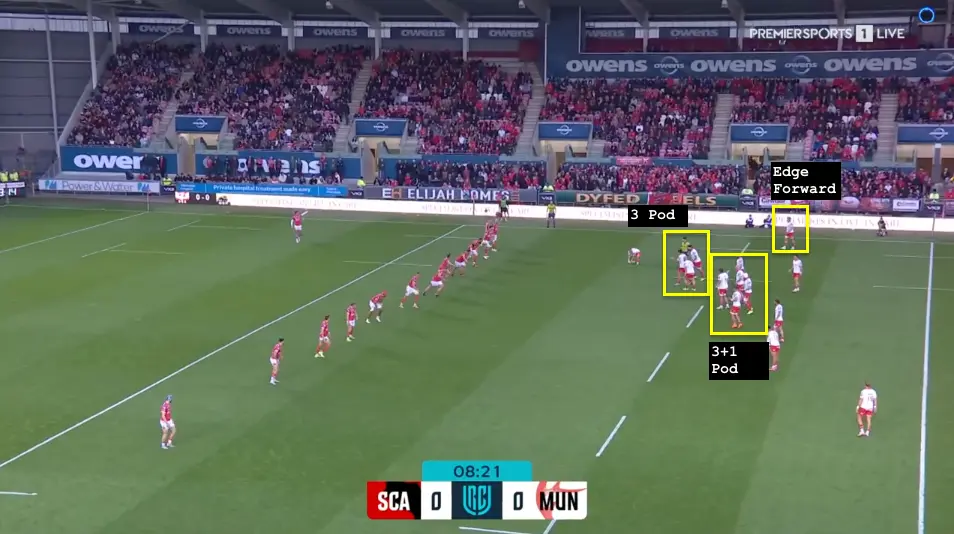
This is a small, but important, change to the 1-3-3-1 shape we used last season. That middle block can look like a four-man pod — and it can operate like that if needs be — but it’s mainly there to smuggle the last forward on the edge onto the next phase as a tight carry option, a cleanout, or a blocker if we want to go to the backline. The edge forward here shows up on the short side of the ruck, rather than holding long width.
Why is less width important? Last season, we played with our forward pods in quite a wide alignment, and usually with one in both 15m trams.
In this game, we used this asymmetrical structure that aligns most of the forwards on one side of the field, with the backline filling the space on the other.
You might say, well, this was off a tapped free kick. That’s a particular scenario.
Let’s have a look at other examples — I like this passage of play that led to Haley’s try. Look for those tight pods of three, with the extra forward only holding width on the shortside of the ruck.
What are we seeing here?
The system progressing phase for phase, but there’s some new stuff too.
The inside tip on by Jager is really effective because we only used it twice in the game; every other carry was direct and right up the guts. Look at this one, right before the linebreak. Barron takes contact, stays on his feet, and because Loughman and Kleyn are only there to secure the ball, rather than stay active for a tip-on inside or outside, they are right on the scene to bully Scarlets backwards with the latch.
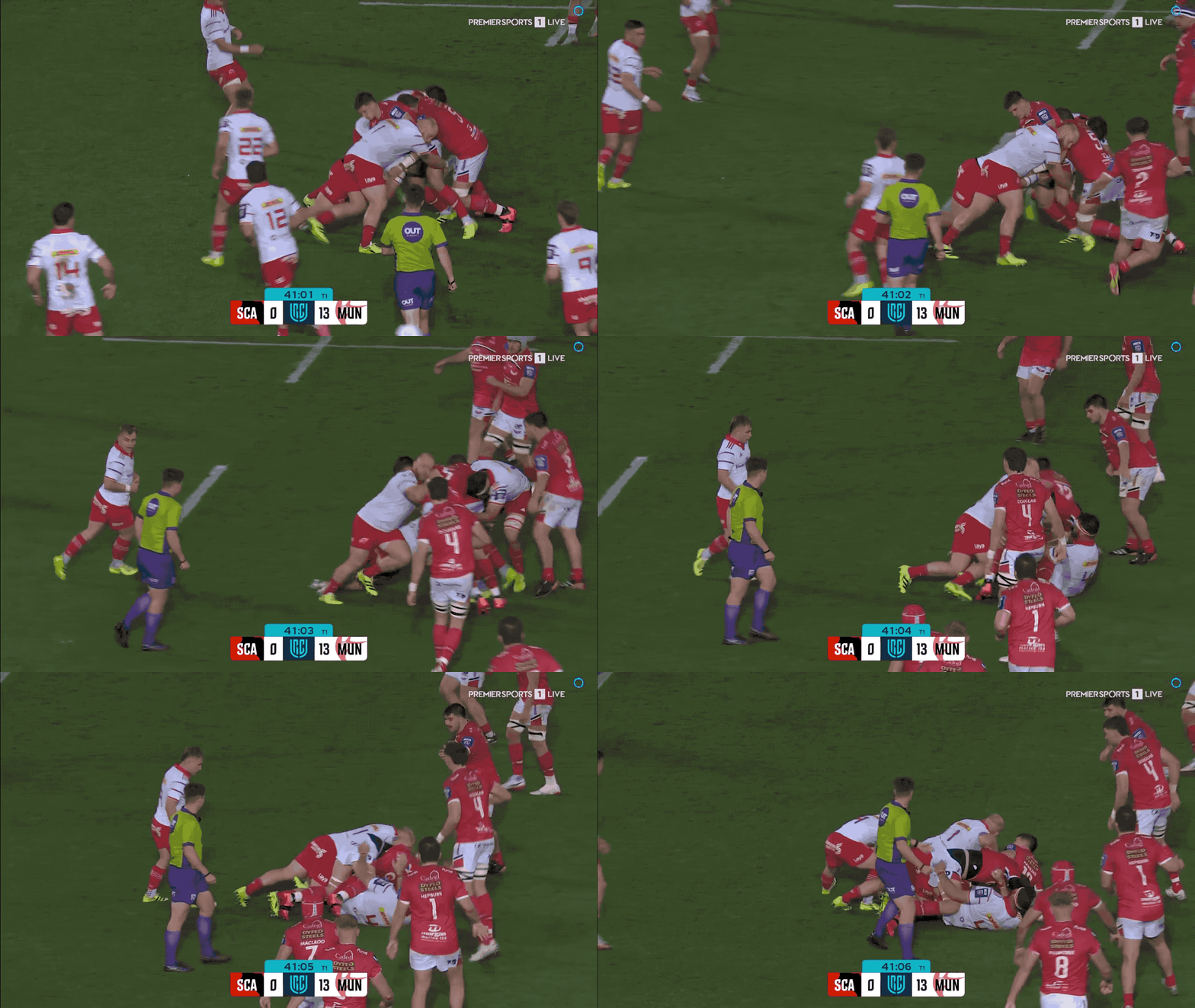
Players with simpler roles in possession will always be more effective in terms of physicality. Even on the previous ruck, there’s no free lunches on this carry by Gleeson and punchy cleanout by Jager.
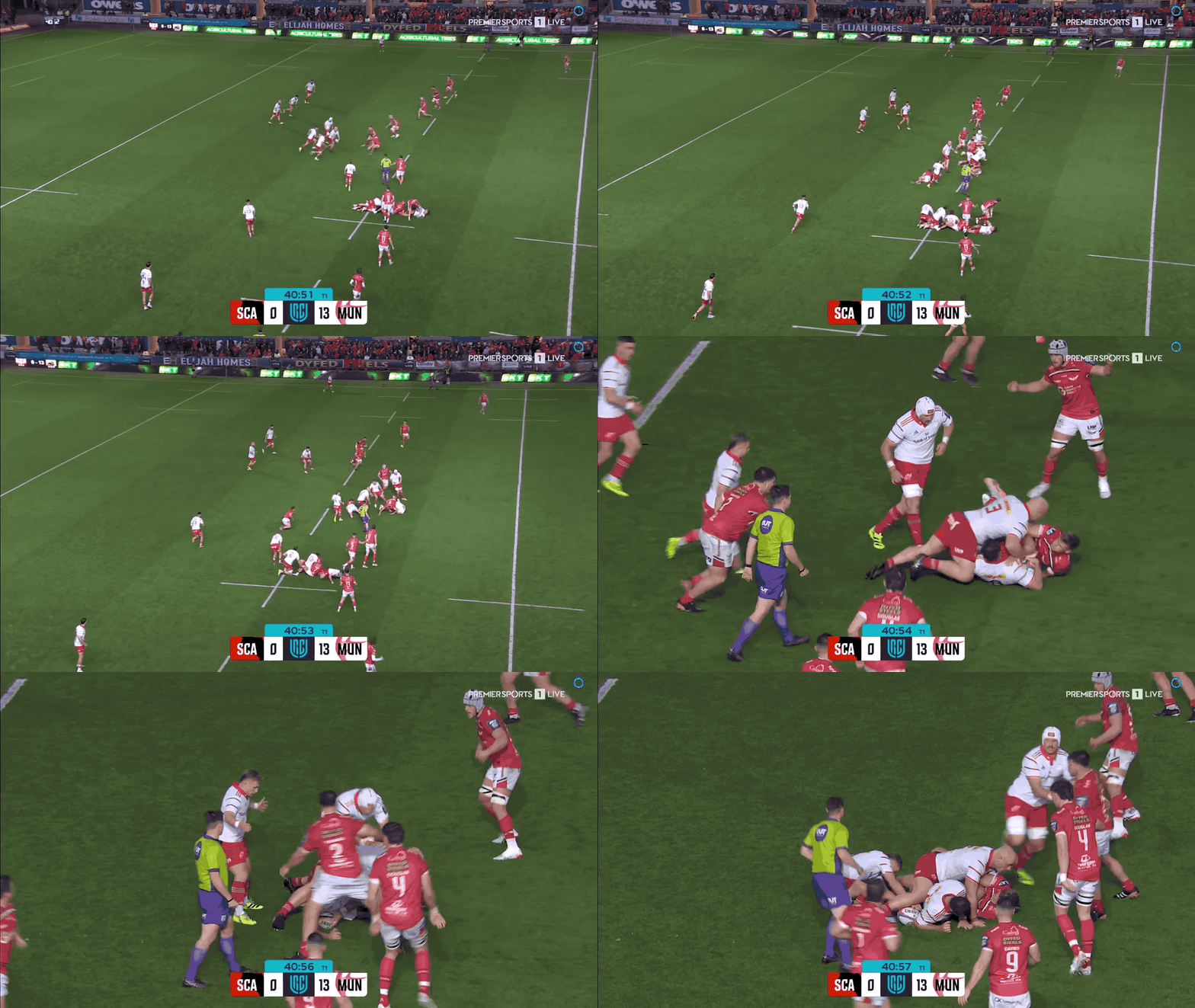
Structurally, you can see the shape forming after that collision point, albeit with a little confusion initially. Like most forward formations, there are no strict rules on where you need to be, especially less than one ruck after you were last involved, but a good guideline is looking where the current ruck is, and then working out your positioning by seeing where the open slots are. I think our back row have the most freedom when it comes to finding the edge space, and working into the 3+1 shape in midfield.
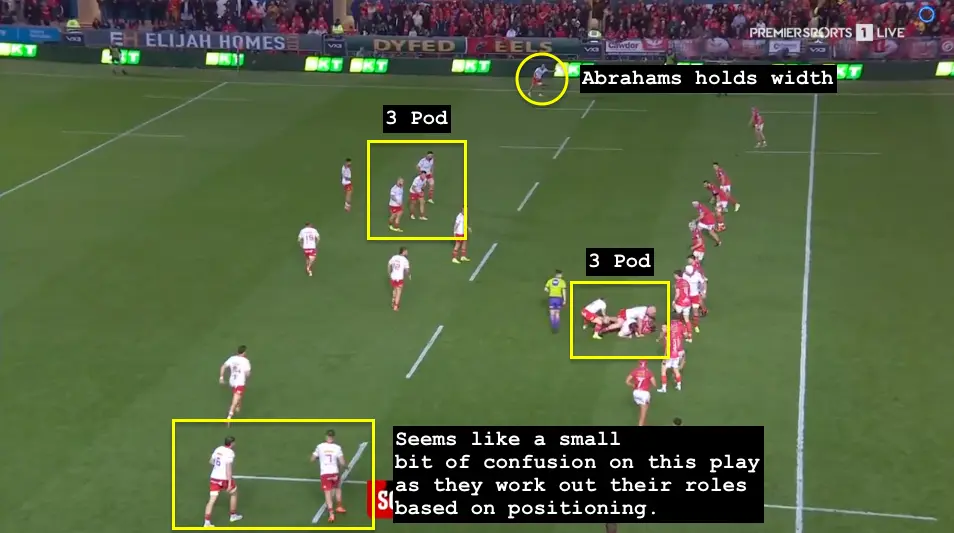
Kendellen works his way to the middle 3+1, Gleeson finds the +1 spot, and Jack O’Donoghue holds the opposite wing to Abrahams, all while the backline loads across to fill the asymmetrical gap around the forwards.
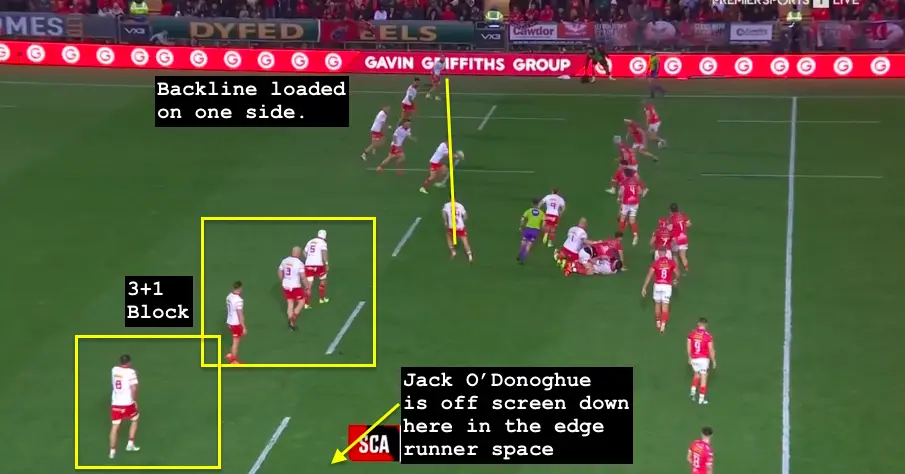
This is similar to last season’s shape, but the tweaks show the intent. The tighter alignment allows for more direct, heavily latched collisions, and that gives players narrower spaces to hit at the breakdown.
Forwards like straight lines and narrow spacing, because it allows you to be on the scene of the collision as it’s happening. When you’re spread out to be a possible pass option, it can stall your momentum and leave you arriving late to a ruck or missing a latch entirely.
We aren’t the biggest team in Europe, physically, but the core fundamentals of carrying in twos and threes get the most out of the proper power athletes that we do have, and it forces compressions. Scarlets were the third-best-ranked defensive team in the URC last season, and won the most turnovers per tackle in the tournament; that kind of team has typically been a nightmare for us in the previous three seasons. Here, we were so efficient in possession that I had people in my mentions already qualifying the win because the Scarlets were, or are, rubbish.
They aren’t. And they aren’t wildly weakened from last season either, or heavily rotated here.
They were just made to look wildly ineffective by a Munster side who seemed to revel in the clarity and focus of their preparation. And the violence that clarity allowed.
***
Watching this game back, it became clear just how different our mentality seemed to be here. Mentality is a very hard thing to judge, and you can often end up pushing what you want to see — be it good or bad — onto the team in question. But it’s like shouting at your reflection in a lot of ways.
Even with that said, there was a pop and aggression to our defensive and breakdown work that I don’t quite remember seeing last season. A hardness. A cynicism.
Nowhere was that more acute than in the big defensive set in the last ten minutes of the first half. Scarlets had two goes off a 5m catch and drive, and we repelled them both times. First with massive maul defence, and then into the tight phases where we conceded a try 46% of the time last season.
That wasn’t the case here. We were aggressive, low to the ground and made shots stick.
Sure, we conceded three tries in total here, but what were they? One was a defensive mistake on a short edge, and the other two were an intercept and a bounce of a ball so lucky it should play the lotto this week.
I’ll go as far as to say that, last season, this is probably a one-score game that goes either way. The way we played then was a bad stylistic matchup for how the Scarlets played, then and now. Yet here, this was a comfortable away win — something we literally only managed against the Dragons last season.
The Scarlets are no mugs. They play pragmatic rugby. They have a good scrum, lineout and maul on both sides of the put-in. Yet, they looked like they had none of those here.
Look at Ahern’s try here, and tell me this doesn’t remind you of what Munster are about. What would our enemies think about this try?
An excellent lineout — look at the lifting — into a maul that was a missed trip away from running under the posts, before teak tough short phases, punchy midfield carries and violent pick and goes did the business. As they have before, and as we know, they can do again.
But, just as we wouldn’t drink bleach at a loss in the first game, there’s no reason to think “we’re back” because of a bonus point win on the road. It’s five points in the bag, and that’s it.
In The Schedule, I looked at our first six games with varying degrees of points accumulation and what that would mean for the middle block of the season. This bonus point win puts us ahead of the curve right now and makes 20 points a realistic goal for the end of November.
In an 18-game season, the first third isn’t everything, but it sets the flow of your season. Hit ~20 points by Round 6 and you control selection, manage risk, and keep Top-2 firmly alive. Other teams can go about their business with pressure, you can pick and choose your strength level depending on home vs away.
If you fall to ~14 or less, the last 12 become a sprint at home-semi pace just to clear the Top-8/Top-4 lines and, as we’ve seen this season just gone, that is unpredictable.
We have four home games before the end of November. Even on last season’s patchy form, that would give us some breathing room, even with Leinster in Croke Park thrown in the middle. 18/19 points in those games, added to the five here, would be exactly the start we’d have drawn up.
That’s all this is: a good start, with encouraging notes that weren’t there for last season’s bonus point win in Round 1.
All that matters now is what’s next. Cardiff. Thomond Park.
| Players | Rating |
|---|---|
| 1. Jeremy Loughman | ★★★★ |
| 2. Niall Scannell | ★★★ |
| 3. Oli Jager | ★★★★★ |
| 4. Jean Kleyn | ★★★★ |
| 5. Fineen Wycherley | ★★★★ |
| 6. Jack O'Donoghue | ★★★★ |
| 7. Alex Kendellen | ★★★★★ |
| 8. Brian Gleeson | ★★★★ |
| 9. Craig Casey | ★★★★ |
| 10. JJ Hanrahan | ★★★ |
| 11. Thaakir Abrahams | ★★★ |
| 12. Alex Nankivell | ★★★★★ |
| 13. Dan Kelly | ★★★★★ |
| 14. Shane Daly | ★★★★ |
| 15. Mike Haley | ★★★★ |
| 16. Lee Barron | ★★★★ |
| 17. Josh Wycherley | ★★★ |
| 18. Conor Bartley | ★★★ |
| 19. Tom Ahern | ★★★★ |
| 20. Gavin Coombes | ★★★ |
| 21. Paddy Patterson | ★★ |
| 22. Jack Crowley | ★★★ |
| 23. Sean O'Brien | ★★★ |
Key Performers
This was a very good performance, all in all, with the three-star curve being a very strong component of a solid away win.
Oli Jager was the standout forward for me. His scrummaging was absolutely top class, and he looked really strong and mobile around the pitch and in the maul. A really encouraging performance from a vitally important player. Some real solid stuff from Conor Bartley off the bench, too.
Alex Kendellen had one of his better games for Munster here, and that’s saying something. I think he’s needed something to stand out in his role, and he showed what that might be here: intense carrying, low, lethal chop tackling and real brutality on both sides of the breakdown. A really interesting performance from a guy who’s coming into his peak years.
Alex Nankivell had his best performance in 12 months, maybe at home to Edinburgh last season excluded. He looked punchy in contact, aggressive and seemed to have that long bridge pass that repeatedly caught him out last season under control. When he plays like this, he looks like a guy who is easily test level.
Dan Kelly had a superb competitive debut and looked incredibly effective on both sides of the ball, with multiple big involvements.
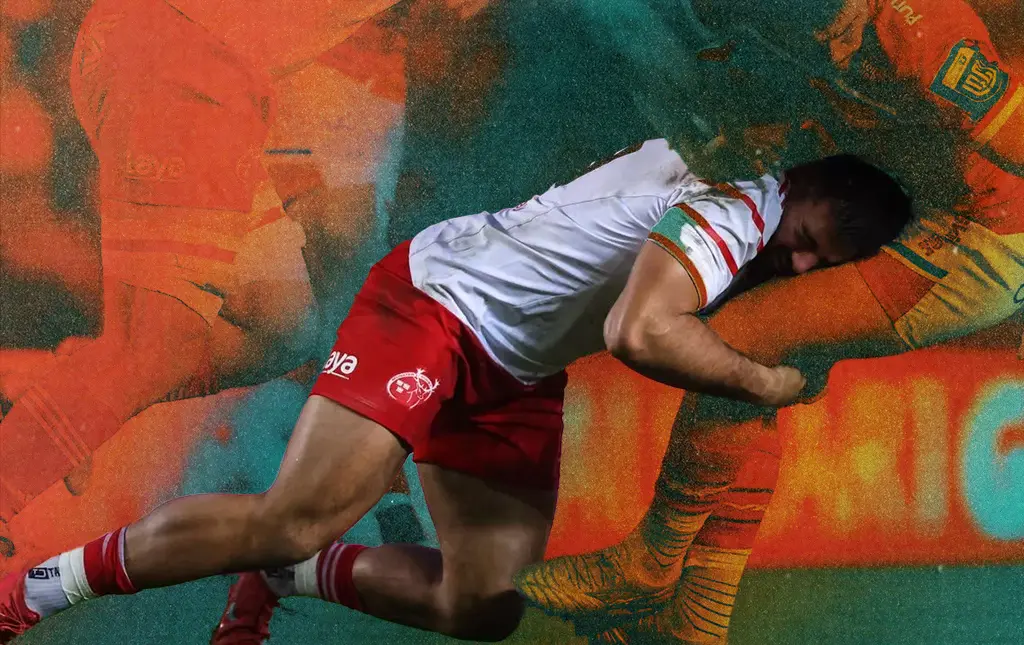
He’s an incredibly mobile, aggressive and has the air of a leader about him. One moment really stood out — not his sharp passing for Haley’s try, not his own try, but this in the first half. He gets stepped on a tackle, but gets back up and hairs after the ball, forcing a turnover with his recovery tackle.
He’s a proper player, this guy, and I think himself and Nankivell already look like they’re building something special as a partnership.
