


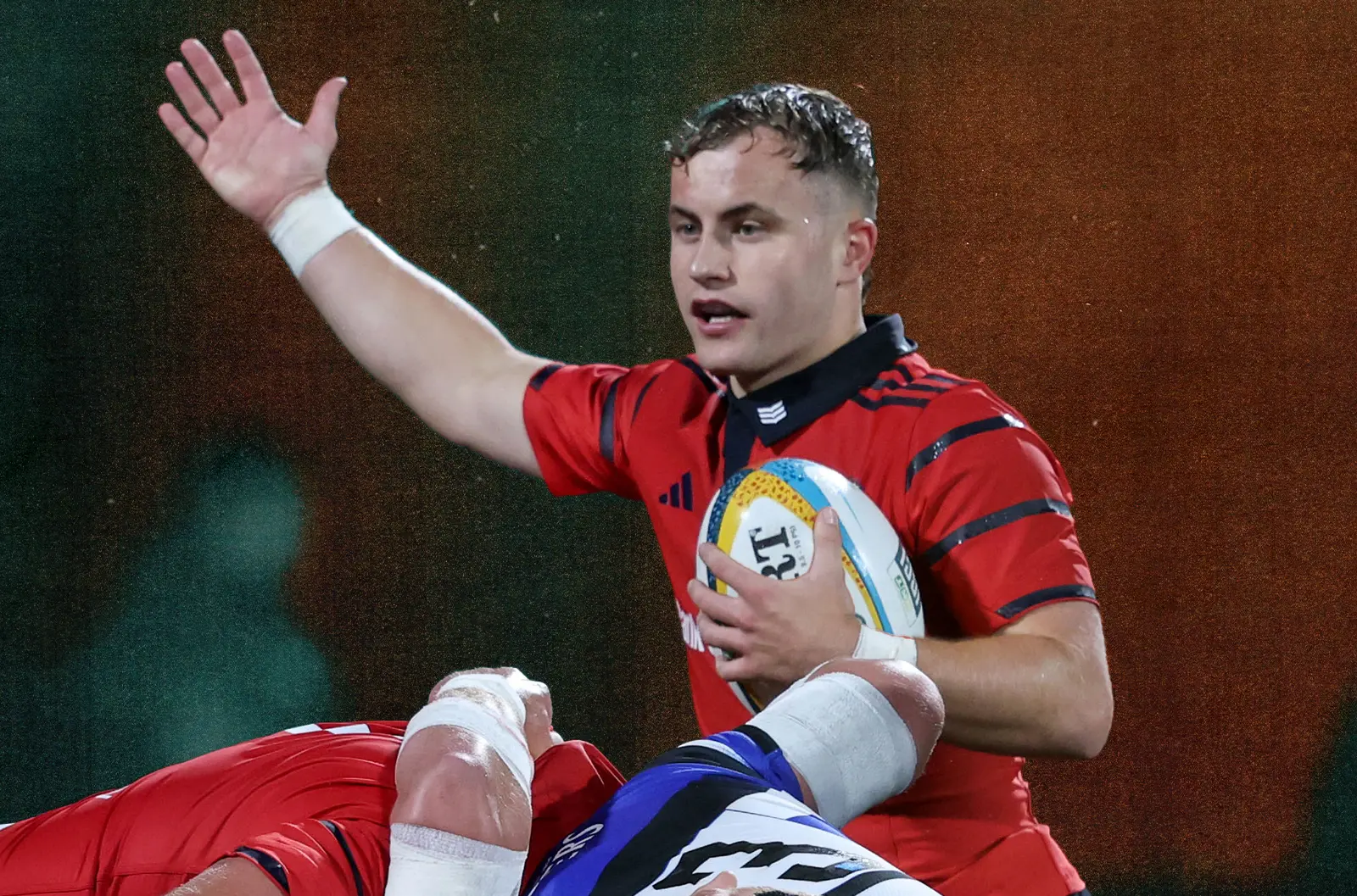
Some contract extensions are so obvious in their importance that there isn’t really any point in trying to beat around the bush.
Craig Casey is one of them. He knows it. We know it.
Casey is coming to the end of a three-year deal signed back in September 2022, and it’s not hard to argue that he is Munster’s most important, least replaceable player this season. Guys like Beirne, Crowley, Coombes and others are as important to Munster playing well at the highest level, sure, but you could argue that they have players who could feasibly step in for them if needs be.
Casey does not.
That is a problem in and of itself, but it was also a problem last year, as we saw during Casey’s spell out with injury. But we’ll get to that.
Most clubs pick and choose where they want the bulk of their halfback contract depth to be.
You will see clubs with either two very good — and, as a result, very well paid — scrumhalves, or two very good players who can play at #10. By far, the most sensible way to run that depth is by stacking players who can play #10, as they can also usually fill in other positions. Toulouse are not short of money by any means, but their #10 chart behind Romain Ntamack is filled with players who primarily play fullback (Thomas Ramos) or literally every other position in the backline (Juan Cruz Mallía) because so much of their budget is tied up in Antoine Dupont. Dupont’s backups are decent players, as you’d expect, but they are very much stand-ins, rather than competitors. Dupont is Toulouse’s primary playmaker, so they don’t waste their budget on guys who are only there to cover for him. Any money you spend on players who can play #10 allows you to fill out other areas of your backline at the same time, so the budgeting is kinder as a result.
The feeling is amongst clubs that I’ve spoken to anyway, is that scrumhalf is a very hard position to get elite talent in, but the general level of most scrumhalves is pretty good on a cost-per-ability basis, so that you can cover the position well without breaking the bank.
Last season, Munster had a — relatively speaking — very expensive scrumhalf depth chart, and I don’t think we were better off for it. Conor Murray was on quite a considerable PONI deal since 2023/24, and that, along with O’Mahony’s deal, limited Munster’s ability to fill out other areas of the squad.

A lot of the hassle over those PONI deals came from Munster’s desire to invest in the front row and backup for #10 for 2024/25, but the unexpected expense of Murray/O’Mahony being lumped onto PONI deals by the IRFU upset the applecart in more ways than one. Conor Murray, in particular, was of immense value to Munster while he was on a central deal, and was almost the perfect use of a central contract for players in their mid-30s and a little beyond their peak.
Murray was solidly a backup for Ireland at that stage — and was again last season — but you could argue that he was a backup at Munster too, certainly from a usage perspective. If Munster were going to spend significant sums of money on any position for last season, it wouldn’t have been for a backup scrum-half, at least not on the amounts that were spent on Murray’s PONI deal. Munster had no choice in the matter, but I would say that the club “owed” it to Murray (and O’Mahony) to keep them on for another year if their Irish careers were over. Where the contention came from was that both Murray and O’Mahony were as involved with Ireland as they ever were on their PONI deals last season, so Munster got the worst of both worlds.
If the club were going to sign an elite veteran scrum-half as cover, and an elite veteran backrower from the Southern Hemisphere, we’d expect to have them week after week, game after game, from maybe mid-October on. Think of how Leinster used Scott Fardy at the end of the 2010s, or how Munster used Doug Howlett post-2007. The amount you pay them is commensurate with them being leaders every single week and every single session, but that wasn’t the case with either Murray or O’Mahony last year, both of whom played full roles for Ireland in the two international windows, along with the required rest windows on both sides.
Munster argued in 2023/24 that if both players were going to be playing most games for Ireland — Murray and O’Mahony played in seven of Ireland’s nine fixtures last year — that it made sense they should be on full central contracts until the end of 2024/25. David Nucifora felt differently. Munster felt that, far from being rewarded after the URC win during 2022/23, the budget space they’d worked to create that off-season was being cut off at the knees.
So, I’m not saying that Conor Murray and Peter O’Mahony’s PONI deals had a direct knock-on effect with the signing of cut-price punts on players like Billy Burns ahead of last season, but they aren’t entirely unconnected either, especially in an environment where there are limited funds, positions that need cover and a self-contained Irish Qualified system where genuine options are limited. When both announced their retirements, it allowed Munster to portion out some of that spend, albeit a little later in the season than would have been ideal, even allowing for the fact that we didn’t know who the head coach would be until February.
That puts all the focus on Craig Casey as Munster’s primary scrum-half, in a massive season for him professionally and contractually.

With Murray retired and Jamison Gibson Park turning 34 this season, Casey is the obvious choice to succeed the former initially, before then taking over from the latter. His incredibly well-received captaincy of the Irish national team over the summer is an even stronger indicator of his importance to the national set-up, especially one that seems a little short on genuine leaders.
This puts Casey in a very strong contractual position, and he could arguably find himself in a discussion for a central contract, which would be the ideal situation for him and Munster. Now, you might well say that Jack Crowley should have been in the same discussion last year, but I would argue that the contract discussion became way more complicated right before discussions started with the emergence of Sam Prendergast at the end of 2023/24, his inclusion on the summer tour as an apprentice, and then the start to 2024/25 and everything that went with it.
Casey is head and shoulders above any other scrumhalf on the island that isn’t named Jamison Gibson Park when it comes to his ability to shape games as a facilitator, control them with his kicking, his pass quality, those unquantifiable leadership skills and the support lines and trail-running he added to his game last season.
Sure, you have guys like Matthew Devine, Ben Murphy, Fintan Gunne and Nathan Doak who all have elements of what Casey does, but none of those bring all of them, on top of having more than a few flaws in their game that Casey simply doesn’t.
Getting him onto a three-year deal, however that happens, is ideal. A central contract would be even better, especially as it’s spreading some of the central pot away from Leinster, even with the 40% split. If anything, that 40% split should make it easier to award central contracts, especially for a no-brainer retention like Casey.
His importance to Munster and to an Ireland squad where he is the next most experienced scrumhalf after our ageing incumbent by a factor of ten.

Behind Casey, Munster also has some decisions to make as both Paddy Patterson and Ethan Coughlan are on expiring contracts this year. Having all three scrumhalves on expiring contracts isn’t ideal, but once Casey is sorted relatively early, it should allow Munster to make some key decisions around the future of the 1B slot in this chart.
Patterson has been really unlucky with injuries in the last season and a half. He suffered an ACL injury at the end of 2022/23 after what was a breakout season for him. He reinjured that knee after a quick comeback at the start of 2023/24 and missed the entire rest of that season. He made his comeback for the latter half of last season, but looked like a lot of players who rely on their speed and change of direction in the initial stages of recovering from a knee injury — nowhere near their best.
At his best, Patterson is arguably the fastest scrumhalf on the island and that can compensate for his pass and kick quality, which can vary wildly. Last season, he looked more than a little off that level as he made his way back from injury. This is a big season for him as he turns 27. If he can showcase that he’s an able backup for Casey with that pace as a game-changer off the bench, a new two-year deal seems like a pretty straightforward deal to make. If not, it’s not out of the question that Munster might look to move on and perhaps invest in a lower-cost veteran scrumhalf to manage the load, both in the short-term and for next season.
Ethan Coughlan will turn 24 this season, and while he’s shown flashes of what he can do in the last four seasons, he needs consistency to nail down that 1B slot. Essentially, both Patterson and Coughlan have to sell the idea that they are a better medium-term bet than being replaced by an Alby Mathewson-style veteran scrumhalf on a one or two-year deal, while Jake O’Riordan and, in the near future, Charlie O’Shea take up those 1C rookie minutes.
I see either one of those scrumhalves re-signed, or neither of them. A fair bit of pressure there.
***
I spoke earlier about how clubs typically choose to use their budget at halfback, and this season, Munster are a really good example of doubling down on #10.
When Murray retired, Munster decided to move that spare budget to JJ Hanrahan, who will alternate at #10, but who can also play at #12 and fullback, after the aforementioned punt on Billy Burns didn’t work out. His injuries didn’t help — they directly led to Munster having to play Jack Crowley for the guts of 80 minutes eight weeks in a row at the tail end of last season — but even before then, Burns looked like an awkward fit.
Hanrahan is anything but and has blown people away this pre-season with how well he’s slotted into that playmaking role. He’ll play #10 when we need to rotate out Crowley, he’ll wear #22 or #23 with ease during bigger games, and he’ll likely play #10 with Crowley sliding to fullback when we want to really open games up.

It’s an ideal signing that gives Munster options for every single game we’ll play this season. It’s a perfect use of budget and, for this season and next, there is real breathing room in Munster’s #10 chart.
I think there was an acceptance during last season’s Six Nations window, in particular, that Tony Butler is still very much a work in progress, even as he turns 24 this season. There’s clearly a talented player there, but a little like Ethan Coughlan, his biggest issue is consistency phase for phase, on both sides of the ball. He’s got really good game IQ, gets what he’s supposed to be doing and seems like a good character around the place — everything I hear is about how coachable and intelligent he is — but he needs to pull it together pretty quickly this season. Even last week in that friendly against Bath, there were really positive moments followed by poor, incredibly costly errors that, translated to a URC game, would have real consequences.
With Tom Wood, in particular, looking like a central piece of this season’s Irish U20 campaign, Butler will have to show that he’s got the composure to handle 7/8 URC games as a starting #10 to allow for deeper rotation of Crowley and then Hanrahan. If he can’t, I think it’s inevitable that Munster look at that 1C contract and decide that Tom Wood is a better investment in the short, medium and long term. Tom Wood looks to have “it”. What is “it”? Well, young playmakers often struggle when the light shines on them, but Tom Wood has been dealing with that his whole life. Keith Wood’s young fella? Playing #10? Gordon Wood knows all about that, but he, at least, has the cover of playing in the midfield. There’s enough pressure on any young #10 anyway without being the son of arguably one of the best players to ever play the game.
When I watched Wood for the U20s this summer, playing a year young, let’s not forget, he looked like he had the bollocks to make the big play, and the gravity to attract those moments, which is almost as important. He’ll spend most of this season prepping for 20s, but don’t write off a URC appearance or two if the season starts well.
Dylan Hicks faces a pretty pivotal season, too, as he enters his third year in the academy.
Hicks joined straight out of school from Bantry at 18, and almost everyone I spoke to about him understood that he was going to be a long-term investment because he just didn’t have the exposure to first-class games as a young player. He was going to need A-games, AIL, U20 games, every rep, every session, to deliver on his potential. I think he was unlucky to have his full 20s year last season, given all the coaching turmoil that went on, but I felt there was a run to be made at #10 and, for whatever reason, it never happened for him.
He’s got a move to Cork Constitution this season in the AIL after a few seasons at Garryowen, where he’s mixed really good moments with the kind of inconsistency you’d expect from a young player, and it could well be the making of him. Cork Con are all about structure, and with a good pack in front of him and a very punchy midfield, I think he can start to showcase what he’s capable of.
