



Back in 2019, I wrote the first instalment of For Every Wall A Hammer.
Many of the images I used for that article have been deleted — server storage is expensive — but the general concepts are intact. Since 2019, many of these rugby league concepts have found a home in union, in one form or another.
When you see inside or outside tip-ons from a pod of forwards, that’s mostly a rugby league innovation that has osmosized across to union in the last decade, but that’s only part of a concept. The real innovation was in taking the larger concepts of rugby league and applying them to a union context.
The greatest innovator in this regard was, and arguably still is, Ireland’s head coach Andy Farrell.

Between 2016 and 2019, Andy Farrell was Ireland’s defence coach, and he brought exactly what had made his name in the sport as a coach to that point: high-intensity rugby league style blitz defence. Before that, he was England’s defence coach between 2012 and 2015, with two spells as the Lions’ defence coach in 2013 and 2017.
So how, post-2019, did Andy Farrell, seemingly all of a sudden, become the main driver of Ireland’s attacking revolution?
Mike Catt was the attack coach during that messy first 12/18 months of Farrell’s tenure, but from what I’ve been told, Catt’s role was misunderstood. He was there to design and implement Ireland’s set-piece strike plays, but his main role was implementing Farrell’s attacking vision on the training field, something that Farrell would take on directly in 2021, after Catt’s departure.
A lot of Farrell’s initial offensive shape was inspired by Tony Brown and Jamie Joseph’s 2019 Japan side, who stunned Ireland (and the rest of the game) during that 2019 World Cup. Yet, the more I watch the NRL, the more rugby league influences I see in Farrell’s attacking system and the reliance — over-reliance, you might say — on cohesion to make the system work as designed.
***
At a very basic level, Rugby League is Rugby Union with the contest for possession on the floor and at the set piece removed.
As a result, in the years since the codes diverged, League has become incredibly detailed when it comes to phase play because, unlike Union, the entire game is phase play.
In League, there are four primary moments of the game;
- Settled Attack (six tackles allowed per set, but most sides kick on the fifth tackle)
- Settled Defence (make five tackles in a set to then, usually, defend a kick)
- Attack Transition
- Defence Transition
League does have uncontested scrums, which creates a slightly different look to their phase play, but only slightly. Not enough to count as a specific moment on its own. In union, there are eight, but I would argue ten primary moments of the game in 2025.
- Settled Attack
- Settled Defence
- Attack Transition
- Defence Transition
- Scrum Defence (set piece itself + defence)
- Scrum Attack (set piece itself + attack)
- Lineout Defence (set piece itself + defence)
- Lineout Attack (set piece itself + attack)
- Maul Defence
- Maul Attack
In Union, the game itself provides the variety. League has fewer moments, but don’t mistake that for it being basic or simple; it’s anything but. All of Union’s natural variety is crammed into League’s phase play, which means that, phase for phase, League is streets ahead of what any Union side is capable of.
And it’s not even close.

To understand how you can take what works in League, you have to understand what teams in the NRL value at a fundamental level.
And that’s PTBs, or Play The Balls, along with some other things, but I’ll get to those later.
This is a Play The Ball. Well, here are three of them, starting with the first tackle off a kick. The carrier runs into contact, usually two on one, and the defenders wrestle with the carrier on the ground to impede the speed of his “recycle”. The rest of the defensive line then have to retreat ten metres.
The tackled player then has to get to his feet from the ruck and roll the ball back from a standing position, and the dummy-half can then Play The Ball. If the ball carrier lands on his back and has to wrestle around to his front, the PTB is slower. If he lands “on front” and gets up fast, the PTB is quicker. If the defenders hold him down for too long, or interfere with the PTB, or don’t retreat quickly enough, it’s a penalty that the attacking team can kick up the field or at the goal.
Post COVID, the NRL brought in a rule called “six-again”, which aimed to punish cynicism at the ruck, and it’s been mostly successful, if increasingly unpopular.
The Six Again rule lets referees replace certain ruck-area and 10‑metre offside infringements with an immediate restart that resets the tackle count instead of stopping play for a penalty. This was intended to accelerate the game by reducing stoppages, increasing ball‑in‑play time, and preserving attacking momentum against cynical defenders. Referees still have discretion to award a full penalty or sin‑bin for repeated or professional fouls, particularly if teams exploit the ruck or infringe near the try line.
Quick PTBs are crucial because they catch retreating defenders before the line resets, enabling dummy‑half scoots, rapid shifts, and momentum that translates into meters, line breaks, and points in today’s faster “six‑again” era. The NRL actively tracks PTB speed and surfaces it on match centres, underscoring its tactical importance across games and seasons
PTBs are the most recognisable thing you’ll see in League phase play because it’s functionally identical to what happens when the scrumhalf gets the ball back from a recycled ruck in Union.
A quick PTB occurs when the tackled player lands “on front” and the ball is played rapidly, limiting defensive reset time and opening immediate running and passing threats from the ruck. In official match centres, average PTB speed is reported per team; for example, Manly and Melbourne recorded 3.85s and 3.75s respectively in a recent NRL fixture, a snapshot of the mid‑3s speeds common at that level.
Why Quick PTBs are Tactically Valuable
They exploit the 10‑meter retreat by attacking before the line organises, letting the dummy‑half attack space or connect to runners while defenders are still backpedalling.
Faster rucks compound momentum across sets, especially post “six‑again,” which increased unbroken play and created more attacking opportunities through extra play‑the‑balls and tackles.
They help convert post‑contact wins into continuity, and emphasise runs, meters, and “on‑front” outcomes so they align with teams that generate more line breaks and scoring actions.
Even when outright ladder correlation is mixed, quick PTBs remain a key mechanism for stressing defensive systems and creating repeatable advantage phases in modern game conditions. I haven’t checked the data in Super League in the UK, but I would imagine it’s the same there.
Key Statistics
After the six‑again and related changes, matches saw a significant increase of approximately 6.2 extra play‑the‑balls and 8.3 extra tackles per team, indicating longer unbroken phases where quick PTBs have a greater impact.
The same analysis reported substantial rises in run meters (+79.1) and post‑contact meters (+100.9), consistent with a faster game where rapid rucks amplify territorial gains.
Essentially, quick PTBs are a force multiplier in the modern NRL: they magnify the benefits of “on‑front” carries, accelerate unbroken sequences, and increase the chance that meters and breaks convert into points within faster, continuous phases of play. Teams that win contact to generate quick PTBs and then capitalise with organised push support and spine connections extract more value from the game’s increased ball‑in‑play.
Here’s a good example of how a quick PTB empowered the dummy-half. This is pre-Six Again law change, but that doesn’t really matter.
Quick PTBs aren’t the be-all and end-all, of course. Much like quick ruck ball in Union, they are a means to an end. But when we look back at what we’ve learned around the League ruck and PTBs, do you start to see a correlation between that and what Ireland have been doing since 2021?
How much of Ireland’s quick ball empowers Jamison Gibson Park, rather than allowing him to empower others?
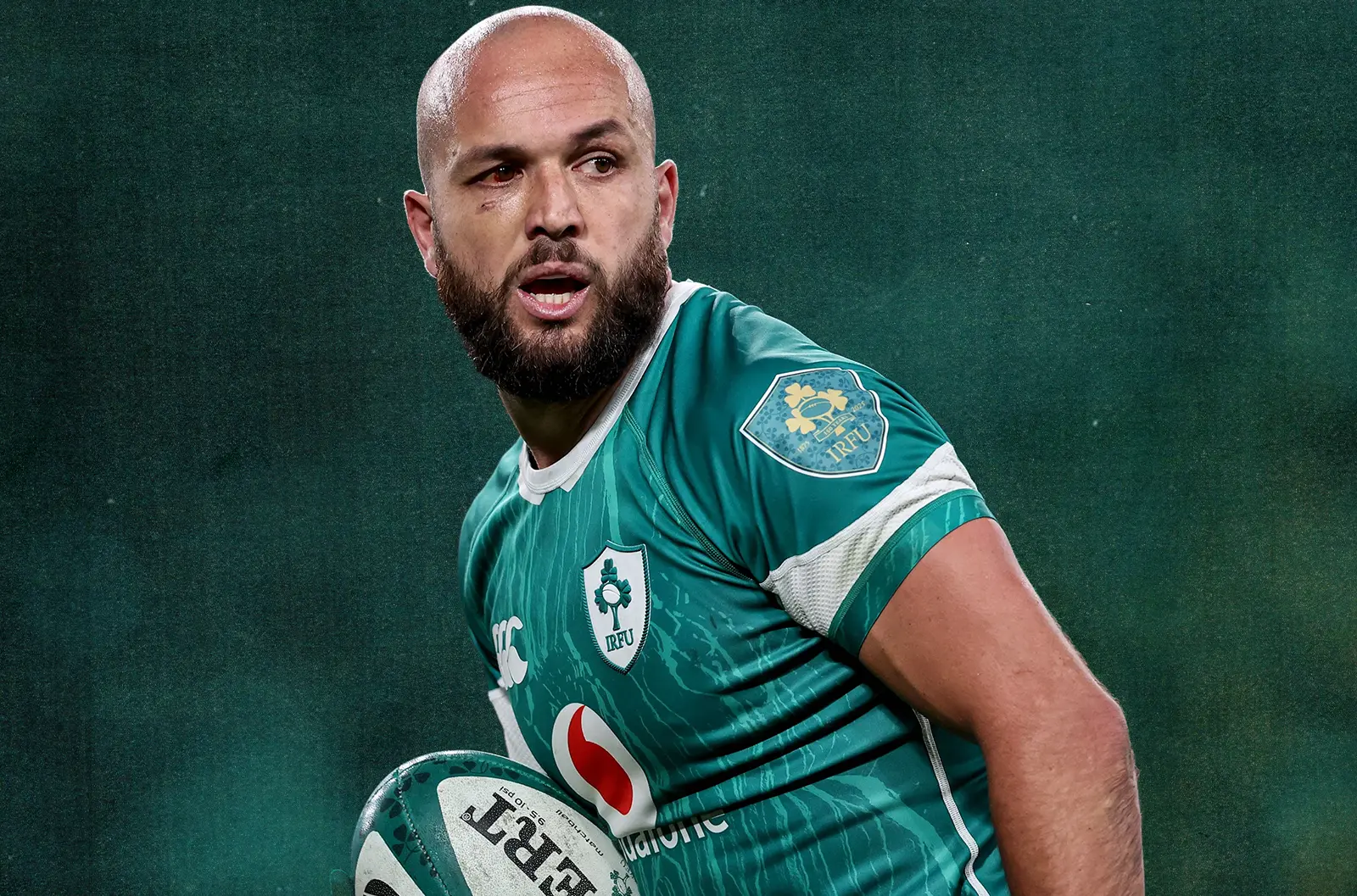
That might sound like a de facto criticism of Jamison Gibson Park. It really isn’t. Ireland’s attacking concept runs better when Gibson Park is the focal point, rather than a facilitator, because his running game on the equivalent of a quick PTB empowers him to dominate games from scrumhalf.
When Ireland’s system runs at its best, it uses a host of League concepts.
Attacking lines from the ruck, multiple deep layers of attack and highly scripted phase plays based on your position on the field.
In League, when you’re playing out from your own 20m/30m line, the carrying is usually very direct, and your layers are usually very flat and compact.

However, when you get to the opposition’s 20m line or even in their half of the field, full stop, you will often see really deep layered lines with multiple possible options along the progression, and the primary creators left with pretty simple pass execution.
You can see multiple layers here, with looping runners coming around the outside from 25m behind the ball. This “swing shape” is a core part of Ireland’s attacking evolution under Farrell, but it is used all throughout the game these days.

Ultimately, League is all about having inbuilt runs based on your field position, with simple pass execution being the primary aim. Simple, in this instance, means never passing beyond 10m unless something unexpected shows up. All the time you would typically spend doing scrummaging, lineout and maul, along with the radiating patterns off those set pieces in Union is spent running through these shapes in League. They have plays for almost every 10m line on the field, on the left, right and centre of the field.
Are you starting to see how cohesion in this concept might be of outsized importance — arguably more important than League — when transplanted over to Union?
We’ll get back to that.
One of the things you see again and again in League is the block shape.
We see it in Union all the time now too, and it’s now a regular target of high blitzing defences, especially on short side plays where you’re going from the centre of the field to the edges.
In League, they’ve started to innovate with “Y” lines, where the block runner starts on one line, before arcing out to take the pass outside the lane of the defender.
The defender starts on the same line, but the pass option is always there to arc outside, and the pass is always going to that width. You can see how this would work in the same scenario in Union. The defender is lined up on one lane, the player he’s defending changes his lane late, the ball goes to where the line runner is going to be laterally at the end of the run, rather than on the same line he started on.
Very hard to defend.

One thing you spot in League pretty quickly is that while the collisions are very, very hard, most of the players have the same approximate build. The heaviest player in the NRL this season, for example, was only 3kg lighter than Oli Jager. Most NRL props would look a lot like Caelan Doris when it comes to their height and weight, so there is a ton of contact parity as most central collisions are stopped by two players, and the onus is on footwork, getting your head through the contact and landing “on-front” to generate quick play-the-balls.
This is largely why Ireland’s League-adjacent style doesn’t really rely on huge gainline winners, and why teams have either found success in heavily targeting Ireland/The Lions breakdown and collision game — to take out the marginal collision win, draw numbers out of the line to kill Ireland’s layers and slow the ruck recyle to take Gibson Park out of the next phase as a runner — or by pillaring up really tight to stop the quick run off the ruck while flooding the field with defenders to stress Ireland’s handling.
Any attempt to do a combination of this has ended in defeat for whoever tries it.
Farrell’s use of League concepts — at both Ireland and the Lions — hinges on quick, punchy rucks that compress defenders just enough to allow those heavily scripted shapes to run through their options lane for lane.
Look for Ireland to try a variant of this play in November. The short side to open side decoy.
This play is absolutely perfect for Ireland against teams that try to stay out of the ruck to fill the field. It starts as a three pod on the short side, the runner out the back then switches back across the ruck point to use a double lead block shape to get the ball to the 3/4 space on the opposite edge.

Now, what kills this is a slow centre field ruck, but if the opposition are giving you that quick ball, here’s how you attack their concepts without needing a one-man ruck to preserve your attacking numbers.
But by far, the biggest area where League is going to influence Union this season is in the use of End of Set kicking plays, especially now that League and Union are almost fully aligned on the laws around kick chasing and escorting.
That instalment is coming next week.
