


So, we got our first in-depth look at what Munster will play like under Clayton McMillan.
Forget about the result, for the most part. Sure, tying a game from 28-7 with 15 minutes to play is disappointing, no matter what way you slice it, but this was a 90-minute game played out over three intervals with rolling subs; the team Bath finished with is close to what they’ll play in their opening PREM game in a few weeks, and ours was closer to what we’d run in an A-game, in several units.
Even then, there were real positives with that team that finished the game, and without question, a few guys moved themselves up the internal rankings.
But, zooming out from that, I think the bigger interest is in how Munster will play this season or maybe more accurately, what tweaks Clayton McMillan will bring to what worked for Munster last season.

That’s an important point — one that McMillan alluded to repeatedly at the High Performance Unit during last week’s presser — that he’s not going to change what was working at Munster last year. It seems obvious on the face of it, but it’s automatically the case when a new head coach rolls into town.
Jacques Neinaber, who isn’t Leinster’s head coach but who drives a lot of their systems, radically overhauled their game plan when he arrived at the club, and that meant losing a lot of what made Leinster so effective under Stuart Lancaster in the previous seasons.
McMillan doesn’t intend to do that, and what we saw on Friday night (full replay available here) scans with that.
Let’s get into it.
***
The first thing to note about McMillan’s Chiefs — and that he called out specifically in his presser — was that the Chiefs kicked more than any other side in Super Rugby Pacific last season.
They kicked an average of 28 times per game across the season, with the Crusaders lagging just behind with 24 kicks per game, again on average.
Across the entirety of Super Rugby Pacific, the Chiefs averaged one kick for every 6.46 passes. Munster, by comparison, in the URC, had a ratio of one kick for every 7.29 passes. To further dial your eye in style-wise, Leinster averaged one kick every 5.8 passes across the same season. This Kick to Pass Ratio (KPR) can give us an idea of a team’s general approach to possession.
When I was analysing the Chiefs ahead of earlier articles, their kicking never really stood out as a core part of their game. Obviously, it was important, but it was a means to an end, rather than a tactical keystone in the way that Off Ball teams like the Blues, Leinster and the Bulls approach key points of their seasons.
When I plotted the Chiefs’ ruck differentials and KTP ratio game by game across the season, this showed to be the case.

The Chiefs’ season read like a case study in adaptability, with wins scattered across both ends of the ruck‑share and kick‑to‑pass spectrum rather than clustered around a single stylistic template.
Across the season, success arrived with both high and low ruck involvement and at varied kick‑to‑pass levels, which immediately showed that there wasn’t one way for this side to template their games.
The Ruck Paradox
Counterintuitively, higher own-ruck volume leaned slightly toward losses; wins averaged fewer Chiefs rucks than losses, and the correlation between winning and ruck count was modestly negative.
The season’s extremes underline the point: a statement win over the Crusaders despite a -107 ruck differential, and a dominant‑activity loss to the Waratahs despite +56 on the ruck ledger.
Kicking Without a Script
There was no silver bullet in kick‑to‑pass behaviour, with victories landing at both high and low values, including a commanding win over the Crusaders at KPR = 8.5 and another over the Brumbies at KPR = 3.1.
KPR differential versus opponents largely failed to explain outcomes, reinforcing that decision quality and field position mattered more than a fixed quota of kicks to passes.
Matchup Micro‑Stories
Against the Crusaders, the Chiefs won in two very different ways: once “without the ball” at -107 rucks and moderate KPR = 7.0, and once with a positive ruck share and high KPR = 8.5.
The Blues trilogy told a similar tale, featuring wins at +48 and -53 ruck differentials plus a loss at -25, a compact illustration of how outcomes detached from simple volume tallies. There was no on-ball or off-ball approach to fit every game, even against high-level opposition.
What the Data Suggests
Rather than a single identity, the season supports a “game‑state first” philosophy: alter tempo, ruck investment, and kicking density to opponent and situation.
The broader lesson for analysts and coaches is to focus on where and when actions occur — territory, timing, and sequencing — more than how many rucks or the exact ratio of kicks to passes.
The Chiefs win these games by changing gears, not by chasing a specific off-ball or on-ball style when it comes to ruck or kicking quotas. It’s the read of the game that is most important to the Chiefs, and arguably, why they fell short against the Crusaders and the Blues in the last two years; they didn’t quite have the top-end decision-makers at halfback.
McMillan’s rugby is pragmatic, at its core. Sure, it prioritises holding the ball, but it also requires elite decision-making. If I were to have one critique of Cortez Ratima and Damian McKenzie, two outstanding players, it’s that sometimes, during the real dogfights, they tended to go into their shells a little bit as game managers.
Fundamentally, I think Munster’s progression under McMillan will rely on kicking pragmatism to roll into long on-ball sequences once we’re in position — but it’s getting into position that’s the thing. For that, Munster’s set piece needs to kick up a level and then some, as well as our kicking game.
***
It’s no secret that Munster’s set piece — scrum, lineout and maul — took a big dip last season on every count.
Our lineout success rate was the worst in the URC, and the 7th worst in all of club rugby last season. It hindered us at every turn. Our scrum was passable, but not a weapon. I’ve covered this already here and here. Our maul was a non-factor in the most non-factorish way possible — middle of the road for success rate, 10th from bottom worldwide for metres per game, bottom six for metres per maul, and fourth from bottom worldwide for maul tries scored per game.
Munster intend to change that this season. It is a primary focus for McMillan, as you would expect. He told us as such, however indirectly, last week; he isn’t going to change what was working, just what wasn’t. Our set piece did not function at an elite level last season.
In the off-season, it’s been an area of huge focus for the forwards. In this game, you are what you do, and in the last few years, Munster’s focus has been on getting the forwards layered into our attacking framework. We had one of the highest Pass Per Carry rates amongst forwards in Europe last season, but to get to that level, it needed reps in training, and there are only so many reps in a training week.
Now, to be clear, I think our lineout coaching for most of the last three seasons wasn’t anywhere near where it needed to be, but our focus was on dominating the unstructured moments, and that took priority.
If you’ve been to any of Munster’s open training sessions this summer, you’ll have seen how much “separation” there is between forwards and backs.
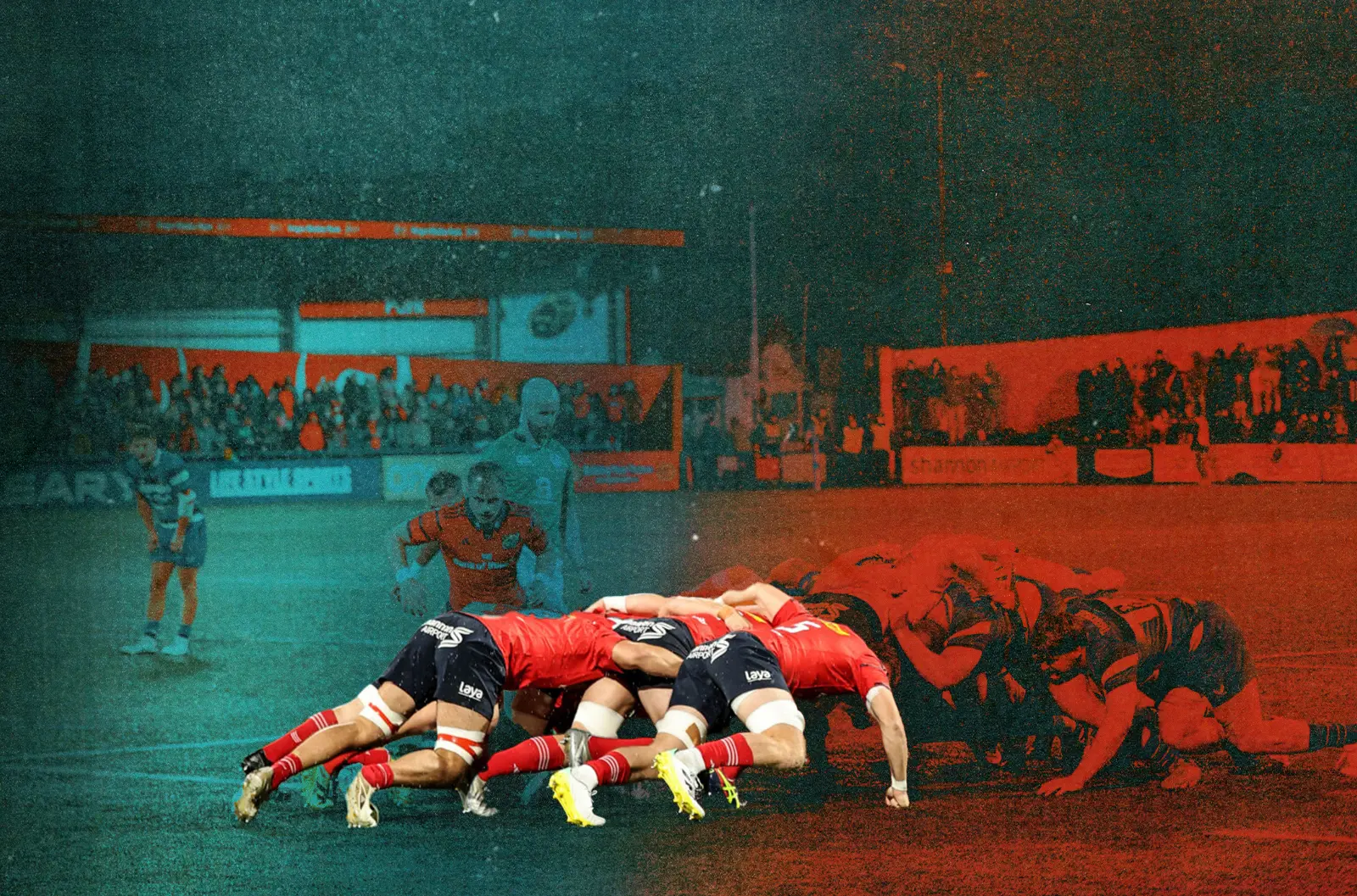
I’d put around half of Munster’s sessions taking up forwards-only scrummaging, collision, lineout and maul sessions; what you do in training becomes what you prioritise. You could see it against Bath, especially in the first 30-minute spell, where I think we had most of our starting front five for the upcoming URC game against Scarlets on the field.
First of all, check out Tom Ahern calling the lineout. That’s new. Then look at the focus on mauling for real, not just to set a compression and bounce out.
We then progressed into a series of tight carries and quick-fire pick-and-goes designed to compress Bath across the centre of the field off the maul break. It ends in an accidental offside and a turnover, but you can see the intent to play tighter and with more directness through the forwards.
It’s not that Munster aren’t going to tip the ball on or pass into the screen, but I would posit that we’re going to do that an awful lot less than last season to allow our pack to play with more aggression and certainty at the collision point.
At a very basic level, the more set up you are for tip-ons and screen balls, the wider your spacing has to be. The wider the spacing, the more likely you are to get swallowed up or blitzed. The only way out of that is through it — blunt force trauma.

That means carrying in twos and threes, hitting teams narrow, and engaging their pillars so there are no easy folds or outside blitzes.
You can see it here in this shortened clip of the above.
The forwards are hunting for those narrow punch-up carries to up the speed and “clear the lane”. Ahern is trying to batter scrambling defenders out of the way to create lanes for others to run through on the next recycle.
Our first try was scored off the back of this concept; two narrow punch carries, a focus on collision winning and stamping the ruck to disrupt the Bath fold and their pillar decision making, before the ball swung wide to pace for the finish.
Playing at pace, with a real focus on that collision point, gets the best out of a pack that has a lot of ruck specialists; if you play tighter, with a focus on that first carry with two players alongside whose primary focus is assisting that collision, you create better pictures for your backline and halfbacks.
When you want to play this way — similar in concept to how Glasgow play, in some ways — the lineout and lineout maul are the best starting points when it comes to generating tight compressions and quick narrow recycles that lead to excellent spacing but also more penalties.
You could really see that focus in the build-up to Munster’s second try — a penalty try off a dominant scrum. It all came from a lineout maul.
Nobody’s reinventing the wheel here, but there’s some nice stuff all the same. O’Connell’s shot to the front looks like a short throw option all the way to the end, with Kendellen moving at pace to sell that surge up the tramline.

That gets both players into a simple 3-3-1 maul formation with both heavyweight props lifting our tallest, most athletic jumper with a simple ball to the front.
Our maul drive core is then in position and braced early to power through on the drop.

The maul turns in-field in this instance, but that turn and drive-through is hugely effective in gaining ground to the 5m line, where we can press the advantage with more tight carrying, a penalty advantage already in the can.
It’s a penalty-generating style of offence that uses a traditional Munster strength as a foundation.
In the penultimate instalment of this series, I’ll illustrate how this change in focus ties in with our wider attacking concepts under Mike Prendergast.
