



It was a big win for the Irish at the weekend.
Exactly the kind of momentum-building win that World Cup campaigns thrive on.
Plenty of tries, mid-game adversity with the lineout causing damage, before sorting it after halftime and pulling away at key moments. All in all, a solid day’s work with some excellent points difference in the bank for good measure.
Last week, I looked at Ireland’s Net Efficiency for their international year up to the World Cup, and put together what I thought might work for Ireland against Japan.
Ireland won 42-14, an exact 28.1 point differential on a per-entry basis, and here’s how all the data broke down.
World Cup 2025 G1 (Japan)
We generated 13 entries at 3.2 PPE and held Japan to 9 entries at 1.5 PPE.
That’s Net PPE +1.7 and an estimated +28.1 net points from the 22.
Our 2-game rolling Net Efficiency (R2) improves from −2.65 (Wales→Scotland window) to −1.55 (Scotland→Japan window). Good direction; still work to do to get back to neutral/positive, but that should happen when we play Spain.
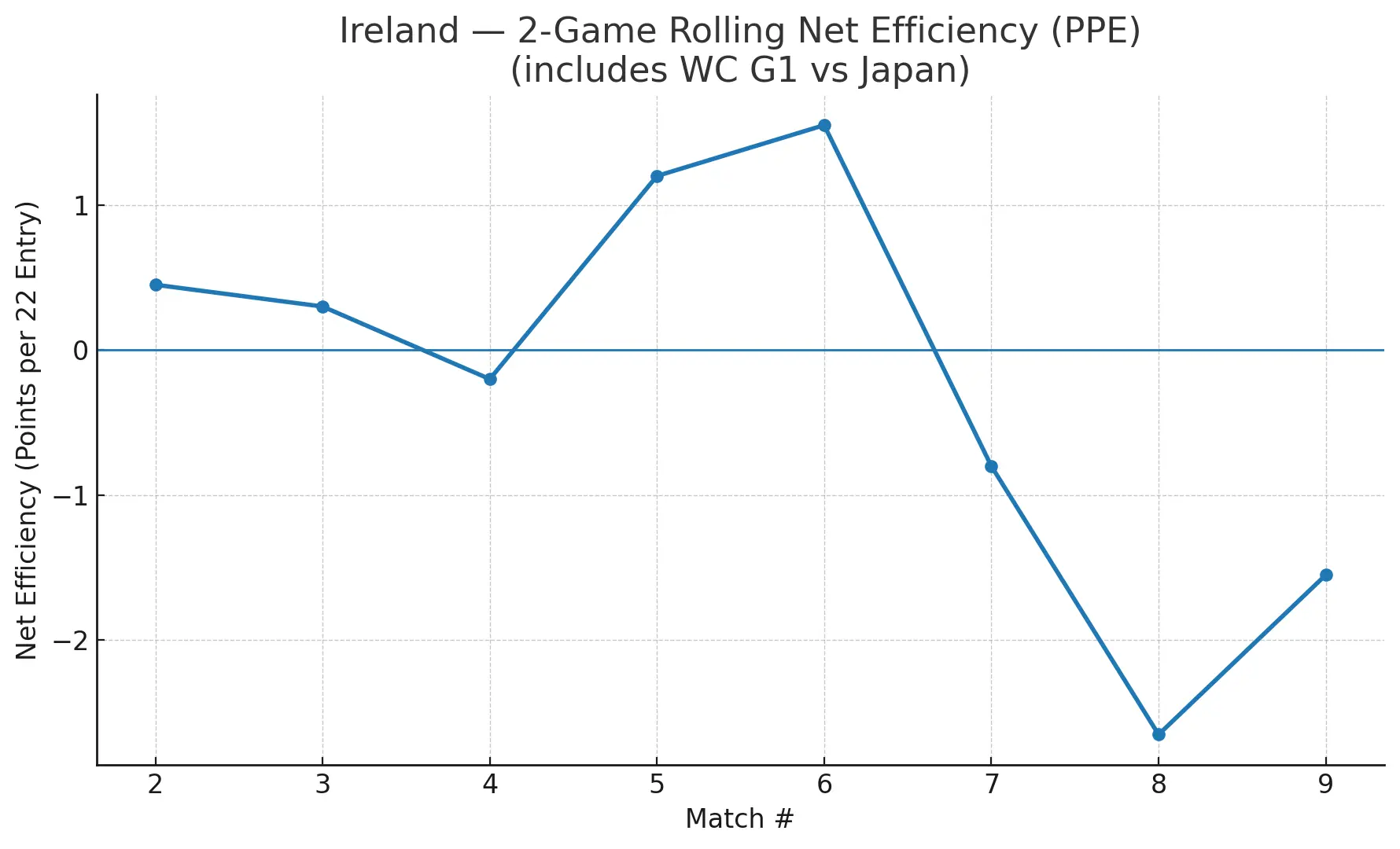
What it Says
Quality + Control together. We hit all three targets that I laid out before the game: Att ≥2.5 PPE (3.2), Def ≤2.0 PPE (1.5), and Entries ≥ 0 (+4).
That combination is tournament gold.
-
Finishing is real, not just volume. 13 entries at 3.2 PPE is efficient scoring by any measure.
-
Defensive yield is where we want it. Holding Japan to 1.5 PPE on 9 entries keeps the floor high.
Bank it / Watch-outs
-
Bank: First-3-phase accuracy and maul/strike returns look on-song, but you could argue we underscored our territorial advantage with the lineout malfunctioning at key times. Keep that menu simple and repeatable.
-
Watch: 9 opp entries is a bit busy — tidy exits and lineout discipline to keep future opponents nearer ≤7 entries so you’re not testing the defensive floor too often. Japan found a good purchase on the game simply by kicking deep and pressuring our lineout. We must prevent it from becoming an exploitable weakness for the Black Ferns in Game 3.
One of the key parts of Ireland’s game was our excellent territorial kicking, primarily by Dannah O’Brien. I had thought that Ireland’s best game state was playing a variant of an off-ball game, but when I dug into the data, I don’t think that’s the optimal way for Ireland to play.
First, let’s lay out the details: our Net Points Per Entry (average points scored minus average points conceded per entry), our ruck count, for and against, and the Kick to Pass Ratios we used in each competitive game so far since WXV1
| G | Opponent | Entries (F/A) | PPE (F/A) | Net PPE | Rucks (F/A) | Rucks/Entry | K:P |
|---|---|---|---|---|---|---|---|
| 1 | New Zealand | 8 / 11 | 3.6 / 1.9 | +1.70 | 87 / 77 | 10.9 | 1:5.0 |
| 2 | Canada | 7 / 11 | 1.1 / 1.9 | −0.80 | 100 / 82 | 14.3 | 1:5.3 |
| 3 | USA | 10 / 11 | 2.6 / 1.2 | +1.40 | 106 / 101 | 10.6 | 1:8.3 |
| 4 | France | 9 / 7 | 1.6 / 3.4 | −1.80 | 112 / 60 | 12.4 | 1:6.4 |
| 5 | Italy | 10 / 10 | 5.4 / 1.2 | +4.20 | 105 / 99 | 10.5 | 1:7.3 |
| 6 | England | 4 / 21 | 1.2 / 2.3 | −1.10 | 78 / 99 | 19.5 | 1:5.9 |
| 7 | Wales | 17 / 5 | 2.3 / 2.8 | −0.50 | 106 / 57 | 6.2 | 1:9.7 |
| 8 | Scotland | 11 / 4 | 1.7 / 6.5 | −4.80 | 128 / 54 | 11.6 | 1:12.6 |
| 9 | Japan | 13 / 9 | 3.2 / 1.5 | +1.70 | 107 / 95 | 8.2 | 1:8.7 |
What our Kick:Pass Ratio is telling us
We’ve played in three distinct bands.
And, for clarity, I’m using Kick:Pass as1:x, so higher x = fewer kicks per pass, which is a more conservative game-state from a kicking perspective. The higher the number, the more passes and carries you are putting together on average before kicking the ball.
These are Ireland’s average Kick to Pass ratios per game.
Kick-heavy (≤ 1:6.0) — NZ, Canada, England
- Entries diff: −8.0 (6.3 for / 14.3 against)
- Our PPE / Opp PPE: 1.97 / 2.03 → Net PPE −0.07
- Net points from 22: −16.3
Read: We kick too much, lose access, and don’t gain efficiency — bad trade. We did kick heavy against the two best sides in the world — Canada and England — which hurts the numbers slightly, but it also suggests that kicking to these teams at that kind of volume is a bad idea regardless.
Balanced (1:6.1–1:9.0) — USA, France, Italy, Japan
- Entries diff: +1.25 (10.5 / 9.25)
- Our PPE / Opp PPE: 3.20 / 1.83 → Net PPE +1.38
- Net points from 22: +18.4
Read: This is our sweet spot — enough kicking to control field position, enough ball to build pressure, and the best efficiency delta. The net points from the 22 are the biggest factor here, as they suggest that not only is kicking in the mid-range from a volume perspective better when it comes to generating entries, but it also shows up on the scoreboard.

Pass-Heavy (≥ 1:9.1) — Wales, Scotland
- Entries diff: +9.5 (14.0 / 4.5)
- Our PPE / Opp PPE: 2.00 / 4.65 → Net PPE −2.65
- Net points from 22: +8.9
Read: We dominate access but invite high opponent yield (low-volume, high-value scores). It works on the scoreboard only if our exits/discipline are spotless; otherwise, we get badly stung (Scotland). So, in essence, if we don’t concede bad turnovers or go through the wars at the lineout, we have the capacity to run up massive entry numbers, but when we have done that this year, we’ve conceded way more. Risk and reward.
Why does this happen?
More passes (bigger x) → more access: Kick:Pass correlates +0.68 with entries differential. We tend to live in their half when we pass more.
But opponent yield climbs as we pass more: correlation +0.65 with Opp PPE. Passing more often coincides with giving up high-value chances (turnover/exit/counter strikes).
Our finishing isn’t driven by kick volume: correlation between Kick:Pass and our PPE is ~0.00 (noise). When we kick, it doesn’t lift our finishing; it just shifts where the game is played.
Phase load matters more than kick volume for finishing: Rucks per entry correlates −0.48 with our PPE and −0.89 with entries diff. When it takes us >12 rucks per entry, finishing sags, and we lose access.
Game Examples (anchors & cautions)
Sweet-spot wins: Italy (1:7.3) and Japan (1:8.7) — balanced ratios, rucks/entry ~8–11, Net PPE +4.2 / +1.7, entries ≥ even.
Kick-heavy trap: England (1:5.9) — −17 entries, our PPE 1.2. We kicked more but ceded the game’s geography.
Pass-heavy sting: Scotland (1:12.6) — entries +7 yet Opp PPE 6.5 on just 4 entries. Low volume, huge yield against.
What we should do (simple dials)
Live in the balanced band: aim Kick:Pass ≈ 1:6.5 to 1:8.0.
Slide down toward 1:6–1:6.5 only in exit-heavy, wet, or pressure games where territory is king. Slide up toward 1:8–1:9 only when our exits/discipline are humming.
Going to the air too often is a mistake for this team, which I didn’t think would be the case before looking at this data. I felt our kicking was something of a calling card, but it’s really a case that balance is what works for this team and off-ball rugby, as far as this code goes, can’t work regularly without either a dominant defensive lineout or the poaching work of Aoife Wafer. As cliché as it might be, a balanced approach is the way to go.
Guardrails to call during games
If Rucks/Entry > 12 and K:P ≤ 1:6 → we’re grinding without gain. Add contestables to touch, push touchfinders, and chase to force opposition ruck load.
If K:P ≥ 1:9 and Opp PPE ≥ 3.0 → we’re giving up high-value chances. Tighten exits (distance + hang), reduce the multi-pass phases in our half,and kick earlier to contest.
Kick menu tweaks (principle, not a rigid split)
Contestables to edges to force opposition ruck count and prevent clean counter launches.
Touchfinders when we’re slow-ball to bank territory, especially vs kick-threat teams (France/Scotland profiles).
Attacking grubbers/chips only in advantage or broken-field — you don’t need more volume, you need clean value. This is especially true against big defensive teams like New Zealand, Canada and England.
Defensive 22 priority when we go pass-heavy. Because Opposition PPE tends to rise in those games, we hard-cap at ≤2.0 PPE conceded: fewer repeat pens, quicker fold speed, and no cheap set-piece launches or turnovers.
In Short
Kick-heavy (≤1:6) → we lose access and don’t gain efficiency.
Balanced (1:6.1–1:9) → best combination of field position + efficiency.
Pass-heavy (≥1:9) → big access, but protect exits/discipline or we’ll concede high-yield, low-volume scores.
Keep rucks/entry ≤10–12, park our Kick:Pass around 1:7–1:8, and use the kick to shape where the game is played — not to chase efficiency that doesn’t come from kicking volume.
With all that said, I think we need to take a very pass-heavy game against Spain to bump our 22 access and run up scores, even at the risk of giving up some turnovers that might lead to the high-yield chances we gave up against Scotland. When we pass more and kick less often, we tend to generate more 22 entries. If our efficiency from Japan holds, that could easily be another +30 point win. On the downside, when we play more pass-heavy, our errors tend to be very costly; avoid that, and a routine win, and the Black Ferns await.
