



The last time Australia beat South Africa in Ellis Park before Saturday was 1963. Twenty minutes into this opening round of The Rugby Championship, it looked like they might well be waiting until 2063.
Everything the Springboks touched turned to tries. By comparison, the Wallabies couldn’t get out of their own way.
As starts go, it was worse than the killer ten points they conceded in the first ten minutes of the first Lions test. It was more than twice as bad. The Wallabies conceded 22 points in the opening 18 minutes, and it genuinely felt like it could be anything at that point. 40 point loss? 50? None would have been surprising when Manie Libbok converted Siya Kolisi’s try in the 18th minute.
But then, something remarkable happened.
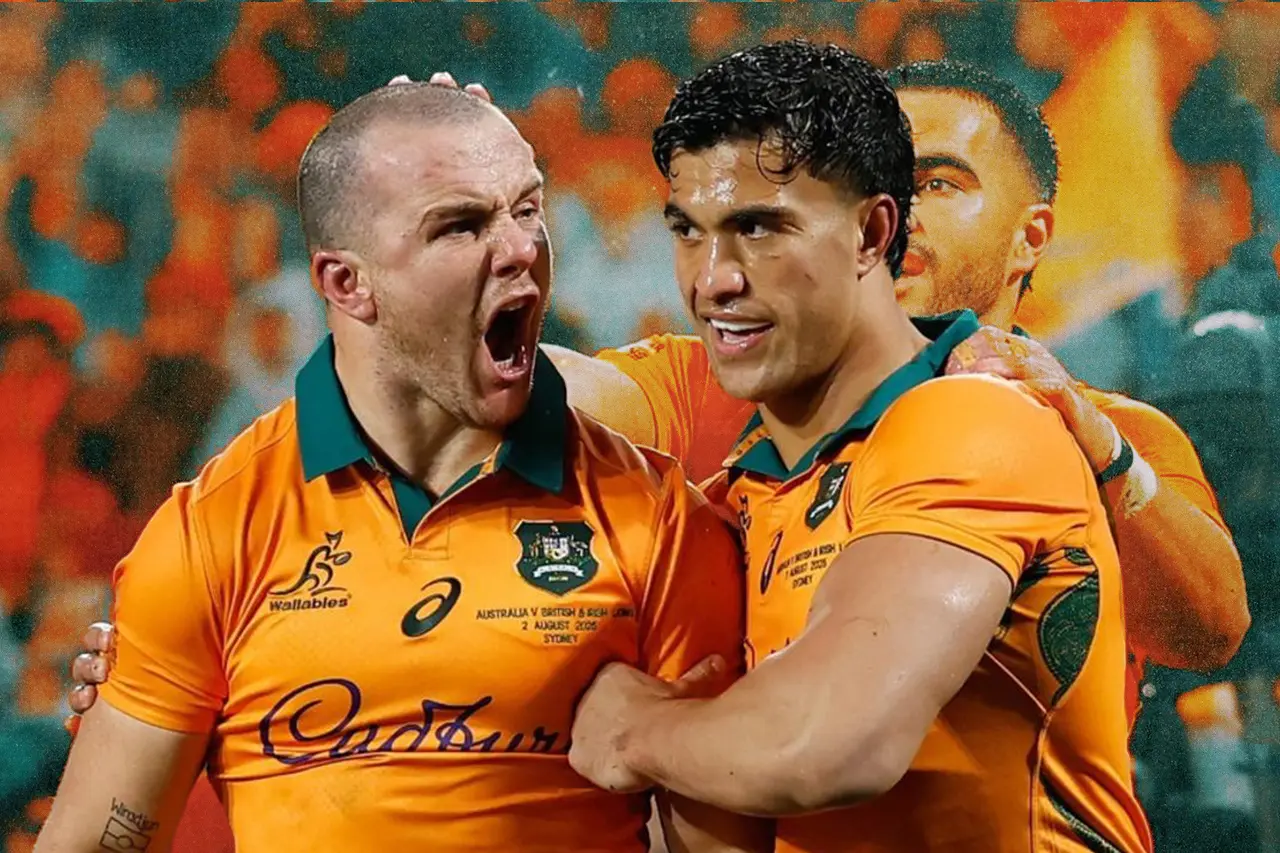
There’s no way to look at a comeback win like this and not factor in the opposition imploding as a key part. That’s certainly true here. At 22-0 with 25 minutes gone away from home, the chances of getting back within a losing bonus point are incredibly slim. Winning from there isn’t impossible, but so difficult that it might as well be.
Australia had just one entry to South Africa’s 22 by the 25th minute. So, to even get back to a lead that’s outside the three-point range in the time remaining, you need an absolutely remarkable points return, all while conceding nothing at altitude. So I calculated it out.
Run-rate to take the lead
- Points needed: 26 (unanswered)
- Time left: 55′
- Required scoring rate: 26/55 = 0.47 pts/min
(≈ 1.4–1.9× a typical Test scoring rate, while conceding nothing, at altitude, against the current World Champions)
Scoring-Event Cadence (minutes per score)
You’ll usually need 5–6 scoring events unless you bag four tries.
- 4 events (e.g., four tries → ≥28 pts): 55/4 = 13.8 min/score
- 5 events (e.g., 3 tries + 2 pens → ≈26–27): 55/5 = 11.0 min/score
- 6 events (e.g., 2 tries + 4 pens / 2 tries + 3 pens + 1 DG): 55/6 = 9.2 min/score
Entry Efficiency Requirement (after 25′)
Australia had 10 A22 entries after 25′. To reach 26 pts:
- Required PPE with 10 entries: 26/10 = 2.60
- If fewer entries, the bar rises:
- 9 entries → 2.89 PPE
- 8 entries → 3.25 PPE
- 7 entries → 3.71 PPE
When do you take the lead?
AUS generated 10 entries in 55′ → ~5.5 min/entry. Time to lead ≈ (entries needed) × 5.5 + 25′:
- If finishing at 3.8 PPE (what they actually posted in the comeback window):
- Entries needed = 26/3.8 = 6.84 → ~7
- Lead around 63′, which is exactly when Harry Wilson scored.
- If at match PPE 3.45: need ~8 entries → ~66–67′
- If at 3.0 PPE: ~9 entries → ~73′
- If at 2.7 PPE: ~10 entries → ~78′
- If only 2.6 PPE: exactly 10 entries → 80′
So, to flip it to just 26–22, you’re looking at ~5–6 scoring events at ~9–11 minutes per score, or — if we frame it by entries —~7–8 entries at the efficiency they actually hit, putting the lead change in the 63′–67′ window if the entry tempo holds and SA stay scoreless.
In short, if Australia lose two 8-minute blocks in that second half through two bad exits or even through good tactical kicking from the Springboks at any point, they lose. If they take 10 minutes to score a try through a series of maul/scrum battles, followed by close-range phase play, they probably lose. If they cough up a penalty around the halfway line and the Boks kick deep for two lineout/maul 22 entries, regardless of whether they score or not, the Wallabies probably lose.
It is both a testament to, at once, the Wallabies’ execution and the Springboks’ lack of composure that Schmidt’s side managed to thread the needle as they did. One moment going against them, and it’s a loss. On the other hand, all the Boks needed was one moment — just one — to swing their way and they couldn’t manage it. If you want a particular instance when the game swung away from them, it was this one.
They had won their only penalty of the second half, got stuffed at the maul, but managed to get to within 5m of the tryline only for Tom Hooper to win a perfect turnover penalty.
This looked like a try, but Mostert will be disappointed that he went off his feet with so little effectiveness.
A lot of referees would penalise Hooper here — I can think of one bald gnocchi enthusiast in particular — but O’Keefe is dead right to give the Wallabies flanker the scope to attack.
Mostert is straight off his feet, so there is no ruck.
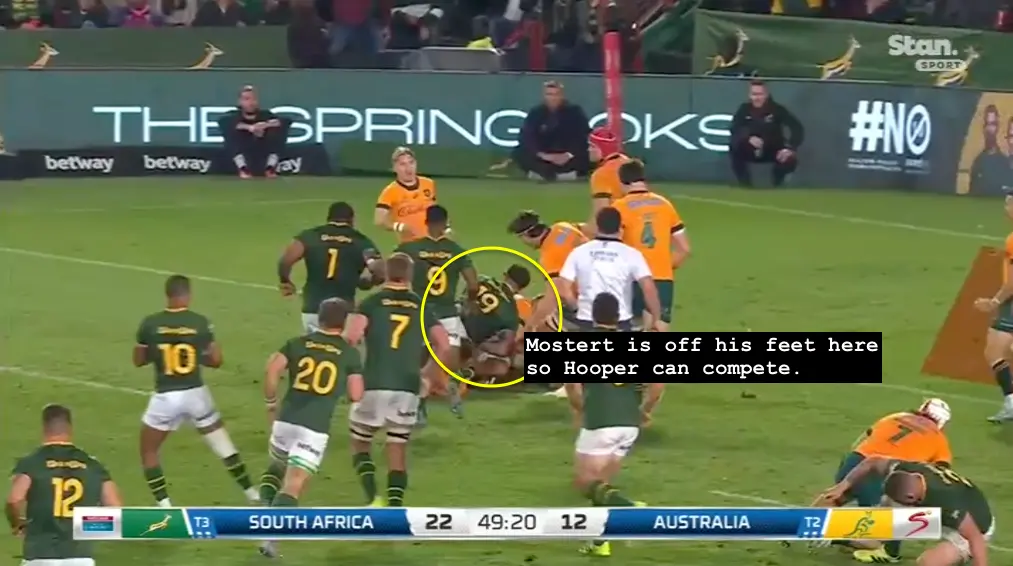
If the Springboks recycle this in-field, they score seven points, and I think that alone kills the Wallaby comeback stone dead. Instead, the Wallabies managed to move the ball up the field, getting to the Springbok 5m line after this nice edge kick sequence.
The Wallabies didn’t score from the territory they’d ultimately earn on this sequence — they should have — but they were putting pressure on. The Boks had probably their scattiest halfback pairing on the field for this one, Grant Williams and Manie Libbok, alongside André Esterhuizen, whose playmaking IQ is wildly overrated, at least in my opinion. You’re always likely to get opportunities with those three guys, even allowing for the huge attacking upside they give you in the right conditions.
This is a great example of what I mean.
Etzebeth turned over a Wallabies lineout on the line of the 22, and the Boks were away on transition. I know what should have happened here, at least twice, but it didn’t.
Libbok needs to own the decision not to kick long to the left, but he’s also got Esterhuizen calling this to the outside pretty hard. Libbok isn’t a young player, but I think when it comes to his tactical IQ, he needs as much help as he can get.
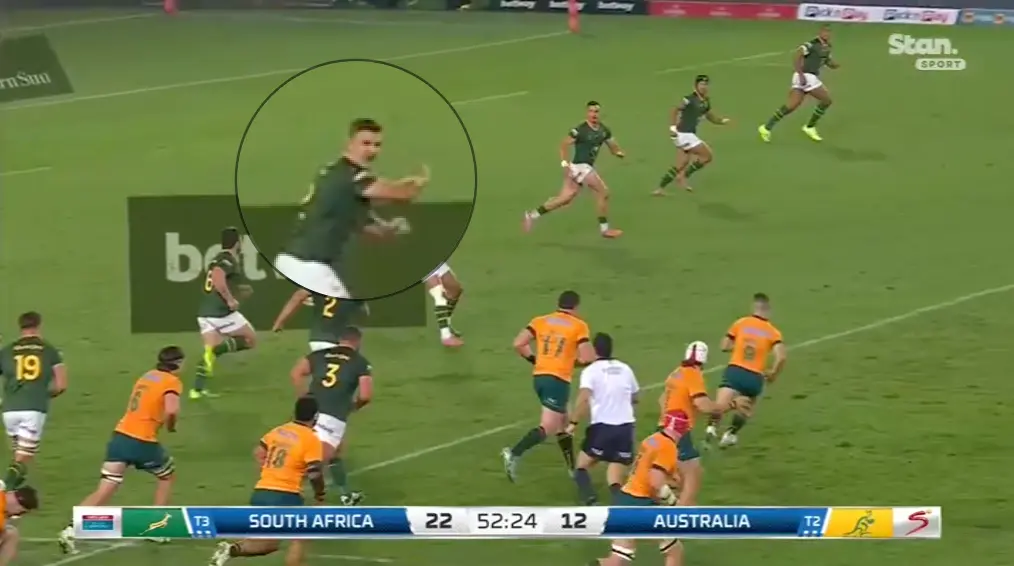
Ten points up, the Boks don’t need to run this through the hands; they need the ball up the other end of the field. Instead, it’s another pressure point.
It’s not overplaying. It’s a lack of tactical awareness from 10/12/13 as a unit.
Couple that with the Boks spending the second half playing like they were 17 points down, instead of being 17 up, and you can see how a game gets out of hand.
Do you need to try a 20m+ pass in this position at ten points up? With no mid-range support? Where it’s either a linebreak or a try up the other end?
I don’t think you do.
Once Sua’ali’i intercepted this, you felt the air wobble around the Springboks.
22-19.
Panic set in.
***
To this point, South Africa had been using a Neinaber-esque outside-in high edge blitz. What does this look like?
You’ve seen it before.
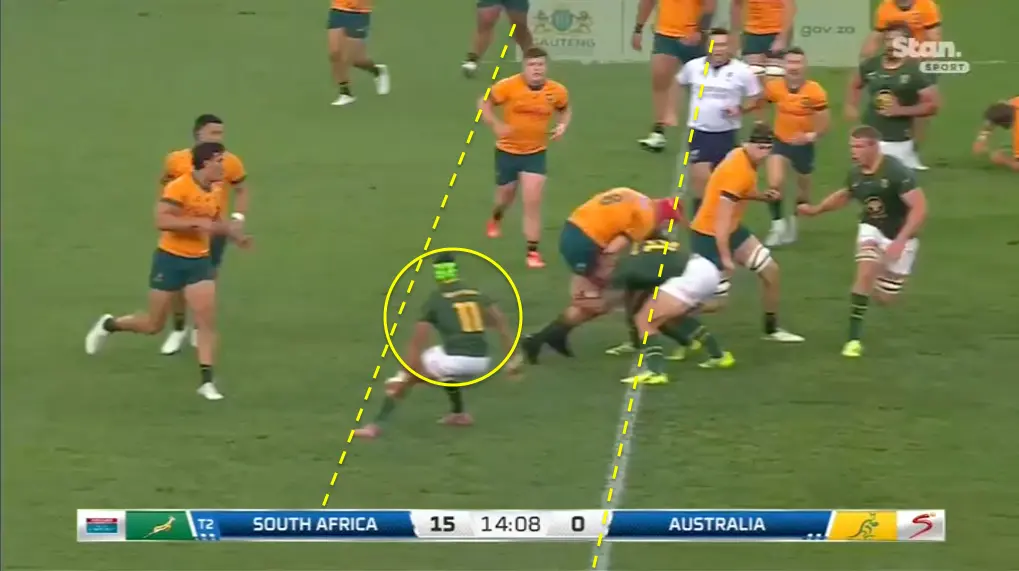
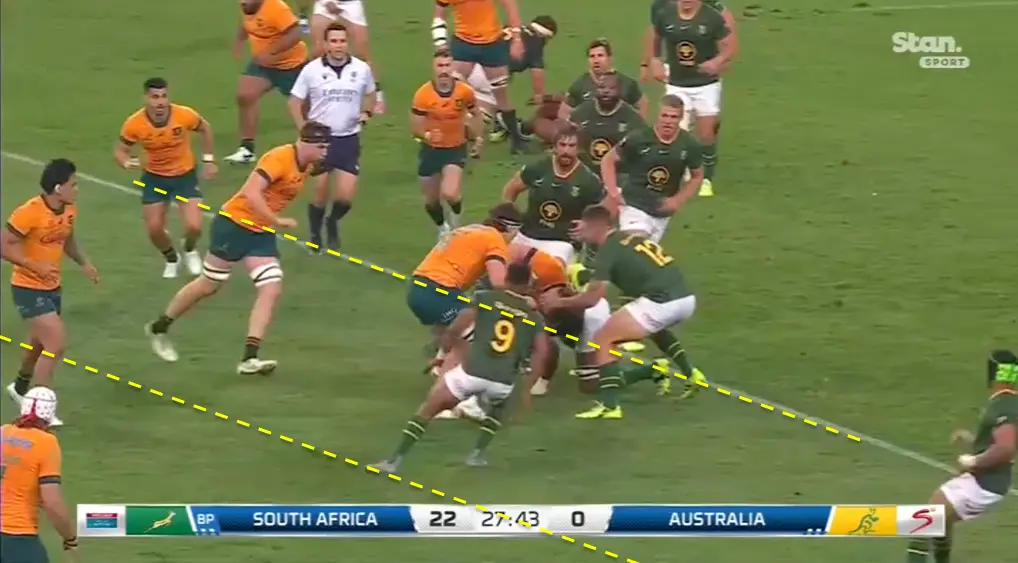
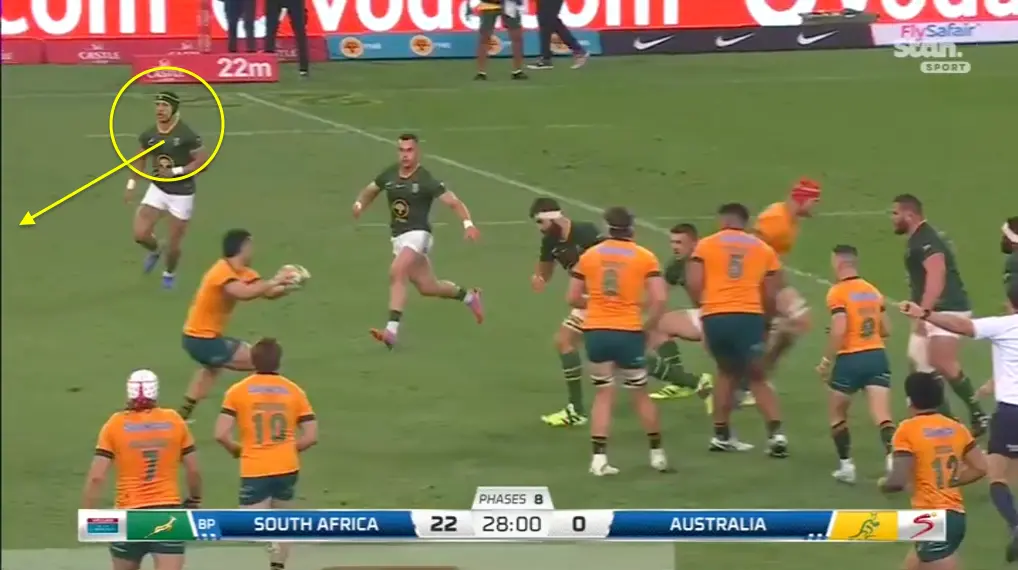
It’s where your edge defenders in the primary line shoot up and into the second layer of any attack — into the screen, so to speak — to prevent the opposition from playing with depth. The concept is that a typical blitz defence is killed by offensive depth, so an outside-in blitz takes away that ability to play to depth because the outside of the defensive line intercepts the ball at the same time as the attacking player gets it.
In essence, the ball has to go through two or three pairs of hands, at staggered angles, whereas the edge blitzer only has to sprint in a straight line. It’s usually the back three, outside centre or last edge forward who blitz in this concept, but the halfbacks are regularly involved too. Whoever is in the edge space seems to be tasked with cutting off the outside and driving the ball back inside.
Once the Wallabies got any kind of settled possession, though, they started to try and “trip” this edge blitz with short, choppy passing and angled, league-style running lines.
In this moment, you can see the Wallabies screen runners trying to create a gap between Etzebeth and Nche — regular tight forward blitzers — and O’Connor in the screen by blocking his transit with theirs.
This creates a pronounced gap between the edge blitzers and the inside overlapping cover.
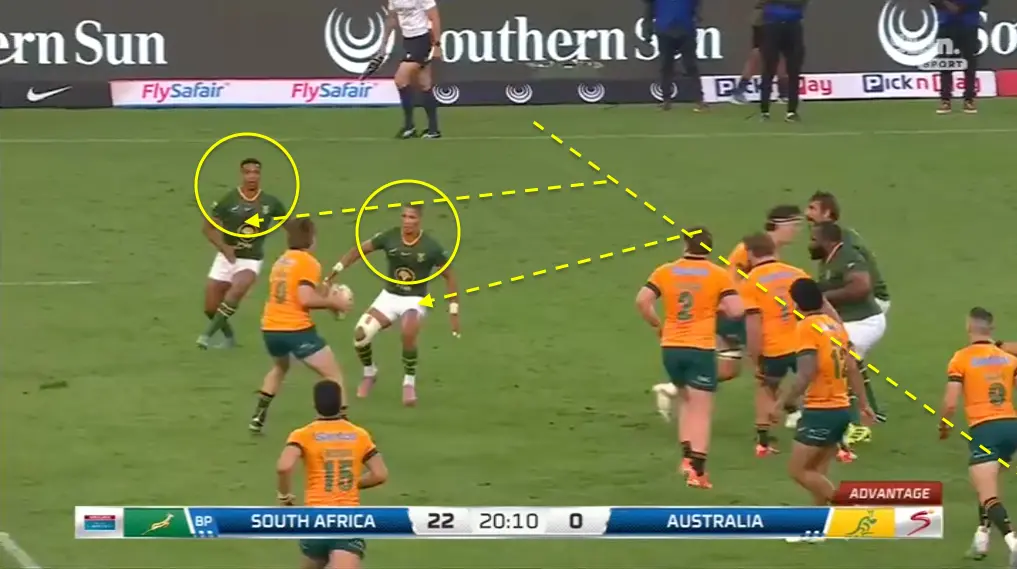
It doesn’t quite work for O’Connor in this instance, but you can see the concept.
Here’s how it played out.
A few minutes later, the Wallabies got another opportunity and used it really well. Look at how this play attacks the edge blitzers themselves with a tight “pinch loop”.
What is this? You use the edge blitzers as the focal point for the loop, not the inside defenders, so you use the knowledge that they are going to be stepping up high and in against them. Watch how Sua’ali’i draws the first edge blitz, cuts back inside, then offloads back to another layer of offensive runners after the trap of the overlapping cover hits. This forces the Boks to reload the edge blitz again, but behind the timing of the ball.
It works best from a central position, and needs tight hands to work.
Their second try didn’t need the decoy, but worked on the same principle. Angus Bell runs a simple pop pass on the edge, knowing that the edge defenders are going to be programmed to attack the layers.
The two red players are drawing Etzebeth and Williams into the second layer. The short pop pass unhinges the entire thing, with Nche likely to come under a bit of fire for zoning in on Bell, rather than Wilson. Try #2. 22-12.
Back to the panic.
***
At 22-19, the Springboks needed something to settle them. Watching it back, it felt a little like they’d become very aware of how uncomfortable they still were in Tony Brown’s system. They looked unsure of themselves. As if they were asking, “should we be kicking this? should we be kicking anything?”
That clarity was lacking.
The Wallabies had now settled into a comfortable off-ball/heavy kick counter-transition game. In the first 20 minutes, the Wallabies barely had the space to get a kick in place. After 20 minutes, the Wallabies’ kick-to-pass ratio was 1 kick for every 9.1 passes. South Africa’s was 1:6.4
By the half-hour mark, the Wallabies were at 1:6.1 while the Boks had bloated to 1:8.8.
At full time, Australia were at 1:4.5. The Boks were at 1:11.8.
As the score narrowed, the Boks began to chase long chains of possession. They went 6/7/8 phases at times, and even though they made decent ground, it felt like they struggled to resource their collision points as they pushed and pushed for the killer score.
The Wallabies, though, were barely putting defenders into the breakdown. It was two tacklers, max, and if one of those got a sniff at disrupting, they could. This sucked all the space away from the Boks, who were constantly running into opposition defenders, even on release balls.
The cross-field kick should have been launched at 62:21 on the match clock, not when the Wallabies had the entire field filled.
Instead, it would be Australia who would find the killer score on the very next play.
Arendse got his pocket picked, Sua’ali’i picked off the outside in blitz, and Tom Wright did the rest with a killer transition score.
22-26.
Miracle territory.
Off the restart, O’Connor found the Boks outside-in blitz looking a little hesitant. He slung the ball over the top, and all of a sudden it was 22-33.
Game over.
No way back.
The Boks looked exhausted, out of ideas and utterly stunned that the game had gotten so far away from them.
