


The Lions are favourites for this, right?
It feels like they are, or should be, which in itself goes against the spirit of the tour, in my opinion. The Lions have always been most interesting when they’re expected to lose. Maybe that’s an outdated concept. I sometimes think that Andy Farrell would prefer if Australia were coming into this test series in better form, or just flat out better, full stop. After all, this is the same man who wished a bus would be 15 minutes late to the warm-up in a game against Scotland to test his team’s reaction to adversity.
“The coach was going a little bit slow to the game. I was thinking ‘this would be great if we were 15 minutes late. That would really test us.’ We got there about three minutes late, which wasn’t too bad.”
The 1997, 2009 and 2021 tours were against a World Champion Springboks side. In 2017, the Lions faced the back-to-back World Champion All Blacks. Back in 2001, the Lions played a World Cup-winning Australian side. Facing up against a Wallaby side who seem to have been in transition for ten years and ranked 6th in the world (they were 8th until Argentina and Scotland both lost last weekend) is about as far away from insurmountable odds as you can get. The odds here are very surmountable, and that was before the Wallabies lost Rob Valetini, Taniela Tupou, Noah Lolesio, and Will Skelton for the first test at least.
For the last calendar year, the Wallabies have been a model of inconsistency, at least that’s what I thought. I mapped out their Net Efficiency rating for the last 12 months, and it turns out I was wrong; they’ve just been awful.
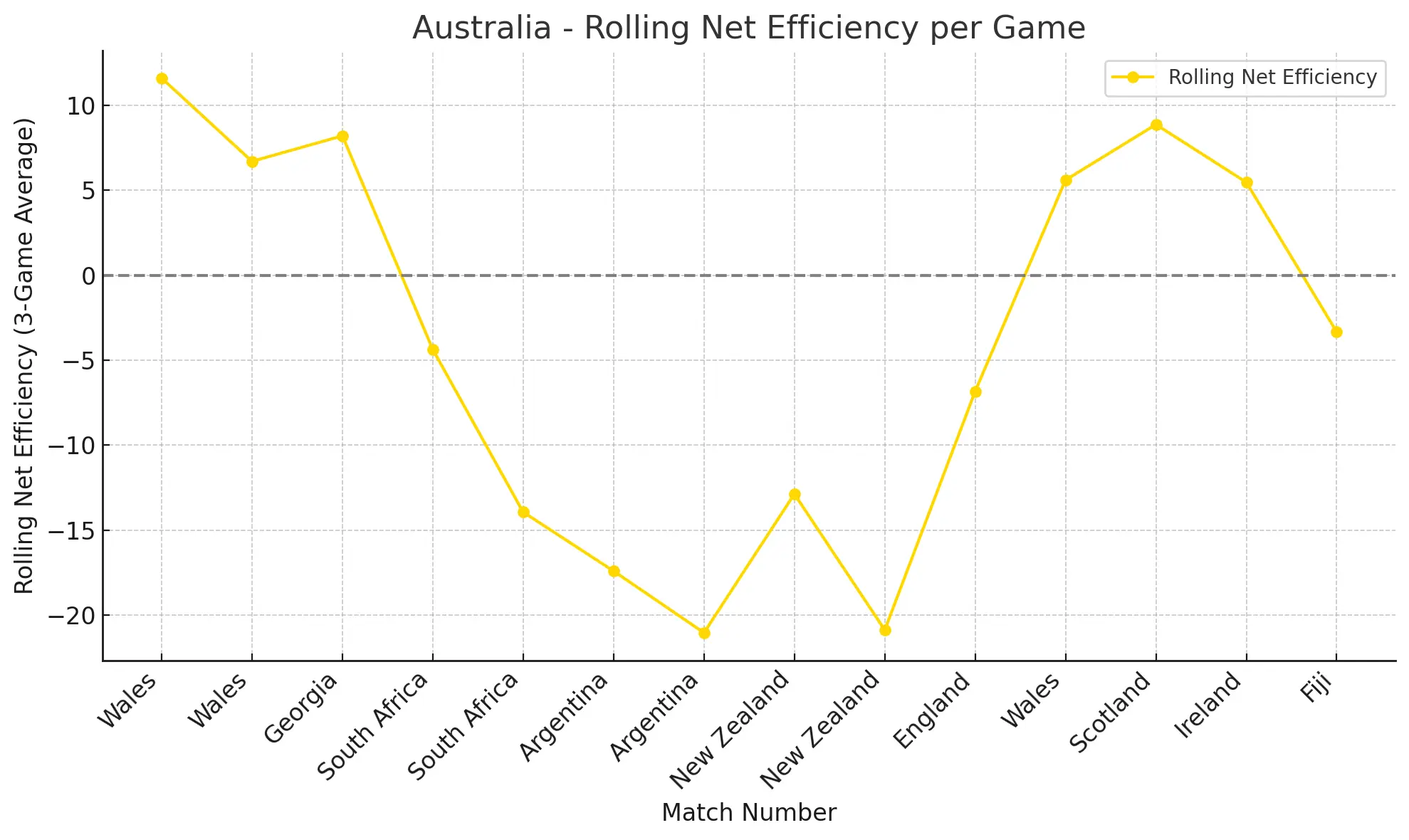
What the Graph Shows:
-
Rolling Net Efficiency is the average net impact (points scored vs conceded per 22 entry) over the last three games.
-
The gold line tracks momentum: upward movement reflects improving form; downward movement suggests declining efficiency.
-
The zero line indicates the balance point. Anything above it means Australia scored more per entry than they conceded on a rolling average across the previous three games.
Using this metric, we can see that the Wallabies’ net efficiency rating was thrashed around by a horrible run against South Africa, a hammering in Argentina and subsequent losses to New Zealand. Wins against England and Wales (they played Wales three times last year) brought them back into the positive before narrow losses to Scotland and Ireland, combined with a narrow win over Fiji, saw them taper off into the negative to end their run before the first test.
What does this tell us?
The Wallabies do not control games. They concede more 22 Entries than they achieve consistently across the year, and the games they managed to win were often based on opposition inefficiency or unreliable, inconsistent attacking efficiency. That doesn’t mean they didn’t have decent performances or that they were unlucky in some games; it just means that they weren’t able to control those games to a point where bad luck or bad spells in games didn’t hurt them across three-game spells.
I think Joe Schmidt is painfully aware of this inefficiency.

However.
That doesn’t mean that Australia can’t ambush the Lions in this first test. Elements of the Wallabies’ performances this season have shown that this is the game they are most likely to be successful — if key parts of their game work as I think they’ve laid out.
I’ll get to that in a minute.
Here are the teams;
Lions: 15. Hugo Keenan; 14. Tommy Freeman, 13. Huw Jones, 12. Sione Tuipulotu, 11. James Lowe, 10. Finn Russell, 9. Jamison Gibson-Park; 1. Ellis Genge, 2. Dan Sheehan, 3. Tadhg Furlong, 4. Maro Itoje (c), 5. Joe McCarthy, 6. Tadhg Beirne, 7. Tom Curry, 8. Jack Conan.
Replacements: 16. Ronan Kelleher, 17. Andrew Porter, 18. Will Stuart, 19. Ollie Chessum, 20. Ben Earl, 21. Alex Mitchell,22. Marcus Smith, 23. Bundee Aki.
Australia: 15. Tom Wright; 14. Matt Jorgensen, 13. Joseph Sua’ali’i, 12. Len Ikitau, 11. Harry Potter; 10. Tom Lynagh, 9. Jake Gordon; 1. James Slipper, 2. Matt Faessler, 3. Allan Alaalatoa, 4. Nick Frost, 5. Jeremy Williams, 6. Nick Champion De Crespigny, 7. Fraser McReight, 8. Harry Wilson (c).
Replacements: 16. Billy Pollard, 17. Angus Bell, 18. Tom Robertson, 19. Tom Hooper, 20. Carlo Tizzano, 21. Tate McDermott, 22. Ben Donaldson, 23. Andrew Kellaway.
If you were trying to beat this Lions team—any Lions team, actually—you’d want to attack the one thing they can’t have, and that’s attacking cohesion.
When the Lions picked Andy Farrell to be the head coach for this tour, they did so off the back of the attacking revolution he brought in as head coach of the Irish national team. Much like Joe Schmidt, Farrell has been the driving force behind Ireland’s attacking concepts, with guys like Mike Catt and, latterly, Andrew Goodman looking after strike plays.
You don’t bring in Andy Farrell as the Lions coach for him to change what he does at a fundamental level, and, since the very first game against Argentina after just two weeks of training, he has been going full bore to fit this squad into the core concept of his attacking framework. Would it have been sensible for him to layer it on gradually? Yes.
But I think he and his coaching staff felt that the opposition they were going to play between Argentina and the Wallabies would be too poor to know whether or not the layering was successful. The only way to know—as much as it can be known in advance— is to play the way you want to play against Australia from the very first week and hope everyone catches onto the roles and concepts along the way. In a lot of ways, it’s been a race against time.
Game, recover, review, train.
Game, recover, review, train.
And then hope it sticks.
There is a lot of cognitive load that comes with this system before you get into the weeds on stuff like the scrum, lineout, maul and restarts. You’ve got passing lanes, positioning, loop routes, pod shapes and breakdown supply lines to consider, and in the pressure cooker of a test match, you can’t be “thinking” about these things; they have to be instinctual.
If you’re Joe Schmidt this week, you’re looking at the Lions backline and thinking “we can pressure them”. Not because anyone there is a bad player, because obviously they’re all very good players, but because Jamison Gibson-Park and Finn Russell are a new combination, Russell, Tuipulotu and Jones are a cohesive unit that have very little time with the pack in front of them, or in this overall attacking concept, and Tommy Freeman is a real odd-man-out from a cohesion perspective. Can you get at Freeman and Jones off the scrum, lineout and maul break? Joe Schmidt will try.
But in a grander sense, I think Australia will try to duplicate what they did to Ireland back in November 2024 when they played a largely off-ball/high kick volume counter-transition game against Andy Farrell’s Ireland and should have won the game. I went back and watched that game this week, and it was hugely instructive. Australia knew exactly how Ireland would look to play and took away key weapons from Ireland, who were playing a system very similar to what the Lions will run in this test.
That game saw the Wallabies produce their best defensive return on 22 entries, conceding the second-lowest number of average points per entry as they did all year. How did they do it?
It’s worth reading the Wally Ratings from that game.
Schmidt realised that Ireland’s biggest method for scoring, as it is with the Lions, is through penalty access, mostly through offside penalties or ruck penalties. So he limited competing at the ruck to very specific zones and scenarios, and ceded most of the rucks in the middle of the field to quick ball, with a view to keeping defenders on their feet to flood passing lanes.
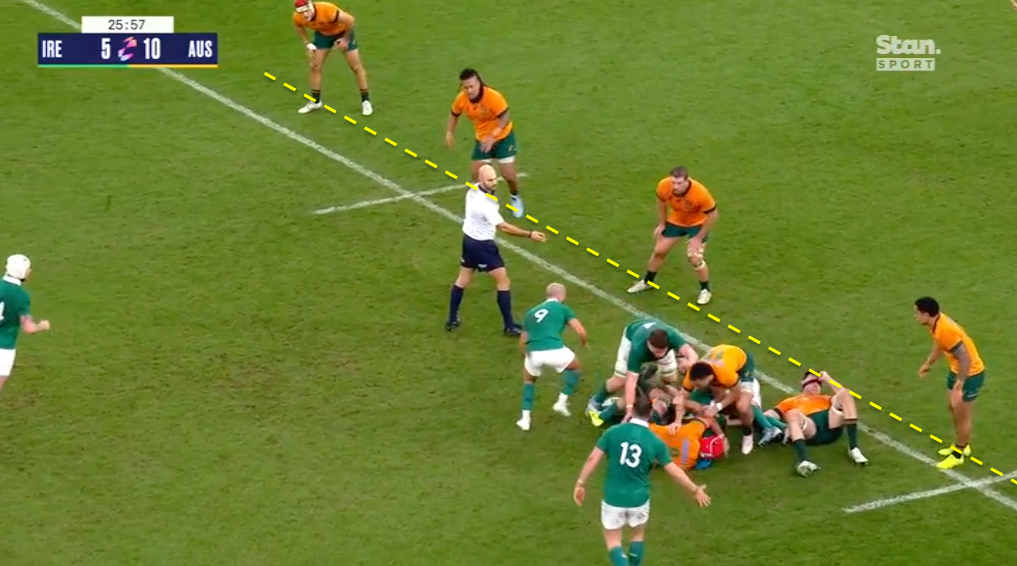
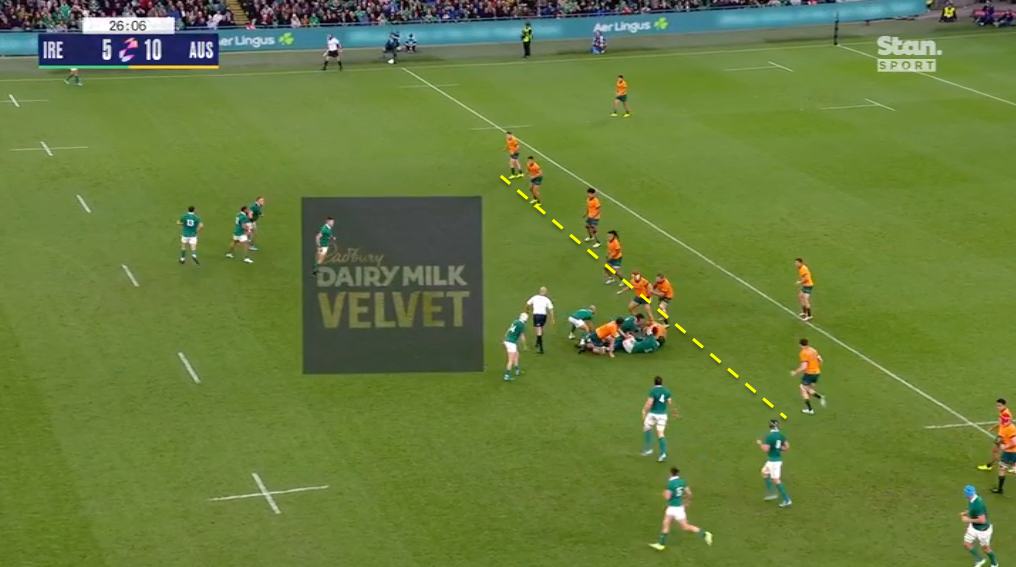
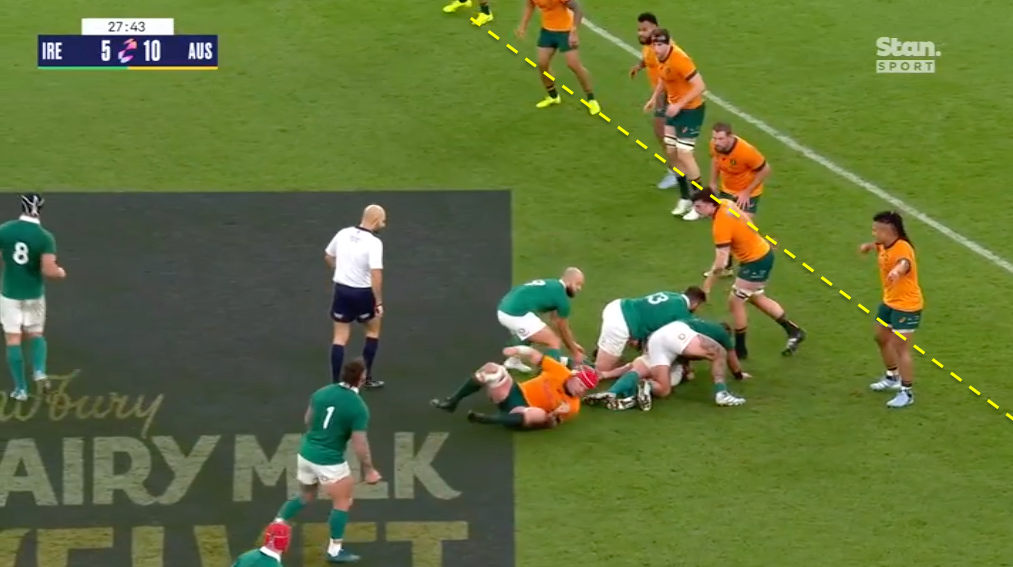
As I wrote in that article, Schmidt reasoned that;
- Ireland are disproportionately reliant on close-range lineouts to score tries in 2024. As an example, look at this very game; all three tries were scored from 5m lineout scenarios. So don’t give any cheap penalties for offside when you’re going to be giving Ireland quick ruck ball in the middle of the field on most rucks. By being this far behind the ruck, there is no hope of a daft offside penalty.
- It prevents Gibson-Park from flowing through the ruck with his agility. Gibson Park loves picking off pillar defenders who plant themselves flat in front of him. He dummies, they look away, and he’s gone by them. When you are giving Ireland quick ruck ball, you can’t allow this to happen, so stand back and keep him in front of you at all times.
- Australia had no intention of blitzing in this game, so being fast off a very aggressive offside line was of no value, especially as Ireland doesn’t have any primary ball-carrying forwards. Australia wanted to push up and drift out, not shoot straight up to cut the legs off big ball carriers who were going to move directly.
I think the same logic holds for this game against the Lions. Not only that, I think it’ll be more effective against a team that are set up to play quite narrow in the forwards and who are without the wider offensive ruck coverage of Josh Van Der Flier and Jac Morgan.
Enter Fraiser McReight.

McReight has 18 forced turnovers this season in Super Rugby and is ranked 9th in the world for the number of defensive rucks he attended this season (Tom Hooper, on the bench for the Wallabies, is ranked #1) with an effective slowdown rate of 16.2%. He’s a high-volume tackler, but he’s most dangerous as a second man into contact, where he’s incredibly quick over the ball.
When the Lions spread the ball beyond their narrow forward envelope, McReight has the pace and agility to win wide turnovers in the zones, Russell and his midfield are going to try and swing possession. This is where the Lions’ ability to retain the ball at the breakdown is going to come under huge pressure, and I think it’s why selection in the back five was so contentious.
I plotted offensive ruck volume and effectiveness of the players in the Lions’ back five who were in realistic contention for this first test – I excluded Pollock simply because of the scale of this occasion and his relative inexperience.
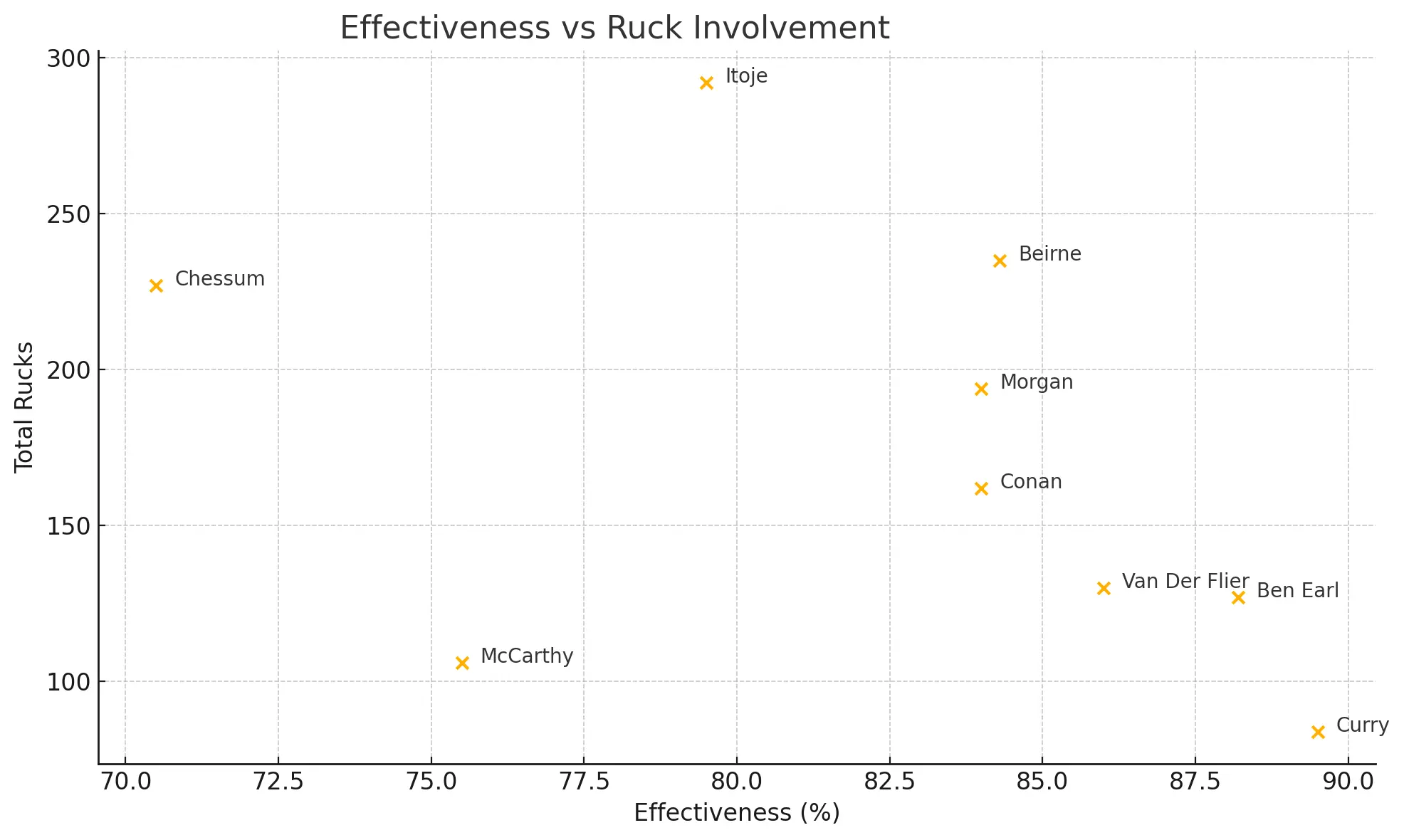
As you can see there, Joe McCarthy is a negative outlier for both ruck volume and effectiveness. He has other qualities that you’d select him for, but if you’re going to select him in the second row, you have to compensate for what he doesn’t do. That’s fine, it’s why you have a pack build that covers certain strengths and weaknesses.
As we can see here, Conan and Morgan are broadly similar output-wise, as are Van Der Flier and Earl.
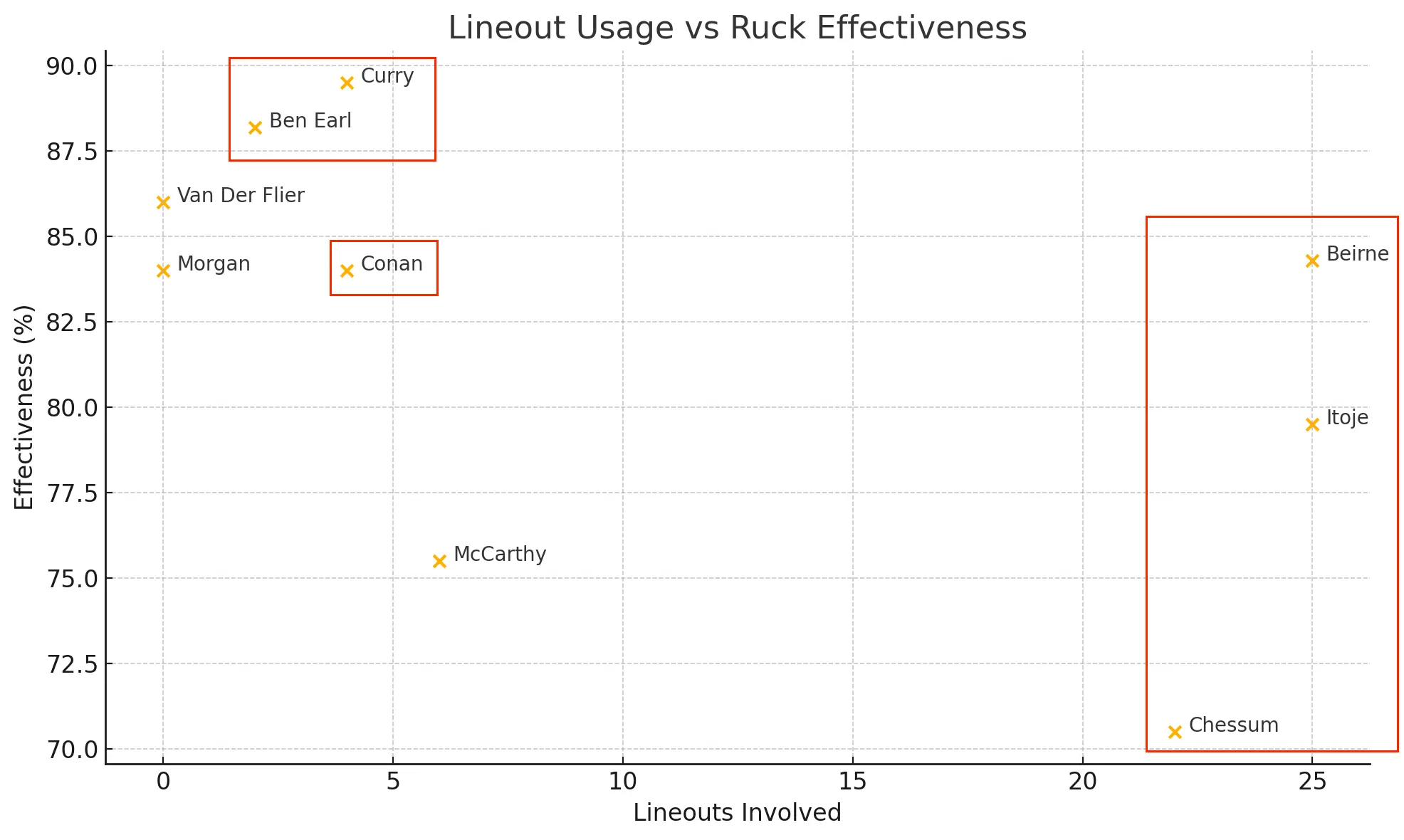
When you factor in the lineout, which is going to be important in this game (the Lions will have 15+, I would wager), then you get another set of data points.
Lineout usage when combined with Ruck Effectiveness gives us this.
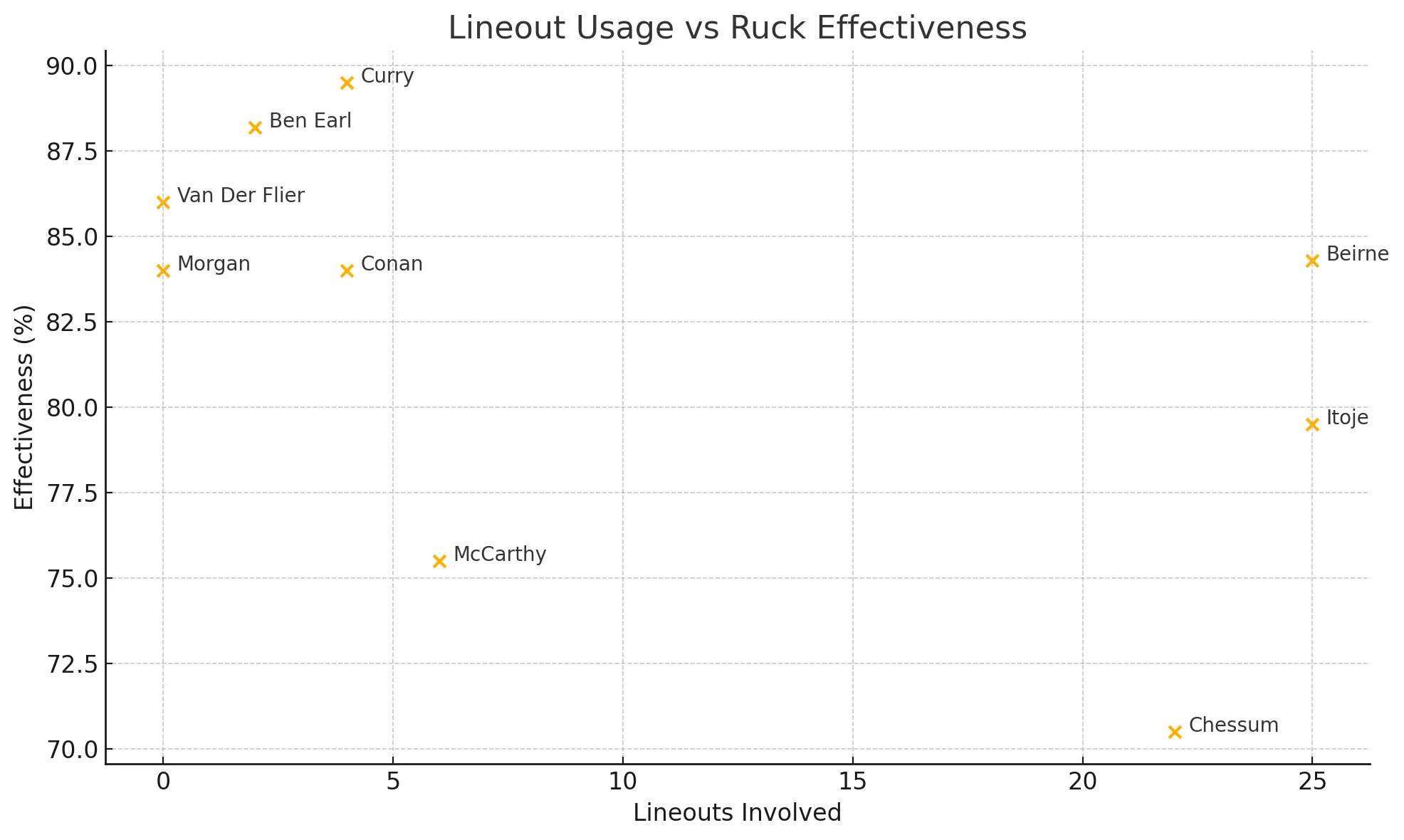
Again, McCarthy is an outlier in this dataset, so if the Lions are set on using a 5/3 split and starting McCarthy, that means you have six slots to build the rest of your back five + replacements.
Itoje is the captain, so he goes into the build and gives the Lions a lot of lineout and ruck coverage, but not enough of either. You have to include Beirne at #6 because he gives you more efficient ruck coverage in a game where accuracy is really important.
If lineout and ruck coverage are going to be a key factor, then you must select Curry and Earl as part of the test squad when you’re looking at your four small forwards. If we class Jack Conan as a Combo Flanker who gives us secondary lineout, edge ball carrying and defensive output with comparable ruck work by volume to Morgan, that excludes Morgan from the discussion immediately. Conan is a better carrier and gives lineout work to the back five build.
That leaves two spots to be discussed, if Chessum immediately takes #19 to cover the second row. So, do you go for Van Der Flier’s high volume, lower efficiency offensive ruck coverage with no lineout, or pick two more efficient, physical, bigger players who do have a secondary lineout game but who don’t cover as much ground as Van Der Flier?
I think that was where the decision fell.
I’d have gone for Van Der Flier’s coverage, be it from the start or off the bench, but I think Farrell was worried about the Lions’ impact ball carrying if he went with a 5/3 bench split.
Earl and Curry give you more cover for Conan than Van Der Flier and Morgan do, so that’s what swung it for them, certainly in the absence of someone like Caelan Doris.
That’s the place where the Wallabies will fancy their chances of ambushing the Lions. Kicking to them at volume, chasing hard, stopping the Lions on those first few transition phases—Harry Wilson and Nick Champion De Crespigny are impact tacklers— and really stressing the Lions’ cohesion under pressure.
That’s where any ambush will start.
