



It might seem blindingly obvious to suggest that a new head coach will look to impart his playing style onto his new team, but you’d be surprised how often people think differently.
A great recent example of this was when Leinster announced the signing of Jacques Neinaber as their new senior coach and a lot of the media just assumed that he would plug his defensive system into Lancaster’s counter-transition style rugby and that would be that. No. That’s not how it works. Neinaber’s high outside blitz isn’t just a way of playing on the defensive side of the ball; it’s the team’s identity that needs to be maintained by a specific approach in your kicking game, and game system and requires very specific role sets all over the team. It’s not just a cosmetic change, it’s a form of open heart surgery.
I mean, as well, the IRFU simply do not spend hundreds of thousands of euros a year for a head coach to fit into preexisting structures; they’re paying that money for him to reshape those structures in his image.
That is exactly what is expected of Clayton McMillan at Munster.
I’ve spoken at length about the different structures that will be looked at, as well as the cultural reset McMillan will enact, but I’m also expecting a significant change in how Munster plays the game.
That is simply because it would be naive to assume that McMillan went through the hiring process where, at various points, in-depth presentations on playing style were discussed, and got the job based on agreeing that everything Munster were doing to that point was fine. It wasn’t. Obviously. The only reason the job was on offer at all was because the previous head coach was let go after six league games.
So what changes will McMillan bring in? I suppose that, in early July, we can only bring our best guess and I think that will be done by looking at what the McMillan’s Chiefs and All Blacks XV side did this past season.
***
From a statistical perspective, a lot of what the Chiefs do on the field seems similar to what we’ve done this season, but as we know, stats can be deceiving.
Let’s see what they say, first and foremost. I’m just going to lay these out in bullet points to make it easier to skim through, as there are a lot of data points.
Munster & Chiefs Similarities
Attack & Ball Movement
- Dominant Carries:
- Chiefs: 33.9% (3rd in Super Rugby)
- Munster: 37.4% (middle-tier in URC)
- Both teams rely strongly on physical, impactful ball carrying as a central component of their attacking strategies, mostly off #10 but in the edge spaces too.
- Gainline Success:
- Chiefs: 62.9%
- Munster: 55.9%
- Both sides have decent success rates, showing they generally make ground effectively.
- Movement Patterns:
- Both sides primarily attack from the openside (Chiefs: 85.2%, Munster: 89.1%) rather than the blindside. Their tactical approach heavily involves stretching defences to create space, with Munster, in particular, playing a lot of screen ball out of our default 3-3-X phase and 3-2-X transition shape.
Set-Piece Emphasis
- Lineouts:
- Chiefs Lineout Success: 85.5%
- Munster Lineout Success: 81.3%
- Both teams exhibit moderate lineout effectiveness, highlighting room for improvement, particularly Munster, as we’ve been over at length.
- Scrums:
- Chiefs Scrum Success: 97.3%
- Munster Scrum Success: 93.3%
- Both are reliable in scrummaging, with the Chiefs being significantly more dominant when it comes to winning penalties and disrupting the opposition’s put-ins. More on this later.
Defence:
- Tackle Success Rate:
- Chiefs: 88.5%
- Munster: 87.0%
- Both teams have strong, dependable defences in a general sense, but more on that in a minute.
Munster & Chiefs Differences
Attack & Ball Movement
- Offloads (successful assisting breaks)
- Chiefs: 10.2%
- Munster: 6.7%
- The Chiefs show greater emphasis and success in offloading to generate line breaks and tries, indicating a more expansive style. Munster have a lot of successful offloads, but they are more about keeping possession rather than directly leading to a linebreak.
- 22 Entries & Conversion Efficiency:
- Chiefs: 10.8 entries per game, with 44.3% leading to tries.
- Munster: 8.6 entries per game, with 42.6% conversion.
- Chiefs create more attacking opportunities and are slightly more clinical in converting opportunities into points, albeit over fewer games than Munster.
Set-Piece and Maul
- Maul Usage (Tries per game from Mauls):
- Chiefs: 0.18
- Munster: 0.11
- Chiefs are slightly more inclined to score through mauls, despite fewer metres per maul compared to Munster.
- Maul Efficiency (metres per maul):
- Chiefs: 2.4 metres
- Munster: 1.6 metres
- The Chiefs drive way more effectively, making significant ground per maul attempt.
Defence & Errors
- Missed tackles leading to line breaks:
- Chiefs: 18.0%
- Munster: 11.6%
- Munster’s defence, despite slightly lower overall tackle success, makes fewer critical mistakes leading directly to breaks outside of the 22.
22 Defence
Chiefs:
- Opposition 22 Entries per game: 7.8
- % of Entries leading to tries conceded: 38.4%
Munster:
- Opposition 22 Entries per game: 7.0
- % of Entries leading to tries conceded: 46.2%
Key Differential
- Chiefs allow slightly more opposition entries (7.8 vs 7.0), but they defend their 22 significantly better, with only 38.4% of opposition entries turning into tries.
- Munster allow fewer entries into their 22, but we struggle more defensively once teams get there, conceding tries on 46.2% of all entries – one of the worst in the game last season.
What This Means
- The Chiefs demonstrate superior 22-metre defensive resilience, possibly due to more effective scramble defence, stronger defensive organisation, stronger collision dominance in tight defence or better discipline under pressure. They also concede fewer metres through the maul.
- Munster, although limiting opportunities outside of the 22, shows incredible vulnerability once breached, highlighting a huge area of concern in defensive execution or discipline close to our try line. Our defensive resilience in the 22 is one of the worst in the world this season.
Exiting The 22
- Exit Strategies (Kicking percentage):
- Chiefs: 74.5% kicks
- Munster: 68.8% kicks
- Chiefs prefer kicking from exits significantly more than Munster, reflecting their tactical approach to relieve pressure through tactical kicking. Throughout the season, the Chiefs were way less likely to try and run out of the 22.
Overall Analysis
- Chiefs play a more expansive, attacking-focused game, reflected by more offloads, higher efficiency from 22 entries, and more aggressive tactical kicking. Their powerful carrying and reliable scrummaging provide a solid platform, though their defensive errors can occasionally lead to line breaks.
- Munster, while similar in terms of physicality, exhibit a slightly more conservative approach with fewer offloads based on maintaining possession, and fewer attacking opportunities in the 22, but compensates with fewer defensive mistakes outside of the 22. Our style leaned more towards controlled phase-play as the season went on, relying less on open-play risks and more on structured rugby out of the 3-3-X and 3-2-X transition shapes.

There are differences within the similarities, as well. For example, the Chiefs play a much narrower game through the forwards, so, while our passing numbers and use of the openside are similar, there are key differences deeper in the data.
Again, here are the main data points laid out as bluntly as possible for ease of reading;
Movement (“Close” vs. Wider Positions)
Chiefs
- Close Movement: 47.4% (Top four in Super Rugby)
- Wide Movement: 8.6%
Munster
- Close Movement: 38.5% (Mid-table in URC)
- Wide Movement: 9.0%
Implication:
- The Chiefs operate considerably closer to the ruck and rely on shorter, tighter carries with frequent ball recycling near the breakdown. This is really important; keep a note of this for later.
- Munster, by comparison, shows a more balanced approach, distributing the attack slightly wider more often per offensive action, rather than persistently operating within tight channels. We’ve seen this throughout the season with our use of screen balls and tip-ons through the forwards to screened runners.
Passing Width (Beyond 2nd Receiver)
Chiefs
- Passes Beyond 2nd Receiver: 10.0%
Munster
- Passes Beyond 2nd Receiver: 12.6%
Implication:
- The Chiefs’ lower percentage of passes beyond the second receiver indicates a narrower attack, relying heavily on tight carries and shorter passing sequences near the ruck. They likely aim to physically dominate opponents, creating quick recycle phases and repeatedly testing the same defensive area.
- Munster’s higher percentage indicates more frequent attempts to move the ball wider, even if modestly so, to stretch defences and attack space on edges or through midfield breaks in the 3/4 space.
Short Passing Emphasis
Chiefs:
- Short Passing: 34.8% (relatively high)
Munster:
- Short Passing: 35.1% (slightly higher but comparable)
Implication:
- Both teams heavily utilise short passing, but the Chiefs combine short passing with predominantly tight carries (“Close” movement). Munster, by contrast, integrates short passing slightly more evenly across the field.
Tactical Interpretation
- Chiefs:
- Their narrow attacking shape (tight carries and limited wide passes) aligns with a style that aims to wear down opponents physically around breakdown areas. When we consider the Chiefs’ use of the bench, this makes complete sense.
- This tactic supports generating quick ruck ball, repeated phases, and eventually defensive fatigue, leading to line-break opportunities, complemented by short offloads.
- Munster:
- With their marginally higher percentage of wider passing, Munster’s attack includes more variety in terms of width. They attempt to stretch opposition defences laterally to create gaps and mismatches.
Strategic Considerations
Given this clear tactical difference, McMillan will likely aim to incorporate aspects of the Chiefs’ tighter, physical, breakdown-focused style, while preserving Munster’s ability to move the ball wider selectively. This could result in Munster adopting a more hybridised approach, balancing sustained physical pressure around rucks with wider attacking threats when defensive structures narrow to counter the Chiefs-like tight game.
The data clearly shows that the Chiefs prefer a tighter, narrower attacking approach compared to Munster’s slightly wider style. The Chiefs’ game revolves around carrying closely around rucks, maintaining constant forward momentum, and limiting wide-ball risk until the likes of McKenzie can attack directly into space.
But this also brings up a key undermining factor for Munster this season – and last season- and it’s one where our choice of scrum coach and scrummaging personnel becomes incredibly meaningful.
Scrummaging Aggression
If you’re going to make as many passes per game as the Chiefs (181 passes on average) and Munster (179 passes on average) do, you have to have an effective scrum. Not just for retaining your put-in but, crucially, going after the opposition on theirs.
This has been a key weakness for Munster in the last two seasons. I had assumed that losing Rowntree’s influence at the scrum – he still took that part of the training, even as head coach – would be a net negative, but, surprisingly, the opposite was true. In 2023/24, Munster had a slightly better success rate (94.4% to 93.3%), but our ability to win penalties and disrupt the opposition put-in was better this year, while still being nowhere near where it needed to be.
At a very basic level, if you’re going to be holding the ball for long stretches and offloading at volume, you’re going to see a lot of scrummaging, and that’s before the rule change on escorting kicks came in, which bumped the number of scrums game-wide.
If we assume that teams who hold the ball are more vulnerable to conceding knock-ons, it follows that the better you are at winning penalties and, crucially, winning opposition scrums, the better you will perform across the season.
The Chiefs had the best, most dominant scrum in Super Rugby this season, and this played a huge part in their ability to dominate games and long sequences within those contests.
This is a significant tactical outlier in the global game.
I combined the data of the teams who won a lot of scrum penalties, and a lot of opposition scrums and compared it to overall passing volume.
Here’s the chart.
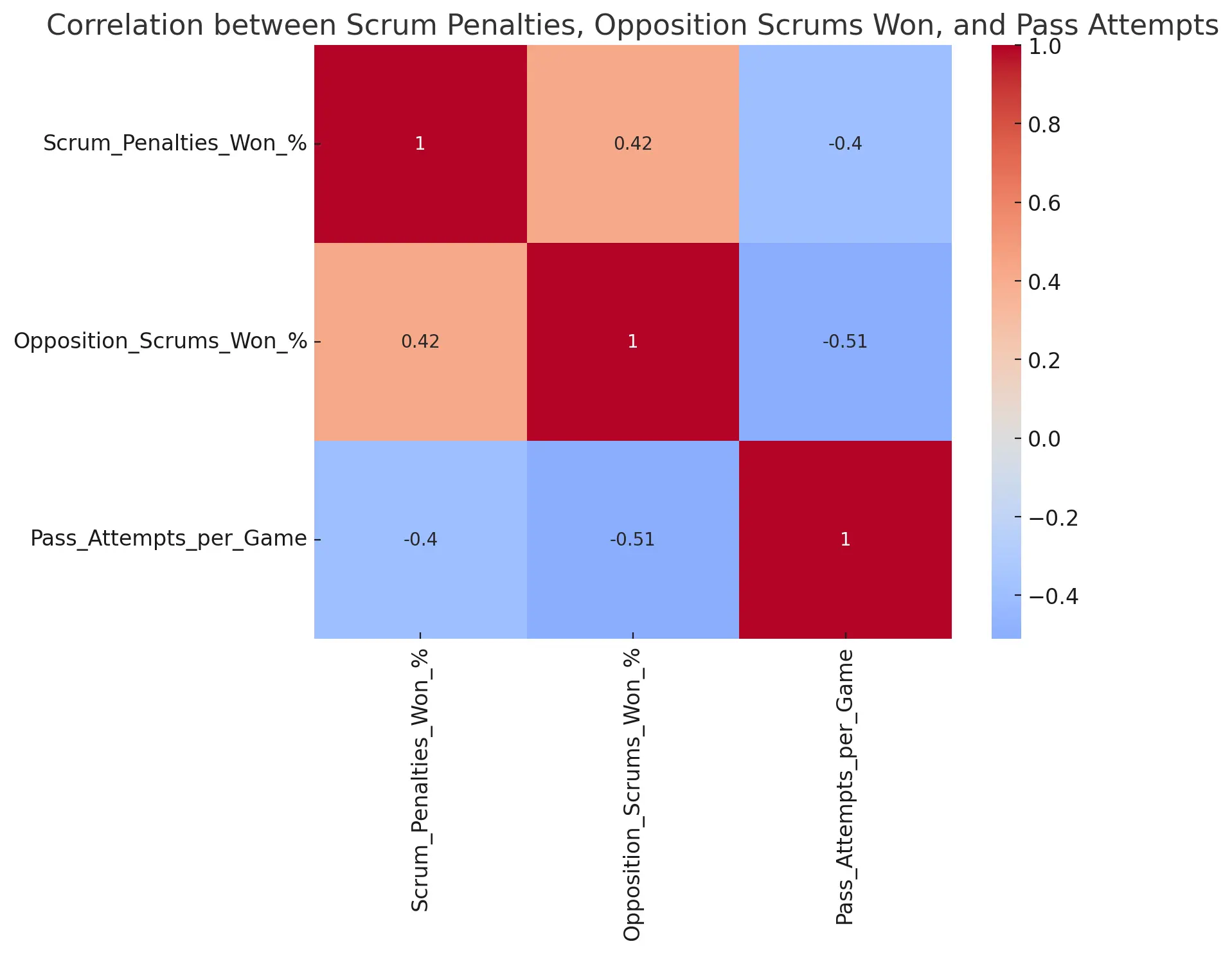
And here’s the breakdown as I see it.
Key Observations
- Moderate Positive Correlation (0.42) between:
- Scrum Penalties Won and Opposition Scrums Won.
Teams that dominate scrums by earning penalties also tend to be effective at disrupting opposition scrums. This is fairly obvious in theory, but I was surprised there wasn’t a bigger correlation in the data.
- Scrum Penalties Won and Opposition Scrums Won.
- Moderate Negative Correlation (-0.51) between:
- Opposition Scrums Won and Pass Attempts per Game.
Teams successful in disrupting opponent scrums tend to pass the ball less, indicating, perhaps, a reliance on set-piece dominance and physical play rather than expansive handling into the wider areas.
- Opposition Scrums Won and Pass Attempts per Game.
- Moderate Negative Correlation (-0.4) between:
- Scrum Penalties Won and Pass Attempts per Game.
Teams that frequently win scrum penalties generally attempt fewer passes, reinforcing the idea of set-piece control as a central tactic, often leading to fewer expansive plays because, for the most part, they aren’t needed.
- Scrum Penalties Won and Pass Attempts per Game.
Tactical Interpretation
- Teams with strong scrummaging dominance generally adopt a narrower, set-piece-oriented style, using fewer passes overall, possibly indicating a tactical preference for tight play or using scrum penalties to earn territorial advantages through kicking rather than expansive attack.
- Conversely, teams who pass frequently tend to rely less on scrum dominance or disruption, favouring a more fluid style.
This data tends to suggest that a team’s scrummaging strength and style significantly influence their broader attacking strategy, with powerful scrummaging teams less likely to rely on extensive passing movements and instead focus on various off-ball or counter-transition styles.
The Chiefs are a massive outlier if we look at this data.
Why are they an outlier?
-
Scrum Dominance:
-
Highest scrum penalty win rate (28.5%) in Super Rugby.
-
Second-highest rate of winning opposition scrums (10.1%).
-
-
Expansive Attacking Play:
-
Highest pass attempts per game (181.6) in Super Rugby.
-
This is contrary to the moderate negative correlation found between scrum dominance (both penalties won and opposition scrums won) and pass attempts per game, typically indicating a narrower style of play. This is also relative to Super Rugby Pacific, which has fewer games overall, so the averages tend to be a little higher or lower than Europe, on top of cultural norms of playing more expansively from a knock-on advantage in a general sense.
What does this suggest tactically?
-
The Chiefs uniquely combine scrum dominance with a heavy passing game.
-
This indicates a highly unique approach, using their scrummaging power not just as a conservative, tight-game tool, but as a foundation from which they confidently expand into wider attacking patterns.
-
The Chiefs leverage penalties earned through scrums to secure advantageous field positions, subsequently launching attacks from further up the pitch, but also use it as a form of insurance for their high passing volume. In short, they hold the ball for a long time and then use their scrum to dominate any handling errors, regardless of who makes them.
Clayton McMillan’s Tactical Blueprint
McMillan’s approach clearly doesn’t conform to conventional tactical norms. He has created a distinctive hybrid style:
-
Scrum Dominance:
Establishing a stable and dominant scrum to provide consistent territorial advantages, penalties, and a platform for attack. -
High Tempo Passing Game:
Utilising the territorial and possession advantages from scrum penalties to initiate tight passing plays, thus stressing defensive structures across the field. -
Opposition Disruption:
Aggressively contesting opponent scrums, forcing errors, creating transition phases, and immediately converting those moments into attacking opportunities.
So when we compare the Chiefs’ scrummaging to Munster’s, we see a core point of difference.
Chiefs (Super Rugby Pacific)
- Scrum Success Rate: 97.3%
- Scrums Won via Penalty: 28.5%
- Opposition Scrums Won: 10.1%
Implications
- The Chiefs’ scrum is a significant attacking weapon.
- Nearly one-third of all their successful scrums result in a penalty advantage, providing either direct scoring opportunities (kicking penalties) or valuable territorial gains.
- Winning 10.1% of opposition scrums shows effective disruption, giving them opportunities to turn defence into attack.
Munster (URC)
- Scrum Success Rate: 93.3%
- Scrums Won via Penalty: 20.0%
- Opposition Scrums Won: 5.0%
Implications
- Munster’s scrum is stable but less dominant.
- With 20% penalty wins, Munster do still generate penalties, but noticeably less frequently than the Chiefs.
- A significantly lower percentage (5%) of opposition scrums won implies Munster disrupts opposition scrums far less effectively, reducing their opportunities for possession turnovers.
Comparative Analysis & Tactical Insights
| Metric | Chiefs | Munster | Difference |
|---|---|---|---|
| Scrum Success % | 97.3% | 93.3% | Chiefs +4.0% |
| Scrums Won via Penalty | 28.5% | 20.0% | Chiefs +8.5% |
| Opposition Scrums Won | 10.1% | 5.0% | Chiefs +5.1% |
- The Chiefs hold a clear advantage in both scrum dominance (penalties earned) and disruption of the opposition ball (opposition scrums won).
- This means the Chiefs use scrums as a proactive attacking and tactical platform, while Munster’s scrum serves more as a secure restart mechanism rather than a dominant weapon.
Accounting for Inflation
If we take the Chiefs’ scrummaging numbers in a 17-game Super Rugby season and scale them across a longer European season, they look like this;
-
Scrum Penalties Won: approximately 34%
-
Opposition Scrums Won: approximately 14.3%
There’s an element of guesswork here, of course, and I would suggest that dealing with French and South African scrums is a total x-factor that the Chiefs don’t have to deal with, but this, to me, shows where Munster need to improve as a priority. In the mess of the lineout last season, the scrum almost became something of a sideshow. It was decent, mostly pretty safe and worked as intended most of the time, but the data clearly shows that we have to improve at a rate of knots on last season.
This also brings up the fact that we haven’t announced a scrum coach as of yet. Sean Cronin did really well last year, but will he get the gig full-time? It’s a vital part of making McMillan’s game work, on top of making sure we’ve got the right personnel across the season, especially at tighthead.
Keep an eye on this part of the coaching set-up as we move into preseason mode.
Later this week, I’ll get into the video clips of the Chiefs playstyle and how I think it’ll translate quite easily over to the style Munster are both familiar with and can easily adapt to based on what we’ve done over the last three seasons.
