


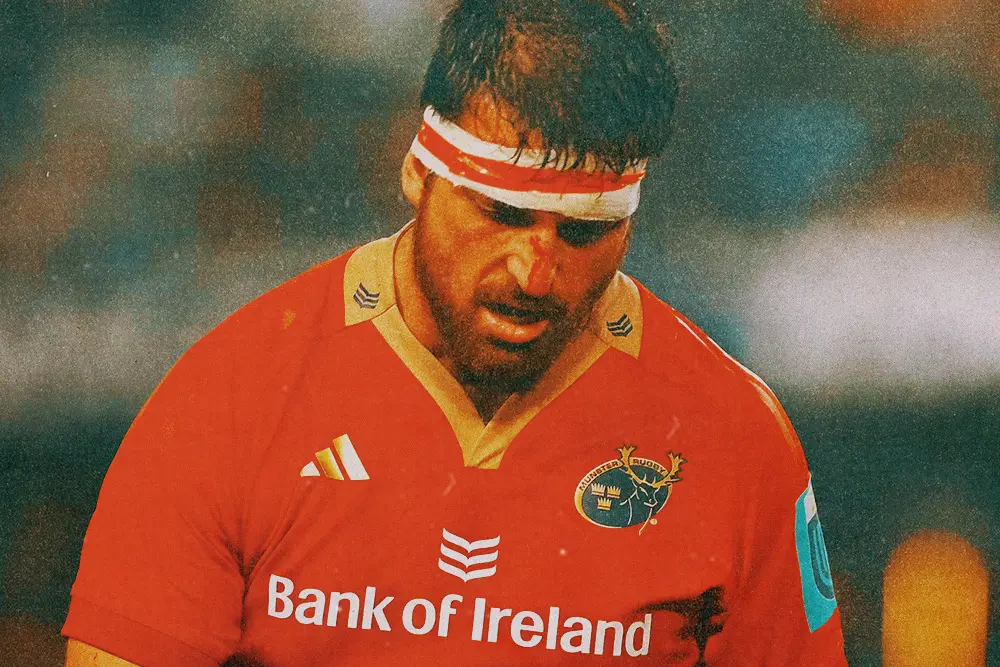
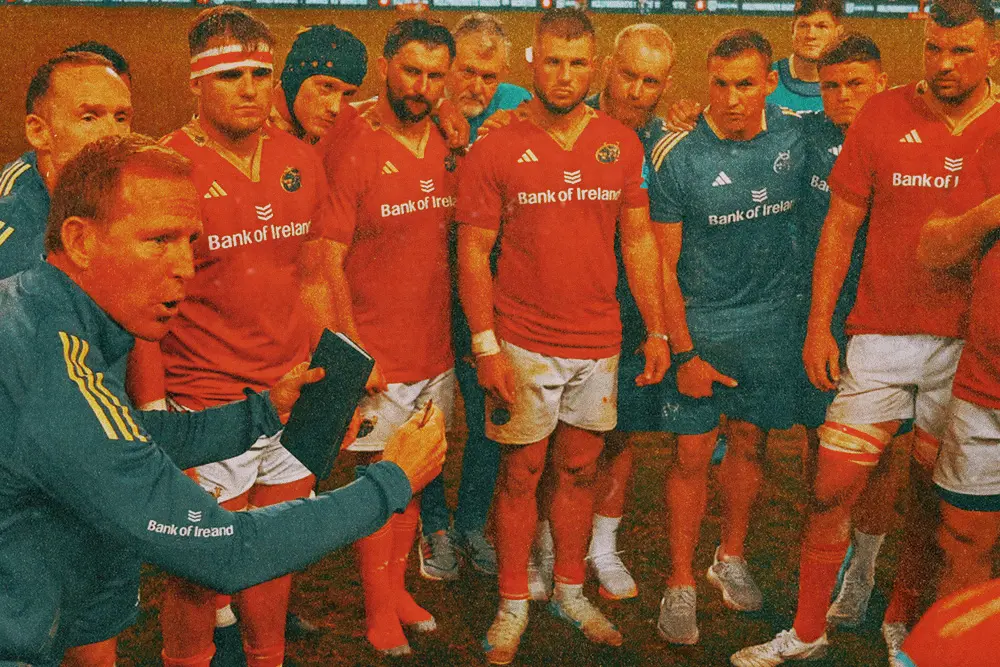
When it comes down to it, all we have beyond this life is how we’re remembered.
In the last few weeks, the wider Munster family lost Michelle Payne, wife of Shaun Payne, and Sheelagh Foley, the wife of Brendan Foley and mother of the late Anthony Foley. Munster remembers these people. You might think that every club does this, but they don’t. It isn’t that Munster is unique in this either, but they reflect a reality you probably know in your own life. We do death well here.
When Ian Costello spoke this week about making sure they remembered these people, as well as people like Tom Tierney, Grieg Oliver and others, it’s not a case that you honour them with the guarantee of a win. Anyone who knows this game at this level knows you can never promise a win when it comes to honouring someone’s memory. There are too many moving parts. You honour them with the effort you expend and the fight you put up in every single moment.
After 100 minutes of tense, never-say-die rugby of test-level intensity against a team packed with Springboks and World Cup winners, the best thing I can say about this Munster squad is that they honoured the memory of whoever was in their hearts and minds when they crossed that white line.
They remembered them well.
“Stick in the fucking fight with the kicking game”
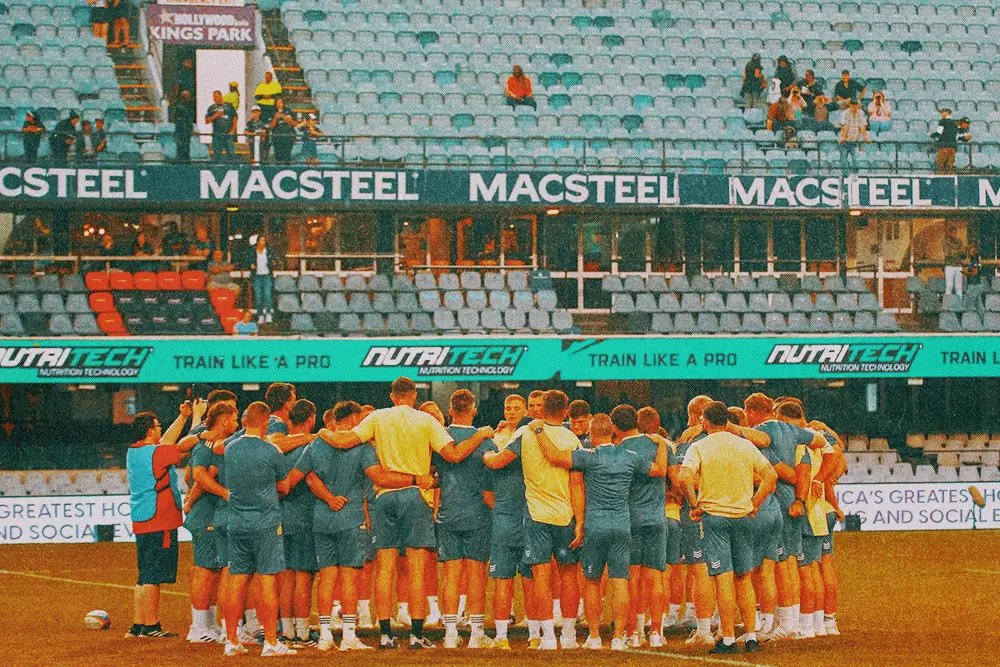
Peter O’Mahony came off the field in what would be his last game of rugby for Munster after 55 minutes but around 40 minutes later he was in the Munster huddle at halftime in extra time, laying down the law on what he wanted to see from Munster’s kicking game in the final ten minutes of this violent, brutally intense rollercoaster ride of a quarter-final.
Before the match, I spoke about Munster’s need to kick at a high volume and in short to mid-range contestables to make sure we kept the Sharks’ long-range transition game to a minimum.
As I wrote;
Going long and non-contestable against the Sharks back three is a bad idea because Hooker, Fassi and Mapimpi are incredibly dangerous runners with any kind of grass in front of them. Flood them with high mid-range contestables where you can swallow them up immediately on defensive transition.
This is where you can get to the Sharks. The quality of the transition game play when they don’t make an initial line break is incredibly average. They are top five in the URC for converting linebreaks into tries, mostly on transition, but they also concede more turnovers than any other side in the league.
This is the exact approach Munster took for the entire game, with a 3.1 Kick to Pass ratio making for our most pragmatic kicking game of the season to date.
Tactically, I think we dominated the Sharks in the first half by, essentially, picking our poison. We knew that by kicking contestably at that kind of volume was going to increase the volume of scrums, and that this would, in turn, expose us to a possible Sharks’ superstrength. We decided that this was a gambit worth taking, and we were right. The Sharks conceded 21 turnovers, and that gave us a platform to get after them 25m at a time through outstanding kicking from Crowley and Casey.
The idea was to keep the Sharks in a phone box. Make sure they can’t get separation on transition, muscle up on that first phase of transition defence where the Sharks struggle to move the ball through their screens, and then hit them on transitions of our own. That the scrum later turned into a serious weakness doesn’t negate the excellence of the tactical plan, for me. We started to get overwhelmed by their size and power, especially as we tired and lost two front row replacements within ten minutes of bringing them on.
When we kicked long, it was almost always for touch to limit the Sharks to their main attacking play outside transition – banging it up the middle through Esterhuizen.
Anytime you saw Casey or Crowley going long on an exit, as long as they could possibly go, and missing touch, the odd time, is because they wanted to minimise Esterhuizen’s crash ball impact.
This is because of the other factor in this game: Jack Crowley playing hurt. You can see him taking off the strapping he had around his ribs here at the end of extra time.
Crowley was hurt in a collision with Brex against Benetton after 30 minutes, and played through it to get Munster over the line as we had no fit, experienced #10 on the bench. The same was true this week, and that meant managing Jack through the game. The Sharks, of course, were well aware of his injury and targeted him all day, something that Crowley and Munster were also well aware of.
He muscled up for 14 tackles, which he knew would be coming most often from the lineout.
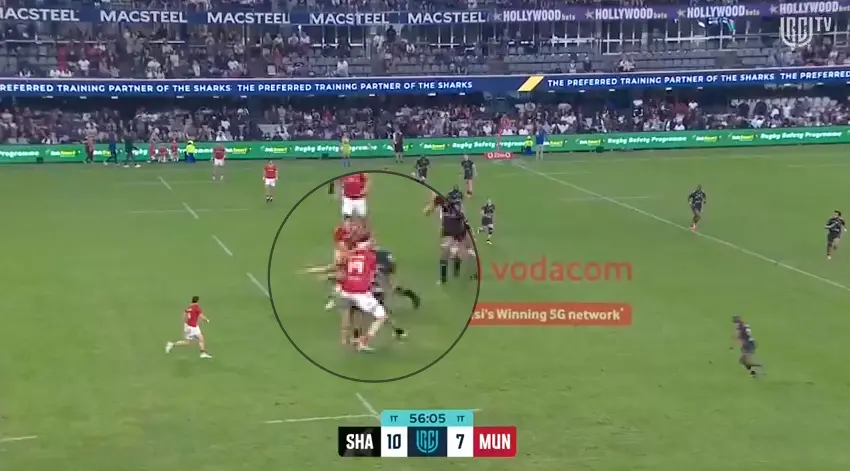
You can see why on what the Sharks thought was a winning try deep into the last quarter of normal time.
Crowley is just throwing himself in the way of this collision to try and get a stop, but the lost gain line meant that the Sharks’ next phase was almost inevitably a try. This is why we wanted every last inch on those exits to touch, while our contestables were short.
We picked our poison.
So it was fitting that the opening score came from a clinical Munster transition play of our own. The impressive Diarmuid Kilgallen ran back a dud kick from Jaden Hendrikse.
Kilgallen’s outside break makes this opportunity, and Crowley’s vision and composure to bend that kick just behind Mapimpi and right in range for Nash was a really nice bit of work.
Those tactics held the Sharks scoreless until the 45th minute. Crowley exited a little long, but we actually handled their transition quite well and got a proper slowdown on a centre field ruck. A somewhat speculative shift to the tramlines should have seen Tshitsuka and the ball brought to ground with Farrell and Abrahams in the tackle, but the offload went to hand and the Sharks were level.
From there, momentum started to swing and it became very apparent that almost every Sharks scrum was going to end up in a penalty as Nche and then Mchunu began to pressurise a tiring Stephen Archer.
There’s no shame in this, by the way. This was Archer’s last ever game of professional rugby at 37 years of age, 306 caps for Munster and a sixteen-year-long professional career.
It essentially meant that any Munster knock-on would result in a loss of metres and possession. The Sharks used that to squeeze 10-7 ahead.
But we were far from done.
Another dud exit from the Sharks was punished by a superb Munster transition. Look at how Munster work that 3-3-1 shape on transition to work Haley into a position where he can release Kilgallen in that 3/4 space for a huge linebreak.
That unbalanced the Sharks’ middle line, and Munster caught them in that 3/4 space again on the return with a killer Farrell linebreak inside the Sharks’ outside blitz.
It was a fantastically executed try. Munster drew out the Neinaber-esque high edge blitz with two layers of passing, but then made sure to get a blocker in the way of the pass into the 3/4 space.
Tom Ahern made sure that the other Hendrikse wasn’t going to get his hands on Nankivell for the key pass.
We would even stretch out our lead from that point to 21-10, but there was too much time left, and our front five was running on fumes. Wycherley and Barron had to leave the field ten minutes after coming on, so Scannell and the massively impressive Michael Milne would have to play the rest of the game.
A cheap penalty off the restart gave the Sharks access, and then momentum started to swing back against us. Two or three penalties in a row around the 5m line made another Sharks try almost inevitable. When they scored it, it felt like we needed to be perfect to stop them from getting another opportunity, and one of the harshest hometown calls you’ll ever see on a defensive ruck gave them the platform to take the lead late in the game.
And yet.
We kept scrapping.
We found the 3/4 space to break their blitz a few minutes later, and they were haunted not to concede at least a yellow card from this deliberate slap down.
That’s a three-on-one on the outside. You know it was bad because the South African TV director didn’t show a replay.
Conor Murray landed the long-range penalty to tie up the game, and from that point on, it was about desire, toughness and soul. Munster weren’t found wanting for any of it.
Four of the Munster front five that started the game were slugging away. John Ryan, who came on with 12 minutes to go in normal time, was being physically outmatched in the scrum but was putting in shots in phase play when it counted.
The longer it went on, the more remarkable Munster’s performance became. Players like Ahern were in full-on “refuse to lose” mode, making one scarcely believable play after another.
In the end, both sides fought each other to a standstill, and it would be decided by a penalty shootout, which we would lose after Rory Scannell shanked the second kick in the shootout. A cruel way for his 200th cap to end, but sport is rarely kind. Scannell will be remembered well, something that others on the field during the shootout cannot say. My initial reaction to the Sharks’ playacting and shady mind games in an attempt to ice Jack Crowley was anger. Then, when it didn’t work and Crowley nailed his kick regardless, but I still had to endure watching South African social media accounts pretend it did work, actually, and that Jaden Hendrikse is a 3D chess playing le epic bacon troll please upvote, I felt a wave of frustration.
But then, when I woke up this morning and set out for Castlegregory with my family, I thought about what the Munster players were playing for, and how they honoured those people with their actions for 100 minutes. Seeing how that contrasted with Hendrikse and that S&C coach debasing themselves to try and get an edge was pretty eye-opening, and my genuine reaction to that thought was sadness.
Some bells you can’t unring.
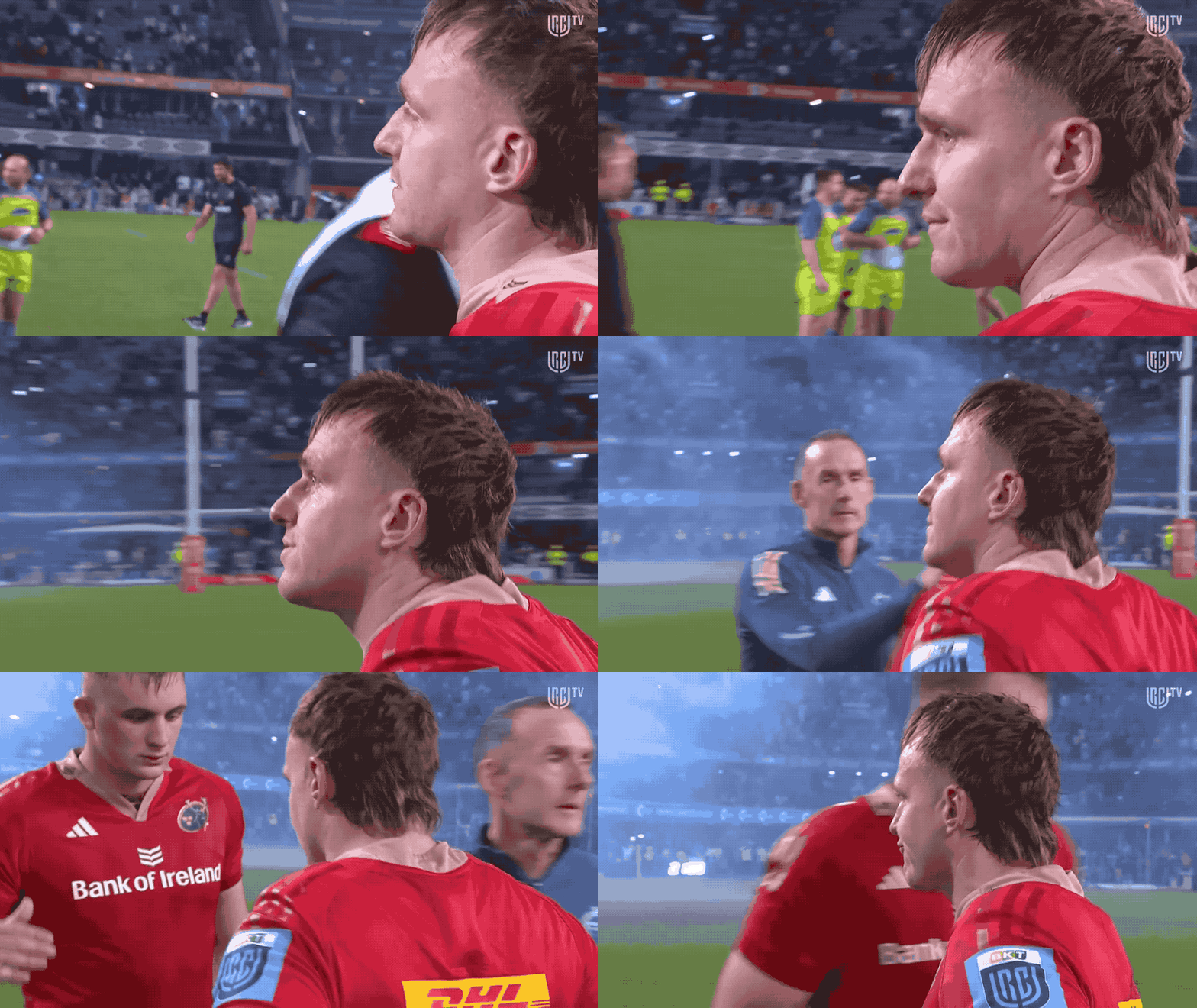
When that last penalty sailed over, Munster’s season ended with it. There have only been four penalty shootouts in professional rugby history, and Munster, of course, have been in half of them. It takes something from you, win or lose. Toulouse found that out in 2022. Won the shoot-out but got walloped a week later. Don’t bet against a similar thing happening next week in Pretoria.
Munster will go into what is going to be a transformative summer with a lot of frustrations, but the promise of something new. A clean slate. A fresh voice. It’s badly needed after a season that has been running at a high temperature since the Round 2 loss to Zebre in Parma back in September 2024, and that was on life support from November on.
Whatever happens next will be new, but that’s good too. Change is inevitable.
The Van Graan Era started in 2017/18 off the back of Erasmus’ kickstart and had a late peak in Rowntree Year One. I think it’s fair to say that we’ve been slowly regressing since that point. That conjoined era is now over.
Peter O’Mahony and Conor Murray, two of the greatest players ever to come out of this island, will retire and move on; their reign as the senior core of this squad is now over, and others will take control, fully and finally.
It’s time to get with the reset and put this season firmly in the rear view mirror before staring off a new era, a new journey and a new hope along with it.
| Players | Rating |
|---|---|
| 1. Michael Milne | ★★★★★ |
| 2. Niall Scannell | ★★★★ |
| 3. Stephen Archer | ★★ |
| 4. Jean Kleyn | ★★★★★ |
| 5. Tadhg Beirne | ★★★★★ |
| 6. Peter O'Mahony | ★★★★ |
| 7. John Hodnett | ★★★★ |
| 8. Gavin Coombes | ★★★★ |
| 9. Craig Casey | ★★★★ |
| 10. Jack Crowley | ★★★★ |
| 11. Diarmuid Kilgallen | ★★★★ |
| 12. Alex Nankivell | ★★★ |
| 13. Tom Farrell | ★★★ |
| 14. Calvin Nash | ★★★★ |
| 15. Thaakir Abrahams | ★★★ |
| 16. Diarmuid Barron | N/A |
| 17. Josh Wycherley | N/A |
| 18. John Ryan | ★★ |
| 19. Tom Ahern | ★★★★ |
| 20. Alex Kendellen | ★★★ |
| 21. Conor Murray | ★★★ |
| 22. Rory Scannell | ★★ |
| 23. Mike Haley | ★★ |
