


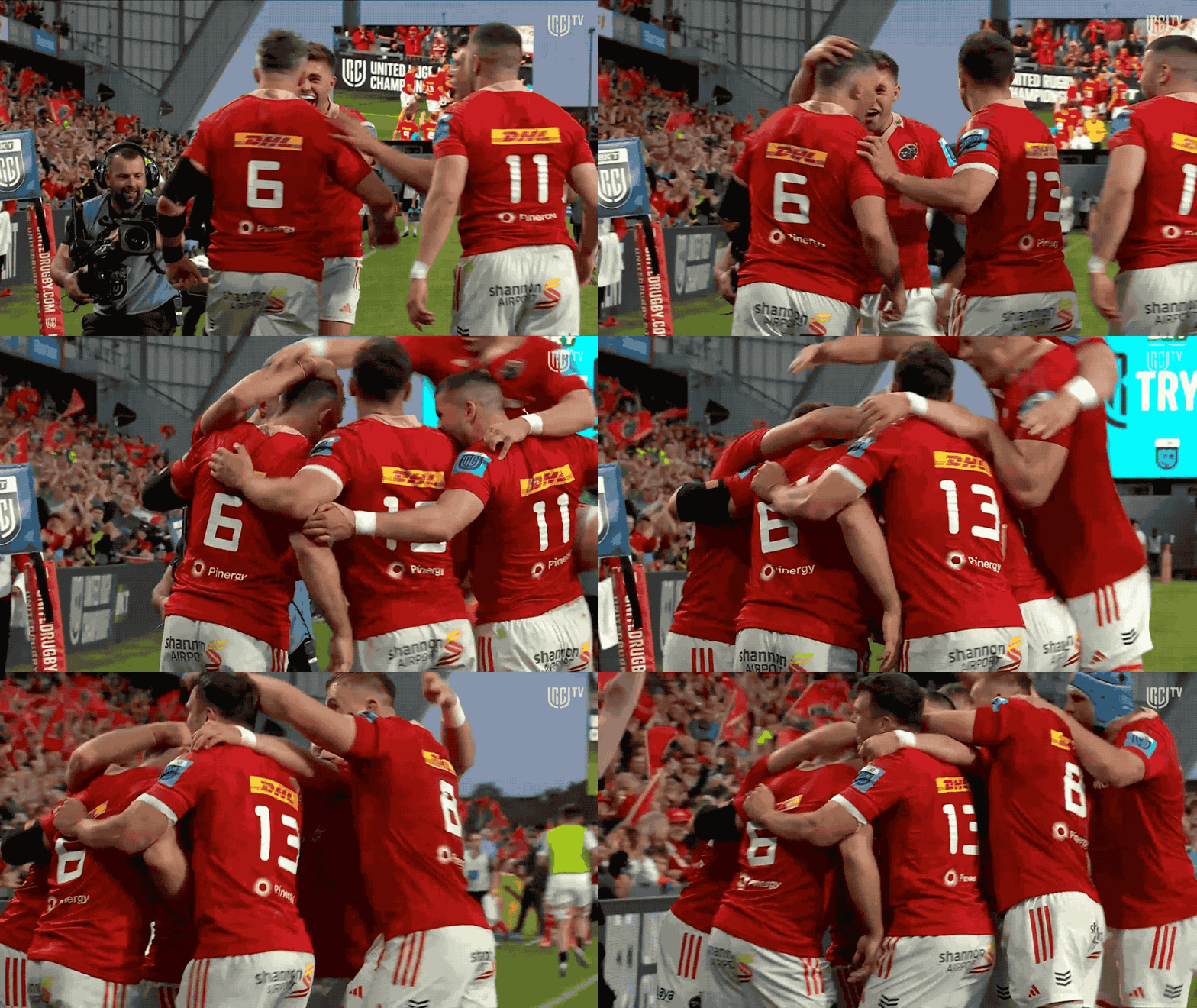
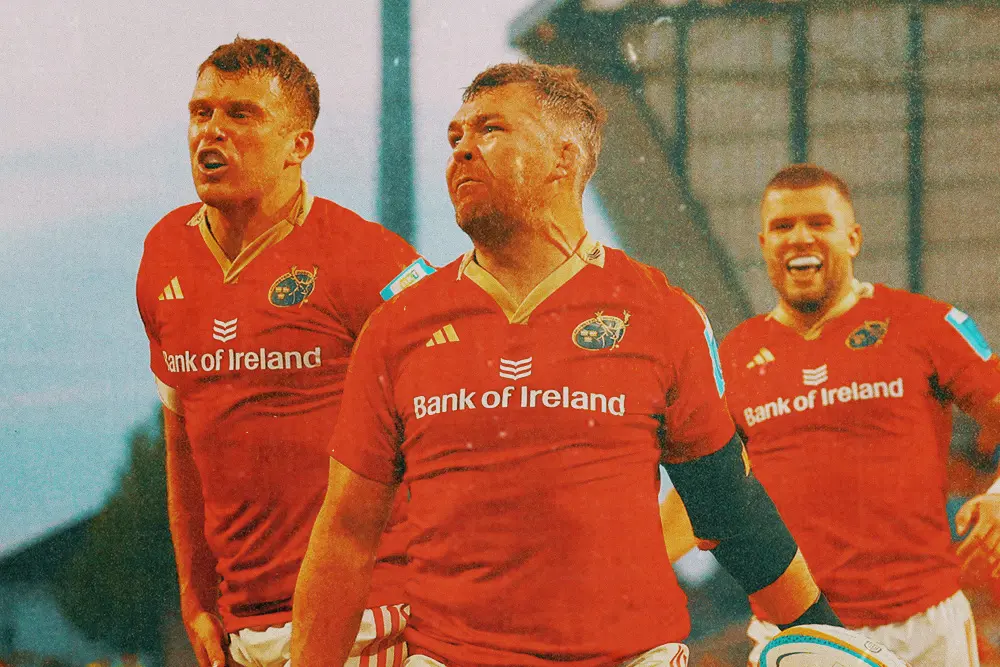
There’s no real catharsis yet, but there was enough here to get a contact high of what catharsis for this season might feel like.
At the moment, the only thing we can look at is Benetton next Friday in Cork. Win that, and we can talk about what a potential landmine Munster might be in the knockouts of this league for anyone. For now, it’s about collecting ourselves after an emotionally draining Friday night in Thomond Park.
I made my way to this game the long way around.
Always the best way to do it.
I met Dan Mooney in Limerick and had a sneaky pint in Crew in the sun. Shades on. Every city looks good in the sun, but there’s just something about Limerick when the sun is blasting. It’s the best-kept secret in the country.
We tipped over to Treaty City Brewery by King John’s Castle, and met a few people from the TRK Secret Club on Discord, which is always cool, if a little intimidating. I’m never quite sure how to act. There was that lovely smell of hot bricks, cigarette smoke and tarmacadam in the air, like it was the height of summer. In reality, this may well be the height of summer, so I’ve learned to enjoy that slightly hungover headache the bald community often gets in this type of sun. A good early sign; there was a lot of Munster red around, even early in the evening, and the vibes were immaculate.
I had to dart away to the game to get what would turn out to be a burrito and check out the vibe in the stadium – also, I had to get my accreditation and get sorted in Seat #13 in the press box. It’s my lucky number. Over Thomond Bridge, up the High Road beyond JJ Bowles, plumes of vape smoke jumping out of cars, stereos blasting that dance music that every radio station seems to do on a Friday evening now and, oddly, Ray LaMontagne singing “Trouble” on someone’s Spotify playlist. I hoped it wasn’t an omen or, if it was, it was one for Ulster.
The crowd was steady. You can always tell by the crowd in JJ Bowles if it’s going to be a 20k+ attendance. It wasn’t going to be a sellout, that was clear, but that’s because it was a Friday evening game kicking off at half seven. If you were any further away than Kanturk in the south, Kilrush in the west or Cahir, Cashel and Thurles in the east, it was impossible to make this game in time for kickoff if you work until five in the evening, as most people do. Can you afford to take a half day for a match and take the kids out of school early? Not many can these days.
I saw some of the Irish media demanding that “serious questions” be asked of Munster Rugby if there were fewer than 20k people for this game, which I always think is pretty rich from people whose job it is to go to these games (for free). I have a serious question for them in return: Do you know any normal people who don’t work in the media? Ask them about kick-off times like this in Munster, in particular, and see what they tell you. It might make for a good podcast segment.
I’d learn later that the official attendance was just under 18k, but it sounded like a sellout from early on. The crowd were into it. Anyone who was at this game didn’t wind up there by accident on a Friday evening, let’s put it that way.
Everyone was nervous. Maybe that’s the difference maker for a Thomond Park Night like this. Anxiety; sometimes it’s useful.
I think a lot of it was from the idea that Munster couldn’t let Stephen Archer, Conor Murray and Peter O’Mahony leave the Thomond Park pitch for the last time on a loss… could they? That was the hook. And the crowd responded.
Crucially, so did the players.
My biggest take on a deeply sloppy first half was that both sides seemed acutely aware that “the number on the piece of paper” was between five and eight, and whoever left without it would be walking into unknown territory of the Challenge Cup pool stages next season. Both sides were incredibly nervous. Passes weren’t sticking, players were conceding the kind of penalties that you always see when guys go looking for a big moment that isn’t on, they were nipping at each other – look, it was a full house of being acutely aware of the stakes involved.
Alex Nankivell conceded a needless enough penalty at an attacking ruck, Ulster’s Jack Murphy found the 5m line from the kick, and then Munster showed more of that sloppy close-range pillar defence that has dogged us all season.
We got a decent stop on the maul, and then two excellent stops by Michael Milne and Niall Scannell handed us the momentum. Ulster weren’t going anywhere fast. Then we lost Stephen Archer out of the line for 9.7 seconds after he made a double tackle, and that forced Kilgallen to guard the pillar, or at least position to do so after Hodnett and Coombes got stuck in a ruck.
Archer then got back into the line, tried to move Kilgallen from the pillar and then bit in on Henderson because – and I’m just casting my own opinion on this – he felt he would do a better job stopping a Henderson pick and go and Kilgallen would be better off guarding the edge with Casey.
They both took the same man, Henderson popped it to McCloskey, and it was a walk-in from there. Our stopping power at close range has been an issue all season and that’s a good example; down a forward for 10 seconds from close range is always leaving someone too much to do.
A bad start.
But that’s OK. We’ve seen bad starts from this team all season; the key is to build back in accurately and quickly. We managed the latter, but not the former.
A scrappy 5m lineout play was recovered, and the Munster pack did enough to get Michael Milne into a position to do what a man of his dimensions does well – barge over guys from close range. Our lineout was scrappy in the face of concentrated counter-jumping by Izuchukwu. Nothing unusual there, you might say, but it felt like we were missing these lineouts for slightly different reasons.
Scannell wasn’t – and isn’t – throwing well in the last few weeks, but he’s not helped by some of the lineout calling, which in itself is from a menu that probably needs to be torn up and rebuilt from scratch. That isn’t easily done mid-season, and impossible to do when you’ve got two games left in the regular season that you have to win.
Ultimately, we’re struggling to get away from teams at the lineout who mark our throw, rather than our jumpers but the difference this week is that we got a handle on it eventually. We came back out in the second half and, sure, missed one or two, but you could see that we made adjustments. We threw short to Milne, we cut out a lot of the movement and decoys and backed players to make difficult throws under pressure.
Core issues with the lineout remain; some of our front row’s lifting when we go down the chart is tired and sub-elite. We could do with getting a rock solid lifter in the market to back up Jager, if I was to pick one area to immediately improve us, now that I think of it, because a lot of our older tightheads are showing the wear and tear you’d expect.
Here’s a good example;
Izuchukwu must have jumped on 11/12 of our 15 lineouts and got a decent return, even at the front. In the above instance, the lift wasn’t as explosive as it needed to be or could have been, and that will always bring a dedicated counter-jumper into play.
Oddly enough, I thought that Izuchukwu’s lineout load actually took away from other areas of his game in this one, but for a while it limited Munster’s ambition but couldn’t hold it for the second half.
An outstanding lineout throw by Scannell opened up the space for Casey to find Nankivell in space, and he duly ran Tom Farrell through the gap left by the sin-binned Stuart McCloskey.
When the lineout works, everything else does too.
One thing that was also quite visible here is that we were way more comfortable playing a narrower, more direct game in phase play. The down week was badly needed for a bit of rest and relaxation away from the attritonal grind stone of professional rugby, but it gave the coaches a chance to look at elements of our game too.
If we take it that anything over 1.4 Passes Per Carry would be considered “expansive” when it comes to playing width, then I think it’s fair to say that our Pass per Carry rate was really pared back overall.
In Cardiff, it was 1.55.
Against the Bulls, it was 1.45.
Away to UBB, it was 1.63!
It was 1.05 passes per carry here.
When you look at some of our attacking sequences, you see it pretty clearly – tight carry, tight carry, and then a release into space.
It didn’t cut down on our turnovers, but it didn’t make it a little easier for our half backs to play. We had a little more separation on screens and on those releases, as a result. Ulster hit hard in defence and our tighter forward alignment and generally narrower shape allowed us to build a platform to play.
It was far from perfect, but it allowed us to put away a game, if limited Ulster side that faded badly in the second half and, in truth, didn’t offer much outside of what our overplaying in the first half gave them.
Ultimately, Munster kept their nerve and rode out the kind of iffy start, on the scoreboard and at the lineout, that could have easily turned into the kind of panicky performance we’ve seen from this team in the last few weeks. One moment stands out to me – Gavin Coombes’ hold-up of a tight sequence of Ulster attack. This was – is – the kind of sequence we’ve conceded on so often this season. We had just gone 18 points up, and with 20 minutes to go, we’ve already shown in the last few weeks that we’re more than capable of slipping off an 11-point lead.
Coombes’ tight defence put the game to bed.
There were a few more moments where a lack of concentration might have upended the game for us – Josh Wycherley’s yellow card, for example – but the team held their nerve, played mostly in the right areas of the field and saw out what was, in the end, a comfortable bonus point win. How long has it been since we’ve had one of those, eh?
A little too long.
On to next week.
| Players | Rating |
|---|---|
| 1. Michael Milne | ★★★★ |
| 2. Niall Scannell | ★★ |
| 3. Stephen Archer | ★★ |
| 4. Jean Kleyn | ★★★ |
| 5. Tadhg Beirne | ★★ |
| 6. Peter O'Mahony | ★★★★★ |
| 7. John Hodnett | ★★★ |
| 8. Gavin Coombes | ★★★★★ |
| 9. Craig Casey | ★★★★ |
| 10. Jack Crowley | ★★★★ |
| 11. Diarmuid Kilgallen | ★★★ |
| 12. Alex Nankivell | ★★★ |
| 13. Tom Farrell | ★★★★ |
| 14. Calvin Nash | ★★★ |
| 15. Thaakir Abrahams | ★★★ |
| 16. Lee Barron | ★★★ |
| 17. Josh Wycherley | ★★★ |
| 18. John Ryan | ★★ |
| 19. Fineen Wycherley | ★★★ |
| 20. Tom Ahern | ★★★★ |
| 21. Conor Murray | ★★★ |
| 22. Sean O'Brien | ★★★ |
| 23. Alex Kendellen | ★★★ |
***
Of course, it would have to be him, wouldn’t it?
Peter O’Mahony’s career has been defined by bossing the big moments. When something needed to be done – a lineout steal, a jackal turnover, a big lineout tackle, a goalkeeper-like snatch of a ball out of the hands of an onrushing All Black midfielder, a fella to be rattled – Peter O’Mahony was the man to do it.
So it should be no surprise to see him pulling Jack Crowley’s crossfield kick out of the sky to jam down the score that ultimately gave Munster the platform to win this game with room to spare. Of course it was.
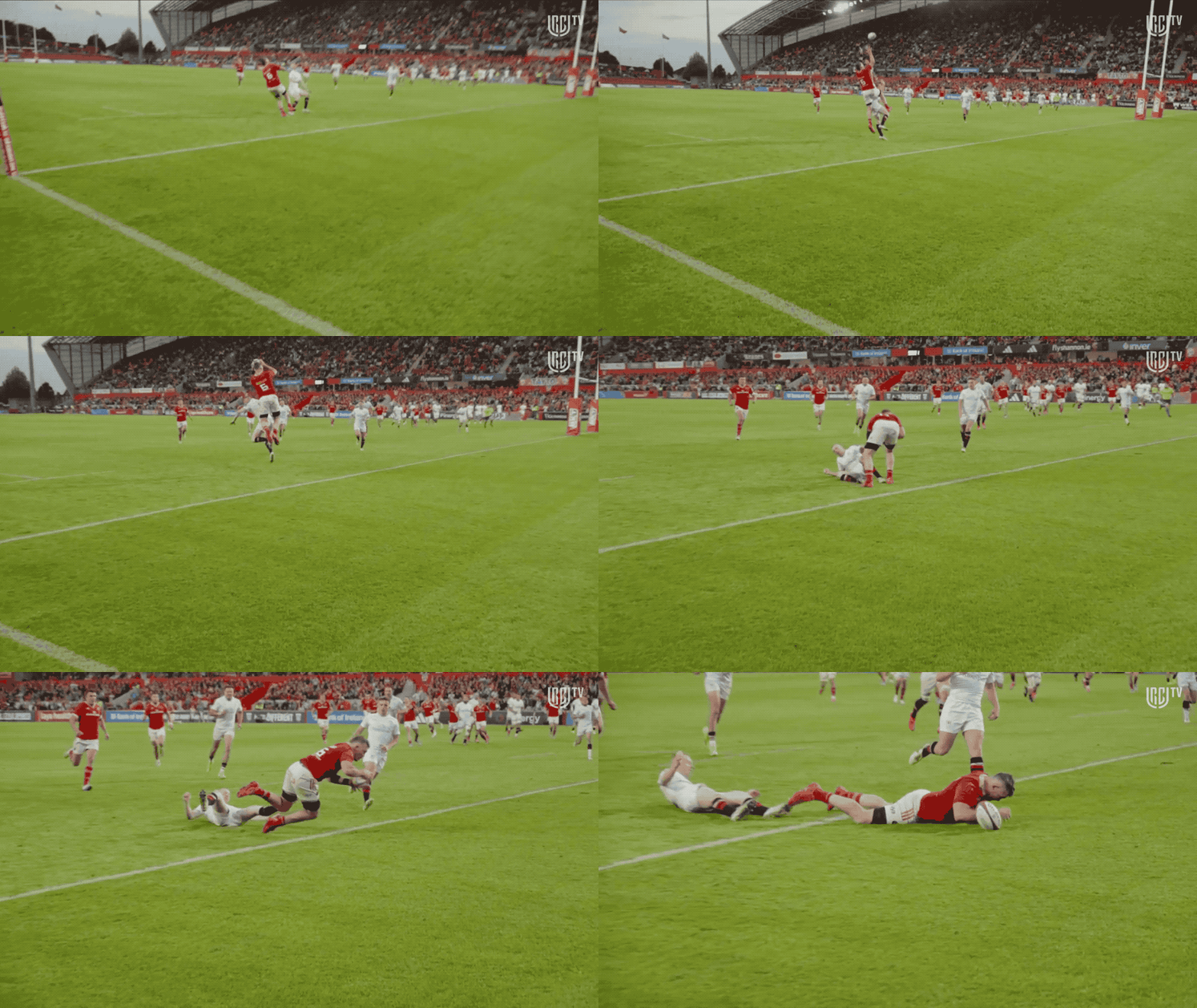
When the Thomond Park crowd realised – hang on, is that O’Mahony hugging the touchline?? He might get this! – as Crowley’s kick stood up invitingly over Nathan Doak, you could feel the electricity running through the stadium.
When O’Mahony took the ball and jammed it down, dropped the hammer, it was a volume I’ve only heard very few times in Thomond Park. I was up, shouting and roaring. So was everyone else.
It was a big moment, and that’s what he does.
A few moments later, O’Mahony’s name was called and he left the Thomond Park pitch as a player for the last time. I stood up in my seat and applauded the man. He’s the first all-time great that I’ve covered for pretty much most of their career, and to see this guy walk off the pitch where he’s done so much to keep the Munster show on the road during the 2010s and into the 2020s, it felt like something big. Something I’ll remember. And I think everyone there who rose to their feet to see this great man of Munster Rugby off will remember it too.
A warrior. A leader.
A wargod.
With at least one more battle to come before the fighting stops.
