All pro sports have their trends, a bit like life. I spend a lot of time looking at graphic trends because I have a weird interest in album cover design. I peruse this stuff in my spare time, such as it is. I won’t hit you with the “oh, I have a two-year-old, I don’t have spare time” stuff because look, she sleeps for two hours a day. I just sit around when she does that. When you look at album cover design, you see visual trends emerging, submerging and reemerging.
For example, in the last two or three years, there was a real trend towards 90s style fonts, visual effects and layouts because that 90s “vibe” was very current. The 90s magazine scan texture I use on this website is part of that because I built the visual identity for TRK when that style was beginning to show up on mixtapes and album covers. I always want TRK to look a year ahead of visual trends.
At the moment, that ’90s trend has kind of morphed into a Y2K vibe where visual maximalism seems to have hit home with the Gen Z and Gen Alpha people as they head into their late teens and early 20s. If you don’t keep up with the new stuff, you get left behind.
Rugby is going the same way. All pro sports are. You’ve probably heard of Moneyball – or seen the film, at least – but you’ll be tangentially aware of the changes that have happened when it comes to training and preparing elite soccer teams in the last few years. I love basketball, so stuff like flat spacing, the mid-post revival and advanced screening moves like the Varejão Screen find their way to my YouTube home page when I’m eating lunch more often than not.
The conversations in a professional rugby team meeting have never been further removed from how the game is discussed on TV and, as a result, how most of the public sees it.
So in this upcoming series, I wanted to discuss some of the ways that I see the game and, after discussing it with multiple analysts currently working in the game, how the game might be looked at in a few years from now. As an example, I’ve been speaking about positionless rugby for a while now through the medium of player roles, rather than strictly looking at the numbers on their backs or the outdated idea of what a “blindside”, “openside”, “#8” or “lock” should do outside of the set piece.
Will Skelton and Tadhg Beirne are both locks, but play such different roles in the game that I can’t say that they play the same position. That, to me, doesn’t explain anything about what they do. They are both locks; they both scrummage in the second row in most of the games they play, but that’s where the similarities end.
I suppose my real aim is clarity. How can I get what’s in my head into your head through the medium of what you read and see on this web page? This is the same problem that coaches and analysts have: how do we get theory into eyeballs, into brains and then into moving bodies? How do we create understanding?

For me, I have to start with a visual. I struggle to properly get things unless they are made very simple and broken down into component pieces, so I can understand what the process to completion is supposed to be. This can be as complex as building a website or data visualisation, or data concept, or as simple as being asked to pick up a surprise from the shop.
“Well, is it a chocolate surprise or a Tayto surprise?”
And if it is a Tayto surprise, are you thinking regular flavours – cheese and onion, salt and vinegar – or something in the more unusual flavours like Johnny Onion Rings, Monster Munch, Bikers (we have Bikers in Rathkeale, I’ve never seen them anywhere else) or Hula Hoops? If I don’t have that clarity, I can get stuck for ten minutes or more trying to make a choice.
I need clarity and a route to understanding what I’m meant to do. Rugby players are the same.
You can have the fanciest, highest concept rugby strategy in the world, but if you can’t break it down into something that 50 players can understand like they do the route from their bedroom to their bathroom and execute that understanding in between car crash impacts for 80 minutes, you won’t get anywhere with it.
Simplicity is king, understanding is God, but so is knowing that, to slightly butcher Jean Paul Sartre, “In rugby, everything is complicated by the presence of the opposite team.”
***
So tactical approaches, game states, “what do I here” all come down to how well you can illustrate them to your players. Once they understand your concepts, you can begin to move forward and start thinking about the actual games against real life opponents.
This season at Munster, I’ve been quite taken with trying to understand why our results – and individual performances – have fluctuated so wildly. I had this article mostly written, but then I came across this article by Jonathan Wilson on Substack titled Nobody Knows Anything.
It resonated with me so much that I had to reference this segment, but please read the whole article, as it’s genuinely a superb and insightful piece of writing. Wilson provides an example of how a player can thrive in one context but suffer badly in another and how this illustrates that large segments of the sport of football, to which rugby is analogous in a lot of ways, are unknowable, even with all the data and context we currently have access to.
Take, for instance, the Ipswich full-back Leif Davis. Last season, as Ipswich were promoted, he was one of the best players in the Championship, registering a record-breaking 18 assists and scoring twice. This season, even before Sunday’s red card against Arsenal, he has been a liability. It’s not hard to understand why. Last season Ipswich averaged 53% possession, this season 40.5%. Last season Davis was both a useful asset when Ipswich had the ball as a surging option on the left and a key figure when they broke. He proved himself a very fine attacking left-back. This season, as Ipswich have been forced to defend far more, his shortcomings in that area have been exposed. This is the Trent Alexander-Arnold dilemma, but at a weaker club; Davis would probably be a very useful attacking left-back for a stronger side, but after promotion, he became the wrong left-back for a team battling relegation.
A player is doing incredibly well with one game state, but then, when that game state is inverted, they struggle to stay in control of their qualities. It reminds me a little of Munster’s issues in the front five; it’s not that they aren’t good players, it’s that there’s very little that can be done to play around what they aren’t good at, without wildly distorting other aspects of our play style.
One constant issue that presents itself is that Munster probably need to have two Jean Kleyn sized locks in the second row of our pack build to compensate for the relative lack of weight and power in our front row, but that has a knock-on effect in that it moves arguably our best back five player – Tadhg Beirne int0 a different zone of the field going on our usual play style.
But the key point is, we don’t have that other lock, at least not fully fit anyway, so we have to adjust players to fit our structure.
So, what is our structure?
Let’s forget about forward shapes for a second because they just tell you where forwards tend to show up more often than not. It’s far more instructive to look at the zones of the field that Munster most often hit so far this season. To do that, we need to break up the field into radiating zones based on ruck position. All of these zones change and morph with the position of the ruck, but for clarity’s sake, I’m going to keep it at the left-to-right flow that we see here.
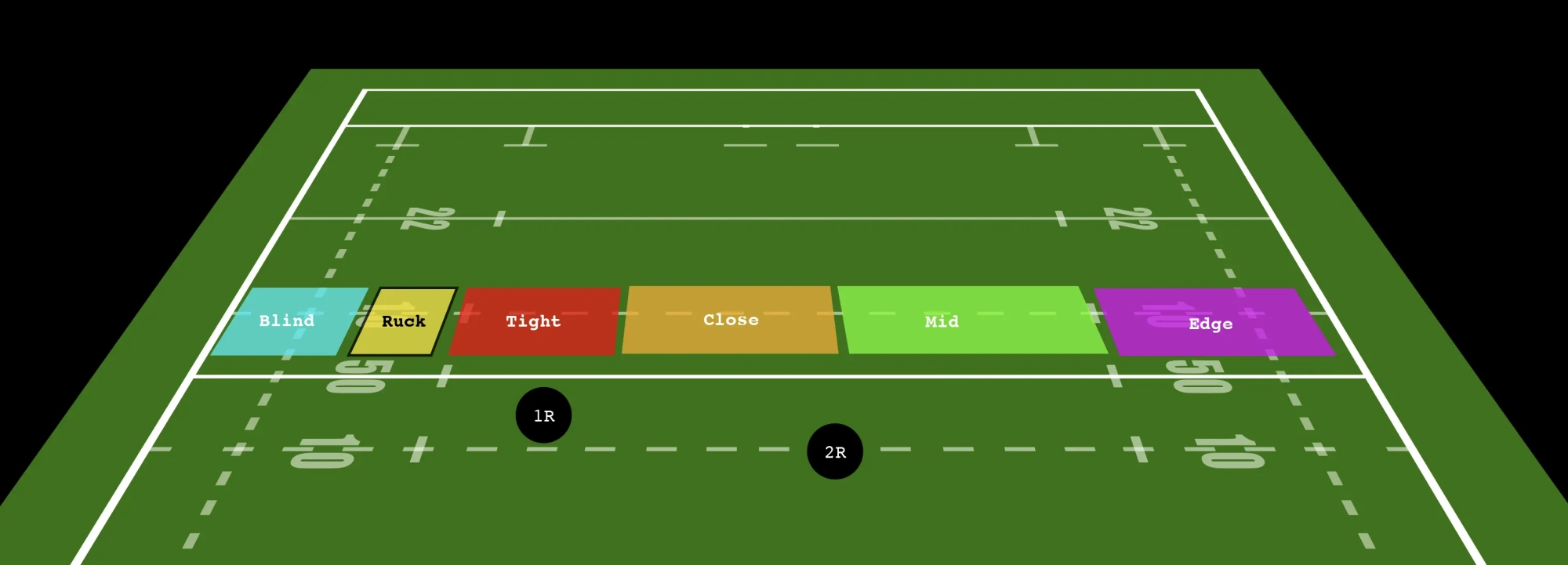
The black circles there represent First and Second Receivers. I haven’t included these as “flyhalf” or “#12” because they don’t strictly have to be any of those things, and in most systems, the players in those spots can be quite fluid based on their skillsets.
When we look at where Munster have played into these zones, we start to see a trend emerging. We aren’t particularly notable for hitting one particular zone over another, but where we are notable is how much ball we move beyond the first receiver and how much of that ball gets moved beyond the second receiver.
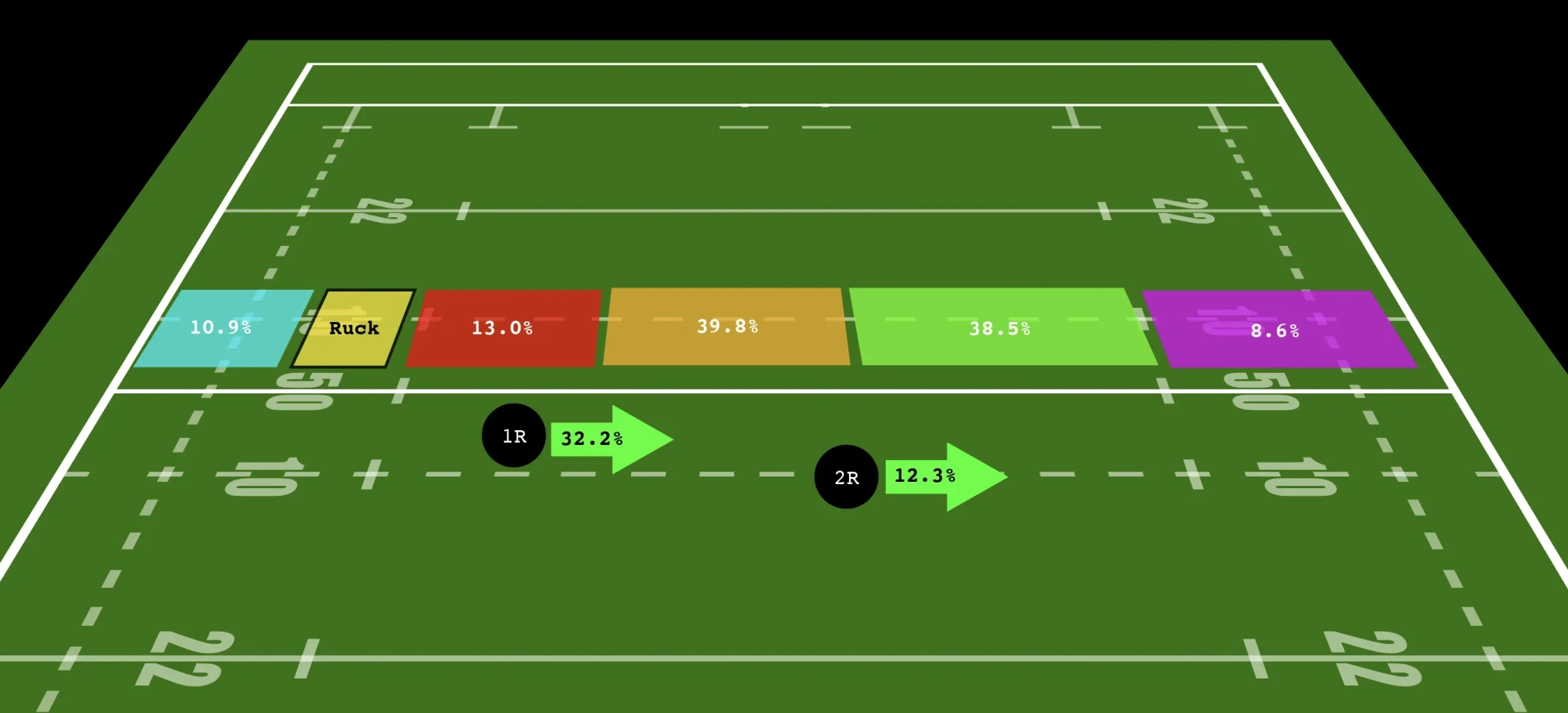
Munster are top five in the entire club game world wide for balls played beyond first receiver this season, top #10 for balls played beyond the second receiver and third in the world for attempted passes per game on average.
So what does this tell you?
We like to hold the ball, we like to heavily involve our backs as handlers, and we also focus a lot of possession into the 3/4 Space.
See, I finally got there, 1500 words in.
This space is the most valuable attacking zone in the game at the moment when it comes to longer range phase play and even close range sequences. Why? It’s the intersection between the last defending forward, the first defending backs and has a massive slope off the side of it between your last defending back in the primary line and the backfield defenders in the secondary.
All of our possession maps flow to this space.
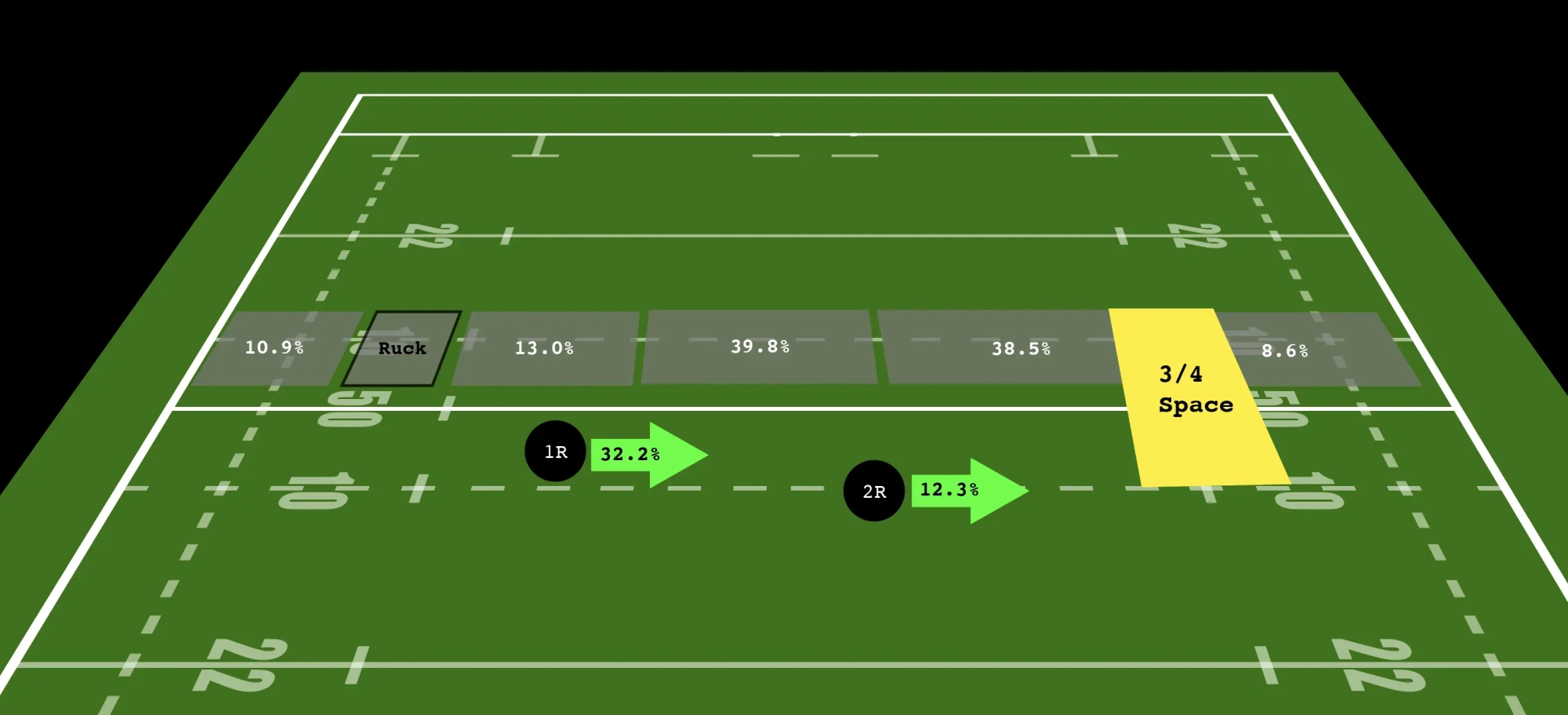
This scans with a few other metrics that show up in the data.
For example, did you know that Munster’s Tom Farrell is the only outside back in the world this season to make the top #10 for ball carries into contact, and only one other – Josua Tuisova – cracks the top #20? Farrell is also the sixth in the world when it comes to total ball carries, with the only other back in the top #10 being Zebre Parma’s Prisciantelli.
Nobody has beaten more defenders in the URC so far this season than Tom Farrell, who has played almost every single minute of Munster’s campaign so far. He is also top ten for metres gained and is the only non-back-three player in that ranking as far back as #19. He is joint first for successful offloads in the URC with RG Snyman. He is joint second for try involvements in the URC so far this season with 10.
Tom Farrell was not producing these numbers last season for Connacht. All it took was a change in environment and a change in playing structure to produce performances and metrics that stack up with the best midfielders in the club game. What are these changes? More possession flowing his way, the nexus of Munster’s passing network focusing on a zone of the field he operates in and a style that maximises involvement in that area of the field by design.
We played poorly against the Bulls last weekend, but you can still see the build towards that 3/4 space on this post-transition sequence.
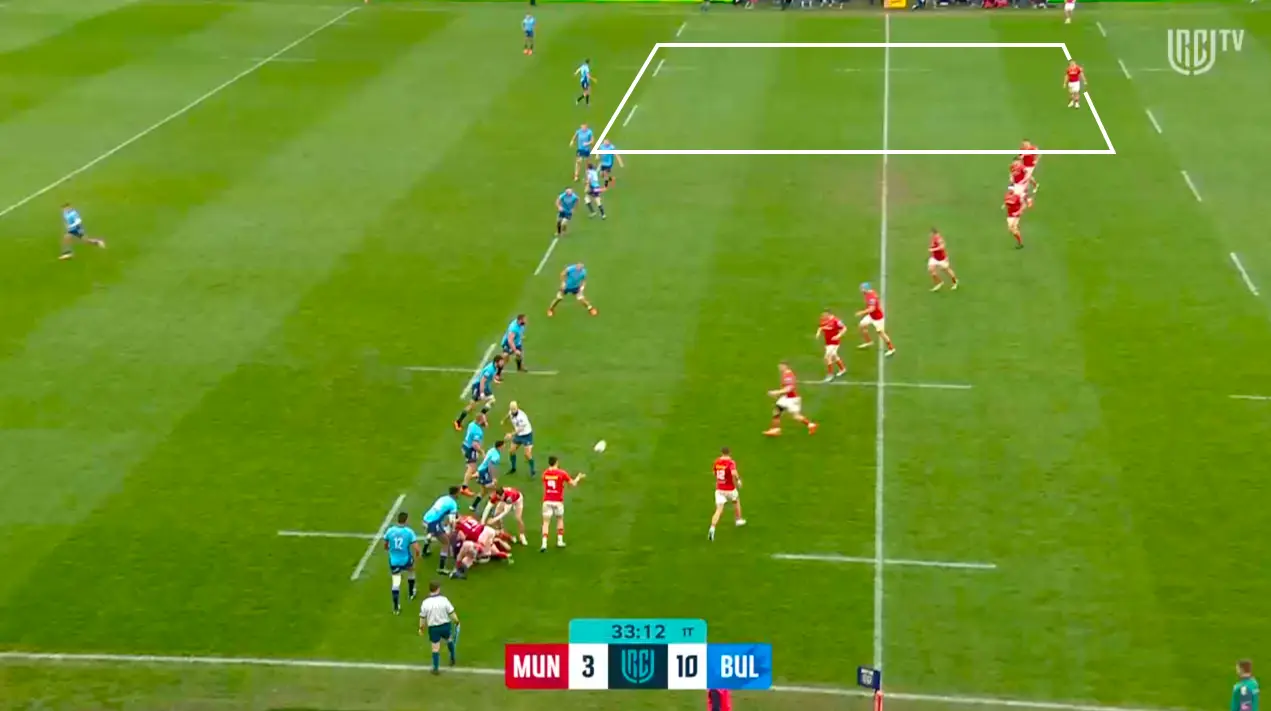
Farrell is involved in the ruck at the bottom of this screengrab as the ball leaves Murray’s hands. Munster hit that close/middle zone sweet spot with the carry, and that opens up Farrell to attack in that 3/4 space as the Bulls struggle to fold around and get their wingers and cover players from the backfield into the primary line.
Murray’s pass to Crowley is objectively terrible, but even with the readjustment from Crowley, once that pass hits Farrell the 3/4 space – I call it this because it’s approximately 3/4 of the way across the pitch from the wider initial ruck – it’s like a gap opens up in front of him.
This is where most of Farrell’s offloading happens – he beats the defender, moves deeper into that 3/4 space, and that’s when Munster’s wingers and halfbacks swarm into the pocket looking for that finishing ball. Watch Munster throughout this season and you’ll see Farrell taking the ball in that very zone.
This isn’t just the zone that an outside centre would typically get the ball either. After all, there are plenty of other outside centres playing in, frankly, better teams than Munster right now who don’t have this kind of production because their system is not built to move the ball to that space with regularity.
In that last example against Glasgow, you see the full concept working as planned – the ball moves from the first receivers hands to the second, and then onto Farrell. When he takes the ball he’s quite deep relative to the 3/4 space, but he is able to read and attack Glasgow’s scramble.
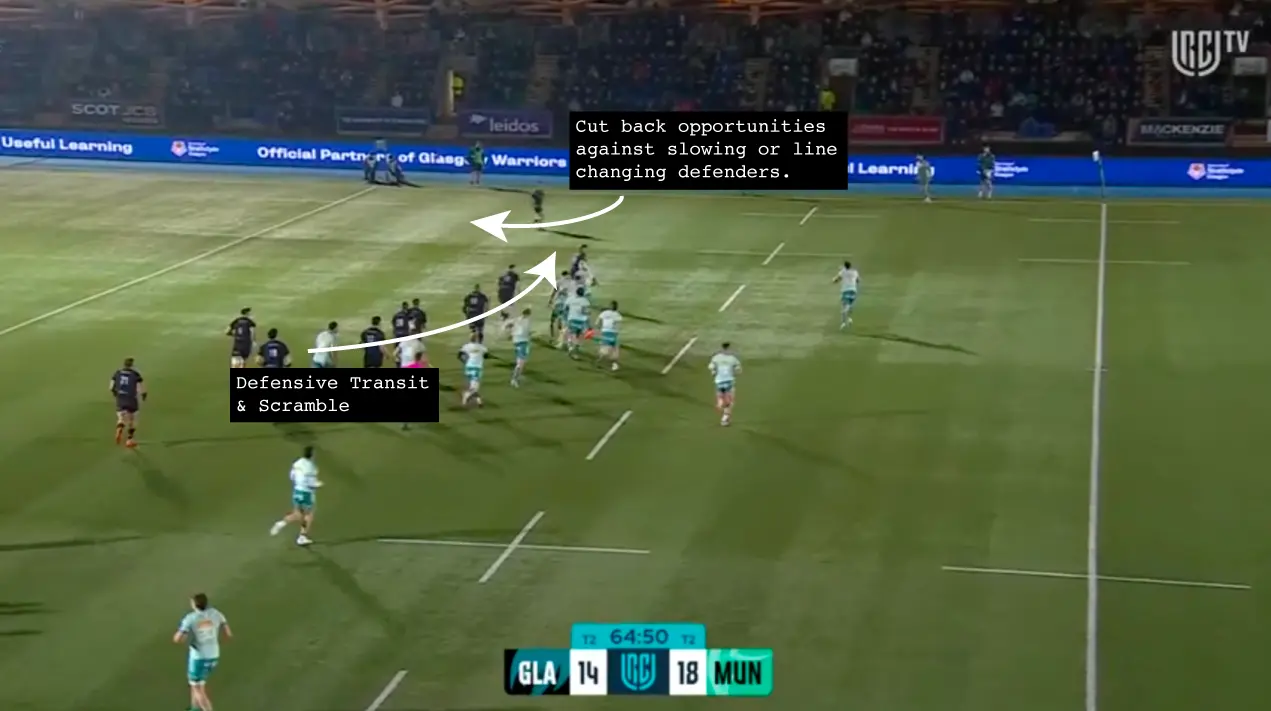
In short, he knows they’re coming across the field to cover him, but he also knows that means there will be line break opportunities coming against the grain as defenders try to chase a gap and then stop, slow and change direction.
It is a system designed to chase this spot – it was initially built to put Antoine Frisch into this very zone – finding the exact right player to operate in it. Antoine Frisch has not found the same success at Toulon for the same reason; their system is not built to get him the ball in this particular zone at the volume he needs.
You can’t just put any midfielder or fullback into this zone either; it’s about finding someone with the right qualities to take advantage of it. It’s not about size and power in the way you might look at other roles. Farrell is a pretty big guy but I wouldn’t describe him as a power runner or as being particularly quick. His expertise in this spot is almost all down to his #10 like playing instincts and his ability to not give away changes in direction until really late, as well being a versatile offloader.
In the next part of this series, I’ll be looking at what other player in the Munster squad is almost perfectly suited to this hybrid playmaking role in this structure.