


I have a few stock phrases that I find myself returning to repeatedly, to the point of cliche. My favourite one in the last few years has been “it is what it is”. That’s a total cliche in 2025, but you know what? Sometimes it really is what it is. It’s not like the insidious Hakuna Matata, which means that sometimes bad things happen, and there’s nothing you can do about it, so don’t even try. I’ve watched The Lion King too many times, and I’m at the stage where I’m about to describe Timon and Pumbaa as pernicious nihilists and are, in fact, the real villains of the movie. It is what it is recognises that bad things have happened, that nobody is to blame per se, but that what happens next is to be decided. I’ve used it a lot with Munster Rugby in the last ten years.
My next favourite stock phrase is “two things can be true at once”.
That reflects directly on this loss to the Bulls. On the one hand, Munster were underpowered, inaccurate and lacked accuracy at the core fundamentals of the game against a side that will punish you when you bring those qualities to a match. That is true.
It is also true that this was one of the worst officiated games you’ll ever see, by an officiating crew that was so out of their depth that they should be stood down for the rest of the season. Not only were Munster improperly reduced to 14 men because of an error by Piardi on-field, but it took the officials on the sideline – MAR referees – 20 minutes to realise it and inform Piardi that he’d made an error.
For this to happen once in a season, in Croke Park against Leinster back in October, is bad enough; for it to happen twice in one season is unforgivable. Tappe Henning will apologise to Munster – again – for another officiating screwup, which Munster will file with all the others in the folder marked “worthless”.
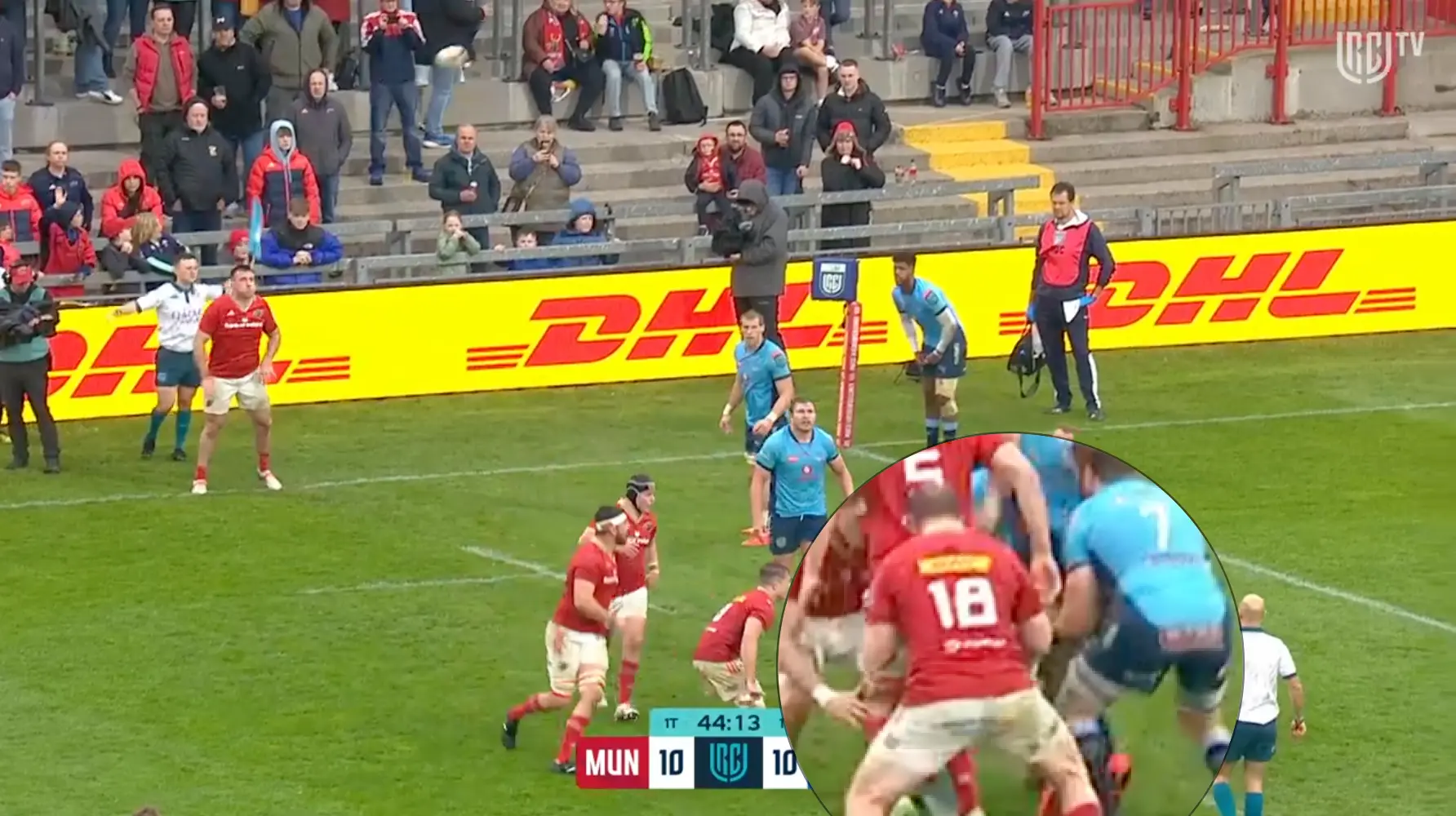
Even outside that, when you have this from Piardi on the key score of the game – the Bulls try. What can you do with a referee who see’s Hanekom knee the ball with his own eyes, less than a metre in front of him – it’s a scrum to Munster as this is technically a knock-on as you can only take a quick tap free kick by kicking the ball with your foot or shin – only to invent a reality where Hanekom kicked the ball with his foot when questioned?
If he’s willing to just make stuff up like this, without his AR or TMO stepping in to advise him any different, how can anyone trust him to referee any game of importance ever again?
But I can’t write an article about refereeing blunders. Could Munster have won if this were 15 vs 15 for the full 80? Maybe. But even then, the key issues that hurt us in this game would still have been there.
A disrupted season took its toll; we appeared weary, lacking energy, and displayed poor basic skills at the set piece.
None of that changes, even if the catastrophic officiating in this game was slightly less catastrophic.
So what’s the main issue? We look like a team without a clear identity. That’s a very nebulous statement, I know, but I mean by it: while we clearly have a playing philosophy that we try to adhere to, you’re never quite sure what you’ll get from this team.
Some of that is down to the players in the stands rather than on the grass, both in general this season and for this game, specifically. Some of it is down to our attacking philosophy being consistently undermined by a lack of power across the 80 minutes that often requires immense passing complexity to work around. Put simply, we can’t stand and bang with a pack that’s physically bigger than us if we don’t have a relatively dry track to play on and a relatively dry ball to work with.
You’ve seen this a million times over the last three seasons.
When we’re up against a pack that’s bigger and stronger than us in the aggregate, and we’re playing on a heavy pitch with a greasy ball, you know exactly how that game will go if the opposition has their head screwed on. We’ve seen it over and over again. Kick to contest, hem us in, dominate us in the close phases and wait for a kick back. Sooner or later, we tend to give up “weak” penalties like getting caught for not rolling away or over-chasing a steal.
When those teams get a decent set-piece position from those penalties, we always look like conceding. This manifests itself in the data. We don’t tend to concede tries from range – we have the lowest number of 22 entries allowed in the world in club rugby this season – but once that ball finds position inside our 22, nobody in the world bar Moana Pasifika in Super Rugby Pacific concedes a try at a higher rate. We concede only 6.6 22 entries per game on average, but concede a try on just over half of those entries.
That tells me that our defensive structure and scramble are really good, but once the game becomes about winning collisions in tight, we drop off.
Even offensively, we know well that with a heavy pitch and a wet ball, we end up forcing passes to laggy runners who can’t get separation from their cover defenders, balls get dropped, or runners get hammered.
That becomes an even bigger problem when you realise that we play approximately half of our games in Limerick and Cork during the winter, when, if you’re not playing in a yellow weather warning, you’re slogging away on a heavy surface in some flavour of wind and wet. This will only manifest itself in a few games a season against Leinster, a fully loaded Bulls/Sharks team, any kind of French team and maybe one or two Premiership teams. But if we come up against those sides on anything close to a heavy track or with anything less than our absolute first choice 23, you know what usually happens.
We try to play a possession-tinged game of rugby but with an underpowered front five for 90% of the season. On a (1) dry track on a (2) dry day with a (3) full-strength 23 and (4) everyone playing well – a lot of provisos there – we will tangle with anyone. If any of those four steps are missing, you’re liable to get anything from this group, despite their usual best efforts.
We have a lot of good players who are quite obviously working their guts out, but who somehow end up as less than the sum of their parts way too often. Our lineout was a disaster against UBB, so we come into this game with an obvious target on our backs and motivation to get it right in an important game. This is where we showcase what our identity is; what we feel is acceptable.
We ran at 73%, which would be sub-elite in Division 1A of the AIL. The lads knew that heat would be coming from the Bulls, but they couldn’t react. There are reasons for that, of course. But people are sick to death of reasons.
Our stand-in forward coach, who we brought in after parting ways with Andi Kyriacou, has had to go back to the Irish Women’s squad for most of the last month. Which means that we’ve had Tommy O’Donnell covering the lineout as best he can, with the senior players needing to take on a bigger role week to week. O’Donnell is just making his way as a coach and is giving us a dig out by stepping up like this.
But is that our identity? Context? Fellas looking frustrated with themselves after another lost collision, another blown lineout? It is what it is? Something needs to change. It will change in the summer, but it needs to be changed now. That won’t magic up a few more 120kg bruisers out of nowhere, of course, or get the guys injured un-injured – but this club was founded on nailing the basics, and whoever is running the lineout between the guys filling in for the fill-in and the senior players, it isn’t good enough.
We knew – or should have known – that the Bulls would try to duplicate what Petti did so well against us in Bordeaux. When they did exactly that, we couldn’t live with the pressure.
Look at Weise at the front with a one-man lifter – Wessels – as a counter-pod. They were going on our throw trigger, so all the pointless complexity before the throw was a waste of energy. A cut-out decoy at the front by Kendellen that isn’t fooling anyone for long enough to force a lift – because it’s the prop he’s trying to fool, not Weise.
When we do throw it in, Scannell’s release is wildly crooked coming out of the hand. Even a referee who sees phantom kicks can see this. Niall Scannell’s entire game is based around set-piece solidity. It’s his big strength as a hooker.
How does this happen on one of our first 22 entries of the game when we’re 10-3 down? It happens. Yeah, sure, but why does it keep happening to us?
On the exit, we got another lineout but blew it… differently. Wycherley and O’Donoghue couldn’t launch Kleyn straight up into the air; they started drifting towards the Bull’s side with him. That meant Kleyn’s pass to Murray was off, which meant that every subsequent action came under pressure.
But even if Wycherley and O’Donoghue were able to control Kleyn in the air, the scheme was always going to blow up because it relied on three Munster forwards “blocking” five possible defensive chargers from the Bulls. Our lift was inaccurate, which threw off Murray. All of this is unforced.
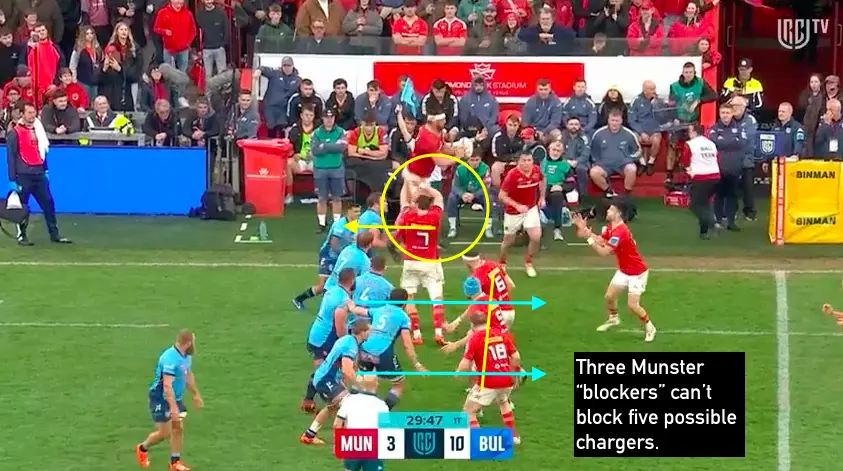
Beirne and Archer just about stopped Nortje, but that left Hanekom with a straight run onto Kendellen, who just about held onto possession under immense pressure.
Another example of making life hard for ourselves. The one that really stood out for me was in the direct aftermath of the Bulls getting a yellow card. Let’s have a look at it. The game is 10-10 at this stage and a try here would definitely swing momentum in our favour. The key here is efficiency and, essentially, getting the Bulls players to start thinking about the hotel bed.
It’s a 5m lineout and the perfect time to nail a driving maul. First things first – the call from Beirne to hit the tail is incredibly ambitious in these conditions, given what we’ve seen to this point. Let’s look at the who thing first and then deconstruct it.
The throw seems fine to me, so we can move on from that.
To really get the structure, we can go back to the Red Eye for this game and look at how the Bulls defend these lineouts. They have one lock patrolling the front and one guarding the opposition tail jumper with a prop as a hinge lifter in the middle.
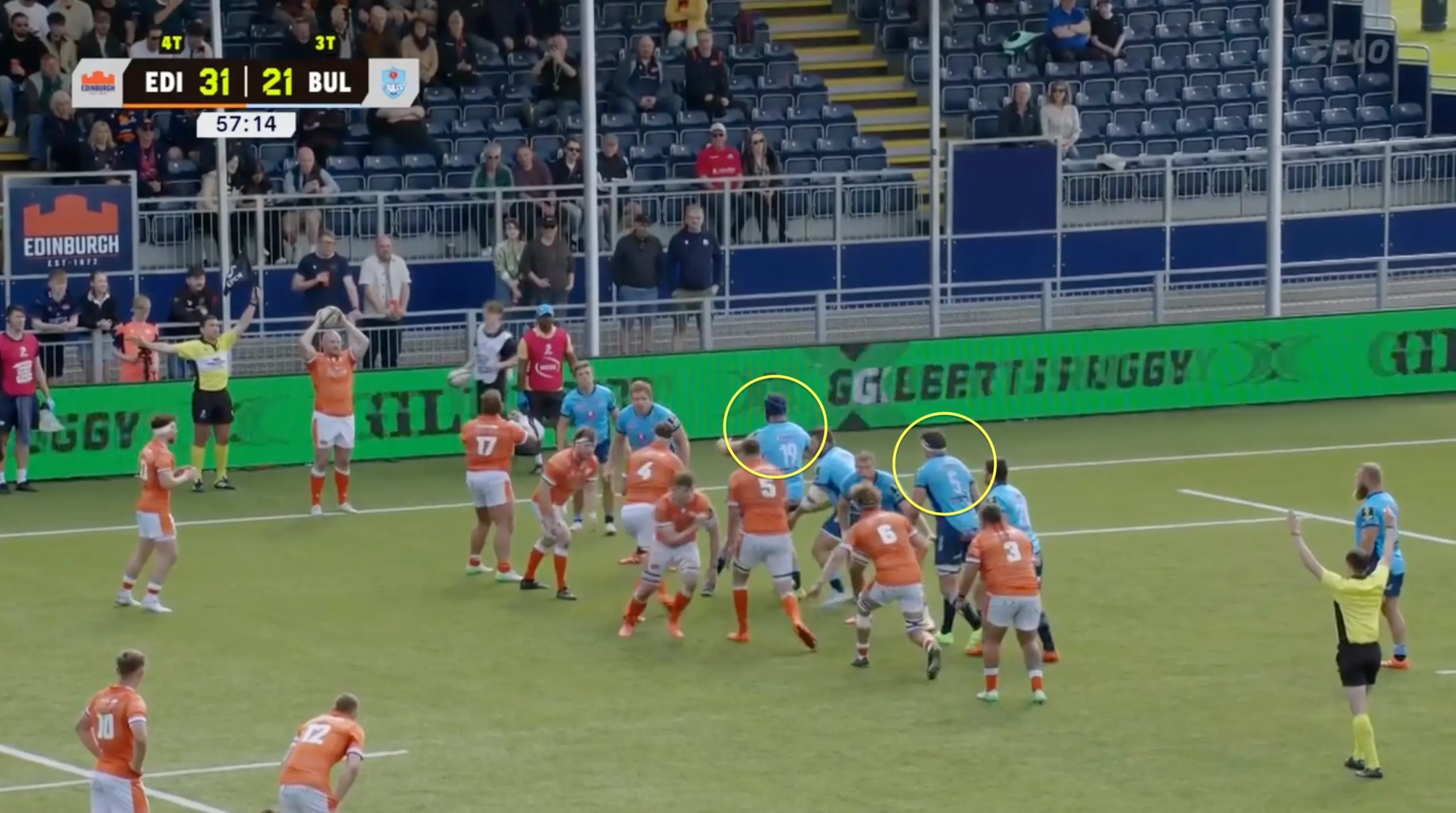
Their defensive structure on this lineout is mostly identical, with Weise at the front, Louw as the hinge and Nortje essentially marking Beirne at the tail.
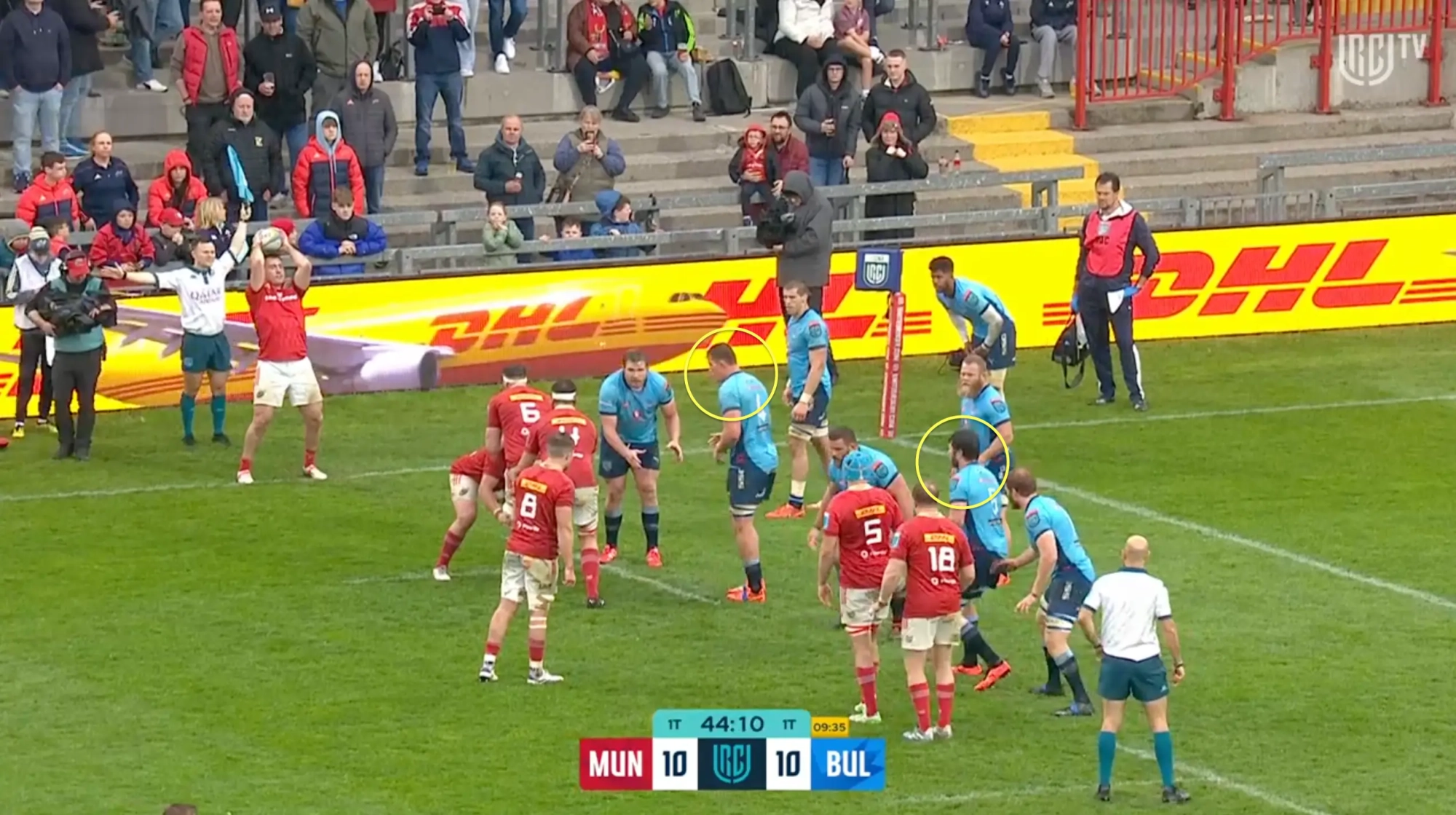
First off, the throw to Beirne here has to be spot on so right away, Beirne is turning this into a lower percentage completion just with where he’s called for the ball to be. Second, look at how many steps back he takes to get into position relative to Nortje.
Remember, as the ball is thrown, Nortje and Beirne are even; Beirne immediately moves to where Nortje is starting from to beat him to the mark. Beirne is, essentially, saying “I know you’re marking me, so start your mark here and I’ll beat you to the launch”.
But Beirne takes five steps backwards and jumps on his sixth step. Nortje takes four back and jumps on his fifth. Archer was in position to lift on four steps back, but I think he planted a little too far back for Beirne’s liking. Beirne didn’t feel him there when he got back to the spot, so he readjusted.
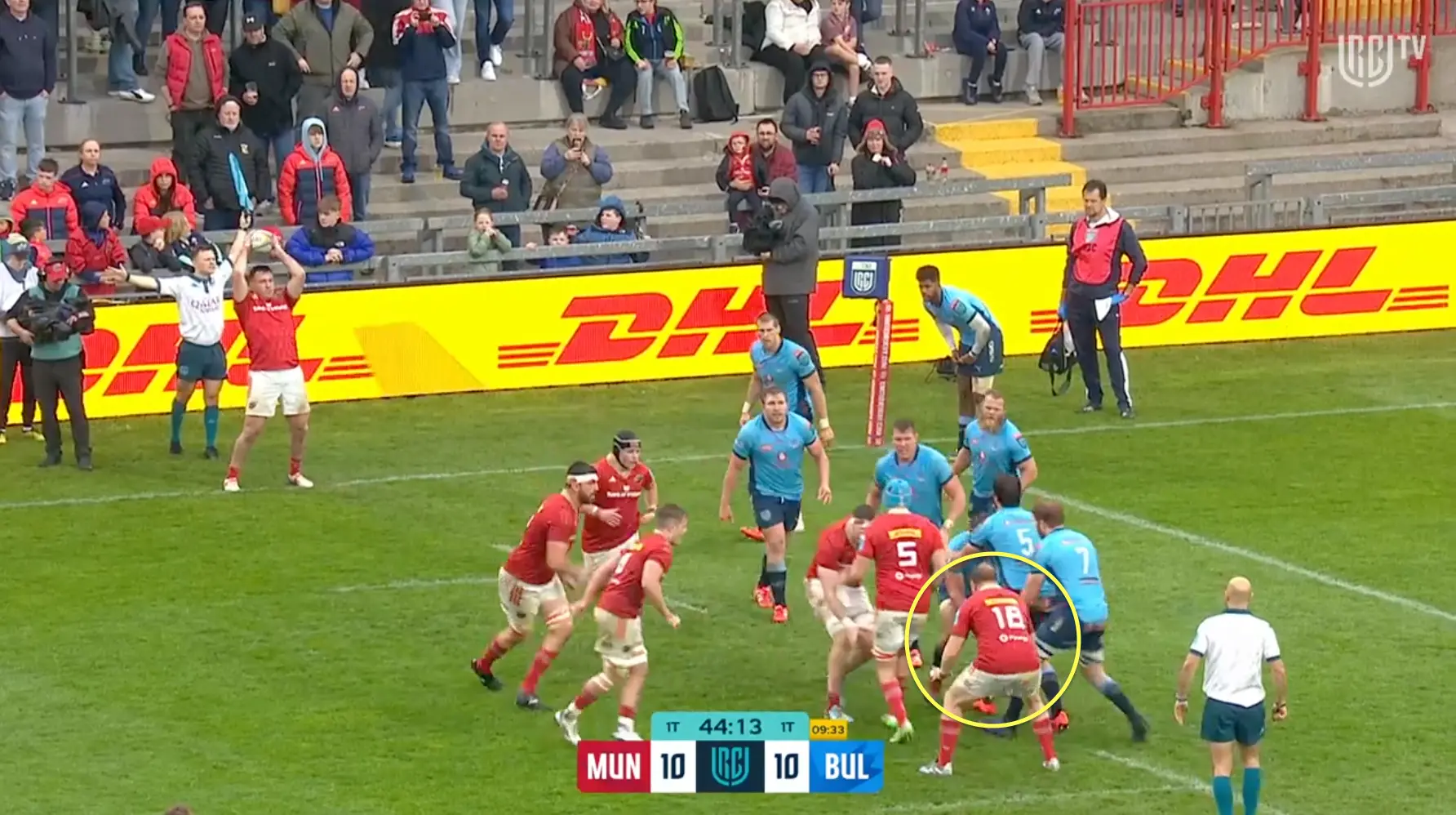
This meant that Beirne took that extra, awkward step back that saw him bunch into Archer, which took almost all the power out of the back lift, which meant Nortje got into the air first, stronger and cleaner, which meant he got to the throw window as if this was a well executed Bulls lineout.
You can see here – Archer has no sink into this lift so the scheme is pretty much busted before Beirne leaves the ground.
The Bulls played a kick to pass ratio of just 1.8 in this game, which means that they kicked the ball almost as much as they passed it. They had just 69 rucks all game. UBB had just 56 a week earlier and had a similarly low pass to kick ratio.
What does this tell us? That the Bulls fancied their chances of beating us up playing off-ball rugby and that with the right pressure at the lineout, that we would struggle to get any sort of platform to hurt them. When the heavy mist and rain landed two days prior and throughout the game, it grew more and more effective. They just needed to kick and wait. We needed one, two, three, four passes to work in sequence to get a breakthrough. As the mist grew heavier, the pitch got heavier, and the ball got greasier – we know what happens next. Hanekom and Coetzee combined for 51 tackles just between the two of them as we narrowed our forward patterns, but the accuracy wasn’t there.
Here’s a lineout we took at the front but (1) Murray’s pass to Crowley is behind him, which means Crowley has to check his line to take it. This means that (2) Nankivell takes the ball standing still and gets smashed behind the gainline as a result, which means (3) Murray’s designed pass to hit Beirne to catch the Bulls over fold has to be inch perfect and it isn’t.
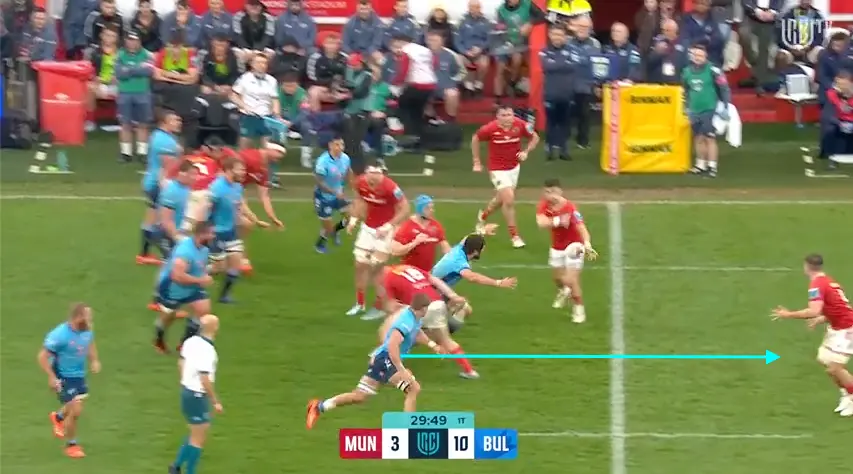
When the Bulls were on a yellow card, we had a perfect opportunity to hit them on a kick transition with a post-transition sequence. It all went well until O’Donoghue takes the pass and tries to run an inside swivel to Farrell but flings an absolute dud of a pass that the #13 does well to hold on to.
But Farrell’s scramble to control that wet ball means that he himself ends up throwing an even worse dud that could have ended up under our own posts. Inaccurate. Overly complex. But we needed that because we were getting mostly ate alive in contact.
That’s the thing with this team; when the weather hits in like this, the fact that we’ve too many wrenches and not enough hammers reveals itself constantly. This is a collision sport. Sometimes I feel like we’ve tried to reinvent the wheel a small bit to try to play around the reality that we don’t have enough guys who can big collisions against other big men in the middle of the field.
It’s wet. The ball is greasy. The Bulls are flying up. Let’s try to truck that ball. Yet, I suspect we sensed that plan was doomed. We barely won a collision all evening. Here’s one example, but I could have stitched 10 or more here. I’ll save you the bandwidth and myself the space on the server
Hanekom and Coetzee stopping us dead on the line on contact. It’s very hard to win a game like this when we could not mitigate our lack of power relative to the Bulls with a wider attacking structure – because of a heady woe cocktail of our own poor passing, our inability to win two collisions in a row and the heavy weather conditions – or with a functioning set piece when it counted.
I feel like we’re probably three tight collision winners in the pack away from allowing some of our “wrenches” to show how technically proficient and good they are. Without them, we just go backwards against any team with elite size if prevailing conditions mean we can’t play around them. Whatever road you take around it, I keep coming back to the same problem; tight five, tight five, tight five.
It’s time to find a few hammers.
| Players | Rating |
|---|---|
| 1. Josh Wycherley | ★★ |
| 2. Niall Scannell | ★ |
| 3. Oli Jager | N/A |
| 4. Jean Kleyn | ★★★ |
| 5. Tadhg Beirne | ★★ |
| 6. Tom Ahern | ★★★ |
| 7. Jack O'Donoghue | ★★ |
| 8. Alex Kendellen | ★★ |
| 9. Conor Murray | ★★ |
| 10. Jack Crowley | ★★ |
| 11. Andrew Smith | ★★ |
| 12. Alex Nankivell | ★★ |
| 13. Tom Farrell | ★★ |
| 14. Sean O'Brien | ★ |
| 15. Thaakir Abrahams | ★★★ |
| 16. Lee Barron | ★★★ |
| 17. Mark Donnolly | ★★ |
| 18. Stephen Archer | ★★ |
| 19. Fineen Wycherley | ★★★ |
| 20. Ruadhan Quinn | ★★★ |
| 21. Paddy Patterson | ★★★ |
| 22. Rory Scannell | ★★ |
| 23. Diarmuid Kilgallen | ★★★ |
