


Munster has always been the boogeyman for away knockout games in Europe.
We all know about home advantage, but is there such a thing as an “away” advantage? No. There is not. If you give any team a choice between playing at home or away from home, they will always pick the home tie.
So why are Munster so formidable on the road, both recently and historically? I can’t explain it. Munster’s travelling fans play a part, of course; they can make even the most intimidating stadia sound a bit like Thomond Park with enough time to pilfer tickets.
But it’s not just that. Take that run to the URC title in 2022/23. You’ll rarely see anything like it again. Scotstoun, Aviva Stadium, Cape Town Stadium, with the first two on back-to-back weeks.
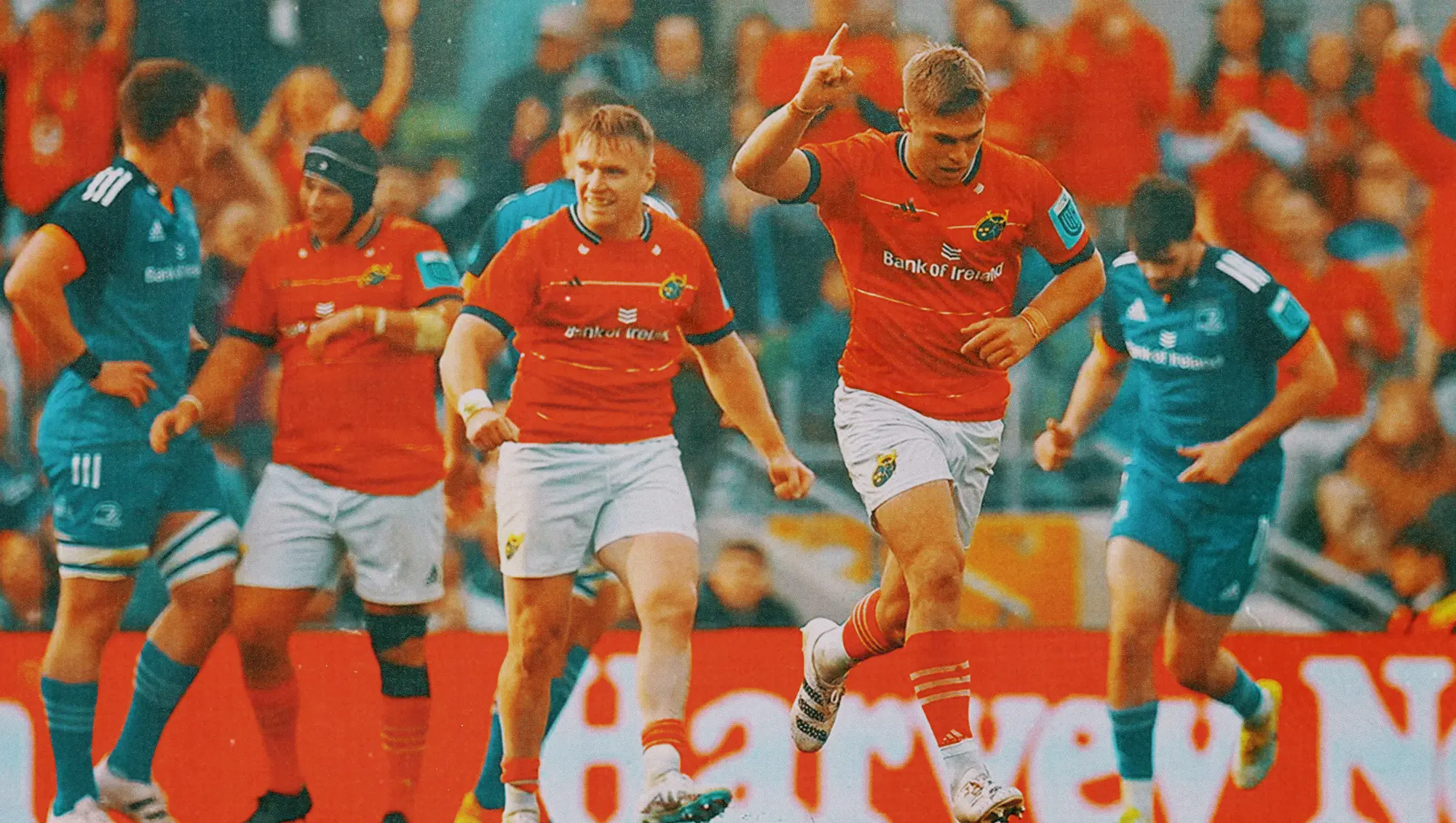
Even then, go back through your history and you’ll find as many famous away days as you will big days out in Thomond Park, especially in the European Cup. If anything, the away days last a little longer. Maybe it’s the sun, the sunburn, the holiday pints (which always go down nicer) all coupled with a big win against the odds. It hits a little different because those wins – especially in France – are harder to achieve.
The first one on that list happened in this very stadium – Stade Chaban-Delmas, Bordeaux. Munster, just two seasons after getting 60 points dropped on us by Toulouse, beat le Rouge et Noir in a European Cup semi-final.
In 2000/01, we won back-to-back knock-out games in Paris and Béziers.
Including last week against La Rochelle, Munster have won ten European Cup knockout games away from home. To put that into context, Toulouse have won seven, with their last one coming against us in 2022, the last time we reached this level.
Can Union Bordeaux Bègles be #11?
It’ll be a very difficult ask. They have been performing superbly for the last two seasons – this season, in particular – and have invested heavily in the last three seasons to bring success to these uniquely merged clubs of Stade Bordelais and CA Béglais. I would argue that their flop performance against Toulouse in last year’s TOP14 final was one of the worst pressure performances I’ve ever seen, and it’s not one easily memory-holed if you were part of that squad. On the one hand, it’s a motivation, something they experienced as a group and won’t let happen again. On the other hand, it’s something that Europe’s boogeyman will want to show them is more than possible once again, especially when that same boogeyman is there with nothing to lose.
That dichotomy between undeniable talent, attacking firepower and an odd skittishness plays a part in the identity of what Union Bordeaux Bègles have become in this ascendant era of theirs. They can be absolutely unplayable for ten minutes and then seem to lose interest as a collective for the next ten. Even this season in this very competition, they’ve often looked deeply ropey in stretches before catching fire in bursts to put the game out of reach.
Saying that, they haven’t really been pressed that hard so far. Not in Europe, anyway, and if Munster can get the squeeze on – and we’ll have to squeeze the right areas – there’s a route here that can trap this UBB side into a game they don’t like to play.
Munster Rugby: 15. Thaakir Abrahams; 14. Calvin Nash, 13. Tom Farrell, 12. Alex Nankivell, 11. Andrew Smith; 10. Jack Crowley, 9. Craig Casey; 1. Josh Wycherley, 2. Diarmuid Barron, 3. Oli Jager; 4. Jean Kleyn 5. Tadhg Beirne (c); 6. Peter O’Mahony, 7. John Hodnett, 8. Gavin Coombes
Replacements: 16. Niall Scannell, 17. Mark Donnelly, 18. Stephen Archer, 19. Fineen Wycherley, 20. Tom Ahern, 21. Conor Murray, 22. Sean O’Brien, 23. Alex Kendellen.
Union Bordeaux Bègles: 15. Jon Echegaray; 14. Damian Penaud, 13. Yoram Moefana, 12. Rohan Janse van Rensburg 11. Louis Bielle-Biarrey; 10. Matthieu Jalibert, 9. Maxime Lucu (c); 1. Jefferson Poirot, 2. Maxime Lamothe, 3. Ben Tameifuna; 4. Adam Coleman, 5. Cyril Cazeaux; 6. Mahamadou Diaby, 7. Guido Petti, 8. Pete Samu
Replacements: 16. Connor Sa, 17. Matis Perchaud, 18. Sipili Falatea, 19. Pierre Bochaton, 20. Marko Gazzotti, 21. Bastien Vergnes-Taillefer, 22. Yann Lesgourgues, 23. Pablo Uberti.
Union Bordeaux Bègles are the statistical inverse of La Rochelle, so our approach to playing them has to be inverted from what worked last week.
If the key to playing La Rochelle was kicking at a high frequency and in the middle-to-long distance to use their poor offensive transition as an entry point against them, the key to playing Union Bordeaux Bègles is to hold the ball for long sequences, bait their overly aggressive poaching game into conceding penalties and, when we do kick, that it’s in the short to mid-range where they can’t transition easily.
As with last week, this approach would not be without risk, but I feel we have to mitigate against where they are arguably the best team in Europe – on transition. The headline stat to notice here is that Union Bordeaux Bègles have the most tries scored on kick return amongst the TOP14 teams this season and are top five Europe wide in tries scored in the aftermath of a turnover.
What does this tell you?
If they score tries on transition, don’t kick to them. If they score tries on turnover, they must, then, be very aggressive in their defensive actions to force those turnovers, so hold the ball well, and there could be opportunities. When they score most of their tries on transition phase play, engage them in set-piece sequences that end with a kick being the logical option.
It won’t be easy, but the path is there.
We can play an on-ball game that can damage a very large UBB pack into a bit of deep water. It won’t be as simple as “moving around a big French pack” but they have gone extra heavy this week with the belief they can beat us up a little after last week’s exertions, plus what we’ve shown already this season when it comes to playing heavyweight opponents. Noel McNamara, in particular, would have referenced how we struggled against the Sharks in Durban, as well as how tricky we found Castres in the pools – so when I see Guido Petti in the back row to give UBB essentially a three-lock pack on-top of their super heavyweight front row, I think it’s notable.
They feel they can bully us physically, on either side of the ball, so they want that size to encourage us to… kick long. We can’t let them dictate that to us. If we can hold the ball well and bring our offloading game, in particular, to bear on this game we can hurt Union Bordeaux Bègles over and over again.
UBB give up an extraordinarily large number of 22 entries on average per game – similar to Zebre, Saracens and Stade Francais who we’ve already played this season – and this is in part due to the gappy alignments they often show opponents on multi-phase possessions.
Look at this around 30 minutes in against Ulster last weekend. Now you’ve got to win the ruck, of course, and they will 100% go after them to dictate numbers to resource, but with Casey’s passing width coupled with Crowley’s established running threat, I think we can manipulate their forward fold on multiphase sets if we can get our handling right in the forwards.
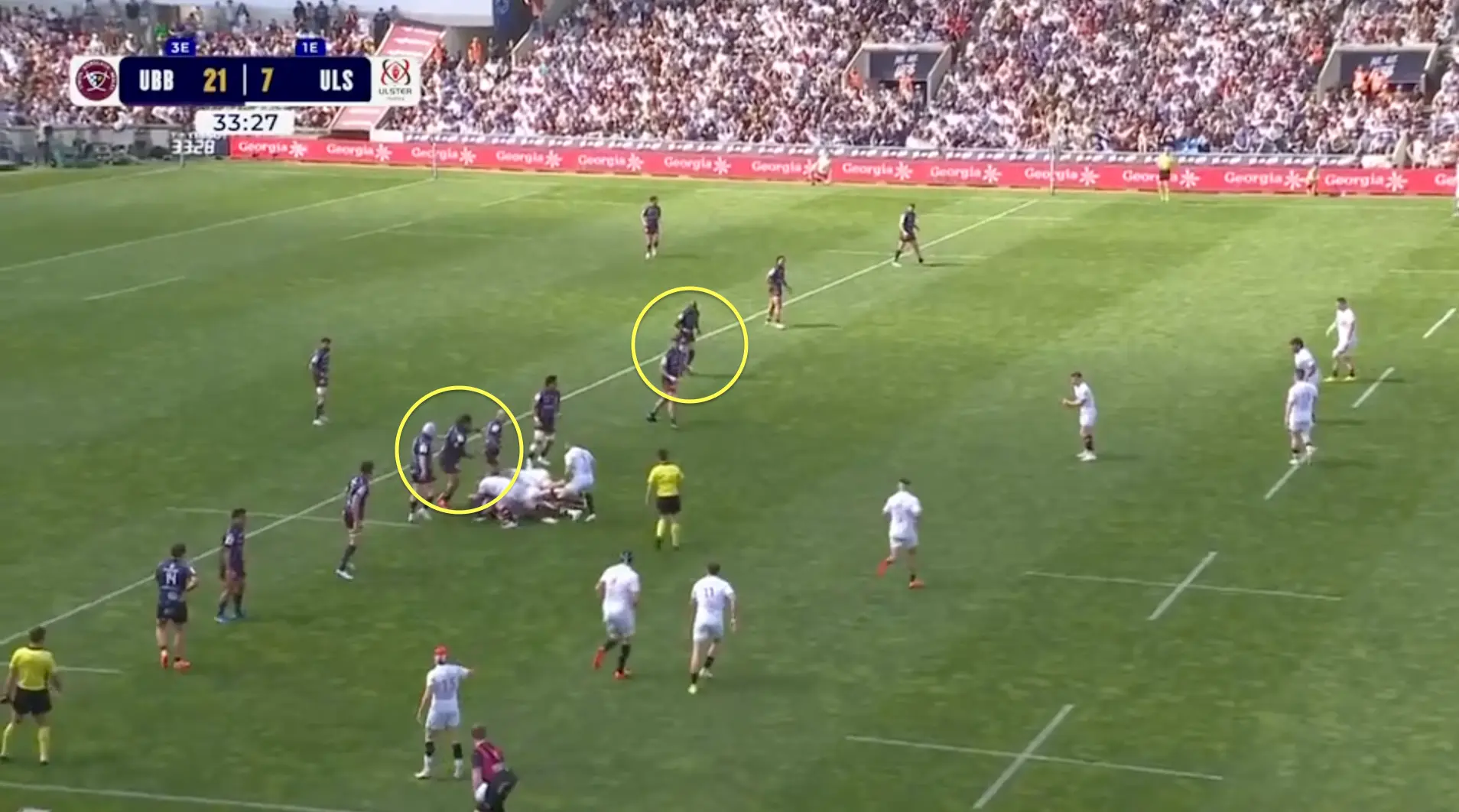
Can we get after them here? Can we force them to overwork Diaby, Samu and their midfield if we can get our mid-range and beyond passing game flowing?
When Ulster got width from the 15m tram, UBB dropped off and left huge spacing when that ball went 40+ metres across. Look at the buildup to Ulster’s second try here – what stands out as something that is (a) repeatable for Munster in this game and (b) something we can exploit?
For me, it’s how often UBB leaves guys like Coleman, Cyril Cazeaux, and Poirot defending the edge of that forward defensive line and how tight they have to sit around their tight and middle-line defence. They can’t afford to leave Coleman, Tameifuna, Poirot, or even Petti guarding any kind of lateral space because if we can establish a tip-on threat early, the threat to running through that heavy middle line is obvious.
You can see the compression here after Ward’s linebreak, but the concept is the same – they are worried about the direct carry through the heavier forwards, so compress around them. Ulster went quite deep here and still got a half break on the inside of the carry without anything too remarkable in the buildup.
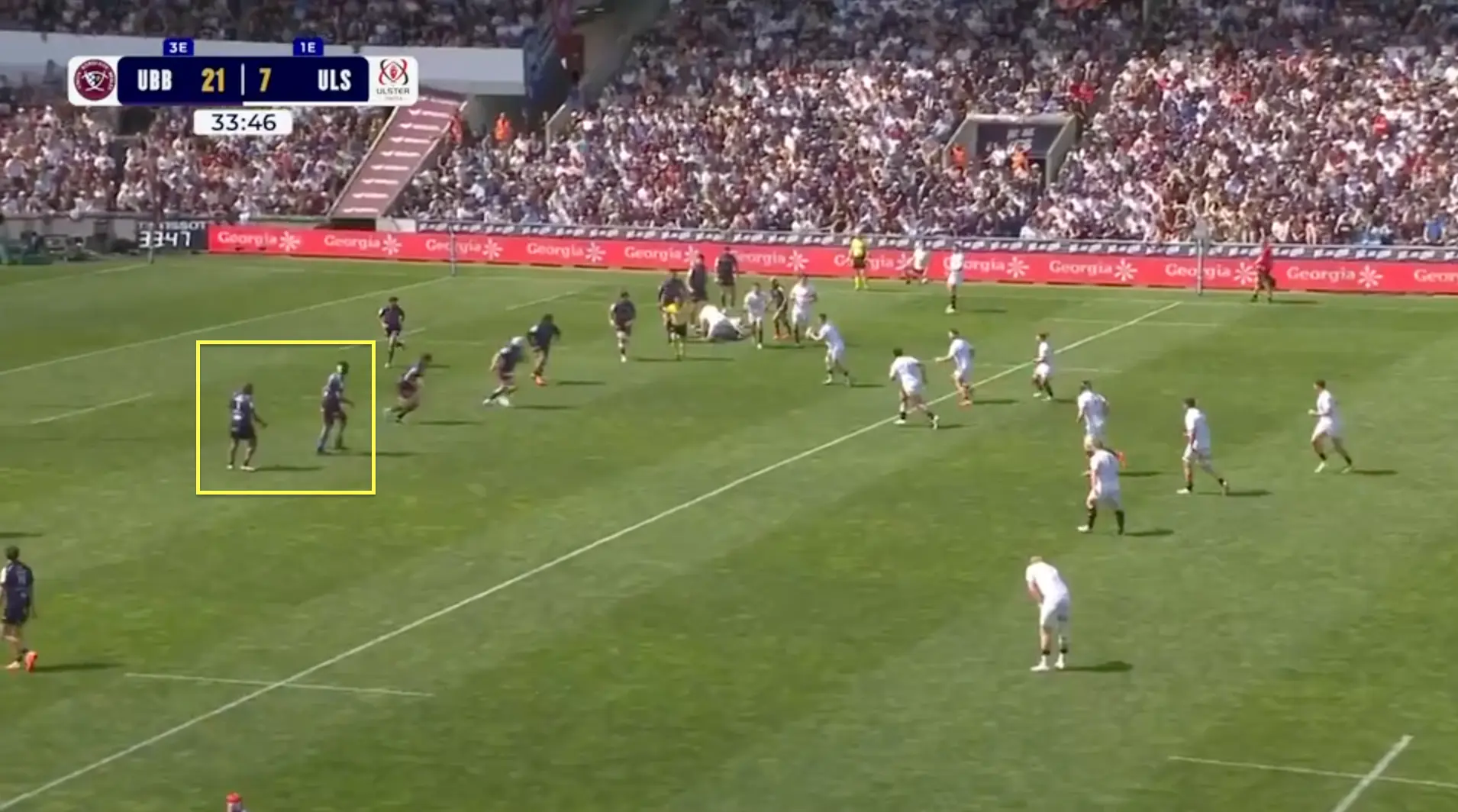
Ulster knocked on and came back on penalty, advantage, but look at the gaps that opened up after that half-break?
Tameifuna is walking through his fold, their hooker – another heavy hitter – is barely pillaring and a bunch of other lads are walking out the line.
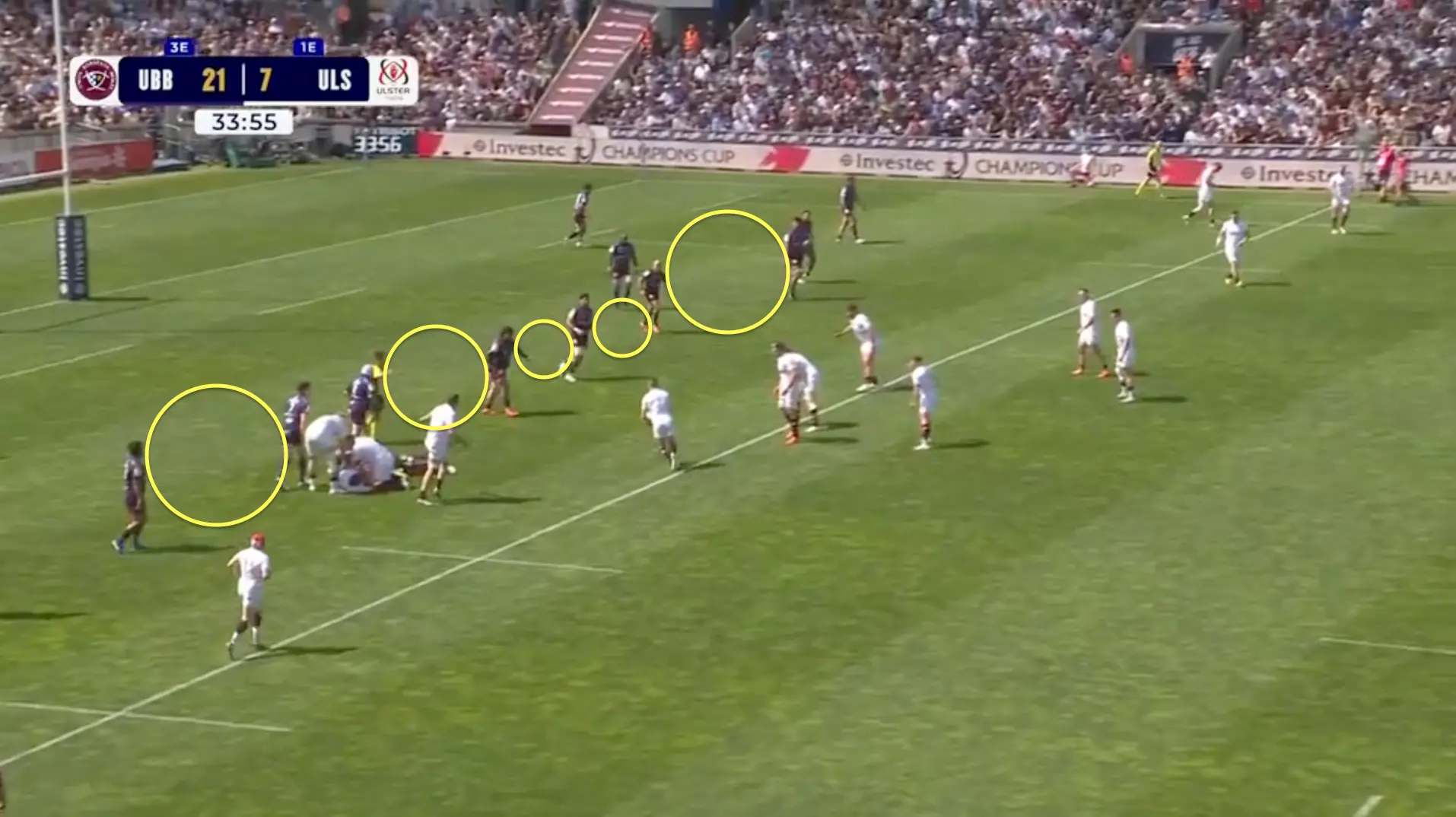
We can work with this.
Sure, they have heavy-hitting defenders and a bunch of guys who can force turnovers like Samu, Petti and both of their midfielders, but if you can bring them through lateral rucks, they always leave heavy forwards on the wrong side of the fold. This is another one late in the first half – when they will be more tired – but watch how narrow they get again and how a guy like Abrahams attacking that 3/4 space might be dangerous.
They use Lucu to cover up the gaps in that forward line, and that, for me, means we’ve got a chance cutting back against the grain if we can move the ball through a screen and into Crowley, Nankivell or Farrell here.
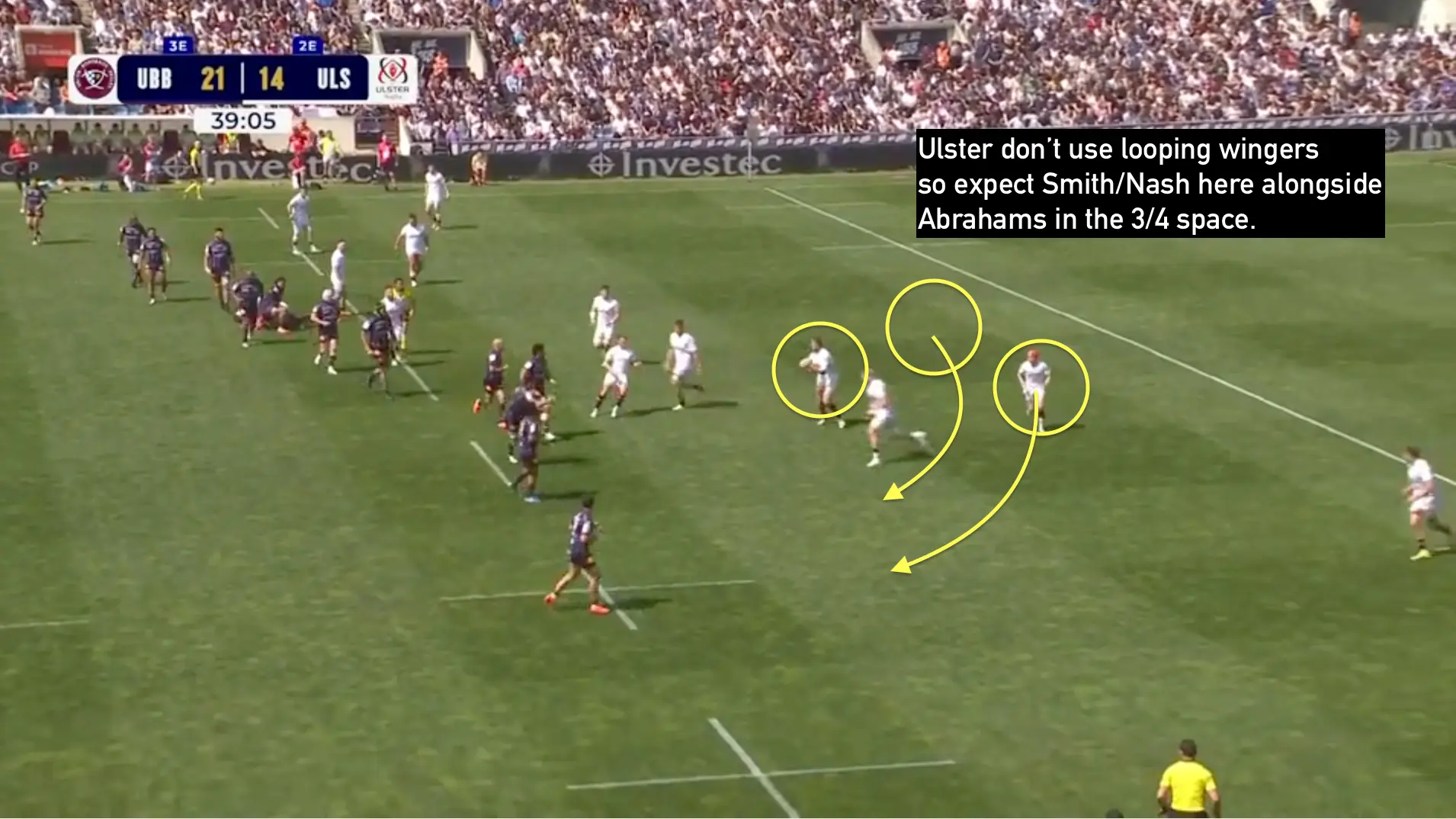
This can hurt UBB in a way they won’t really expect but we need to be brave, hold the ball well and when we do kick, for the love of god, either make touch or kick in a way where we can get transition defence in place. Take the extra ruck, set to box kick, and go from there.
Ulster had a great attacking position right before half-time in the clips above, but James Hume launched a dud kick upfield on a reset, and UBB scored directly on the transition and killed the game. That can’t happen here.
UBB will have been talking all week about how they are too big for us, too physical and they’re going to force us to play their game. They will believe it. They’re favourites, and rightly so, and are expected to win.
But Friday night as they go to bed, I know they’ll be thinking about the boogeyman at their window. The one that will show up in Bordeaux on Saturday with no fear and nothing to lose.
And they’ll think the four most dangerous words a French team can think before playing Munster at home in the European Cup.
“What if we’re next?”
