


We pride ourselves on being very smart in Irish Rugby.
That’s certainly how we’re seen from the outside anyway but it’s true on the inside too. Not just that we’re smart, but that we like to think we’re smart. Again, both of those are true and if you hang around the game in this country for long enough, you’ll experience it pretty quickly.
You don’t even need to do all that much, just listen for long enough.
“If you look at it statistically, they [South Africa, France, New Zealand] are probably heavier than us but we pride ourselves on being very very smart rugby players. If you look at all the teams around the world physically there’s this much of a difference [holds up thumb and index finger together]. We all do the same gym sessions, more or less. But it comes down to up here [taps temple] I’d be a big believer, we’d be big believers that you win the game up here. So we rely a lot on our smarts. We don’t just play the game… everything we do has a purpose, has a reason for it. And that’s why we think we’re better than all the other packs. For sure.”
– Ryan Baird speaking before the 2023 World Cup
It reminds me a little of when I was in secondary school and we did an IQ test in transition year, where I got a big score. A genius! So much so that I got a thing to write away to join MENSA! Wow. Very smart boy. I was so taken by this that I decided – in a particularly big-brained move – that I was so smart that I could take it easy in fifth and sixth year. Study? No, that’s for people who aren’t geniuses. I can just chill out.
How did I do in the leaving cert? What do you think?
Dropped an absolute dud. Blew it completely.
Why? Too stupid to realise that being smart only counts for so much in this life and that IQ is meaningless. It’s just a test you did well on once, dumbass. Falling in love with how smart you are rarely ends well.
In rugby, more so than anything else, you are most likely to uppercut yourself when you’re trying to pat yourself on the back.
“Rugby’s a physical game, it’s not chess. Fucking go play chess if you want to be so smart. Let them be smarter, but at least match us physically within the laws, man. Match us physically within the laws, we’ll be smart enough.”
– Rassie Erasmus
Ultimately, I think if we were as smart as we’d like to think, we might be asking about the very deliberate decision to move away from unstructured, transition rugby right when World Rugby is encouraging it at a meta-level through the law changes of the last year. We might ask why one of the top “structured transition” teams of the early 2020s has decided to move away from that game, right as the laws have supercharged it.
The results are clear – this Six Nations has seen the most tries scored in the history of the tournament. This is what World Rugby wants – tries. The last time we scored fewer tries was in 2021. Not only that, we’re beating fewer defenders, making fewer linebreaks, throwing fewer offloads to assist linebreaks and making fewer metres with the ball in hand than all our recent campaigns in this tournament.
Why is this? Because we have turned into a kick-pressure team.
We aren’t doing this version of kick pressure in the same way that the Springboks did or identically to how Leinster have done it under Nienaber – even with the dramatic statistical similarities – but make no mistake, the Irish rugby you knew from 2022 to the 2024 Six Nations is gone. Maybe we’re not as smart as we’d like to think.
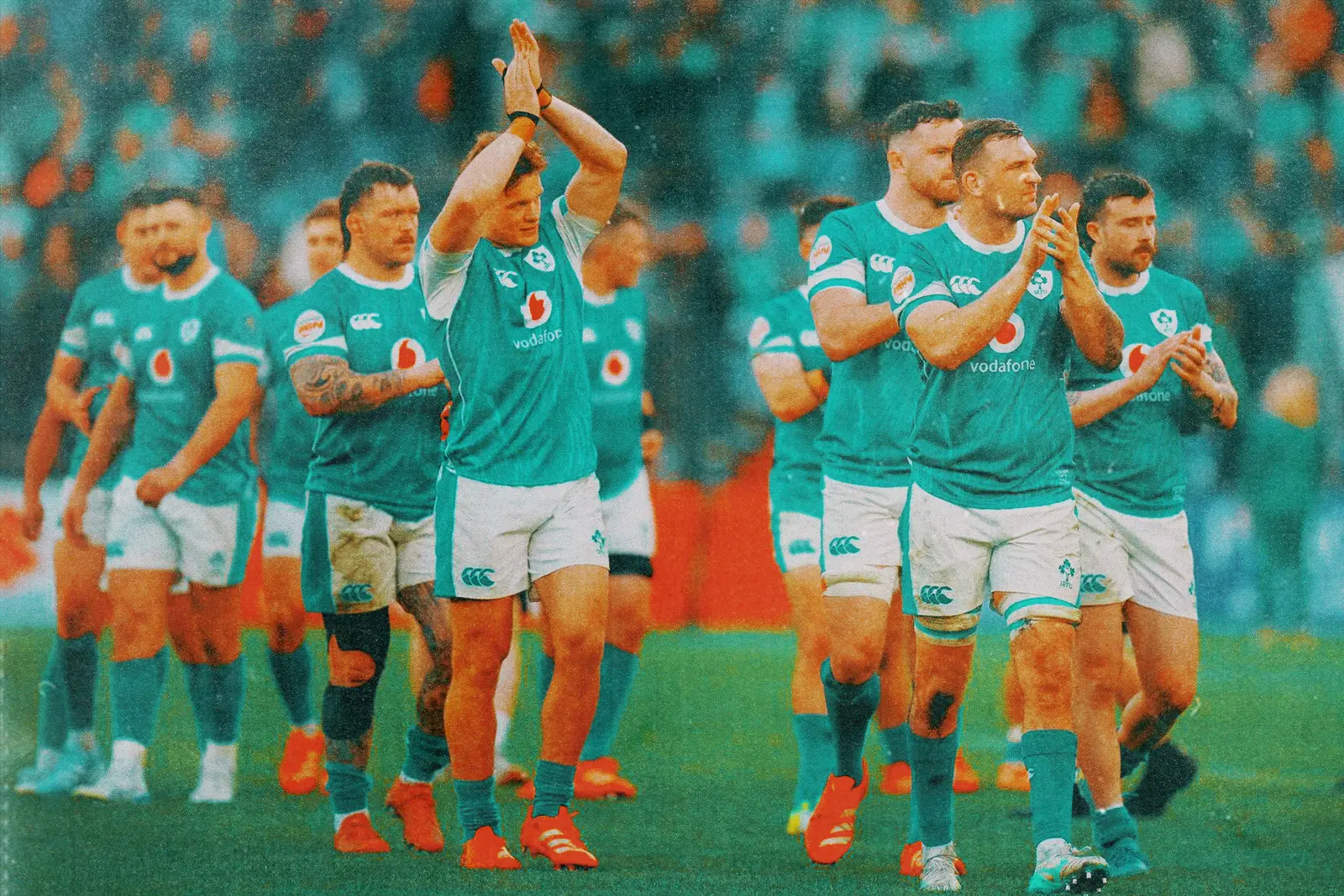
This win over Italy was, in one sense, meaningless. It was a box to be ticked. It’s easy to assign this to a hangover from the loss to France – and I do think there’s some merit to that – but this is a very motivated group with the kind of characters in it that don’t throw their hat at a game like this.
As much as we wouldn’t have deserved it, as honking as it would have been, we approached this game with the intent that if we won with a bonus point, we might win the Six Nations and make history. Again, nobody would care about the asterisk in five years. At a very basic, just looking at the scoreboard way, we achieved that aim. We got the win, got the bonus point, and that’s that.
But it doesn’t even tell half the story. We didn’t play well (again) and, with even slightly better discipline – they had one yellow card sin bin and two reds – it’s not outlandish to say that Italy could have won this. They certainly came close, even with that indiscipline.
Coming into the game, we would have known that Italy were going to kick to us a lot. This is the new way for teams to attack Ireland – and Leinster – so we’d better get used to seeing it. The logic is that Ireland’s primary goal on any transition phase is to revert the polarity of the kicking team.
Essentially, if Italy kick at us from one zone, we’ll retain the ball and, within a phase or two or directly, we’ll look to kick the ball to an empty zone in their backfield or aim for an isolated contenstable. We will then pressure that space with aggressive transition defenders and, in all likelihood, we’ll end up with a lineout platform in their half.
Watch these transition examples and you’ll see the principle
I’m not suggesting that we run every single one of these transition opportunities, but maybe we could be a little more expansive? On this example in the montage, almost our entire team is locked onto the ball side of the pitch, even when the pass travels approximately 11m out of the previous ruck.
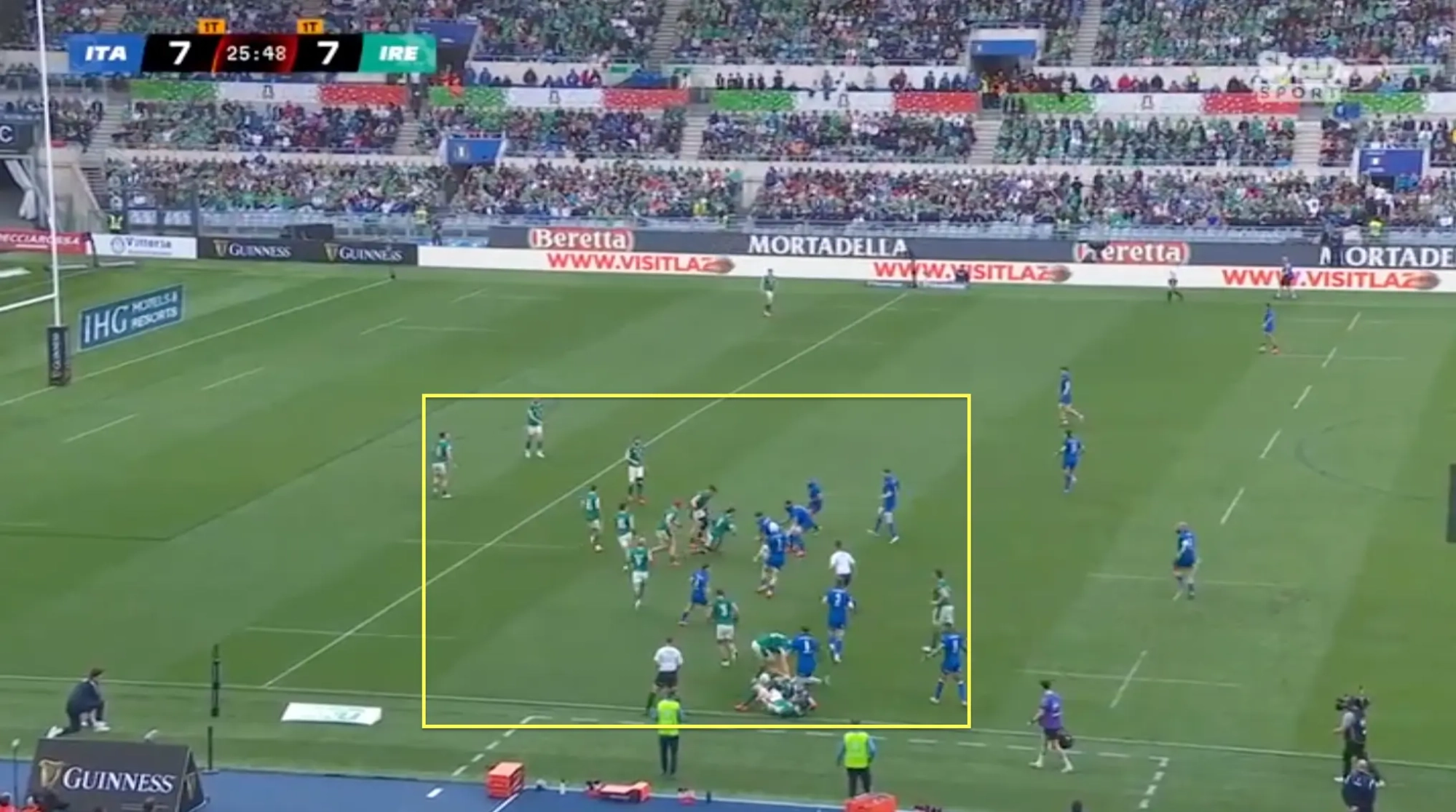
This is not the structure of a team who wants to punish an opposition kick – it’s one that looks to stay narrow, cut down on errors and then exit. Pressure over ambition. It’s not the worst approach in isolation, but we have to also see the context.
Teams are kicking to us more because they know that we don’t attack on transition in the same way that we used to. This creates an effect where they can almost use our kicking tendencies as transition launchers of their own.
As an example, what strikes you about this phase of play on transition?
It’s one of the few times we’ve run off a screen pass all tournament. Now, we blew the sequence with an obstruction call that looked more like a team who wasn’t used to playing phases this far out rather than trying to cheat a linebreak, but this was a two-phase strike play on transition with a linebreak that we haven’t really been creating.
These kinds of linebreaks on second and third phase post-transition were really from 2022-24.
This isn’t a Prendergast vs Crowley thing either, but I noticed that Hansen had more prominent involvements in the central areas of the field because of Crowley’s extra carrying and ruck involvements;
Prendergast doesn’t really get involved in those kinds of offensive actions – he almost never carries like Crowley did in this clip – so Hansen is rarely in position to rotate in first receiver or as a screen runner at the volume he did here.
But this is also part of the problem. While Crowley enhanced Hansen’s game, I think it’s clear that Jamison Gibson Park and Crowley are not on the same wavelength as half-back partners.
Here’s a good example;
You’ve probably seen it here too – that’s a very gappy looking inside fold from Italy and Ireland have more than enough runners waiting on a spatial overload to create a linebreak directly here. Crowley loves these blindside snipes, and it’s a constant feature of when Crowley plays with Gibson Park that a pass rarely, if ever, rewards the effort.
In fact, this arguably Gibson Park’s worst performance of the tournament so far, even allowing for his excellent assist on Sheehan’s try. This kind of uncertainty and recklessness with the ball in hand wasn’t really visible in the previous games.
The only sensible option here is to hit Crowley directly or that pod forming ahead of him, but instead he throws a blind pass to an Italian player.
Even the decisions on transition as I showed above seemed to be hurried and lacking in clarity. There’s no way Sheehan should be getting the ball here.
And that’s doubly true when you look at the structure outside him. I’m not sure he makes either of these passes with Prendergast on the field.
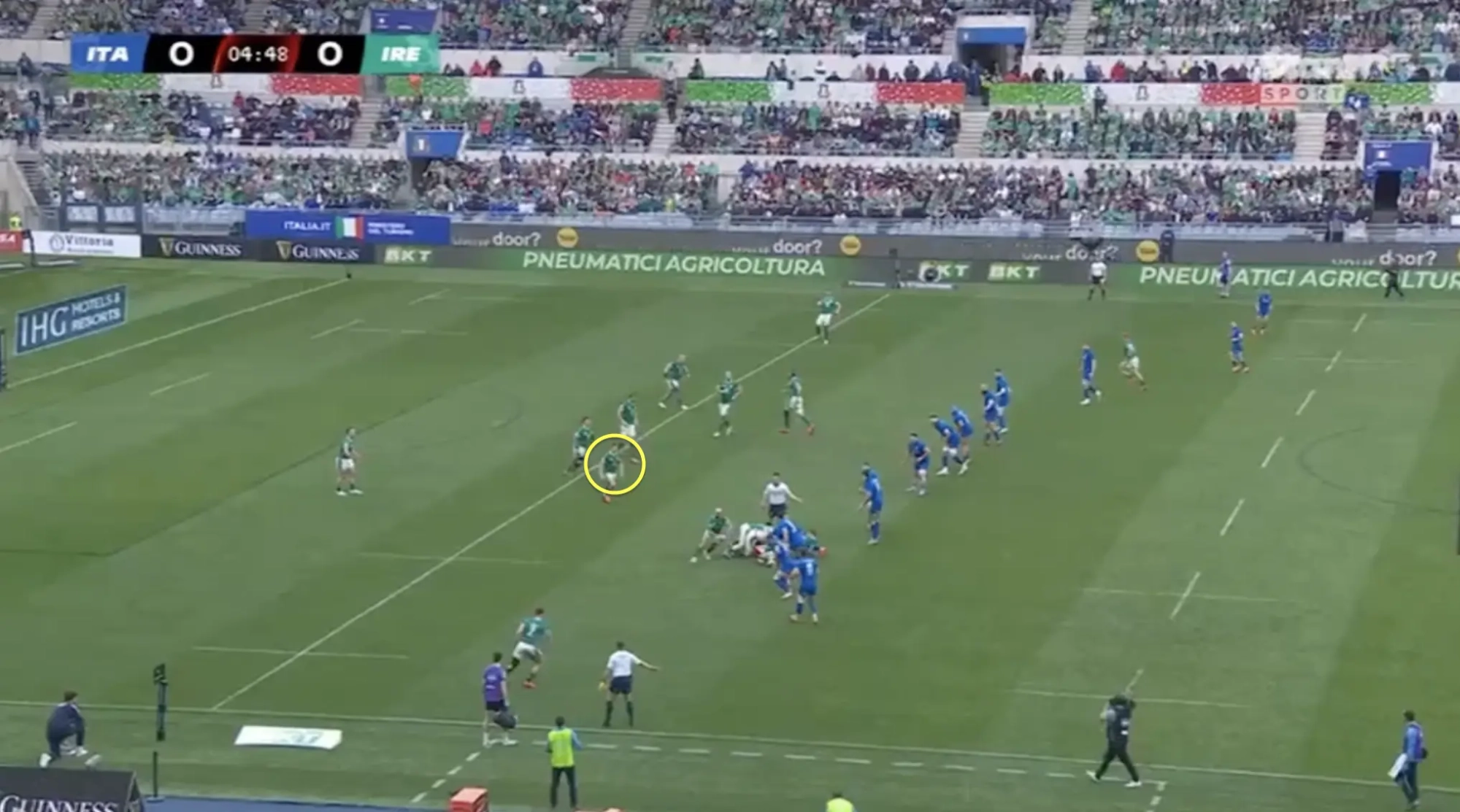
This isn’t about Gibson Park “sandbagging” Crowley, even if Crowley’s involvements were lower than Prendergast’s averages at #10. I think it’s more to do with Gibson Park trying to dominate the attacking focus of the team, as opposed to knowing that when he signals for a drop back and exit, Prendergast will do exactly that and almost always be at first receiver.
For whatever reason, I think Crowley’s natural game seems to unbalance Gibson Park, who definitely seems to prefer the consistency of access to Prendergast. I think this makes Ireland easier to defend on phase play and lessens the impact of guys like Hansen.
But that also means Ireland are exposed to more turnovers – we had 21 in this game, our highest total in the whole of the Six Nations. Our forwards handled the ball more than any other game in the Six Nations and coughed up 12 turnovers all on their own. Caelan Doris has three just on his own.
This is the crux of the debate on Ireland’s style change; are our forwards – many of whom are looking physically wrecked – better defenders than they are handlers and carriers at this stage of their careers?
Is that why we’re changing our game to be one reliant on the set piece? It’s worth asking at this stage because it feels like our forwards spent most games getting stuffed in contact.
Could this also be why we seem to throw a tonne of 10m+ passes to the wing, primarily to James Lowe?
I think the concept is that he gets us wide gainline – or a kick through into space, also concept friendly – and that then opens up the field for our forwards to play with a little more space.
When we dig into the deep data, our forwards aren’t drawing as many defenders as England and France. Is this why we are playing wider and more beyond the second receiver than any other side in the Six Nations?
Of our forwards with over 10 carries, only one (Ryan Baird) has drawn two or more defenders more than 70% of the time. 70% is considered the elite cutoff point for drawing 2+ defenders or forcing compressions, in so many words. You want to be forcing that many compressions in a shortened competition like this to create the space you need*.
* For club rugby across a season, anything over 60% is elite.
For context, England have four forwards who meet these criteria. France have six. Scotland also have four, but their numbers are slightly bloated given they’ve carried so much more than everyone else.
Is this our actual problem?
I think only the Lions and the November series will show us for sure. Either way, this win over Italy highlight all the quandaries in this squad at the moment.
A half-back pairing who seem to produce more attacking opportunities (Crowley and Gibson Park) but also downgrade the effectiveness of Gibson Park overall.
A running #10 in Crowley who opens up space for the creativity of Hansen, but who also seems to be going through a case of bad mechanics off the tee.
A stand off #10 in Prendergast who gets the best out of Gibson Park but who seems to stifle the other backs around him.
And all in an environment where our only reliable method of getting go forward ball and forcing compressions is slinging a wide pass to James Lowe, hoping that he’ll produce something out of very little, because our forwards are running into brick walls and stopping dead almost every time.
In just five games, Lowe has shown that he’s Ireland’s most important back and, arguably, our most indispensable player.
Ireland haven’t become a bad team overnight. We’ve become a sub-elite team that’s probably closer to fifth in the world right now than we are to our actual ranking in third in the last 12 months. The slide is there for all to see. We just have to hope that the coaches have a better idea on how to stop the skid than what we saw this spring.
Being the smartest boys in the room just isn’t enough anymore.
| Player | Rating |
|---|---|
| 1. Andrew Porter | ★★ |
| 2. Dan Sheehan | ★★★ |
| 3. Finlay Bealham | ★★ |
| 4. James Ryan | ★ |
| 5. Tadhg Beirne | ★★ |
| 6. Jack Conan | ★★ |
| 7. Josh Van Der Flier | ★★ |
| 8. Caelan Doris | ★★ |
| 9. Jamison Gibson Park | ★★ |
| 10. Jack Crowley | ★★★ |
| 11. James Lowe | ★★★★ |
| 12. Robbie Henshaw | ★★ |
| 13. Garry Ringrose | ★★ |
| 14. Mack Hansen | ★★★★ |
| 15. Hugo Keenan | ★★★ |
| 16. Gus McCarthy | ★★★ |
| 17. Jack Boyle | ★★★ |
| 18. Tadhg Furlong | ★★★ |
| 19. Joe McCarthy | ★★ |
| 20. Peter O'Mahony | ★★★ |
| 21. Conor Murray | ★★★ |
| 22. Sam Prendergast | ★★★ |
| 23. Bundee Aki | ★★★ |
