


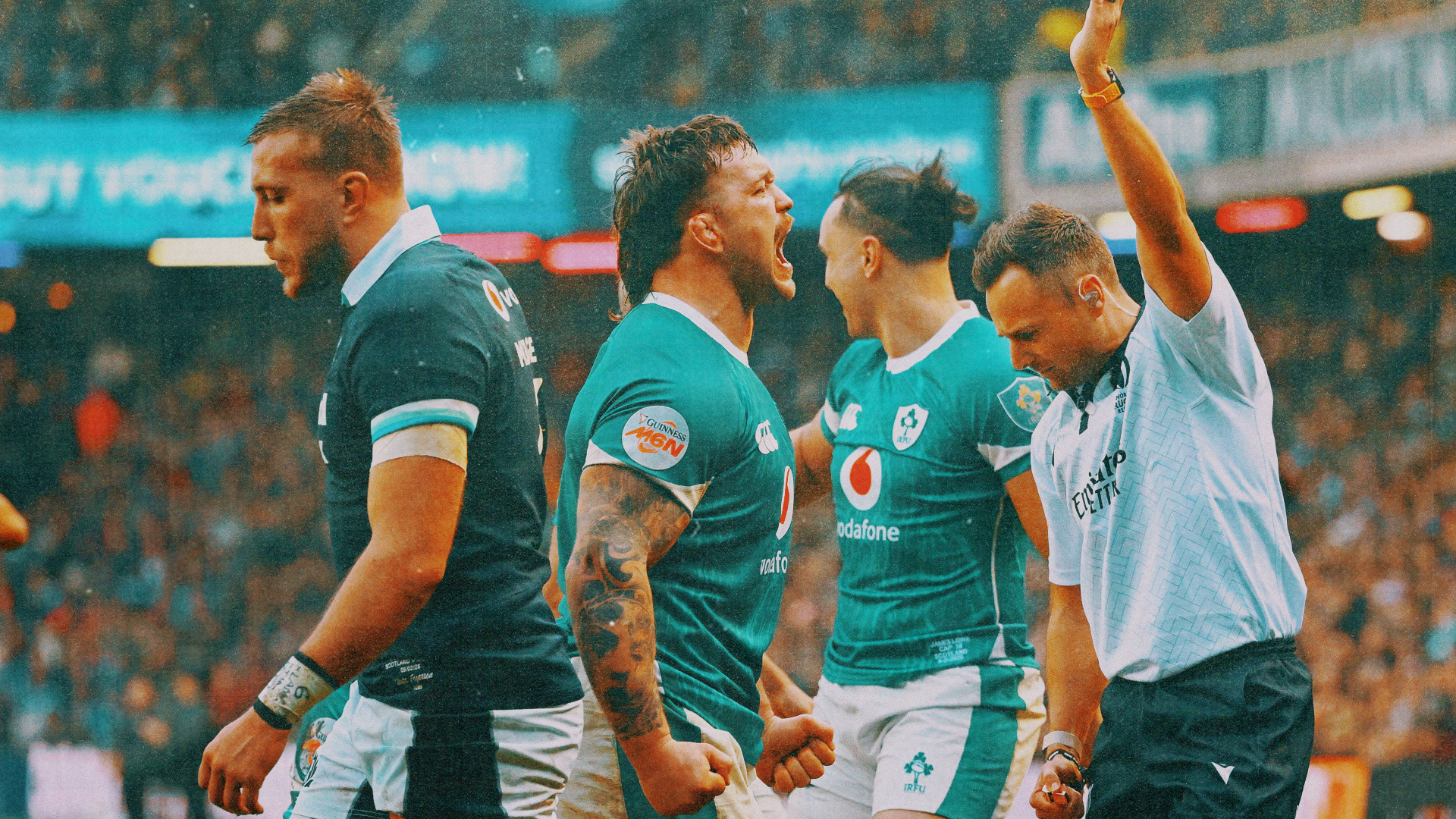
If you’re Gregor Townsend, I’m not sure what you do after a game like this.
Maybe you just have to accept that any hypothetical Scottish success to come in the Six Nations has to account for losing to Ireland by default. After my third watch back of this game, I became sure of one thing; you probably won’t see Scotland play as badly as this first half an hour again in this tournament. Whatever it is about that green jersey in the last decade, Scotland seem to save their daftest indiscipline and sloppiest handling for whenever they play against Ireland.
Where else will you see a team concede a try by leaving 20m of open space on the edges inside their 5m line and then concede a penalty from the restart for pushing a guy off the ball? Only from Scotland, and only against Ireland.
In theory, Scotland was a proper test for this Irish side, but on grass, it felt very much like all the stuff they likely swore to each other would not happen inside the first 30 minutes all happened regardless. Honestly, it reminds me a lot of Munster’s last few games against Leinster outside of that URC semi-final win – knowing what must not happen but somehow finding a way to ensure it does.
No sloppy penalties. No overplaying. Solid platform.
And yet.
One thing is very clear about this Irish side. No team in the game has a higher floor at the moment. I’m pretty OK with saying that Ireland didn’t even play all that well here after watching it back, it’s just our baseline is so high and consistent that it’s good enough to beat every team in this tournament bar France eight out of ten times. Even England, as improved as they are, still needs a lot to go their way to beat Ireland playing poorly.
Any Scottish performance intent on uppercutting themselves in the jaw early and often has no chance. Genuinely. They need to play at their very best to get into a position to win against this iteration of Ireland, and any sequence of events that leads to them being 17-0 down at any stage is likely too steep a mountain to climb.
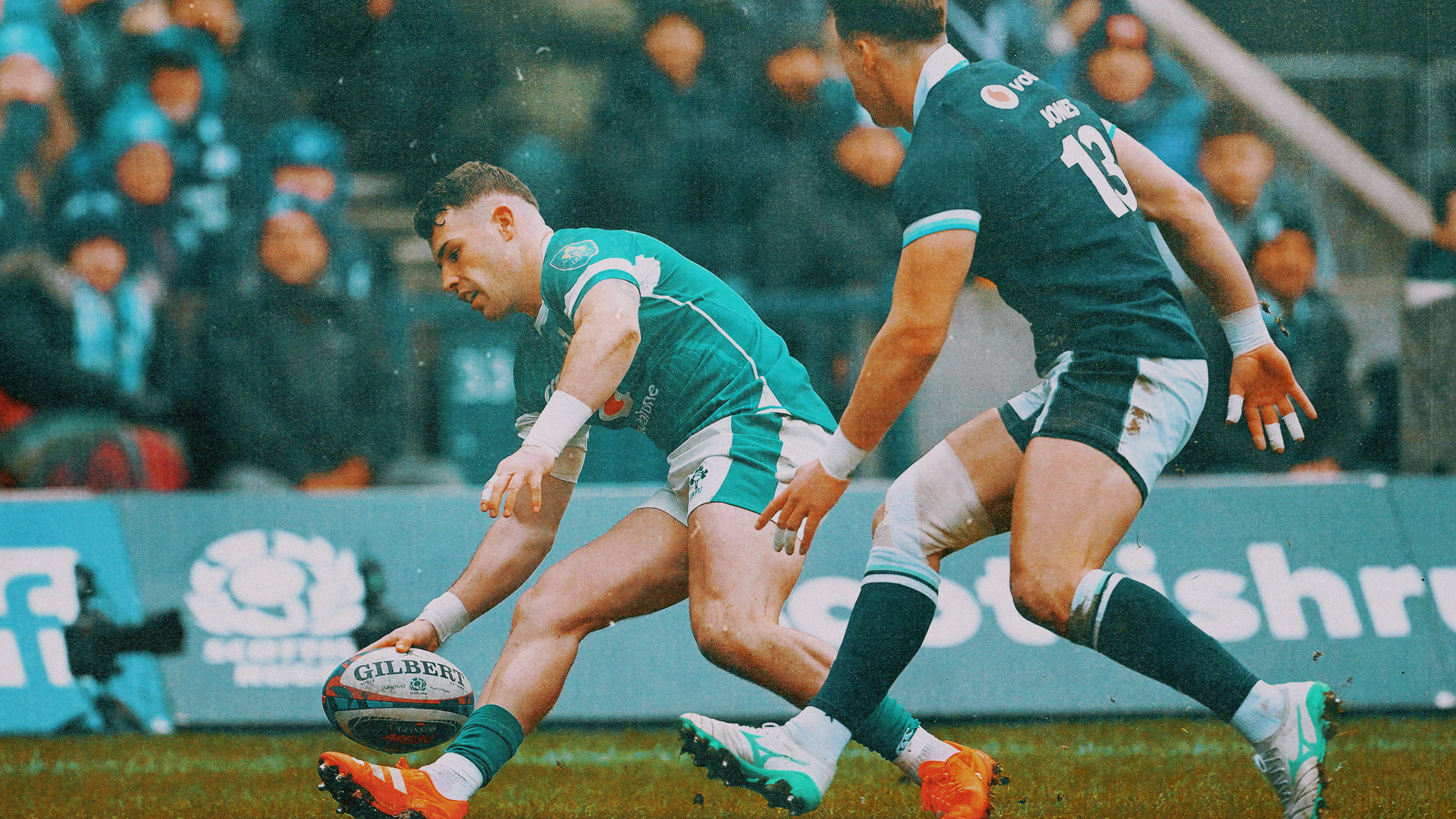
It’s indicative of the gap between the current top four teams in the world and most of the rest. Ireland, New Zealand, South Africa and France can all beat each other as peers. Teams like England, Australia and maybe Scotland have a puncher’s chance, certainly at home, against the current Big Four. Everyone else is in moonshot territory.
But we know well that this Big Four can change. In the last ten years, France were not always in this conversation before 2020, and Ireland wasn’t until 2021, at least consistently. South Africa were a rabble in the mid-2010s before the arrival of Erasmus and they are quite concerned about what a post-Erasmus South Africa even looks like.
Wales were a Big Four team in the early 2010s and England were a solid Big Four team, or at the very least, arguably so, until the late 2010s, very early ’20s. It depends entirely on your top players, your succession planning for those top players and the quality and consistency of your coaching.
If two of those three big rocks start to crack, things get ugly. If all three go, there’s no limit to how far you can fall and how long it takes you to recover. Just ask Wales.
Ireland’s biggest strength right now is also our biggest potential weakness, and it ran through this win over Scotland like DNA. Ireland are the most experienced side in the test game right now and it’s currently in that sweet spot before there’s a mass physical drop off and right when we have a core of hugely competent, emotionally stable, mentally resilient and highly skilled players who have been there and done that at the highest level as a unit for close to five years now, longer in some cases.
That allows Ireland to approach less consistent teams with a constant, seemingly effortless pressure – like water on a dam – and if the opposition has any weakness in that wall, Ireland will find a way through it through the universal application of that pressure when the game is being formed as a contest.
Ireland’s experience mostly shows on the defensive side of the ball where we’re every bit as cynical and bolshy as the All Black sides that tortured us in the early 2010s when we were the team looking for a puncher’s chance. Here’s a really good example early in the match when Scotland were still only a try down.
They had a decent attacking platform and got good middle ball at the lineout to threaten Prendergast with. You can see Tom Jordan, the Scottish #12, be a little too clever by stepping back inside to attack the space inside Doris’ compression but he gets snagged by Van Der Flier.
All very expected – they would have known Doris and Van Der Flier would be in those very spots to protect the space around Prendergast – but look at the detail in Ireland’s tackle zone. It’s all about frustrating the Scottish attacking flow.
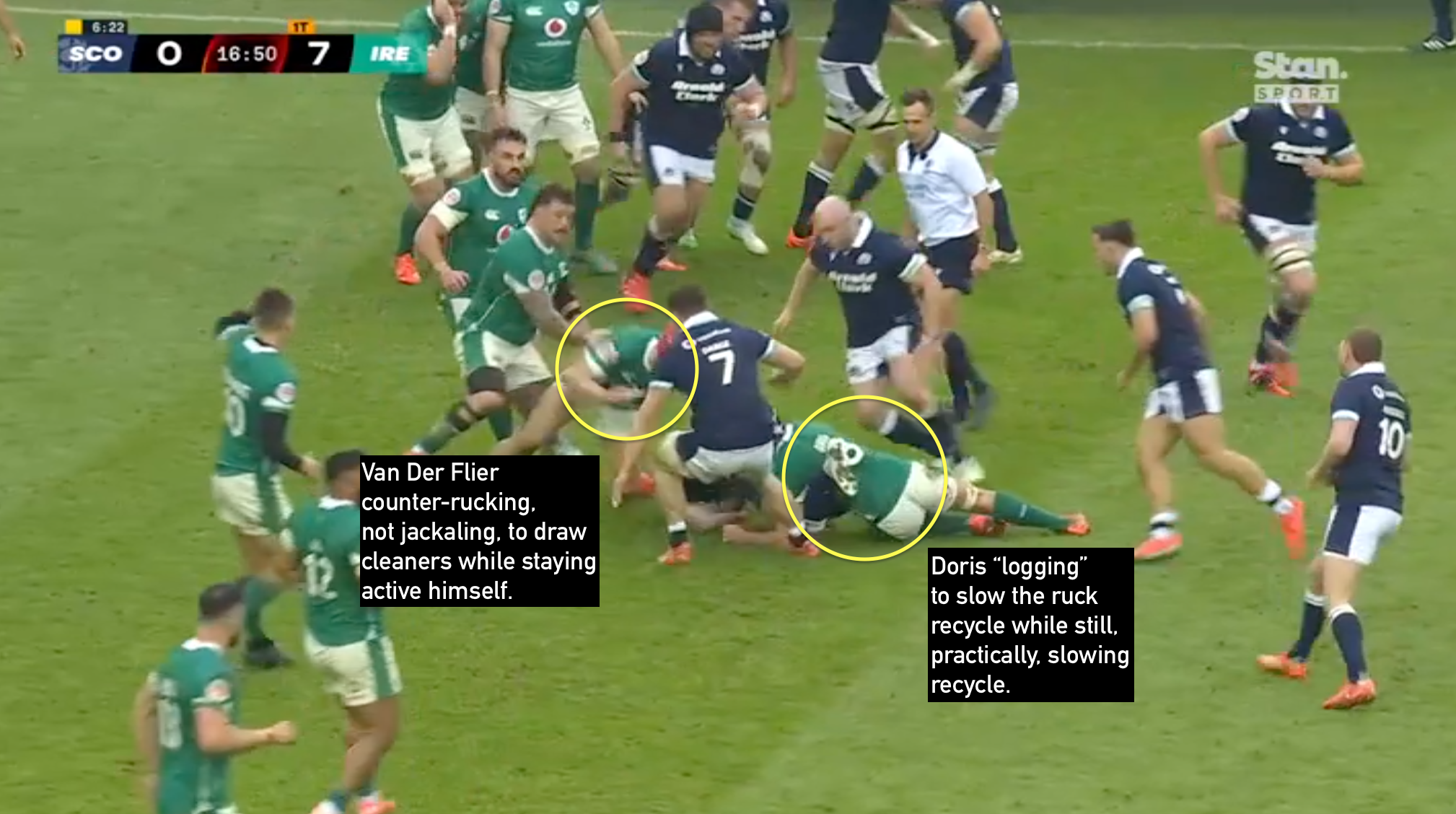
Scotland like to punch narrow to spread to width so Ireland knew that drawing attacking players out of the line made the next phase incrementally easier. That’s always true regardless of the opposition’s concept but it’s particularly effective against Scotland. Could the referee blow Doris up for slowing the cleanout? Yeah, probably, but they rarely do. His body is like a log, rolling away towards the referee so it looks like a legal action but it does effectively slow the attack.
In the next phase, Scotland goes narrow again with a punchy carry from Zander Fagerson that Ireland meet primarily with inside shoulder pressure. The key here is to avoid Prendergast getting isolated defending a pillar or second man out with space on either side.
Porter compresses in to be sure the tackle is completed but bounces out again.
Look at that tackle zone detail again. Ryan is “logging” this time and goes straight for Fagerson to slow his approach to the ruck.
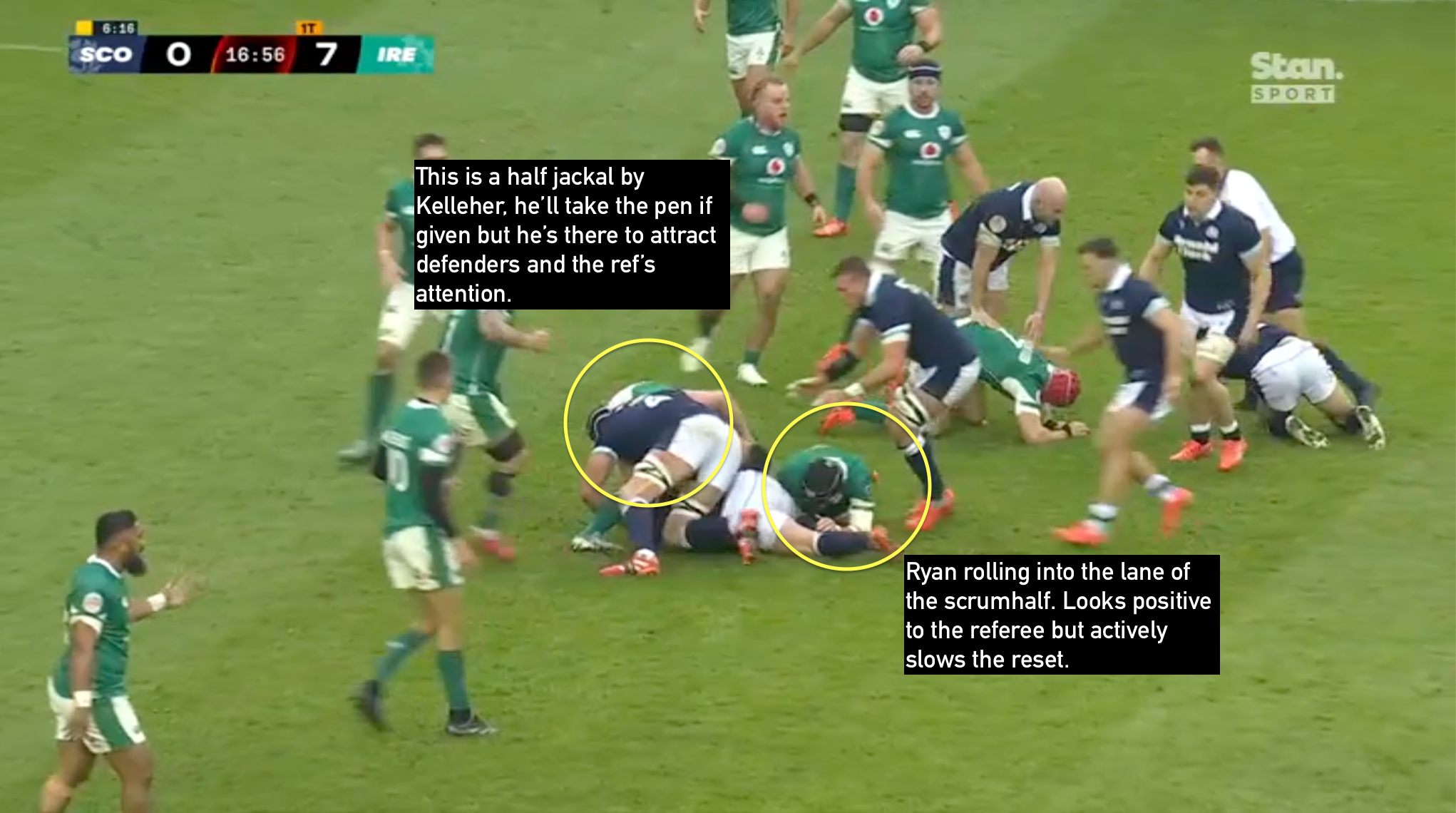
Kelleher takes up all the referee’s attention with his “half-jackal”. It’s not really a full attack for the ball and he’s there to be coached by the referee while Ryan rolls out into the cleaning lane. Another slowdown.
When you look at the next phase, you see a possible chink in the defensive armour with Prendergast’s tackle attempt being particularly weak, but it’s completed by Aki and backed up by Porter. Watch Prendergast sweeping around the outside of the tackle though – more on this later.
The interesting bit is in the next phase where we see that contact work again. Inside tackle pressure, logging and a roll across the face of the ruck, counter-ruck pressure rather than jackal attempts.
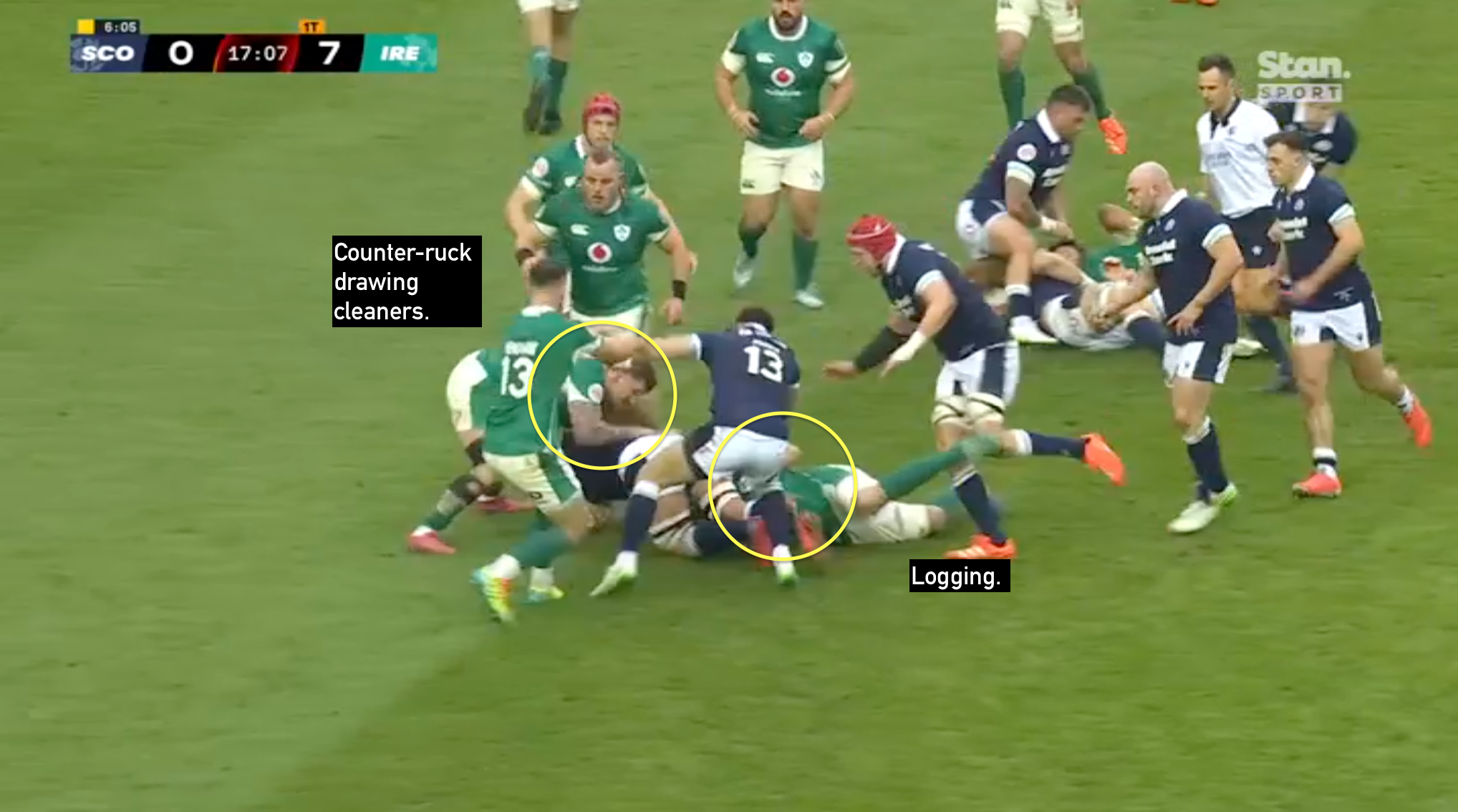
All of this steals ruck speed and breaking opportunities for Ben White at #9 while also sucking the life out of Scotland’s narrow punch pattern. You could say “Scotland have to trap Ireland in there to buy a penalty” but it’s clear that there’s no such penalty coming especially as you have to slow your own ball to try and get it.
On the next phase, we see it again – Henshaw this time with the classic Leinster Leg Sweep behind the tackle. The contact comes from outside and swings across the back of the ruck in the direction of where the support players are coming from.
It’s plain as day. Ireland counter-ruck to draw cleaners and sweep across to make a mess of the contact zone for the attack.
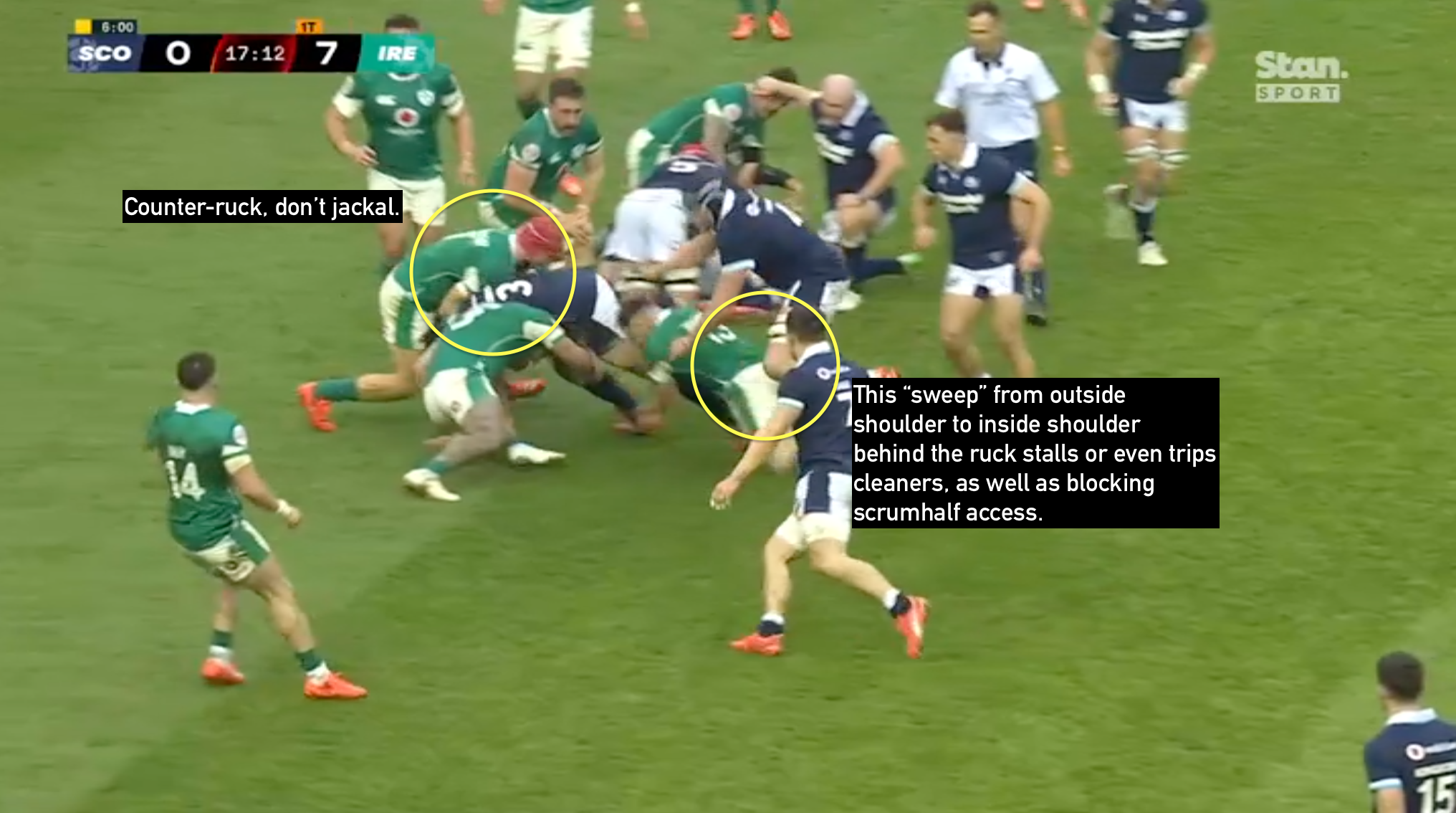
From there, Scotland only have one place to go and that’s to the tramlines, where Ireland have a tonne of transiting defenders in place to scramble and cover any wider attacks.
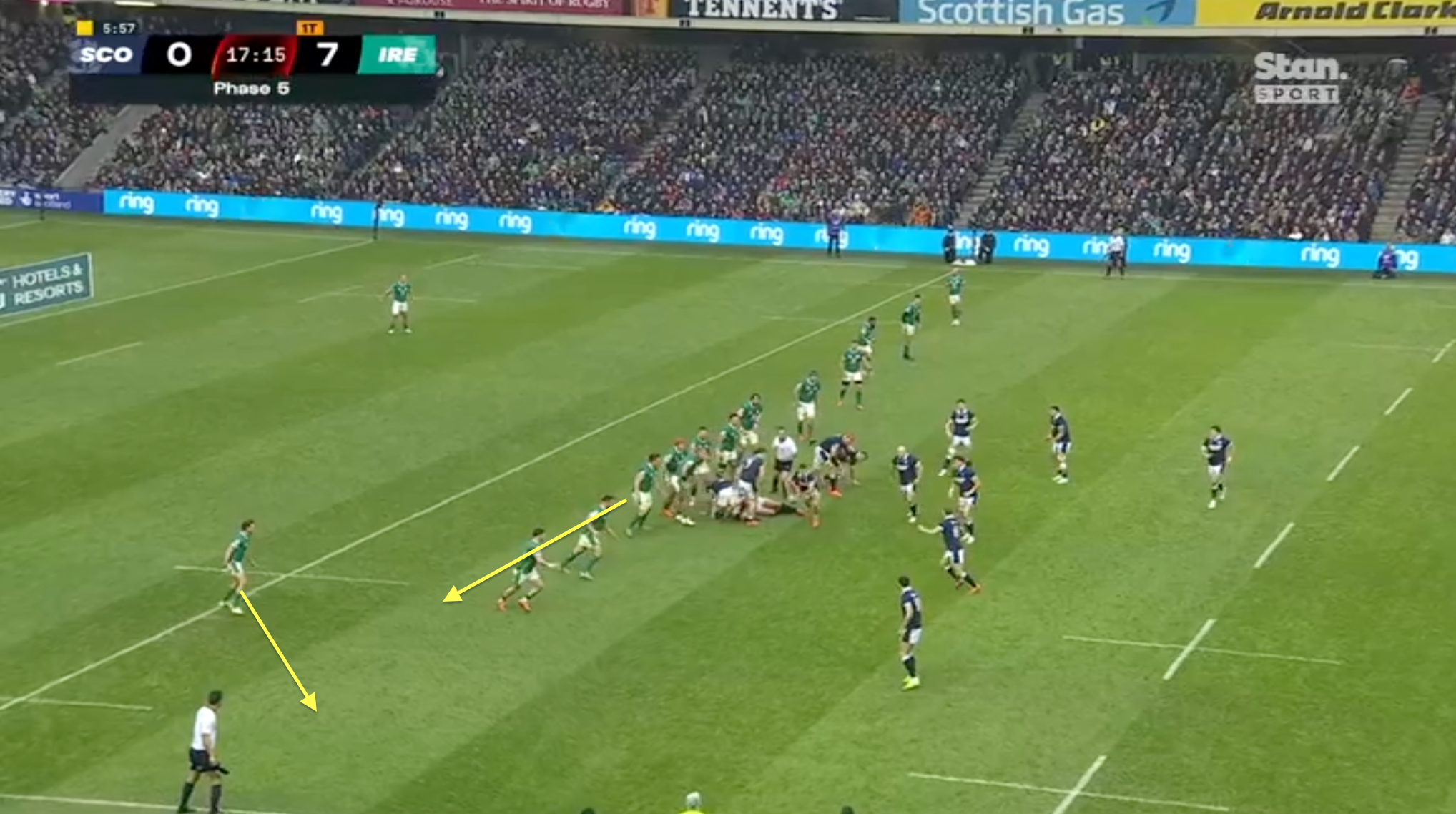
When this pass goes to the edge, it’ll be to a wildly outnumbered Scottish attacker with a disjointed ruck support system.
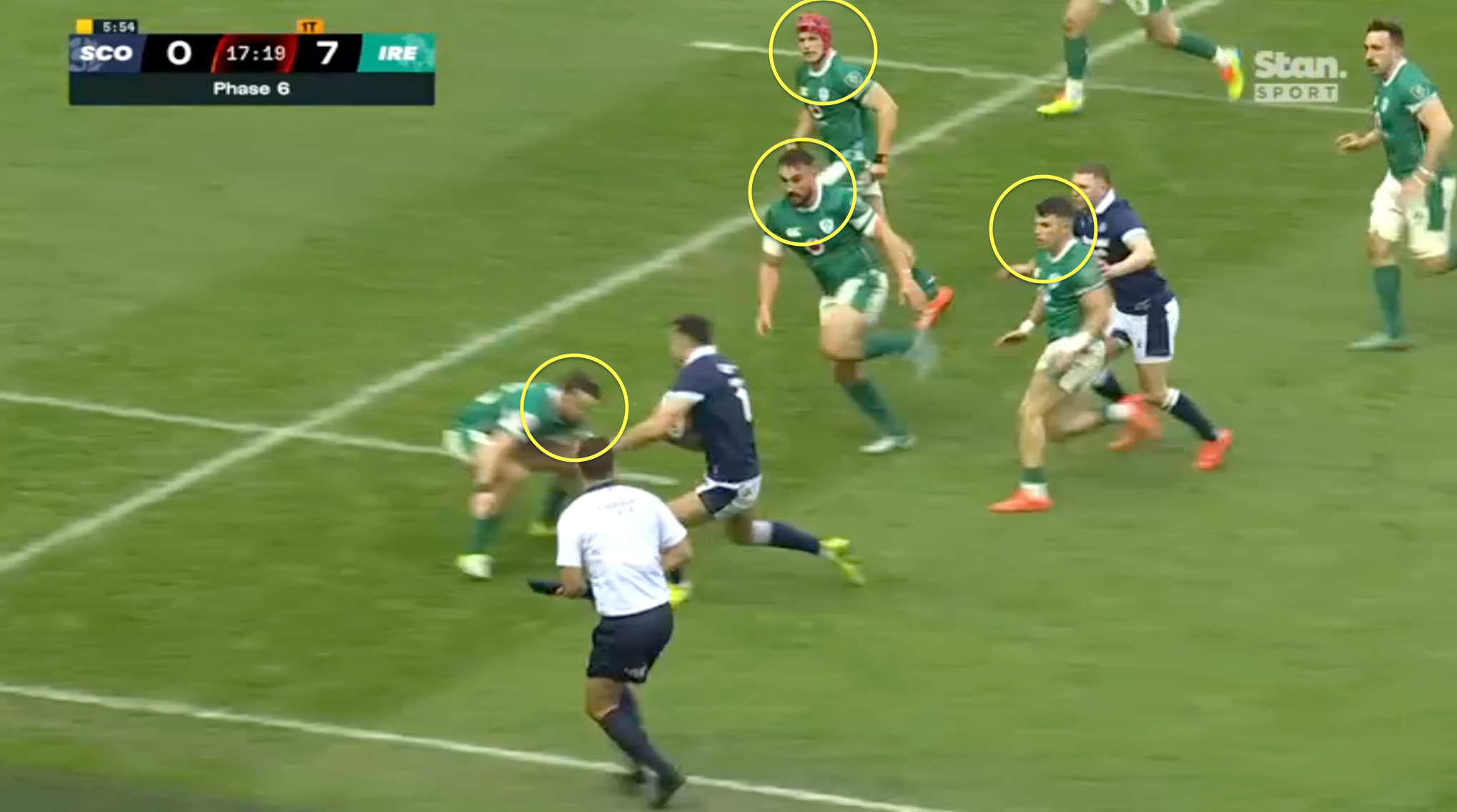
Let’s see how it played out. Scotland gets fake width, Ireland are always in control and Finn Russell has to try and brace out Jack Conan all on his own to avoid being counter-rucked. It ends… predictably.
All of this sucks the energy out of Scotland and burns the clock in Ireland’s favour. It’s why playing a low pass-per-kick game against Ireland is so effective at the moment – you avoid getting trapped in the quagmire of Ireland’s phase defence.
There are gains to be had against Ireland directly off the set piece, however. I spoke about this before the game and Scotland almost scored directly from a long-range scrum strike play.
Henshaw gets caught out on an all-or-nothing blitz play and he’s bailed out by unbelievable tracking defence by Gibson-Park who makes a try-saving tackle on Kinghorn. Henshaw was then quite lucky to get away with a knock-on in the tackle on the next phase but the problems on the scrum happened a little earlier.
Prendergast reacts very late to a decoy line, and staggers his line in – almost like he missed the path of the ball beyond him – and that serves to isolate Aki and then Henshaw in turn.
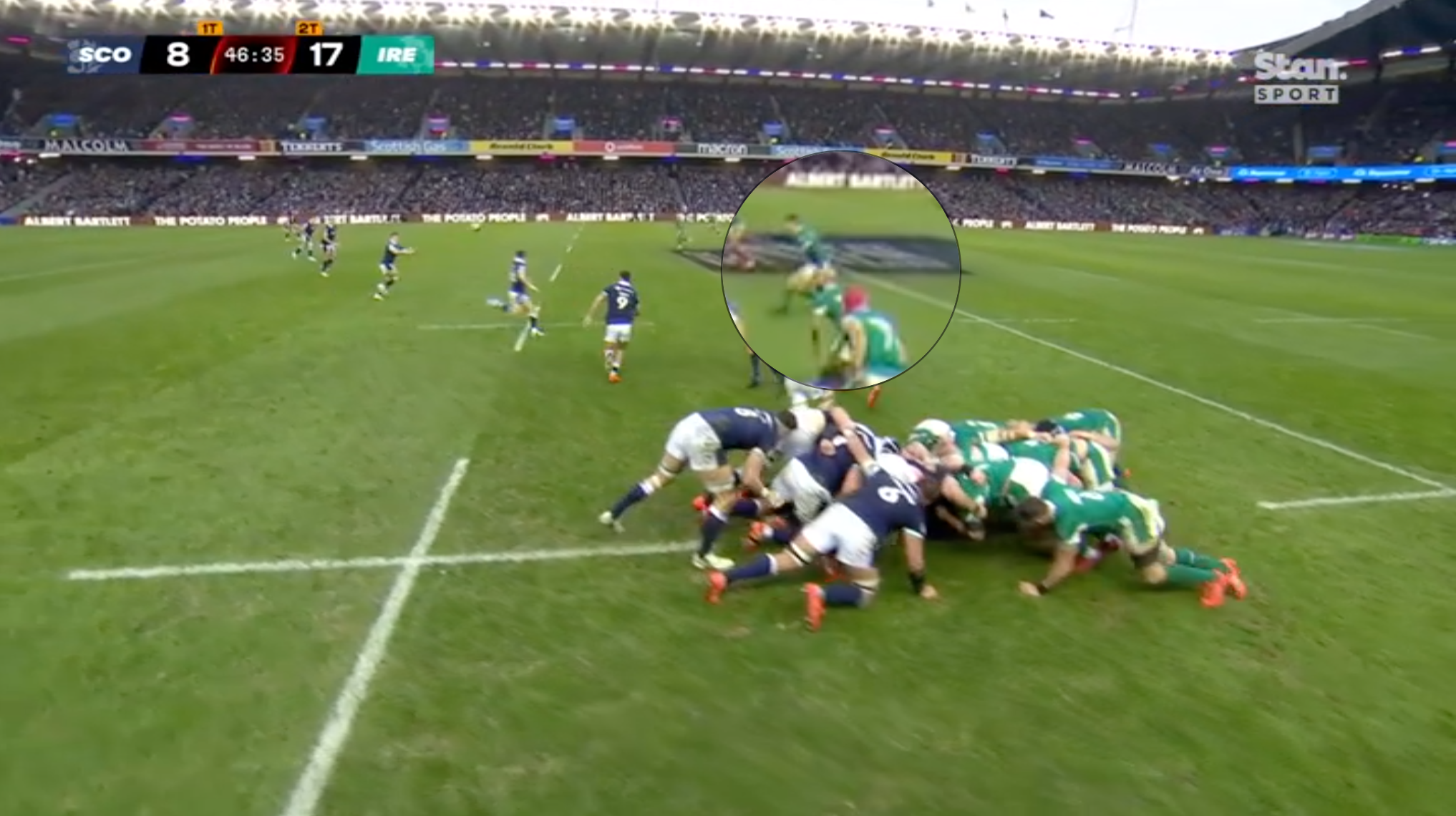
Gibson-Park saved the day and then Scotland ended up taking three points from the resulting field position, something Ireland will live with any day of the week.
From there though, Scotland had momentum before throwing it away on the daftest exit you’ll see all month from Ben White. He attempted a box kick contestable from a centre-field position to the tramlines. You don’t really see kicks like this all that often because of how exposed they leave you in the backfield behind where you kicked the ball to.
That is usually inverted when you kick up the tramline, but the opposition has to win the ball and then get across 70m of lateral space to hurt the other wing.
When you kick from the middle to the tramlines off #9, you don’t get the same hangtime as you do from #10, you don’t get the same contestable distance and you also leave yourself outnumbered if you don’t retain the kick or at least get knock-on advantage. This is an immediate three on two immediately.
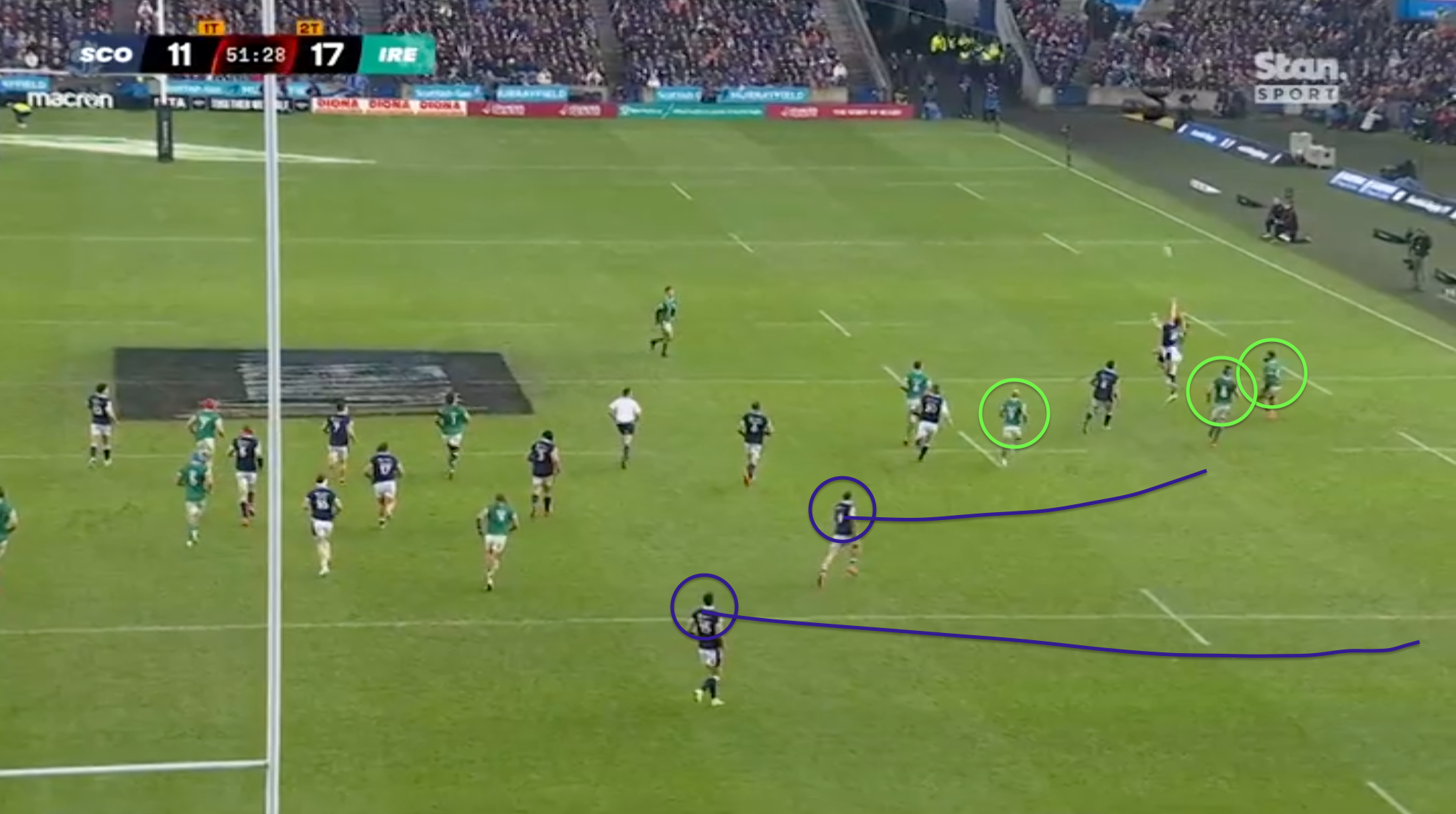
Watch the kick in real-time. It’s an all-or-nothing play right when you’ve got the game back to under a converted try.
Ireland got the 5m scrum and scored on the next sequence. Back to a two-score game. The worst thing is, I think it was a blown kick.
Looking at what White saw, I think the intent was to land this on Sam Prendergast with pressure coming up the middle in the air and outside him to cut off the pass.
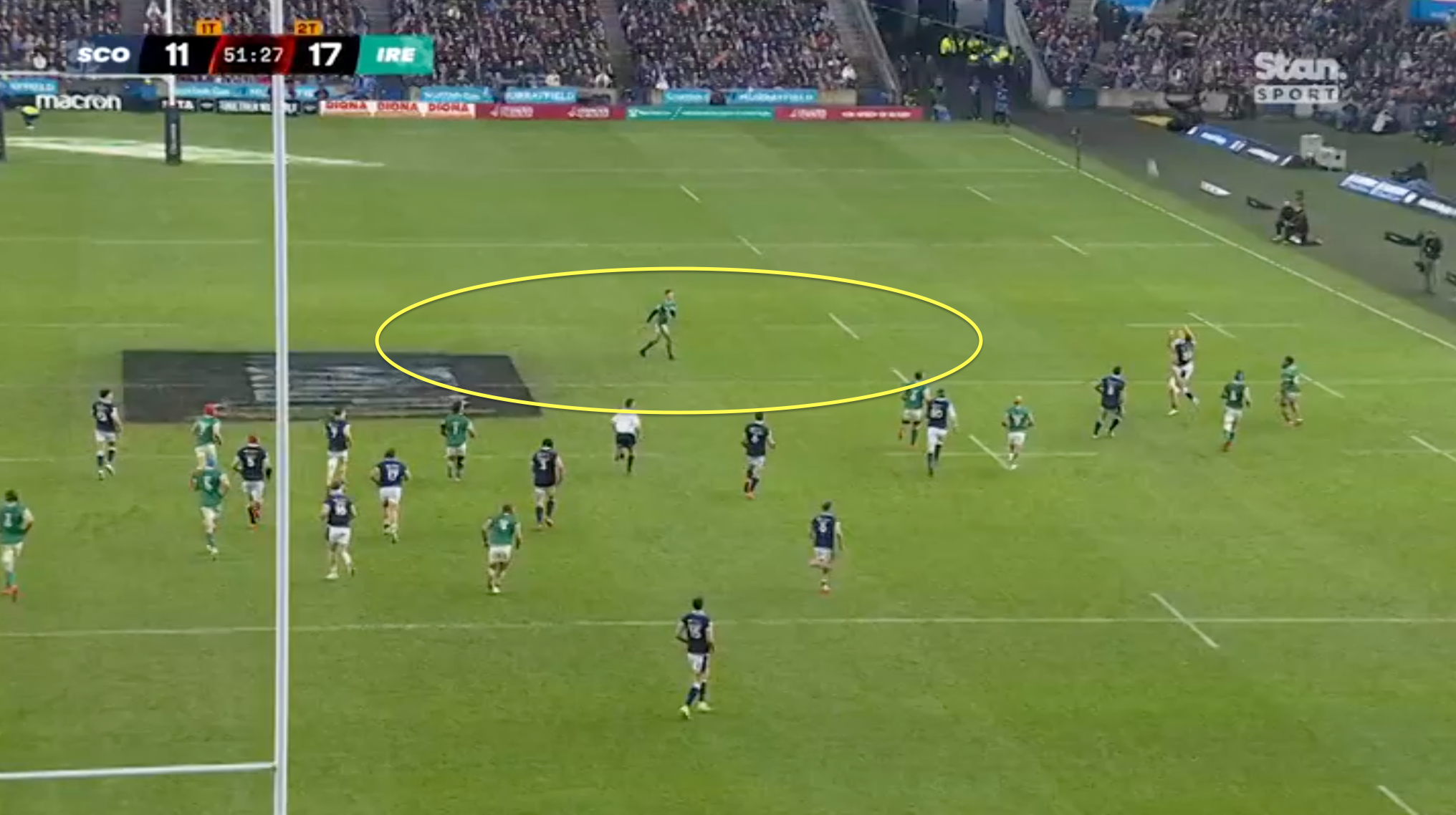
Either way, that was the Scottish comeback completely neutered and left in tatters.
There was a point around just after halftime, right before Scotland threw away the game, where they could have put real scoreboard pressure on Ireland but the moment faded through the defensive excellence of Jamison Gibson-Park. Robbie Henshaw will take the heat for the missed blitz but I think he felt he had no choice. Watch how isolated Bundee Aki is and then Henshaw is as this play progresses.
The key moment is Prendergast getting stung by the decoy line, which did enough to make him step inside for a beat. You can see it here.
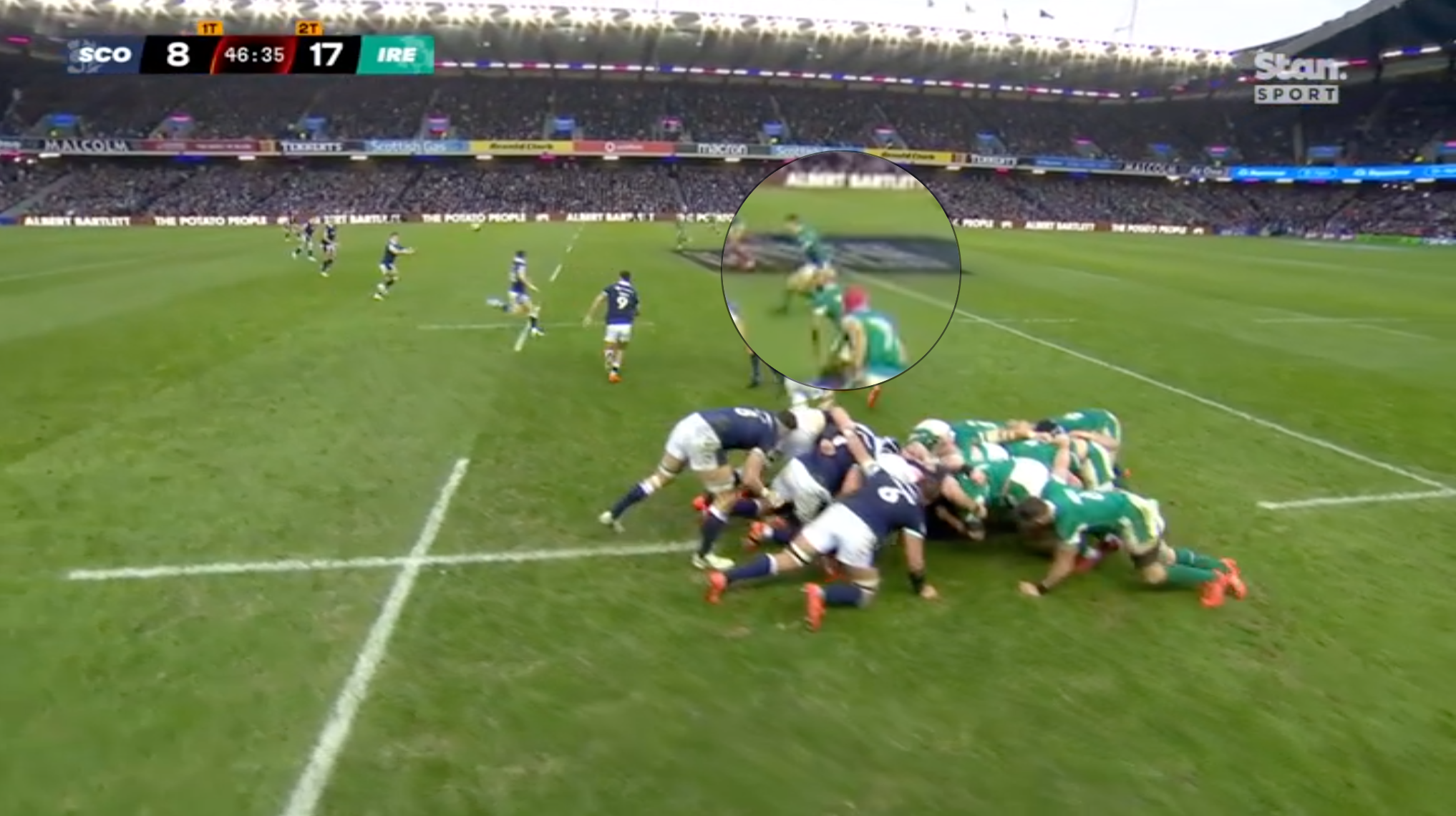
The ball is gone but Prendergast still reacts to the threat and that tugs on Aki, which in turn spooks Henshaw into an all-or-nothing blitz. When Ireland’s midfield is this worried about Prendergast’s ability to cover inside, these linebreaks from wide scrum position will keep happening.
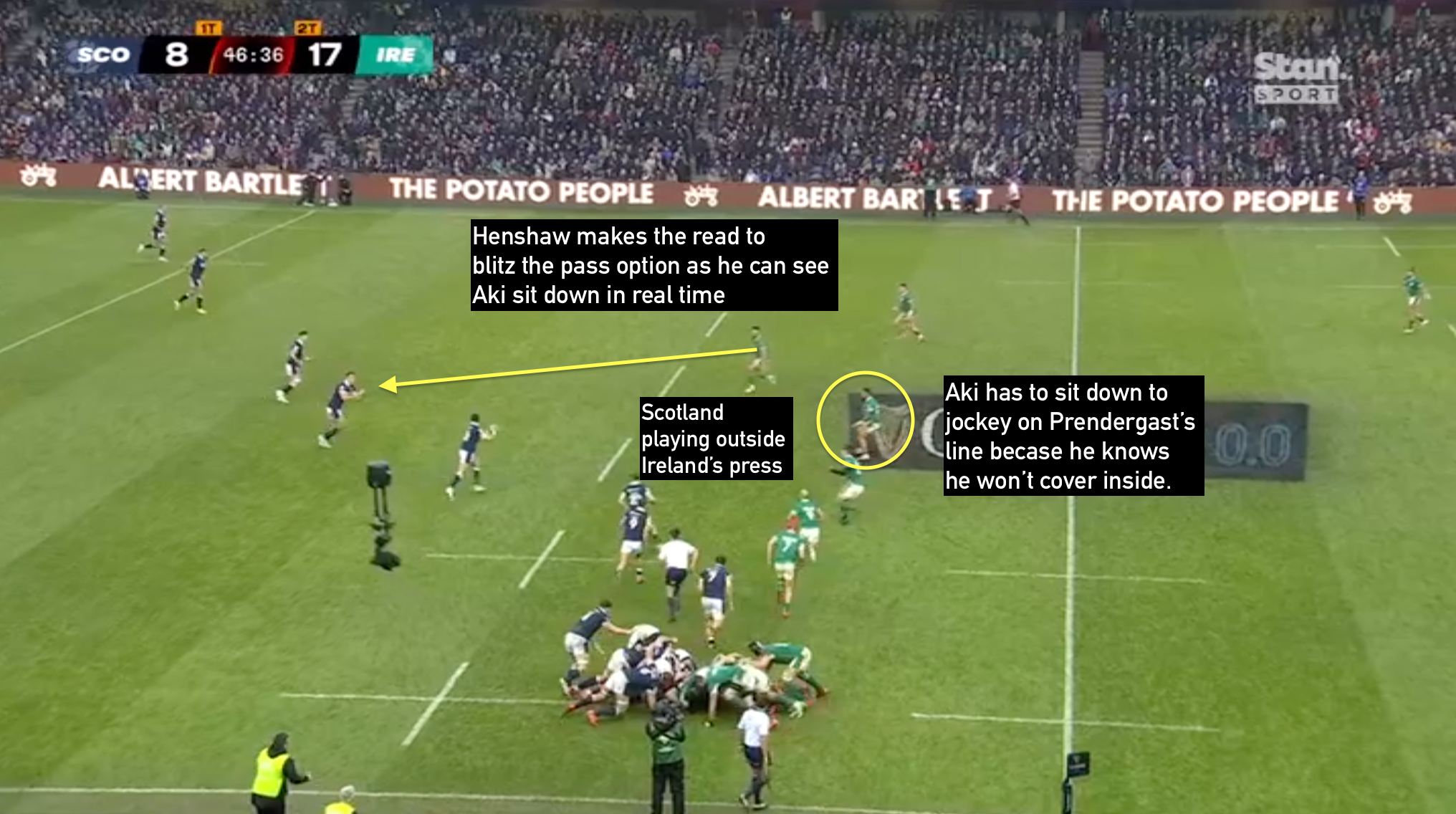
Gibson-Park’s defence here is superb.
Prendergast’s display earned him Player of the Match from the BBC team covering the game and, while I think that particular meaningless award should have gone to the peerless Andrew Porter, the young #10’s performance was much improved on last week. Quite simply, with Ireland playing counter-punch rugby, Prendergast could pick his spots and get into the zones he knows he excels in.
I was most impressed by what he did in the areas where he hasn’t excelled. His deep line on Russell here was perfect and Scotland didn’t seem to have Prendergast’s traits nailed down in the video room.
Russell needs to be half-on Aki’s line here and back White to cover the inside threat if – and it’s a big if – Prendergast takes contact but because he rarely does, Russell creates a cascading compression that Henshaw profits from.
It’s an excellent set-piece design and Aki’s outside-to-inside line adds +1 to Prendergast’s threat on the gainline. He won’t carry, but the pop to Aki is spooky enough that you have to bite.
Prendergast really excels deep in the second layer taking the ball off a screen. Ireland have schemed a lot of tight runners on him to create an artificial running threat for him. Watch Kelleher’s line here.
If Prendergast was going to have a cut inside off the screen, Kelleher’s line would be in the way of that but it does the job of simulating a carrying threat and allowing Prendergast to sink into a nice pass outside.
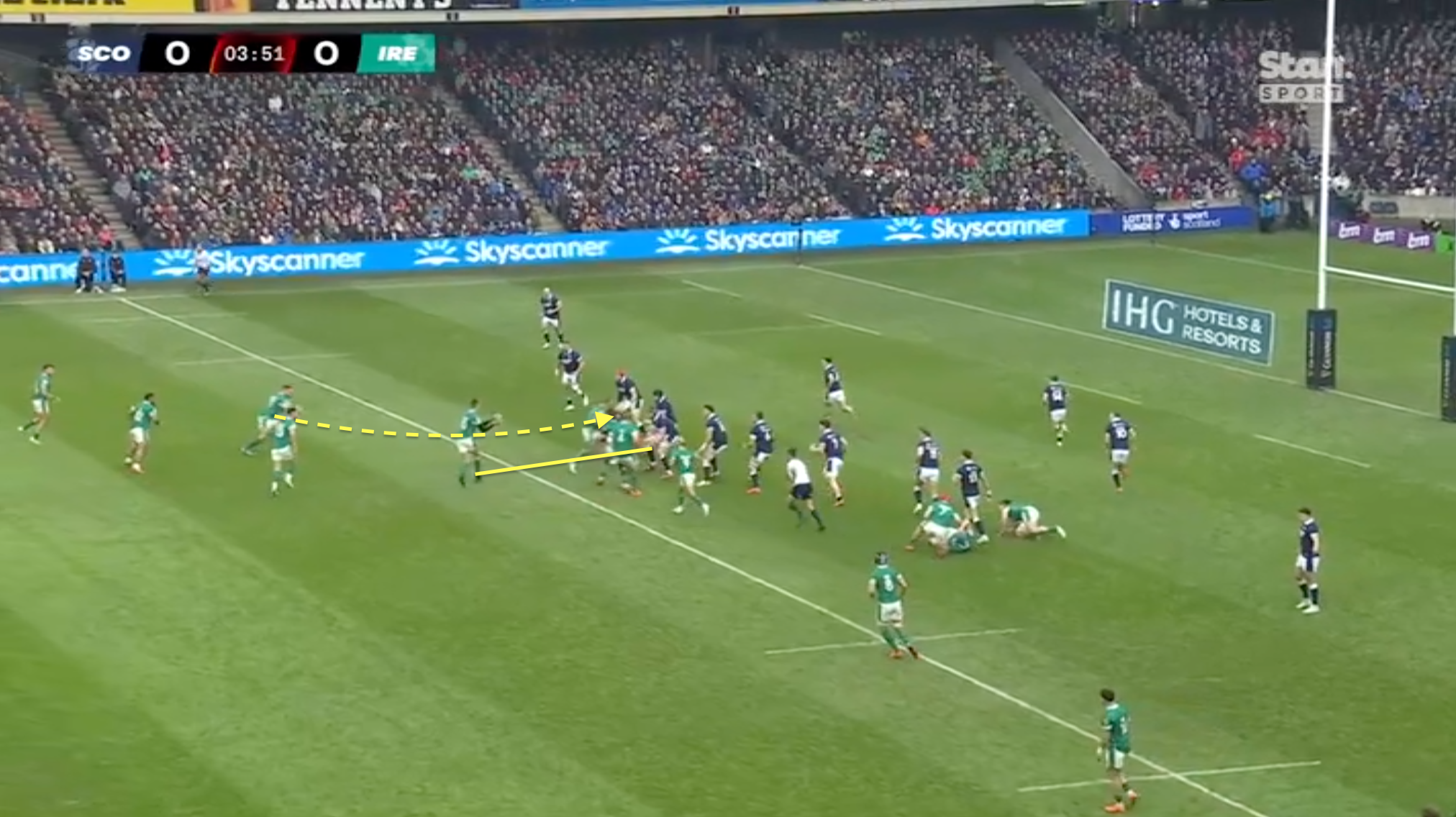
Ireland are a little shorthanded in the wide channels as a result but we’ll live with that. Those 10m passes buy the attack time as well as the defence. Prendergast picks his spots well, even if Scotland half understood the assignment as the game wore on, even early. Watch Scotland no sell Prendergast as a running threat here, which leads to Henshaw getting stuffed in contact on the inside ball.
If you’re Prendergast, I think you have to carry this to establish that you will carry into the tackle. Prendergast has a tendency to avoid carrying unless he has an angled space to run into and I think until he shows and goes here, even taking a big shot for his trouble, the video analysis might start to make that a necessity.
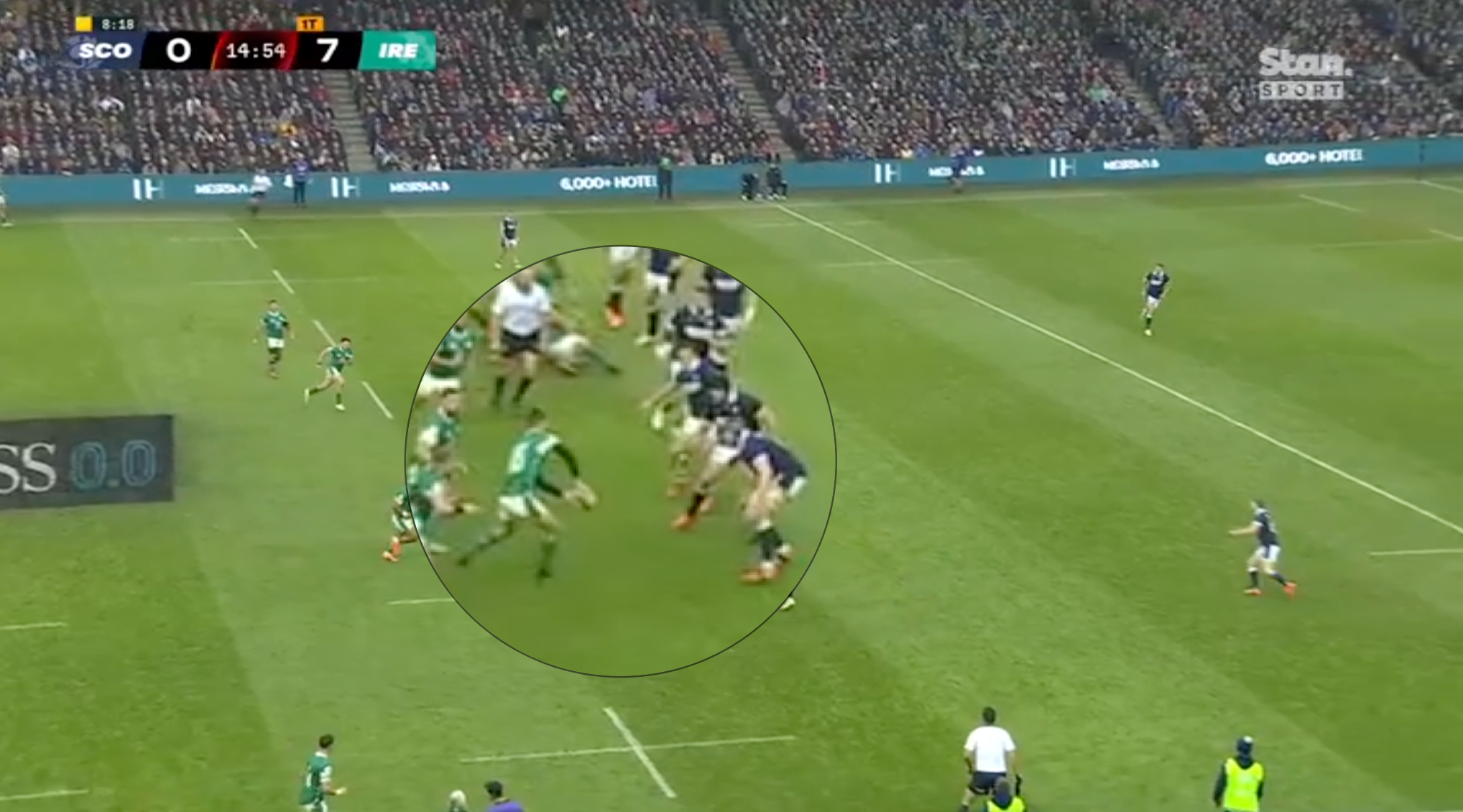
Even here, you can see Scotland ignore the possibility that he might carry this so the outside defender is free to pressure Keenan before the release of the pass they know is coming.
I think he’s lucky this gets knocked on because it looks like an intercept all ends up without it. This is a defender who knows Prendergast is always passing here, never pump-faking and he’s getting ahead of the play.
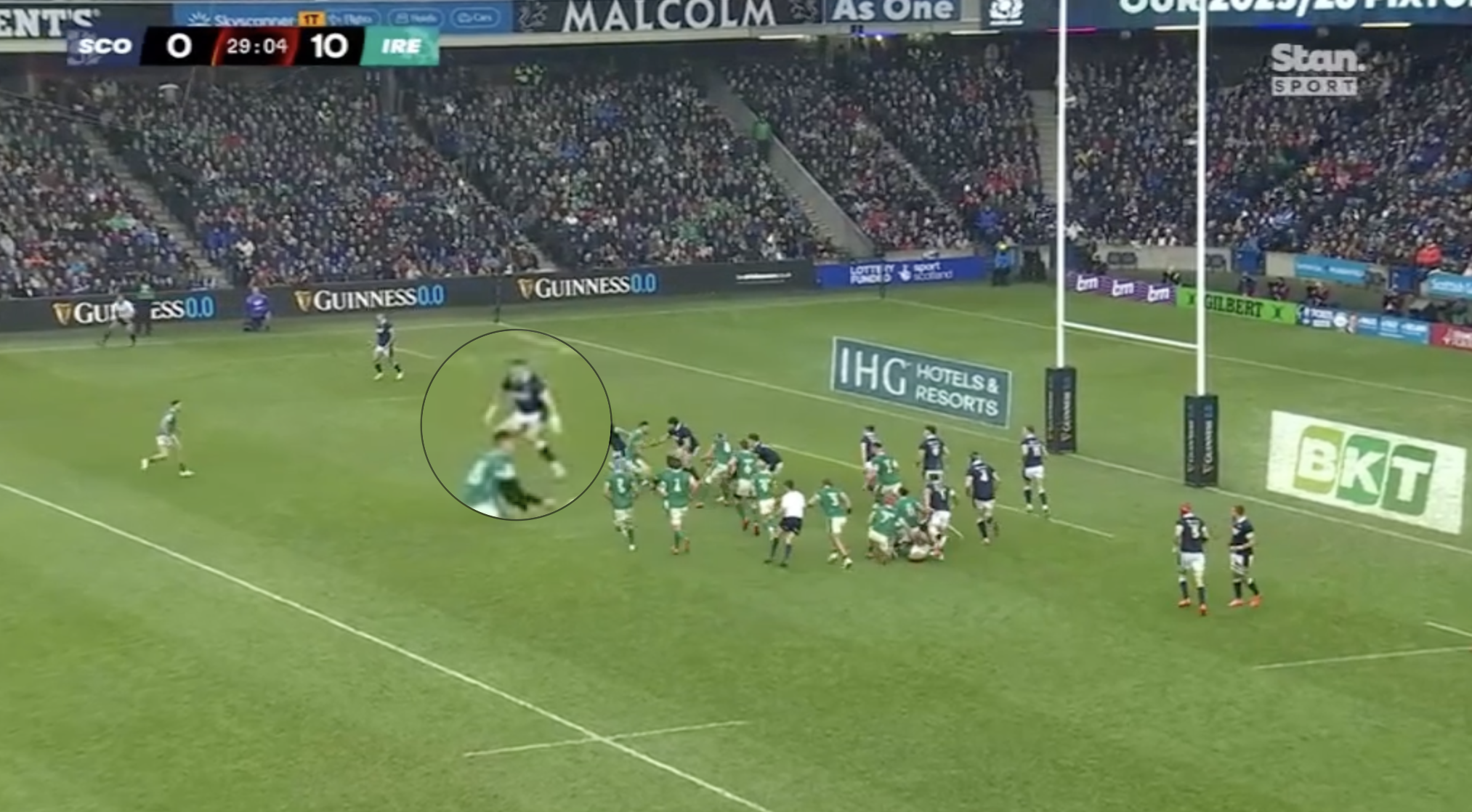
There are massive gaps in Prendergast’s defensive game that should be spoken about but won’t until they are costly. Take away the narrative that surrounds Prendergast like Saturn’s rings and you have a very talented and very incomplete young distributor who Ireland are working very hard to amplify in attack and hide in defence.
I worry that the defensive display he showed here will (a) be punished by better, bigger, less mentally frail teams and (b) the resulting whiplash in the media will turn the boy inside out. This would be unacceptable defence in a URC test window sludge match never mind the Six Nations. It was far from the only example.
For everyone’s sake, let’s hope that Prendergast doesn’t get picked out and isolated like this against France deliberately, as Scotland did here almost accidentally. The media have spent this much capital to build him up, I do not want to see them knock him down. Ireland are all in on Prendergast – for now. But just ask Harry Byrne, Ross Byrne, Joey Carbery and Ciaran Frawley how quickly you can be all out.
This was a decent Irish performance amplified by wild Scottish headloss. Giving this Irish team a 17 point lead is an impossible hill to climb and it gave Ireland the arm’s length control they love when it comes to little brothering Scotland for 80 minutes.
The big test remains on the horizon but this Irish team’s consistency will spook a French team who are anything but.
| Player | Rating |
|---|---|
| 1. Andrew Porter | ★★★★★ |
| 2. Ronan Kelleher | ★★★ |
| 3. Finlay Bealham | ★★★★ |
| 4. Tadhg Beirne | ★★★★ |
| 5. James Ryan | ★★★★ |
| 6. Peter O'Mahony | ★★★ |
| 7. Josh Van Der Flier | ★★★ |
| 8. Caelan Doris | ★★★ |
| 9. Jamison Gibson Park | ★★★★★ |
| 10. Sam Prendergast | ★★★★ |
| 11. James Lowe | ★★★★ |
| 12. Bundee Aki | ★★★★ |
| 13. Robbie Henshaw | ★★★★ |
| 14. Calvin Nash | ★★★★ |
| 15. Hugo Keenan | ★★★ |
| 16. Dan Sheehan | ★★★ |
| 17. Cian Healy | ★★ |
| 18. Tom Clarkson | ★★★ |
| 19. Ryan Baird | ★★★ |
| 20. Jack Conan | ★★★ |
| 21. Conor Murray | N/A |
| 22. Jack Crowley | N/A |
| 23. Garry Ringrose | ★★★ |
