


There is a fear factor around this game that I don’t think we’ve had with Scotland in a while.
Past instances of these articles have focused quite a bit on the enmity between both rugby nations right now but it can be boiled down to this; Scotland are sick to the back teeth of losing to us, and our shoulder blades are sore from patting ourselves on the back so hard for repeatedly putting them back in their box.
Ireland are not a good team to lose to – not in the modern era. The modern social media algorithm glories in finding that which makes you the most upset at any given moment. That engages you in a more focused way than anything that makes you happy. If you see a video or a post on Twitter or Instagram that annoys you, you’re far more likely to linger on that post, stewing in your own seethe, reading the comments to see if anyone else is as mad as you or, if you’re particularly furious, leaving a comment.
All of this means more engagement for the content creator, which means better metrics that you can roll into a package that says “we had X number of views, comments and shares last month, please sponsor us”. Of course, they don’t tell those sponsors that 60% of those views, comments and shares were “look at this moron” but that doesn’t matter. A view counts as a view on a spreadsheet regardless of whether the person is happy or angry. And, as it turns out, it’s much easier to make people angry than it is to make them happy.
Enter the Irish Rugby Media.
If you’re a Scottish rugby fan, you’ll have seen countless videos of marble-mouth Irish pundits crowing down the camera about how “mouthy” the Scottish rugby team is after every loss. It doesn’t matter if Scotland were mouthy or not, Ireland won so Eddie O’Sullivan can say what he likes.
If you’re an unlucky Scot, that marble-mouth Irish pundit will be someone like Jamie Heaslip talking down his nose to you like he’s rejecting your invention on Dragons Den that turns dogshit into an ice cream cone. If you’re really unlucky, it’ll be a reel from Off The Ball on Instagram with Ger Gilroy, looking like a guy who lives in a waterfall asking “What’s going ON up there?” with the kind of scorn you can feel through the screen like radiation off the elephant’s foot in Chernobyl.
All of that adds up and the Scottish have the kind of motivation to put Ireland back in our box in a way you can only understand if you’ve lived on the other side of hubris. Will that “want” be enough? Will it be enough this time? At some stage, it has to be. Our winning run over Scotland in the last 10 years defies belief. Since 2015, we have played each other thirteen times and won twelve. That includes two World Cup pool wins too, to salt the wounds even further. The last time things were this lopsided between the two nations was in the late 80s, 90s, and early 2000s when that run was reversed. Scotland had twelve games against us without defeat between 1989 and 1999 before Ireland turned the tide in the 2000 Six Nations.
It is not a normal sequence of results. Sure, Ireland ascended into a proper top-four team in the last ten years, but when you look at their results against France since 2015, the difference is stark.
They’ve played sixteen games against the French since 2015 and won six of them. That is still a picture of French dominance, yes, but not the one-sided results we’ve had. So are Scotland due one? Probably. But the thousands of bluebottles I’ve killed in an unbroken sequence in every house I’ve ever lived in are also due one, but I don’t see that happening anytime soon.
Scotland’s chances are a lot better than that. And I think this Irish coaching staff are very aware of that this weekend.
Ireland: 15. Hugo Keenan; 14. Calvin Nash, 13. Robbie Henshaw, 12. Bundee Aki, 11. James Lowe; 10. Sam Prendergast, 9. Jamison Gibson-Park, 1. Andrew Porter, 2. Ronan Kelleher, 3. Finlay Balham, 4. James Ryan, 5. Tadhg Beirne, 6. Peter O’Mahony, 7. Josh Van Der Flier, 8. Caelan Doris (c)
Replacements: 16. Dan Sheehan, 17. Cian Healy, 18. Thomas Clarkson, 19. Ryan Baird, 20. Jack Conan, 21. Conor Murray, 22. Jack Crowley, 23. Garry Ringrose
Scotland: 15. Blair Kinghorn; 14. Darcy Graham, 13. Huw Jones, 12. Tom Jordan, 11. Duhan van der Merwe; 10. Finn Russell (cc), 9. Ben White; 1. Rory Sutherland, 2. Dave Cherry, 3. Zander Fagerson, 4. Jonny Gray, 5. Grant Gilchrist, 6. Matt Fagerson, 7. Rory Darge (cc), 8 Jack Dempsey
Replacements: 16. Ewan Ashman, 17. Pierre Schoeman, 18. Will Hurd, 19. Sam Skinner, 20. Gregor Brown, 21. Jamie Ritchie, 22. Jamie Dobie, 23. Stafford McDowall
If we go back to the last two games between these two teams, the common denominator is Scottish errors handing Ireland the win in both cases. An overthrown lineout straight to Dan Sheehan did the damage last year, the season before in Murrayfield it was the baffling decision not to get the ball off the field every chance they got and compete in the air in the lineout when Ireland had Josh Van Der Flier throwing for forty minutes.
Scotland will surely feel that, if they can cut out these wanton self-uppercuts, they have enough for the Irish team as it stands, especially in Murrayfield. As ever, a lot of the game will come down minimizing those killer errors but this is true of every game at every level.
I keep coming back to what last week’s game against England will have shown the Scottish analysts. How much encouragement do they take from the first 50 minutes? How repeatable is Ireland’s 55-70 minute pull away? How much of Ireland’s gameplan was specific to Borthwick’s England and how much of it represented a new strategic baseline? What did England do well and what did they do poorly? How much of what they did poorly was done in service to the stuff they did well?
All of these are pertinent questions. I think it’s clear that Borthwick’s small-forward build back row worked in the first instance in that they did a good job of clogging up Ireland’s wider structures quite well and won key breakdown penalties in those attackable tramline rucks.
I initially thought that England’s defensive lineout suffered due to this small forward build, but that wasn’t really the case. A good defensive lineout performance from the opposition often coincides with spluttering Irish performances in the last 18 months but Ireland did everything possible to minimize the chances of this against England, limiting our own attacking effectiveness in doing so.
Of our 23 lineouts against England, 19 were to the front and both of our hookers had the lowest average throwing distance in the first round of the Six Nations. Ireland did this in the first season of O’Connell as lineout coach too; when this team comes under pressure at lineout time, as we did in November, O’Connell tends to pull our menu right back and exclusively go for the areas that the opposition is most likely to cede to us by default.
England could have selected a four-lock pack and it wouldn’t have made that much of a difference to Ireland’s lineout retention. We looked to compensate for this narrow, less-than-optimal platform with lots of wide passing. Van Der Flier releasing Gibson-Park essentially playing at #10 and making up for the lost width that way combined with tight loops from the front to bring runners like Sheehan and Kelleher into the space just inside the #10 channel at speed.
O’Mahony’s selection for this game suggests that we are looking to play more to the middle of the lineout, likely as a counter-move to what we expect to be heavy counter-jumping action at the front of the lineout from Scotland, but also in an attempt to hurt Scotland’s lineout in turn.
Ireland really can’t afford to spill lineouts over the top in this one, especially with Scotland having three outstanding handlers in their backline. Here’s a good example of how an Italian five-man lineout ended up 40m down the field.
That passing width from Russell to Kinghorn to Van Der Merwe is super effective.
But I think Ireland’s big worry here is that Scotland can get lots of middle ball at the lineout, maul feint and then start using Prendergast’s defence of the #10 channel to manipulate Van Der Flier and Aki, with Henshaw being dragged out of position in turn. If Scotland takes the front of the lineout primarily, as they did against Italy, then Ireland will live with that, I think. It frees up Van Der Flier as a covering defender if Scotland goes for full-man lineouts – which I expect them to do to increase the isolation on Prendergast. Five-man schemes do nothing for Scotland as it will mean Ireland stacking Van Der Flier and Doris alongside Prendergast.
You can see here how Scotland take a ball at the front and use Russell’s passing range to get Dempsey one-on-one with Italy’s #10, Paulo Garbisi.
They use three more phases to get that Russell>Kinghorn>Van Der Merwe chain moving in the edge space but they probably can’t afford those three phases against Ireland. The middle of the lineout with six or full-man schemes open up more space to manipulate Ireland’s key defenders on these lineouts – Van Der Flier, Aki, Henshaw and Doris.
If Scotland gets five or six middle balls on fifteen or sixteen lineouts, they could end up being more than a little spooky with bounce-out plays that isolate Prendergast on Dempsey or an inverted Duhan Van Der Merwe, or that bring Graham in on the loop around the outside of Henshaw biting hard on Aki, who will be glued to that #10 channel on set piece all game.
Aerial Duels
I think Ireland would be worried about this specifically if we were planning on kicking a lot, which I think we’ll do to keep away from Scotland’s two-way threat in the back five. Scotland have, essentially, gone with a small-forward-build back five to start here, the same as England, but they offer more of a lineout threat than England’s unit did last week on both sides of the throw.
Scotland offers a similar breakdown threat in the wide channels to England, more lateral coverage on transition and proper punch in the carry. I think that’s why we’ve doubled down on the lineout with O’Mahony’s selection, at least initially.
I expect Scotland to kick long off White through the box kick and kick to isolate that Prendergast/Lowe back pin under the high ball off Russell. Scotland are very comfortable in transition and under the high ball, even with the lottery of the bounce that we see almost constantly in the game since the start of January.
Expect Scotland’s kicking to get more frequent in the second half as they look to focus on scrummaging from 50 minutes on. They will feel that Graham and Jones plus one of Darge and Fagerson give them real sting in the chase, with Ireland looking a little ropey there last week. Their decision to leave Pierre Schoeman on the bench for this suggests they want to maximise his scrummaging impact on a tired and possibly injured Finlay Bealham or get after Tom Clarkson when Ireland only have one player even close to a tighthead lock’s scrummaging chops on the field, and none off the bench.
The scrum ended up being really important against England with one key decision starting the snowball that led to Ireland’s win. Scotland will feel they have a very positive matchup off the bench with both Irish tightheads, but a lot will hinge on how Zander Fagerson deals with Andrew Porter, and how that particular battle is refereed.
But the battle won’t be just on scrum penalties won or lost; Scotland’s attack off the scrum looked really potent against Italy, in part because of Italy’s worries about protecting Garbisi from defensive contact. Ireland will have to worry about the same.
The key point is here. Italy compress on Garbisi in line with the Scottish midfield push, Russell swings behind it with Graham lurking to punish any rash reads by the Italian outside defence.
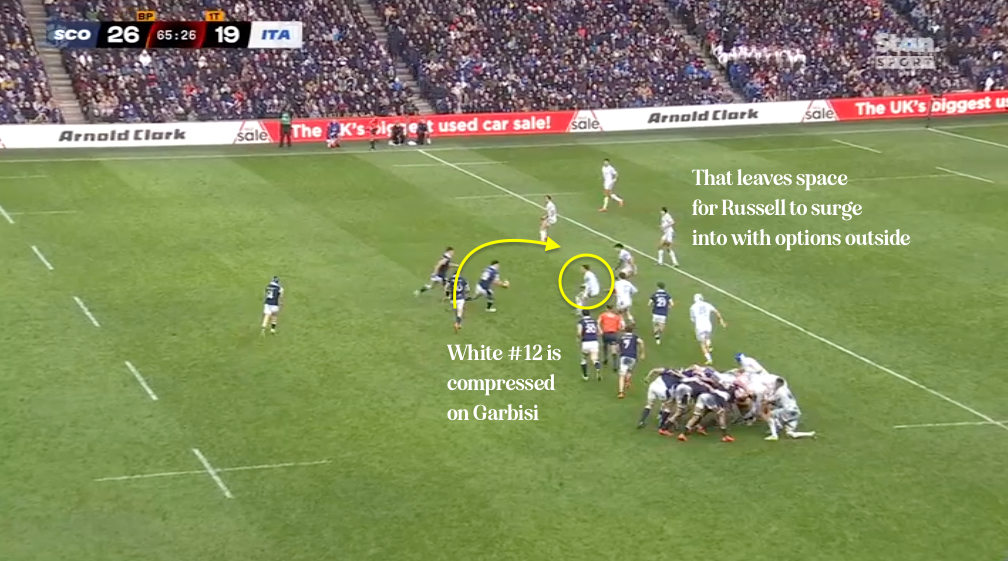
Russell’s work here is superb because he matches up that passing range with real threat on the inside. Italy can never drift onto his targets and once he gets outside of the line of Italy’s #12, he has a rake of options.
This one from deep is another good example of how Russell’s two-way threat is enhanced off the scrum launch, more so than the lineout launch. Scotland would score directly here but look at what that Italian concern over Garbisi’s defence does;
You can’t switch off on Russell’s carrying threat and White, who excels at giving good long passes at pace, is really good at getting Scotland outside a narrow midfield defence.
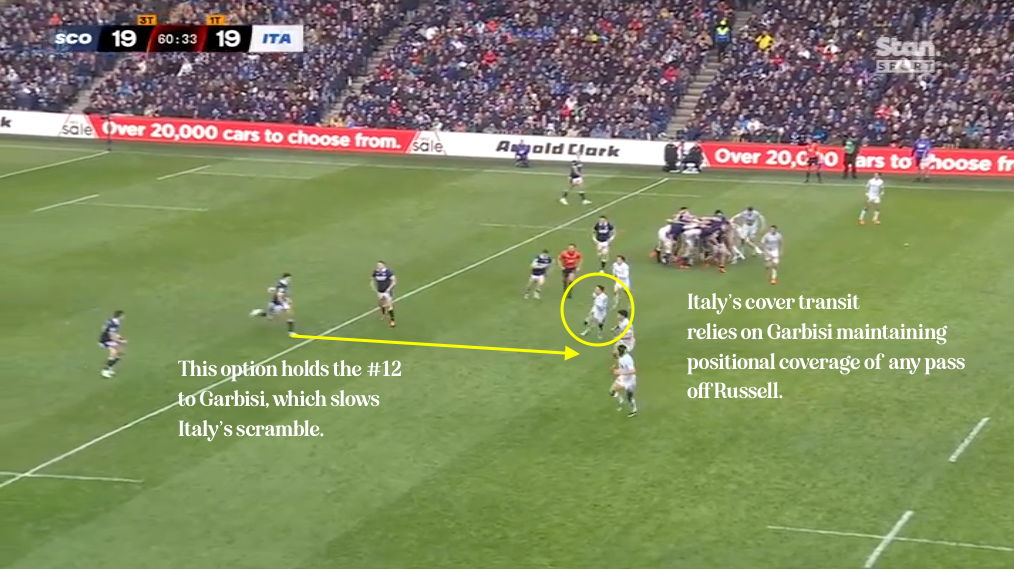
They are going to try and compress Henshaw and Aki while stressing the coverage of Gibson-Park and Van Der Flier across the field. Just like in this clip, watch out for Graham stepping back inside against the grain to attack any pockets of space that flow through the “pipe” of that defensive transit.
Outside of this, I think Scotland will kick an awful lot to put as much emphasis on Ireland’s offensive transition game as possible – I think they think that there are gains to be had against Ireland here, but they will focus mostly on their set piece and defensive transition game – they are faster than us here in almost every unit and they’re going to try and make it pay.
