


What makes a Big Night in Thomond Park?
It’s hard to quantify. There wasn’t a particular buzz around the town before the game – well, that I could see anyway. I walked from the Dunnes carpark to Bold Boy Coffee, around the maternity hospital and up the long road to Thomond Park and didn’t detect the seeds of a Big Night, but maybe I don’t know what to look for anymore.
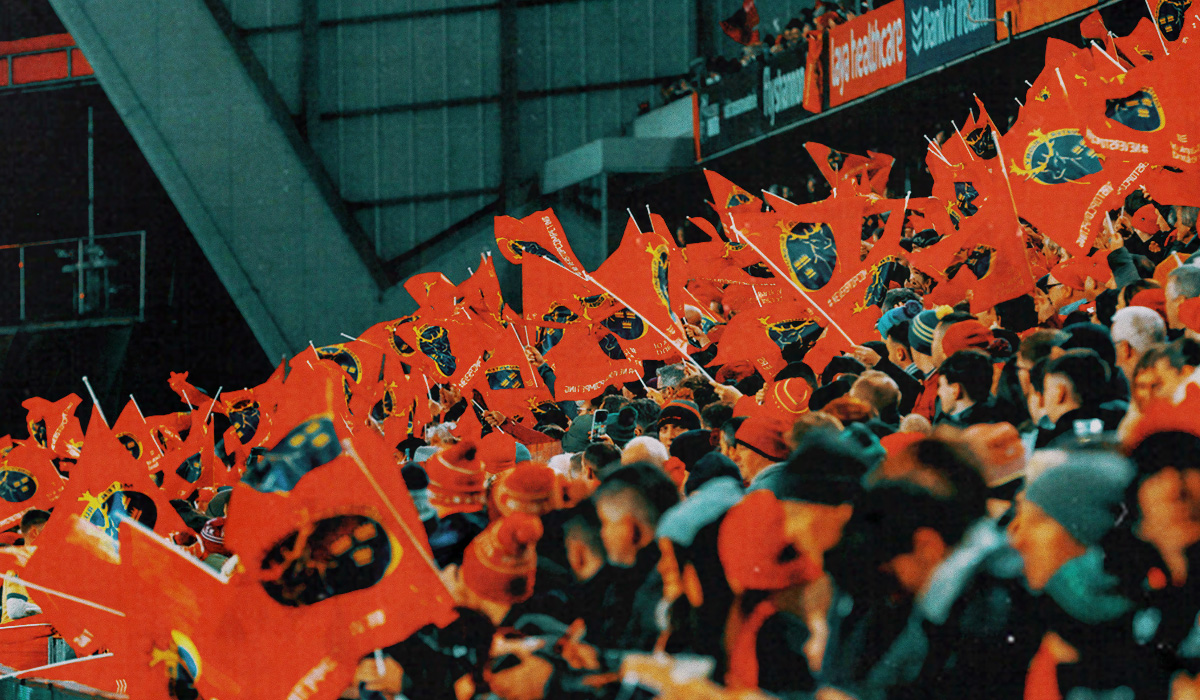
If they’ve been going to the stadium long enough, everyone remembers one of those nights in Thomond Park. I was first in Thomond Park in the early 2000s, and those nights take on a mythical air where everything is louder and everyone is more connected to the field than they might have been in reality.
And then Munster always seemed to win. That encouraged the crowd to be louder and more intense the next time. You saw the impact on the field and wanted to be a part of that again. The energy we gave seemed to be reflected by the players, which we then reflected back onto them. Results followed, and the circle of intensity was complete.
I’ve been to Thomond Park plenty of times recently when that’s been the case, so these nights are far from over, but they can never match those in our collective memory.
Until Saturday night.
The one way to know that the crowd is properly into a game is during the half-lap that the players do after the warm-up to get back into the tunnel on the East Stand. You’ll know straight away if it’s going to be one of those nights. You’ll hear it, you’ll see it, you’ll feel it. It starts with the noise on the West Terrace when they spot the players getting into formation and then it loops around the stadium, especially in the East Stand when they’ve been cued up by the noise on the West.
At its best, it crushes you like a landslide of noise tumbling down onto the pitch. You feel it.
On Saturday night, I felt it. Everyone did.
Maybe it was being cooped all week with the snow. Maybe it was because we were playing Saracens. Who knows? But something clicked with the crowd and it produced a memorable night in Limerick that won’t soon be forgotten.
***
When I’m at these games in the press box, I don’t really act like a journalist – whatever you think a journalist might act like. Whenever I look up at the lads during the game they look miserable. I suppose they’re “at work”. I don’t see what I do as “work” in the traditional sense. Maybe it’s because actual work always made me miserable. After all, I’d rather be doing something else, so why wouldn’t I be miserable? So being at a game like this and having it be “work”? Dream street. The best seats in the house, a desk, a TV, and a plug for the laptop. It’s a privilege, and I never forget that.
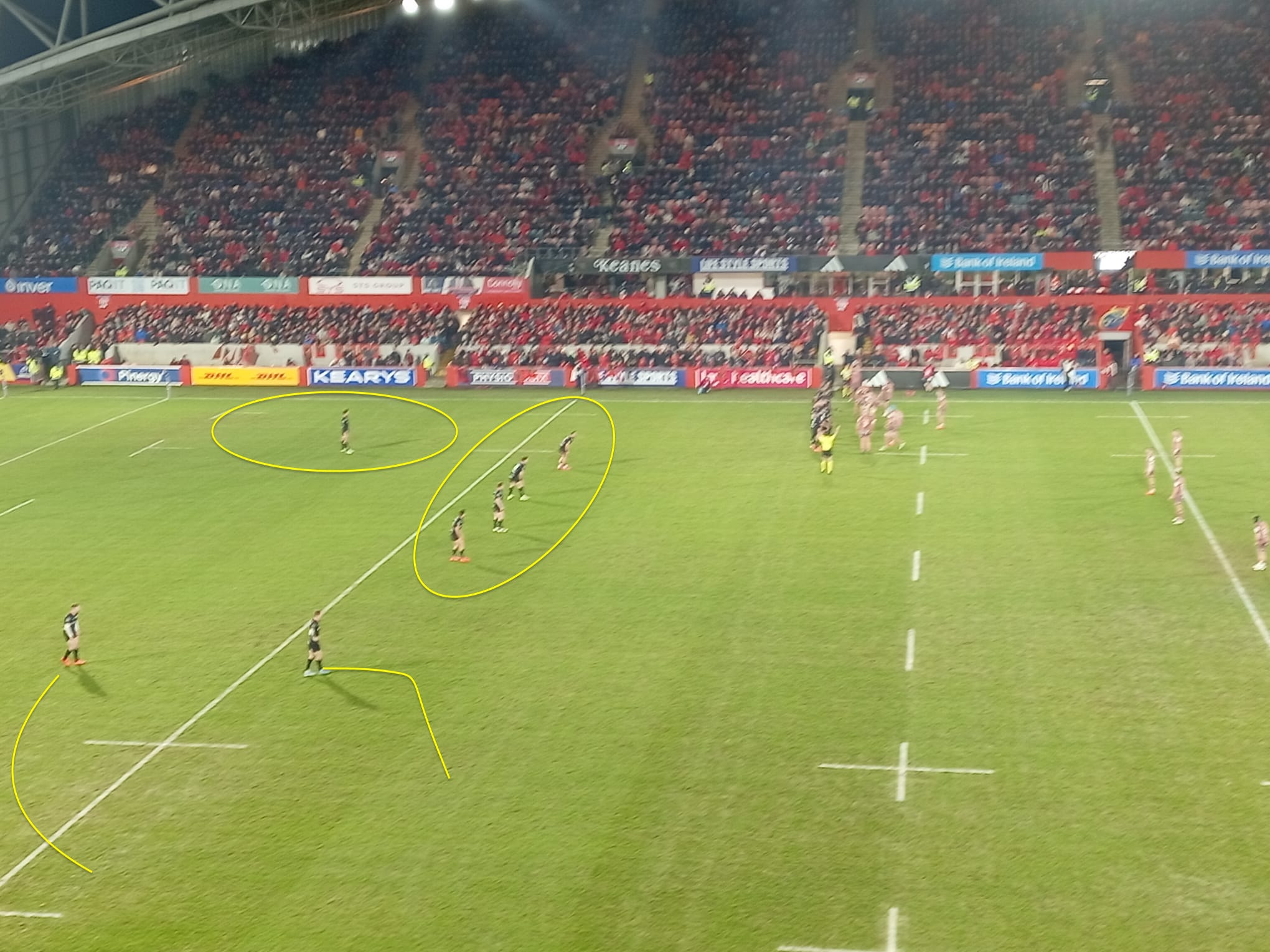
At the desk in the press area, I’m taking notes on my phone about backfield alignments, I’m looking at who’s occupying certain zones on both sides of the ball, phase play and set piece and I’m seeing who’s talking and who’s organising.
For example, I mocked this up during the game in the first half so I could get a head start on my analysis of the game on the watchback which, of course, is filmed from the other side of the field.
I don’t like to be in the press room any longer than I have to be to either get coffee or the complimentary curry/steak burrito. I like sitting in the stand from 90 minutes to two hours out, watching the warm-ups and feeling the buzz in the ground by almost steeping myself in it. I am a large bald frog, boiling in the atmosphere of the stadium.
You’d be surprised at what you see.
Alex Codling, the Munster lineout coach, catching up with old friends or compatriots on the Saracens staff before doing a very thorough warm-up of throws with both hookers that were almost entirely to the tail of the lineout, something we didn’t do once in the game itself.
Saracens doing very rudimentary walk-throughs of their phase play that didn’t once feature the kicks over the top of our defensive line, something they did repeatedly during the match itself.
Saracens standing as a large group around the middle of the pitch before Munster came in, almost visibly taking “ownership” of the ground itself, something Glasgow Warriors also did at the end of last season when a large number of their players walked around barefoot as if they were at home in their houses. Small moments of disrespect to us, bravado and collective will from them.
At this level, the match begins when you wake up in the morning and only finishes when you go to sleep that night. Everything is important, nothing is insignificant.
***
One thing was clear early in the match, Saracens wanted to get at a weakness they’d rightly identified in our game; we’re a little slow in the middle of the field and the backfield at the moment.
A lot of that is due to injury, but some of it is embedded in our most experienced players. Sarries have broadly the same issues carrying the ball as we do – only Vannes and the Dragons have a lower dominant collision rating than Munster and Saracens so far this season – and they tried to get around it in this game with a short kicking game to target our drop back and scramble from the back pins.
They especially liked to do it from their preferred scrum launch platform where they could broadly predict where certain players would be stacked in defensive positions.
Here’s a good example;
They knew that we keep Haley and Daly in those backfield spots off any kind of scrum with a lopsided launch spot so went after the space that must be in the middle to try and beat them across the field to the ball. It almost worked.
The same thing is true for lineout launches where the positioning was equally predictable and scoutable pre-game.
On a wet, heavy, slippery pitch it gave Sarries valuable field position and they did a good job of snatching any penalty opportunities that came their way in kickable range.
Three. Six. Nine. That’s how Saracens tried to eat the Thomond Park elephant – one bite at a time. Their kicking fueled it. This was another example from inside the first quarter where they set up for the kick as part of the lineout scheme – they deliberately left Maro Itoje on the wing post-lineout to apply pressure on the kick chase they knew was coming.
For our part, we tried to use the “late wipe” to allow the contest in the air with Scannell and Farrell staying on the line of the ball before splitting away.
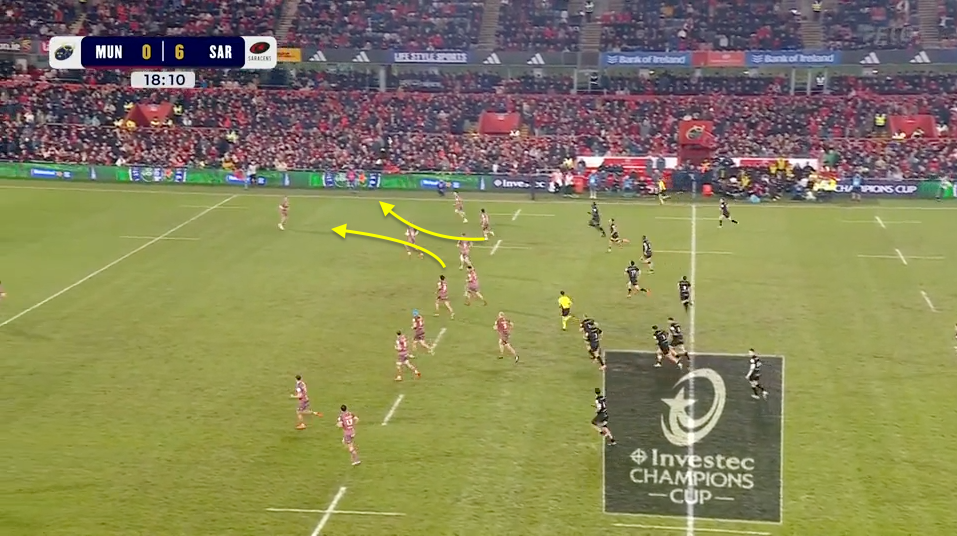
It serves as an escort of sorts in that it obstructs the view of the catcher for a time, but the pressure is still on the player in the backfield to take the ball and Daly withered under the pressure of Itoje here to force another handling error from Munster. It was the night for it, it seemed.
That made for a very scrappy first half that hinted at how little Munster trained during the week; loop lines looked a little clumsy, albeit on very heavy pitch, and screen passes weren’t as sharp as they needed to be. At the same time, there was a freshness to Munster’s work in the collision on both sides of the ball that helped at key moments. A balance can be found there I think.
Saracens’ kicking game and our subsequent trouble retaining those kicks nerfed our work on kick transition, which has been our most improved area of play so far this season. When we get an opportunity these days, lads are primed to have a crack in open field against off-ball teams.
This was almost a try for the ages if not for an eye off the ball late in the play but it highlights what we’re empowered to do.
The new law tweaks around kick escorting will result in more kicking, yes, but we’re trying to build some poison to that – with more pace in the backline, I think we’ve got more than enough to hurt most teams but it’s the intent that’s key. When it came to it, the decisive, match-winning try came from this very area of the game.
Saracens kicked a lot all game – so did we – but excellent pressure by Ahern, who made up nearly 50m to pressure Tompkins into a dud exit gave Munster a chance to attack in transition.
It started with an excellent, hard run back by Nash with a killer, cleanout to guarantee possession.
Keep an eye out on this clip for Rory Scannell filing out to the wing once he sees Tompkins return to the kick. He goes from an edge defence position to holding width in post-transition phases as the kick goes up. This is instead of filing infield to act as a layered handler or a direct carrier.
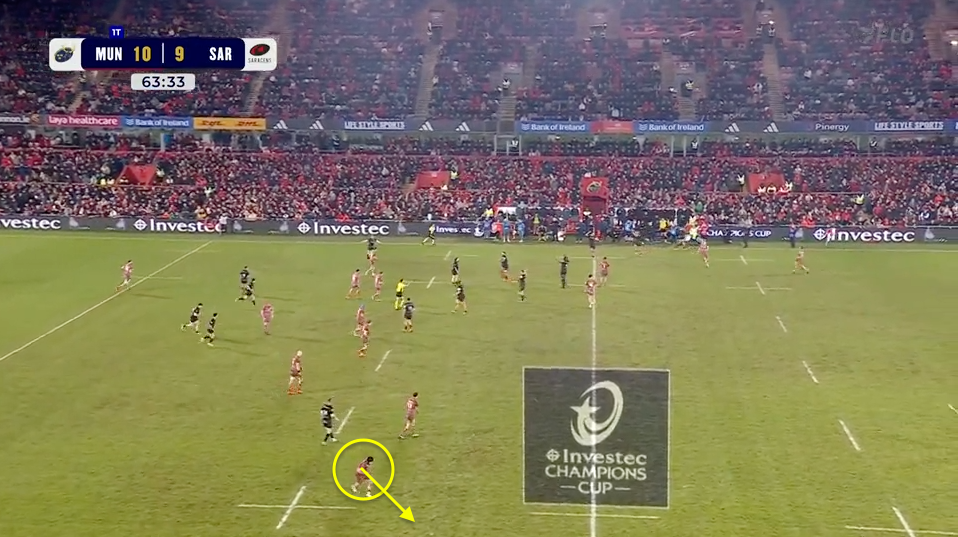
Once that ruck is secured, we’re moving pretty directly towards a kick to the edges of the play. Saracens defend with a narrow, inward blitz so we know that there will be space in that 15m tramline if we’re accurate. But we have to also hold their scramble and we did this really well with a tip-on pass from Barron to Beirne that attacked that inside press.
There’s that diagonal inside press. Barron’s pass sent Beirne outside Wilson into Lozowski.
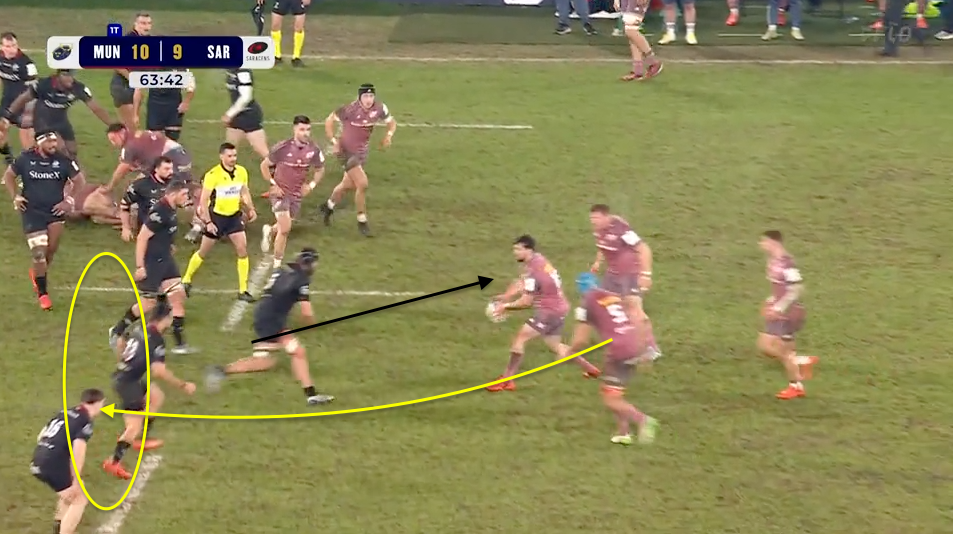
That ended up trapping ten Saracens defenders in around twenty metres of lateral space, which opened up the kick space on transition that we were looking for.
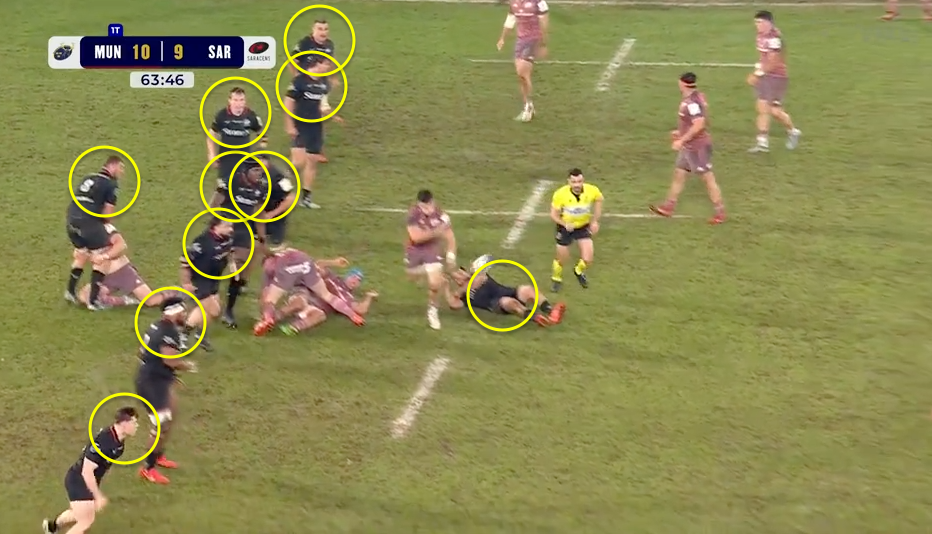
We ran a three-pod off Crowley which held that middle line of Saracens’ defence and opened up the target for Crowley to kick to.
The kick was right on the money and it opened up this isolation in that flow space at the edge. This is the kind of space that we’re keyed up to attack. There’s so much space to cover, the right players in attack can draw and stick any defenders.
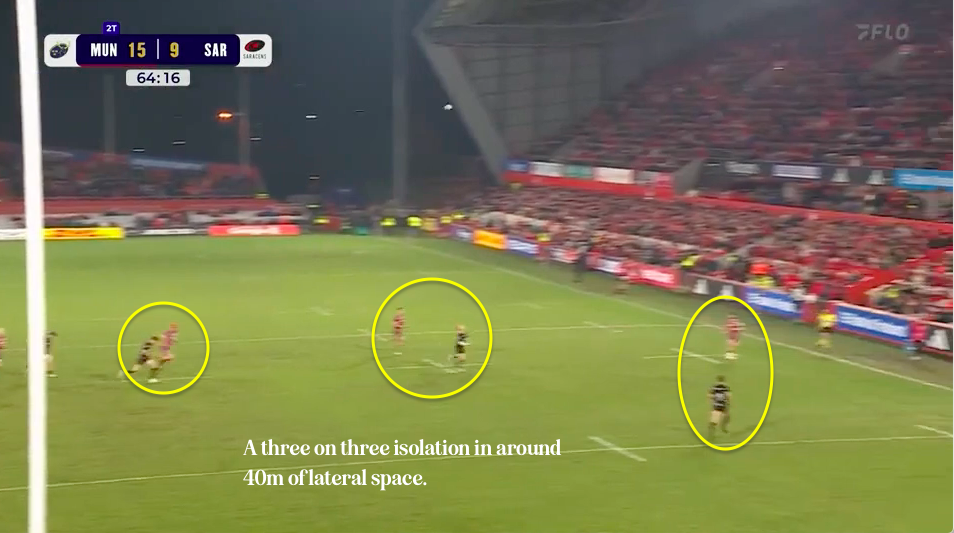
What we saw then from Scannell, Farrell and Hodnett was far from simple but they were schemed to be in just such a position and work on this kind of execution as a point of difference.
It decided the fixture.
***
There was enough grit inside Thomond Park that we didn’t need the extra grit traipsed in off the roads outside on Saturday night. Maybe it helped. The performance was exactly the kind that Munster’s name was built on – tough, hard-working, even making things slightly harder for ourselves than needed, but always with uncompromising, intense support in the stands.
Saracens played such a well-drilled game and won so many key successes as they did with their kicking game that it strikes me as a fixture we’d have lost this time last year. So much of the pattern of this game reminded me of Northampton’s win here last season; they kicked 12 points that day too and killed us with sucker punch tries, one of which we almost conceded right at the end of the game but for superb defensive work from Jack Crowley and John Hodnett.
There is more to this Munster side than we’ve seen for much of this season – much more. But now’s the time to show it. Franklins Gardens awaits, and revenge if we can take it.
If we can, a much brighter second half of the season awaits.
| Players | Rating |
|---|---|
| 1. Dian Blueler | ★★★★ |
| 2. Niall Scannell | ★★★ |
| 3. Oli Jager | ★★★★★ |
| 4. Fineen Wycherley | ★★★★★ |
| 5. Tadhg Beirne | ★★★ |
| 6. Jack O'Donoghue | ★★★ |
| 7. Alex Kendellen | ★★★ |
| 8. Gavin Coombes | ★★★★ |
| 9. Conor Murray | ★★★★ |
| 10. Jack Crowley | ★★★★ |
| 11. Shane Daly | ★★ |
| 12. Rory Scannell | ★★★ |
| 13. Tom Farrell | ★★★★ |
| 14. Calvin Nash | ★★★ |
| 15. Mike Haley | ★ |
| 16. Diarmuid Barron | ★★★ |
| 17. John Ryan | ★★ |
| 18. Stephen Archer | ★★ |
| 19. Tom Ahern | ★★★★ |
| 20. John Hodnett | ★★★★ |
| 21. Paddy Patterson | DNP |
| 22. Billy Burns | N/A |
| 23. Brian Gleeson | ★★★★ |
