


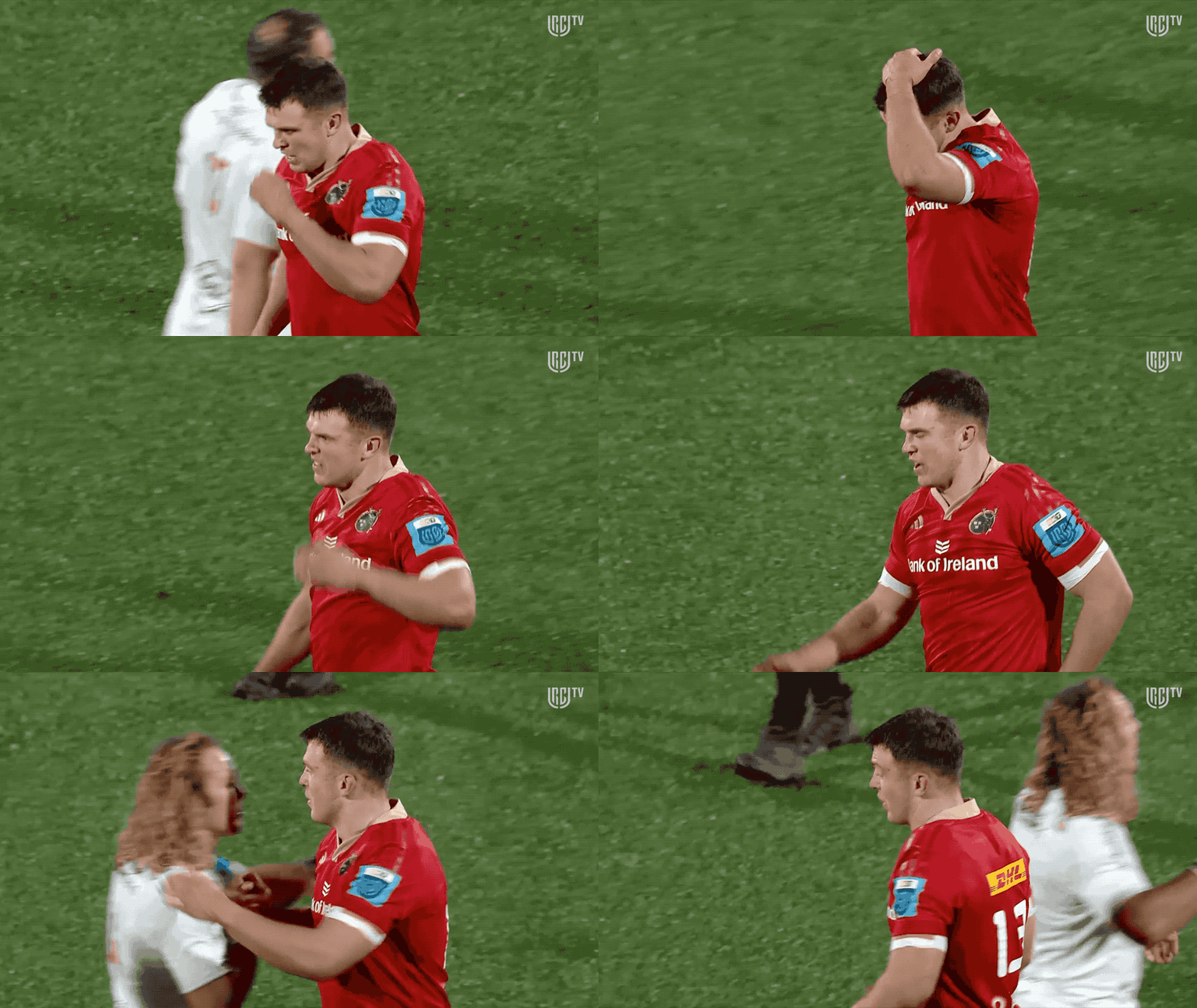
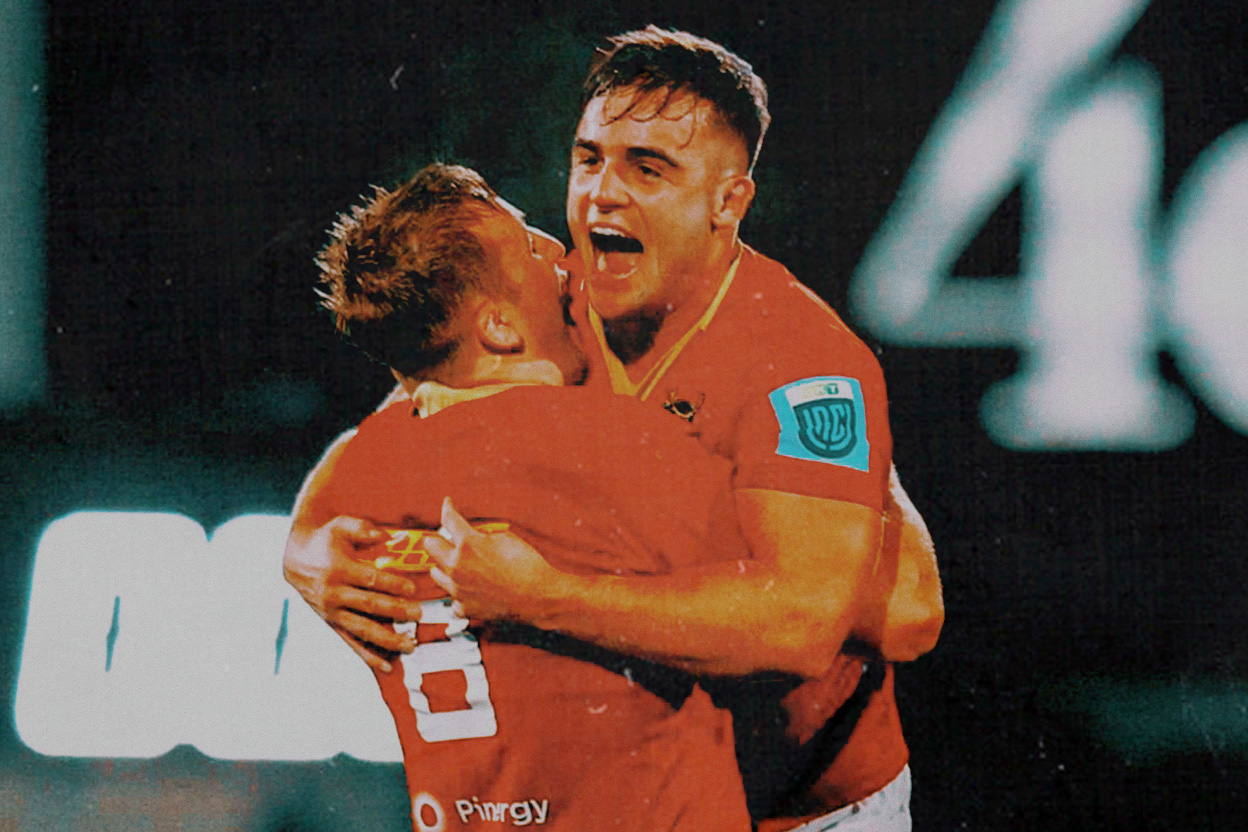
The red card shown to Tom O’Toole around the half-hour mark of this game will take up a lot of post-game oxygen but it shouldn’t. Munster’s last-gasp win and Ulster’s last-gap loss didn’t have too much to do with it.
If anything, it showed up some of what I wrote about in the Red Eye pre-game. Based on the stats so far this season, my theory was that Ulster would play a very narrow game based on kicking to the right area of the field and then staying there. With O’Toole red-carded, Ulster returned to eight forwards almost immediately and surrendered a back before doubling down even more on that short pass and carry game.
They had a pass-per-carry ratio of 1.03 on 183 carries. That is insane, but it echoes the received wisdom of getting a forward red-carded in the modern game. Get back to eight forwards immediately, drop a back three player to the bench, and then narrow the game up to retain the ball at all costs.
Stade Francais did the same for 20 minutes when they went down to 13 men a few weeks back, Northampton did it in Thomond Park last season and Ulster did it here.
I think most people are familiar with how a soccer team that is reduced to 10 players might play. Drop deep. Keep it compact. Concede possession and make yourself difficult to break down. Refuse the temptation to get drawn out of shape so you can be counter-pressed and killed on transition. In soccer, you control the width of the game easier without the ball. In rugby, it’s the opposite. You hang onto the ball in narrow, un-poachable carrying lines because if you have the ball, the opposition can’t score, even if you can’t score either.
If you get a bit of luck with penalties, you can advance up the field and end up scoring with that same narrow strategy. Play the game across the full width of the pitch- you lose. If you keep the game within a 10m lateral space at all times, you might win.
And Ulster almost did.
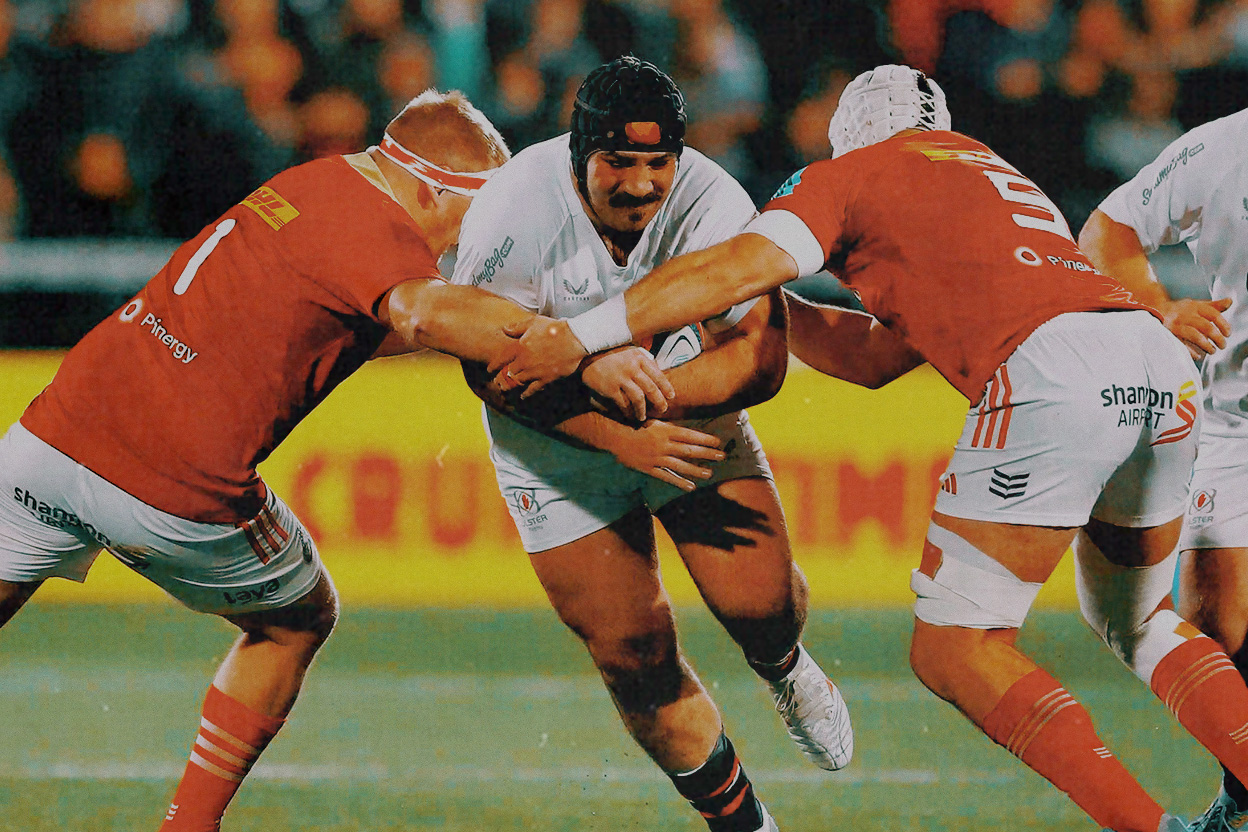
When they kept the ball narrow, they picked up sloppy penalties from a Munster defence, kicked deep and pressured Munster deep in the 22.
45% of Ulster’s possession was inside the Munster 22 on a day when they owned 72% of the ball. Munster essentially off-balled Ulster here. I say “essentially” in this instance because I don’t think this was an explicit strategy coming into the game, it just occurred as part of the tangle of strategy and counter-strategy.
We made 293 tackles with a 93% success rate but only attempted jackal turnovers when the ball went to width or broke through the line. You can see the concept here – two-man shots, quick roll away, a step back from the ruck to eliminate offside penalties, and connected line speed at the first receiver as part of an inside-out press.
You can see it here pretty clearly too; all of those principles are there and it gets a deep kick back from Ulster. Ulster were going to play narrow anyway and we knew that coming in. As a result, we schemed to stuff them in contact just like this and hurt them when they released but, with the red card, that release never really came.
So it ended up being Ulster narrowing their game down and kicking almost exclusively when the target could be around Munster’s 22 – with Kok primarily used to shut down transitions – and Munster defending in a way designed to burn out Ulster, with a choke tackle focus in some carries that went beyond Ulster’s first receiver.
It made for a claustrophobic game that primarily turned on penalties and transitions.
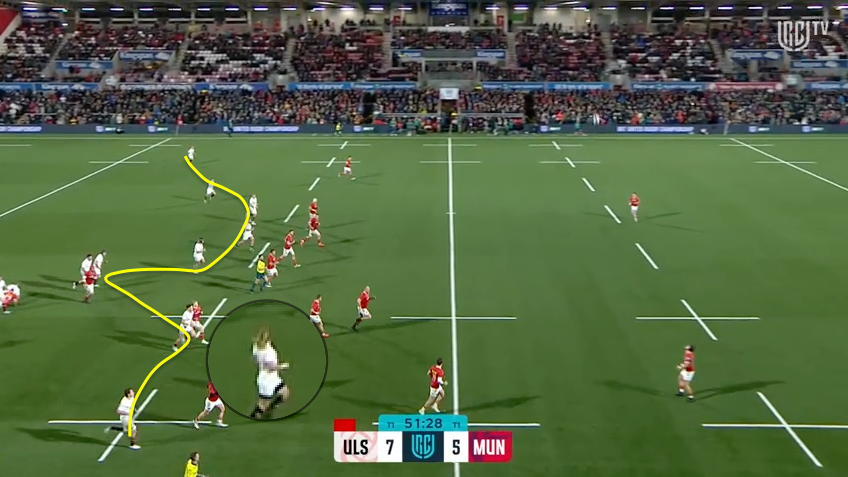
For example; Ulster were criticised for “a bad exit” from Cooney when it came to this try but I think this was exactly on scheme for them playing with a back down.
Going to touch here – not only incredibly difficult from outside the 22 – would expose that area of Ulster’s defence to a lineout play. He also has to maximise the distance on the kick to make sure he keeps Munster at arms length. Remember, Ulster also know that Munster love getting to the edges of the field, exactly where Ulster have sacrificed a defender.
So you have to pick your poison.
In this instance, Kok was paying a lot of attention to the rest of his chase line to make sure they were connected as he went after Haley.
They almost shut it down, too, if not for a superb kick by Crowley right on the gainline – something he’s been workshopping all season – that found Farrell lurking on the wing. The work from there is of the highest standard with Farrell taking the pop off the floor for his second try.
Ulster defended this well but Munster got the kind of width and accuracy on transition that they couldn’t live with a man down.
On the next play, Kok made a huge play to draw a penalty out of Gavin Coombes on the restart.
And from that starter point, Ulster spent nearly five minutes in Munster’s 22 – with a relieving goal line dropout in between – that ended with Rory Scannell coughing up a needless yellow card. Munster won the ball back on the next defensive set but could only exit 2m up the field with a sliced Patterson box kick.
Ulster eventually scored one penalty and two close-range mauls later, ten minutes after their initial 22 entry. The Patterson exit is the big what-if moment on this set, but it didn’t matter – Munster would score directly from the next restart with another try on transition.
We knew we’d get opportunities from Ulster’s exits; they kick out of their own 22 more than anyone in the URC, 5% more than Leinster. Our execution of those kick exits was outstanding though. Look at this one – again, Ulster kicking long to maximise distance and to the 5m tram to give their transition defence a chance to keep us pinned outside their 10m line.
Again, they defended the first phase well but a power carry by Scannell (!) and a superb pin and swivel pass by Gleeson opened up the space for Nash, Farrell and Daly to make a play.
Farrell starts this sequence on one wing and loops around the play. One of the weird things about Munster’s transition work is that we’ll often stack our midfielders outside our wingers on these loop plays.
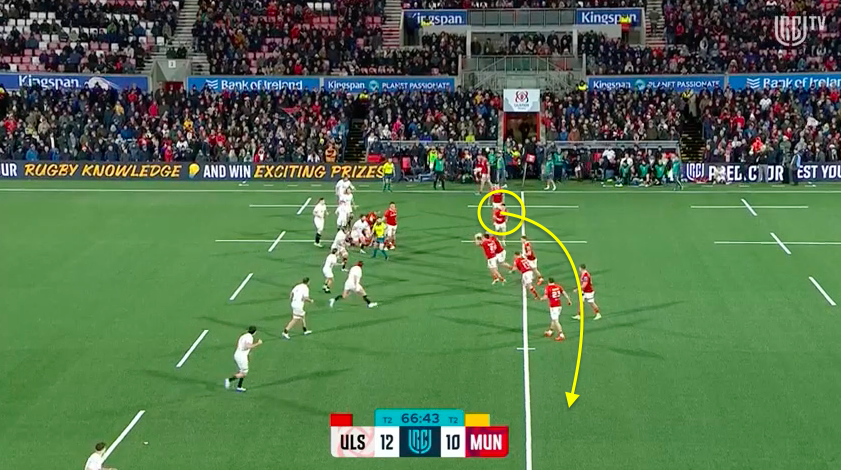
When the play comes around, Nash is the one adding speed to attack the edge of the defence while Farrell lurks on the outside. I went into this about this in his What’s The Story article during the summer but he’s at his best attacking in that 3/4 space. As we’ve seen so far this season, Tom Farrell is the guy you want to give that last pass. He invariably makes the right decision in almost every single case when he’s in a critical position.
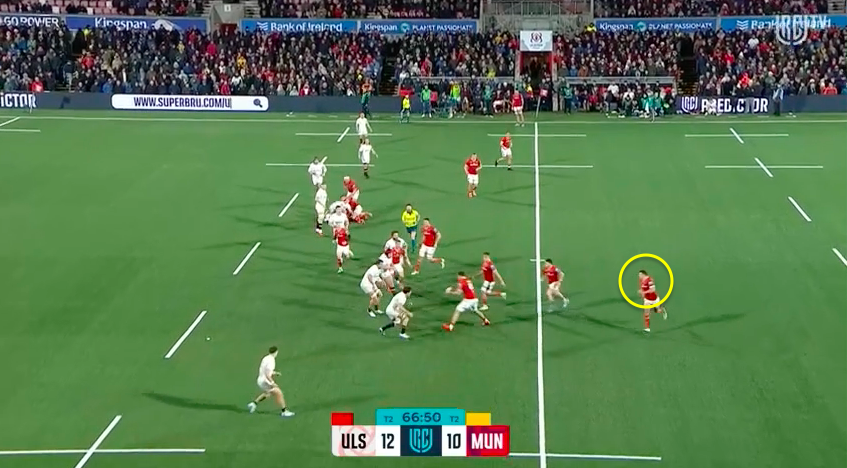
He did that here repeatedly. It was needed, repeatedly.
As the game hit the last quarter, both sides began to make mistakes. We were still very much committed to keeping up the high ball in play time – we have a high win percentage when the BiPT creeps above 40 minutes – but we kept giving Ulster access.
This was the most egregious one from an “option” perspective. We’ve given up penalties a lot on these strike plays this season but the pop to Kendellen here was always going to leave him isolated. And so he was.
That put Ulster into position, five and a bit minutes from time where they could expel all their energy to get the win, either via a try or a kickable penalty. Scannell missed a first up tackle on Wilson a few minutes later and Ulster would crash over for what seemed like the winning score.
But again – kick transition. And two huge plays.
Ulster exited off Cooney and this time he was aiming for touch. Ahern got in with a massive arm to duff the kick. Haley took it on the 15m hash, hit Crowley and then the Munster #10 made a massive gain beyond the Ulster 10 metre line.
From there, we could start working on a tired Ulster defence with Crowley and Farrell hugely involved. This offload from Farrell to Coombes is ballsy – verging on reckless in the moment – but Farrell always knows what he’s doing. He hit it perfectly.
Gleeson hammered home the advantage with another great carry. Then we had Ulster where we wanted them – scrambling and with their forwards compressed on one side.
When we have this kind of momentum – usually generated outside the 22 – our relative lack of tight power is a non-factor and we can use things like Ahern running a loop line like an outside back as a finishing move. Look at the late, late pass from Crowley on this play and look at where Ahern comes from.
And that was that. We’d won, somehow both improbably and as expected.
Not only that, but we won in a very “un-Irish” way. In the last few years, rugby in Ireland has become quite boiled down when it comes to the crunch. Mostly that means penalty>kick down the line to the 22>lineout>try. It is witheringly efficient. Munster hasn’t had that red zone efficiency in the last few years, for several different reasons but it’s a fact. We are the worst Irish province when it comes to converting 22 entries into tries, despite only creating 0.6 fewer entries per game on average than Leinster.
What we have become good at is scoring tries on transition. We are the best Irish province at scoring from turnovers; 4% ahead of Ulster, 8% ahead of Connacht and 19.9% (!) ahead of Leinster.
We identified that Ulster kicked the most amount of possession as an exit in this game and blew them away on kick transition, to the point it’ll bump us up to the top four for kick transition scoring in the league off the back of it. Four tries, all from kick transition, is extraordinary and that’s what it took to win this game as it developed – something extraordinary.
It’s fair to say that Munster are a deeply incomplete side at the moment. We do the hard things well, and the relatively easy things quite poorly. In the first half, there was a sequence off a lineout that is most big team bread and butter – a roll off a lineout that teams like Leinster use all the time to bang away off fast rucks to get to the 5m line.
We don’t move beyond the line of the 22 where the lineout starts after a few promising initial carries.
Running out of power carriers is a common trend with this team, especially inside the 22. It goes wrong on this carry here from Scannell, where we lose our entire front row to a carry that only binds two defenders and doesn’t make the gainline.
We never get the impetus back but we scored a try directly from the kick Ulster used to relieve the pressure! Nash ran it back infield, all of a sudden Ulster compressed a little and Crowley was able to pull open a space big enough for Haley to send Farrell away into the corner.
The first clip is supposed to be the simple stuff. The second is hard. But we seem to have reversed the polarity on it. It’s encouraging in one way because if we can sort the tight stuff, our growing danger on transition could turn us into a top six or seven team in Europe overnight and a far greater threat to the top four, but that remains to be seen if it’s possible this season. Easier typed than done in reality.
With that said, you’ll take a bonus point win like this all day every day, regardless of how scuffed it is because it’s immediately erased our defeat to Zebre from the board. We’re a win off the top four in the URC log, we have breathing room from the dead zone outside the top eight and we’ve showcased that we can be a dangerous team on hard ground. All while winning our first away game of the season.
Worth sticking with, this lot.
| Players | Rating |
|---|---|
| 1. John Ryan | ★★★ |
| 2. Niall Scannell | ★★★★ |
| 3. Stephen Archer | ★★★ |
| 4. Tom Ahern | ★★★★ |
| 5. Fineen Wycherley | ★★★ |
| 6. Jack O'Donoghue | ★★ |
| 7. John Hodnett | ★★★ |
| 8. Gavin Coombes | ★★★★★ |
| 9. Paddy Patterson | ★★ |
| 10. Jack Crowley | ★★★★ |
| 11. Shane Daly | ★★★★ |
| 12. Alex Nankivell | ★★★ |
| 13. Tom Farrell | ★★★★★ |
| 14. Calvin Nash | ★★★★ |
| 15. Mike Haley | ★★★ |
| 16. Eoghan Clarke | DNP |
| 17. Dave Kilcoyne | N/A |
| 18. Oli Jager | ★★★ |
| 19. Evan O'Connell | ★★★ |
| 20. Alex Kendellen | ★★★ |
| 21. Ethan Coughlan | ★★★ |
| 22. Rory Scannell | ★★ |
| 23. Brian Gleeson | ★★★★ |
