


Ulster and Munster have found themselves in the same boat lately.
It’s not a bad boat, by any means, but it struggles with the big waves of European Cup rugby and the grind of playing a sport that has never been more physical and attritional than it is right now. Talk of money and budgets is all over European rugby, like it or not, and both Ulster and Munster find themselves in the middle of the pack when it comes to that conversation. Munster are slightly higher up in the jostle of the middle, and Ulster, currently, are marginally lower but the wear and tear is clear in both.
The thinner your squad, the more injuries will bite and cause more injuries as you try to pull resources from elsewhere. This isn’t your PRO12 or PRO14 anymore. In the middle of the last decade, you could make the semi-finals with seven or eight losses. The year Connacht won the old PRO12, they got an automatic home semi-final with seven losses across the season. That has never happened in the URC so far and never will. With fewer games in the regular season – 18 compared to 22 – there is no wiggle room. Every game is incrementally more meaningful so injuries bite harder. You have to use guys more than you’d like or use players who are closer to injured than they are to full fitness to get through the next game.
We saw that last season – and this season – where injuries beget more injuries as you try to compensate. Last season’s run to the URC semi-final is a great example of this from a Munster perspective; we needed results from February on, nothing gets results like a settled team, a settled team means minimum rotation, which means using your top guys way more than you’d like until they either get injured or look like 75% of the player. The bigger your squad spend, the more options you can use while still winning the games you need to.
Munster and Ulster sit 11th on 16 points and 1oth on 17 points, respectively, in the URC log at the time of writing. Connacht sit in 8th, a point ahead of Ulster. That feels like something of an artificial position for both Munster and Ulster at the moment, but two unsuccessful tours to South Africa are depressing their points – and their fanbases – which goes some way to explaining the malaise that appears to hang around both provinces at the moment. I say “appears” because as with everything in this life, perception is everything.
Munster are still the victim of nostalgia and expectations being wildly out of whack with budgets, for example. Munster aren’t in contention for Europe this season, bar a freakish run of results and fitness, but they shouldn’t be. Not really. It’s one or two seasons too early for this group and maybe two or three players short. No shame in that.
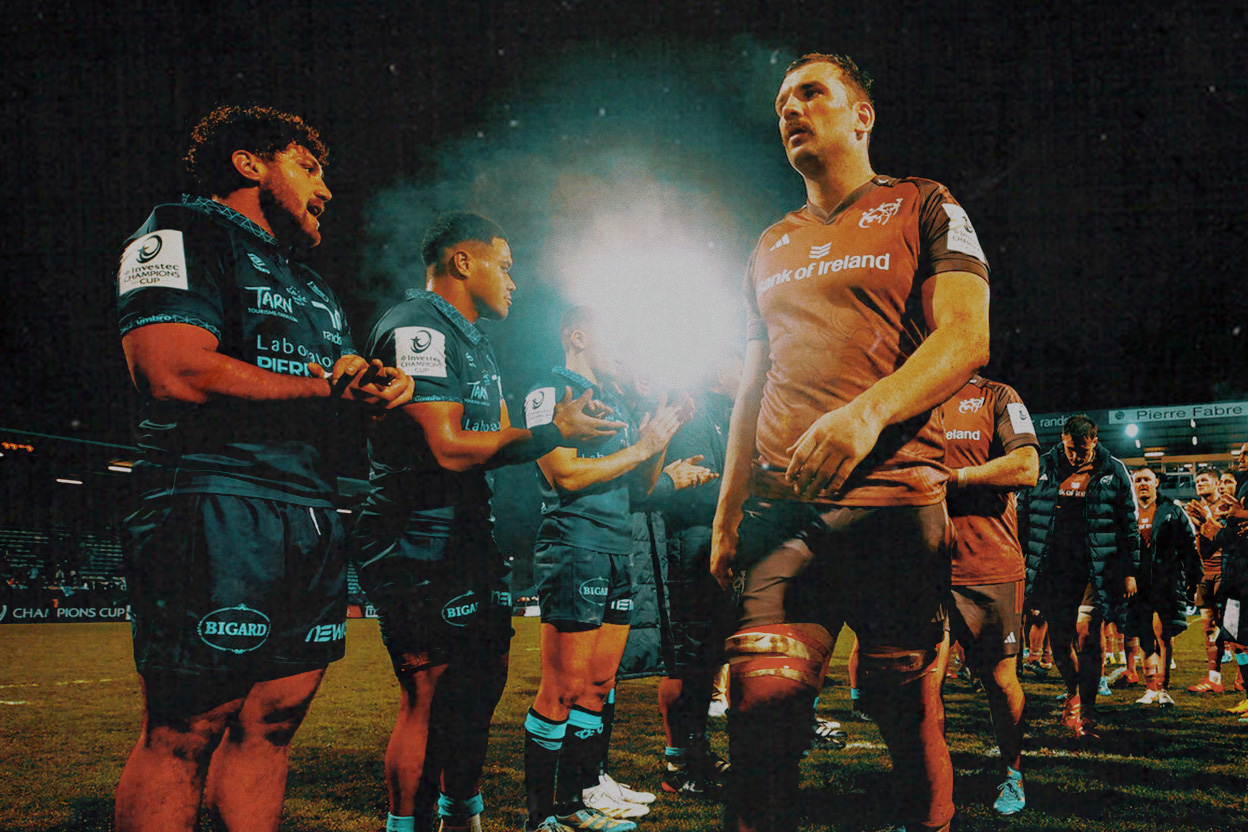
Ulster are in a similar boat, maybe a few more seasons out and 4/5 players short, but they have probably had the two most difficult back-to-back games that it’s possible to have right now. Away to Toulouse and at home to Bordeaux – two sides that can kill you 1000 different ways. At the same time, Ulster are clearly building towards something a season or two from now, so losing to two of the European Big Four back-to-back doesn’t and shouldn’t mean all that much.
Long story short, that puts both Ulster and ourselves on a collision course here. We both need something. Ulster have lost their last four games, including their last home game in the URC to Leinster. Leinster, Toulouse and Bordeaux back to back is a murderer’s row of fixtures – we know all about that with Leinster + our South African tour in October – but losing five on the spin and three in a row at home is not something that will sit well in Ulster, regardless of the context.
At the same time, we know that we’re in danger of getting left on an island ourselves if we don’t start picking up wins. Leinster have budgeted a strong showing for Thomond Park, for example, and after that, our next game in this competition is at the end of January. We need six points at least to put us in range of a home quarter-final finish in this tournament.
Both have to win, neither can afford another loss.
Something’s got to give and whoever does will be left with more than just bruised pride.
They’ll have a season-defining problem brewing.
Munster: 15. Mike Haley; 14. Calvin Nash, 13. Tom Farrell, 12. Alex Nankivell, 11. Shane Daly; 10. Jack Crowley, 9. Paddy Patterson; 1. John Ryan, 2. Niall Scannell, 3. Stephen Archer; 4. Tom Ahern, 5. Fineen Wycherley; 6. Jack O’Donoghue (c), 7. John Hodnett, 8. Gavin Coombes.
Replacements: 16. Eoghan Clarke, 17. Dave Kilcoyne, 18. Oli Jager, 19. Evan O’Connell, 20. Alex Kendellen, 21. Ethan Coughlan, 22. Rory Scannell, 23. Brian Gleeson.
Ulster: 15. Michael Lowry; 14. Werner Kok, 13. Jude Postlethwaite, 12. Stuart McCloskey, 11. Zac Ward; 10. Aidan Morgan, 9. John Cooney; 1. Andrew Warwick, 2. Rob Herring, 3. Tom O’Toole; 4. Alan O’Connor (c), 5. Kieran Treadwell; 6. James McNabney, 7. Marcus Rea, 8. David McCann.
Replacements: 16. John Andrew, 17. Eric O’Sullivan, 18. Scott Wilson, 19. Harry Sheridan, 20. Matty Rea, 21. Dave Shanahan, 22. Jack Murphy, 23. Rory Telfer.
Leinster’s first full season under Richie Murphy was always going to be difficult. The last few years of player movement at Ulster have been similar to Munster’s in some ways; lots of work trying to dance around signing players where they’ve really been needed. Compensating for one area by buffing another.
For Ulster, they’ve often got the tight power forwards and even the props that Munster have so badly needed but then spent long months ruing a general lack of top quality in the second row and at halfback. Pulling yourself up by the bootstraps hasn’t just been the preserve of Munster in the last 10 years. Ulster have been the same. Sometimes one side or the other manages to pull a little harder and hop a little higher, but it’s still the same impossible challenge at the end of the day and has been ever since they were forced to drop Ruan Pienaar in favour of Irish-qualified options that went on to earn a mighty 11 caps in seven years. The right thing in theory, but the wrong thing for Ulster, as good a player as John Cooney went on to be for them. Imagine how good he’d have been alternating with Pienaar for a few years.
What a pity that it took very recent NIQ signings for that kind of value to finally be identified.
Under Richie Murphy, Ulster have done pretty well, recent results aside. It’s an easy thing to say, but they’re better than the last four losses suggest. They were right in the game against Bordeaux until the Wine Boys (a nickname of my own creation) flicked the “Bullshit That Works Somehow” switch and pulled away in the last half an hour. Almost everyone is going to get walloped by Toulouse – home or away – so there’s no point focusing on that.
I think the Ulster we’ll see tonight are far closer to the one that almost beat Leinster but couldn’t quite get over the line at the end of November.
Structurally, Ulster will tend to kick quite a bit when they’re on the front foot but primarily in the mid-distance. They are in the middle of the pack for average metres kicked – around 30.19m per kick per game. Leinster are sitting on an average kicking distance of 30.27m, albeit on a lot more volume. Munster are on 28.4m per kick on average on fewer kicks than Ulster and much fewer than Leinster.
What does this mean? The closer you get to an average of 25m per kick per game, the more likely you are to be a box-kicking team. The Sharks, for example, are on an average of 24m per kick this season, which stands to reason given the weight of their pack.
Shorter kicking distance correlates with heavier packs, on average. Longer kicks generally favour lighter teams. Munster are an outlier in Ireland in this regard given that we’re arguably running lighter than all of the other provinces in the pack at the moment but this stacks up when you see what our strength has typically been over the last few seasons – our scrum, our defence and our ability to score off turnovers.
Last season, we were in the top five for scrum completion rate and in the top ten for the fewest scrums lost via penalty. Those numbers have tracked to this season. What do they mean? When you kick shorter distances, one of the most likely outcomes is a scrum. If you kick short and advance 25m up the field and you have no fear of conceding penalties at the scrum, while also having a very effective set-piece defence – as Munster does – you can bottle up opposition teams and get them on the back foot almost unbeknownst to themselves.
They keep falling backwards and they don’t quite know why.
From Ulster’s perspective, that kicking distance fuels a very short-range carrying game that looks to release players via offload. Ulster are in the #1 team in the URC for the percentage of short – less than 5m – passes they make. As a result, no team in the URC draws more two-man tackles. They are bottom of the URC for the percentage of Medium (5-10m) and Long (10m+) range passes.
What does this tell us?
They look to use their weight in the pack and midfield to force central compressions that they will then try to skip out and around.
This is a good example of some of their good work in the tight with the “bounce” out I was referring to. For reference, this is off a long exit by Leinster where they offloaded out of the initial contact – something they will often do when they have space on transition.
Look for Postlethwaite to show up in this winger spot quite a bit on post-transition phases. Ulster use Kok as a roving loop player on these phases so shows up pretty much everywhere. Postlethwaite’s size makes him an edge mismatch for most defenders.
Kicking long to Ulster brings out most of their best work.
It’s where they are most likely to offload and find a linebreak, and most likely to find easy collisions. As you’d expect with Richie Murphy, they play with solid counter-transition fundamentals and get into shape very quickly off those first rucks off long kick exits.
So how do you deny them this? Kick short and contestable to deny them the first counter-transition structure mismatch and getting the ball to the touchline for a lineout.
Ulster are in the top two for lineouts thrown to the front in the URC but in the middle of the pack for successful completion. They are in the bottom two for lineouts thrown to the middle while being well under two metres per successful maul on average. What does this suggest? Maul feints. Lots of them.
This is a fairly classic Irish style movement over the last few years. Leinster and Ireland use this type of action a lot because of the default compression it brings and how useful it is to get McCloskey one on one with a flyhalf for a burst carry.
There is value to choking off the front with O’Donoghue as a constant counter-launcher and then using Ahern as a nightmare throw-over in the middle, where Ulster really don’t like going this season.
Disrupt them there, and we take away a lot of their primary weapons.
