


“The gunshot holds no fear. You welcome the sound. In fact, it’s the sound that sets you free.”
Denzel Washington, Man on Fire
Everything you see between the white lines in this game relies implicitly on everything else you see in a way that can’t be easily untangled. Your system is your players; your players are your systems and all exist in a knot with each other. When you look at teams that are underperforming relative to their budget and expectations, there’s always a conflict between systems and players that can sometimes be something so small as a “;” in a line of your team’s internal, metaphorical code. Sometimes it’s something bigger; the plutonium rod hidden behind the radiator.
This is shorthand for saying that if one part of your game doesn’t work, it’s very hard to compensate with other parts of your game. Some players are so good that they exist outside of the gravity of system problems – Dupont, for example – but everyone else is touched by their cold, flailing fingers in one way or another.
In the last 18 months, we can now be pretty sure that Munster’s lineout was the plutonium rod behind the radiator. Its effects have been profound on our system and our players.
Look at Diarmuid Barron’s performance in this game. He looked like a guy who you could put in test rugby and not worry about. Look at Fineen Wycherley’s performance – he looked like the guy we hoped he’d be when he hung Sexton up by the collar six years ago. What is the common denominator? Having a lineout that was so functional that we were able to run four-man schemes in the middle of the field for large stretches of both halves.
You rarely see a team pull a four-man lineout scheme in this area of the pitch because… you just don’t. A four-man lineout takes the three-shell game of the set piece and turns it into a two-shell game. You trade the opposition being able to counter against you with set lifters by backing your movement and impetus to get clean ball to furnish an exit. It’s why you see teams using this on their own 5m line or inside their 22.
Except – we didn’t treat it that way.
You can see in the above clip. We took a shortened three-shell game where our jumping unit and one dedicated lifter took Stade through the wringer with clever, logical feints and sharp movement. I can’t even imagine what this might have looked like in October.
Here’s another early lineout where, again, logical planning and expressive feinting opened up a window in the middle for Barron to hit.
O’Connell’s feint was… realistic. I have seen many lineouts this year from Munster where the feints were, and I’m being charitable here, unrealistic. Barron still has to make the throw, of course, and it’s tricky in this wind but he makes it because he believes fully that O’Mahony will be there when he does.
Diarmuid Barron’s big strength when he came up through the 20s and into the senior team was that he was an excellent thrower of the ball. He had all the shapes, all the tempos and had a great tight spiral but, in the last few years, you really wouldn’t think that. Here, without the lineout consuming mental bandwidth like a Call of Duty install, Barron was able to impose himself around the field and become visible in more areas than just looking nervous every time the ball was kicked down the line.
This Stade Français side builds a lot of their game around their defensive lineout and its ability to force turnovers from which they are one of the best in Europe at converting into tries. From a statistical perspective, they were the biggest challenge to our set piece all season so far. Only three more teams in Europe have won more opposition lineout ball this season than the Parisiens – 19.9% of the lineouts they faced so far, they’ve stolen.
As a guideline, if you were to apply that 20% to our South African tour – where we ran at an average of 73% as part of a season where we were at 78% completion for the season before the October break – it doesn’t really bare thinking about what damage they could do.
And, let’s be clear, they competed pretty heavily here all the way through and they just couldn’t lay a finger on our throw. That, all on its own, is a sign that the invisible radiation that has been skulling our season might be contained.
But that’s not all.
Look at the impact that Dian Bleuler had on this game and, indeed, the last two games. I don’t think that Bleuler’s incredible work across both games – 14 carries and 15 tackles on average across both games with 0.23 carries per minute during his 69 minutes on the pitch here – is unconnected from the improved performances we’ve also seen from Fineen Wycherley in both games. The work that Bleueler does in bulk and with incredible regularity across his time on the field lets guys like Fineen Wycherley use his physicality that little bit more freely in the middle space of the field and against the fold of the defence. Not only that, Bleuler has produced some excellent lineout lifting in the last two games that, along with the stellar work of Alex Codling, has made a palpable difference to how everyone else looks. Wycherley amongst them.
“In fact, it’s the sound that sets you free.”
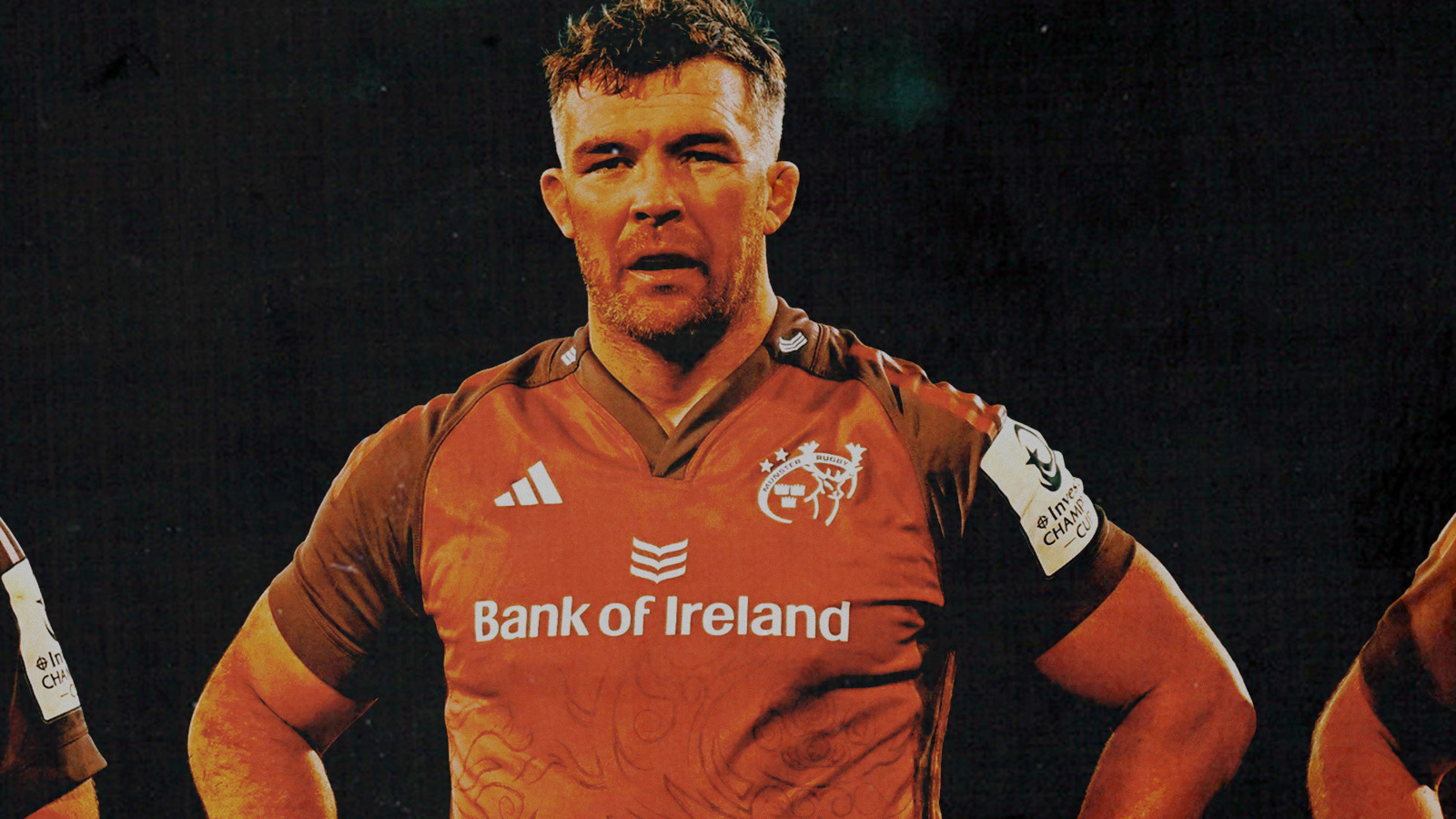
When a game gets as scrappy and nasty as this one did, there’s nobody in the game I’d rather have on my team than Peter O’Mahony. O’Mahony understands that this game is just a bad tackle away from descending into something you might see outside a nightclub at 2 AM. He understands that intimately and plays with that in mind when he’s playing at his very best and fully focused. I’ve often felt that, in the last few years, we haven’t seen that version of Peter O’Mahony in a Munster jersey all that often. That Peter O’Mahony has, more often than not, had that focus for the Irish jersey. Sure, there’s been flashes of the War God for Munster but they’ve been few and far between. Last season, in particular, I felt that O’Mahony cut a vaguely disinterested figure as the season wound to a close in the URC knockouts. Games passed him by. When O’Mahony is in full-on War God mode, games do not pass him by; they are stopped in the road in front of him to get their pockets ran and shoved on their way, forever changed.
That was the O’Mahony we got in this game. Focused. On it. Seething at slights, physical and otherwise, that he seemed to know were imminent. His work in the lineout on both sides of the ball was outstanding and he showed what he has to offer the club going forward.
When he plays like this, few players in the game alter the flow of a game with this regularity. Lineout has always been his superstrength, even when its value wasn’t fully known, but as long as he’s got that spring in his boots, there will be a role for him at the top of the game. As long as he’s got that fight and mongrel in him, he will – and should – have a central role at Munster.
With the lineout running at 100% and super efficiently at that, we got a look at what Munster’s performance levels look like when we can retain the territory we win off the opposition and see what our structures are supposed to look like when we’re not scrambling for a loose ball or flexing into transition defence mode.
Turns out that it’s pretty good. Sure, our attack has a lot of moving parts and relies on high levels of accuracy in our handling and passing lines – more so than teams who play a narrower, safer game – but that’s what we feel will be a point of difference for us.
We really come alive on transition ball. We haven’t really clicked yet on kick transition – we still need some work there – but our work on turnover transition and turning that into 22 entries and tries is genuinely one of the best in Europe.
Here’s a good example of our attacking work after forcing a turnover;
Look at the actions of O’Mahony and Nankivell in particular as the play develops. They start on an against-the-grain loop route to force a sleeper overload on the Stade Français defence as it reloads. This is the beginning of the loop route;
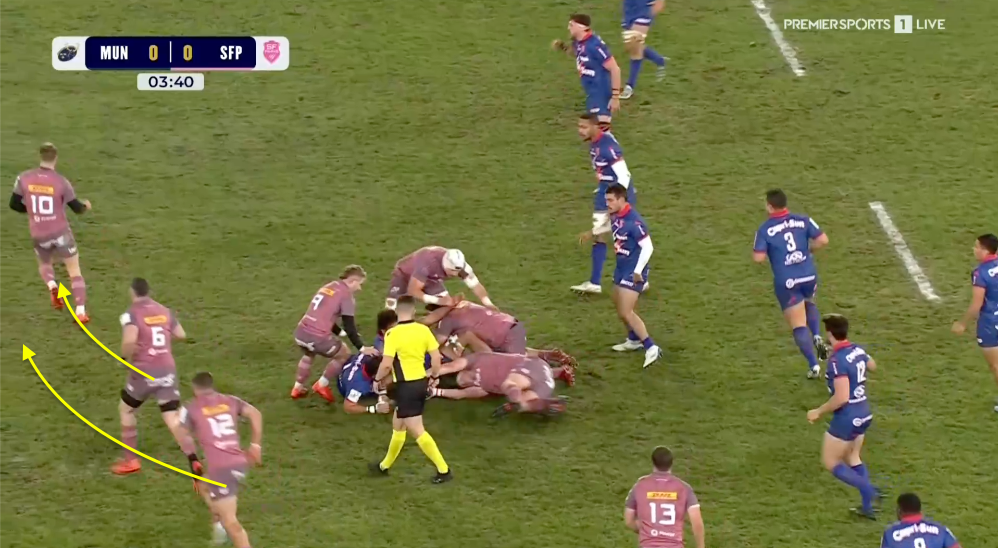
But look at the picture on the previous carry. Stade clustering around the ruck to cover for their multi-man hits in defence. What does that leave? A fraying edge in the direction the play came from.
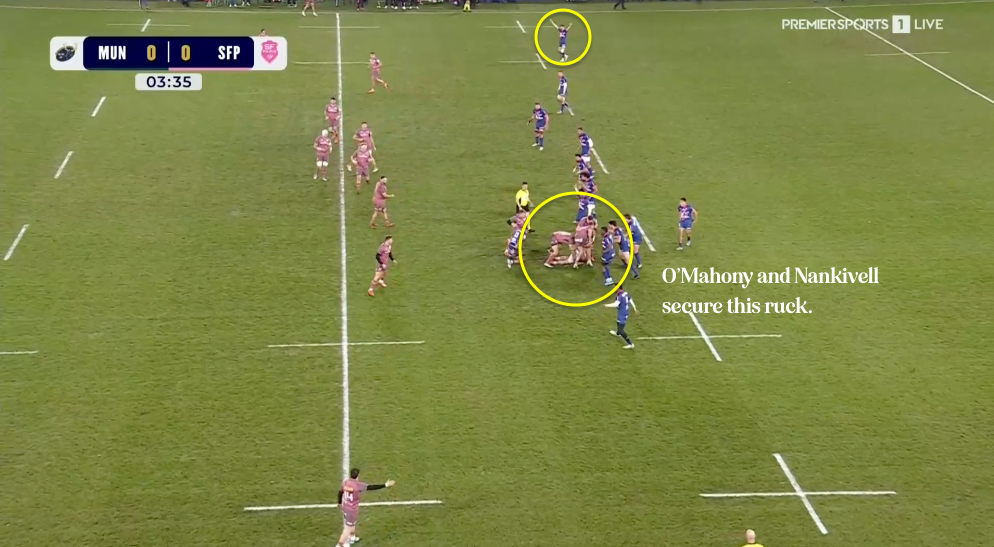
That means when the ball swings through the screens, Nankivell shows up “blind” to the edge defenders and can turn what was a loose two-on-one into a practical four-on-one.
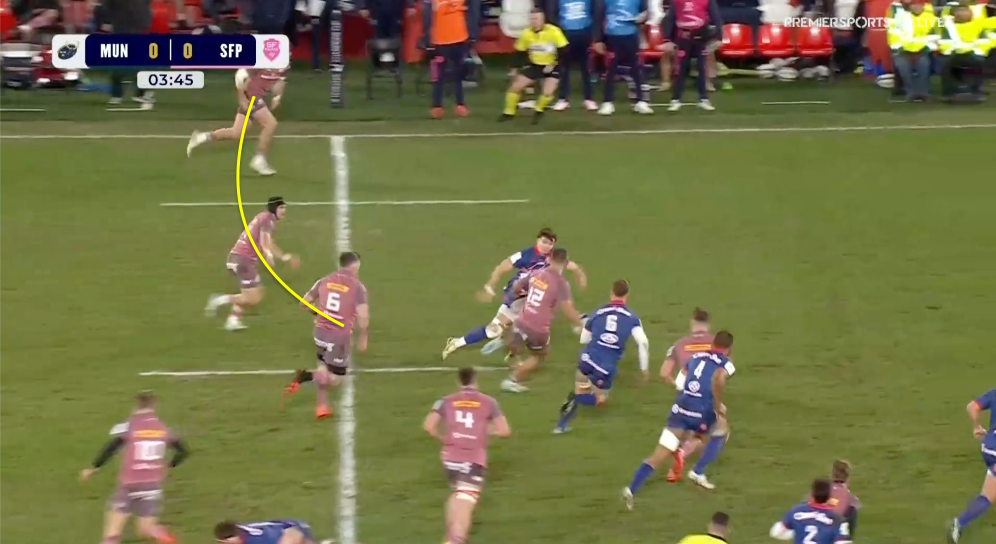
And, in Thaakir Abrahams, we have the kind of killer pace that can turn what might have been a scragged ball outside the 22 last season into a full-blown entry this year. As the season progresses and relationships build, these entries will turn into full-on scores.
Later in the half, we did it again – this time off a retained box kick that had the same effect as a turnover transition. The loop action wasn’t as pronounced here, but our ability to stretch Stade Français and attack Gustard’s edge blitz defence opened up a lot of space.
Casey saw the space and took it, but the outside/in blitz from the winger created a problem for Stade.
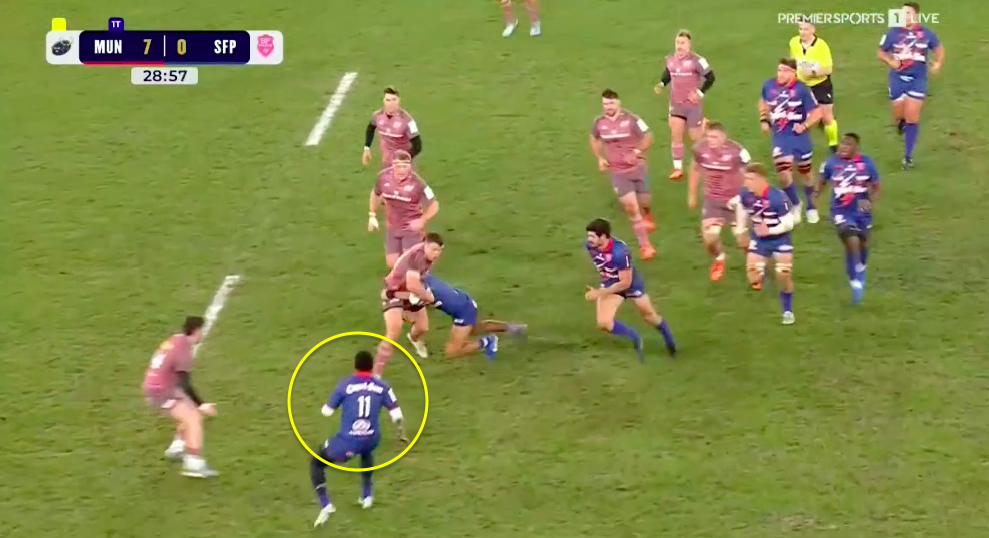
Without him covering that edge space, Stade’s tendency to cluster came back to hit them again. You can’t leave that space for Craig Casey to find a pass, because he always will. Watch Stade Français enough and you’ll see this again and again.
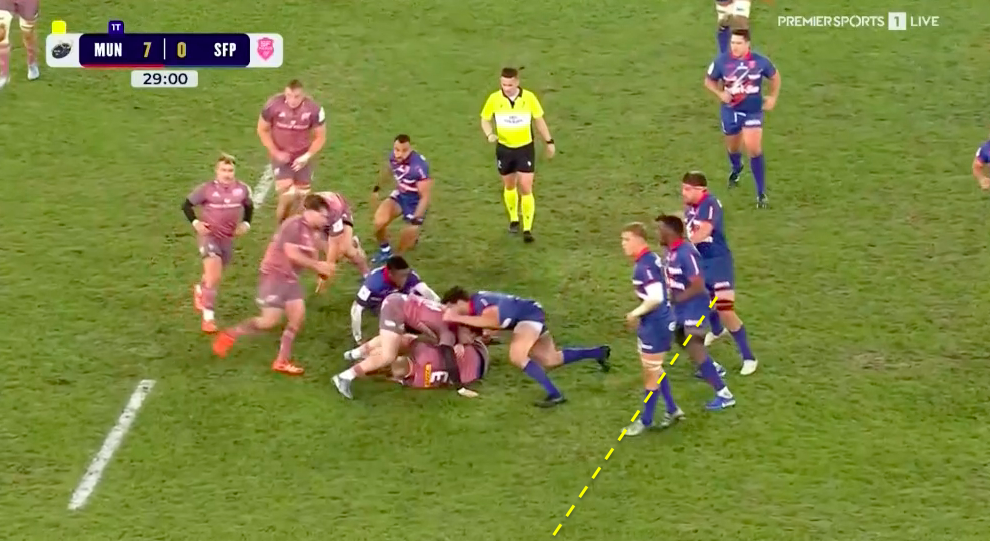
Daly’s finish from there is top drawer stuff. And we kept at it. Look at Coombes double-effort on this play after Munster turned over a lineout. Makes the screen pass and then loops over to compress the edge defence.
This allows Crowley to make the best pass of the weekend;
POM gets taken out by a swinging arm here that would eventually be a red card for Stade, but that type of edge attack is what we’re trying to build. After the turnover, O’Mahony filters to the edge.
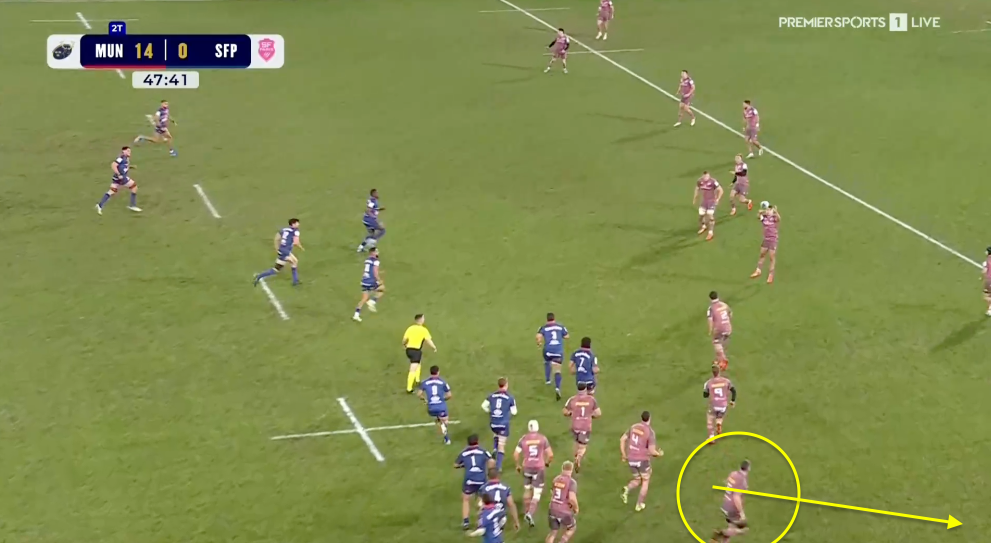
Munster then work the ball infield but it’s to drag Stade around 3/4 of the way across the field so they have to make a decision on resourcing; how many do you leave on the edge?
When Crowley runs this aggressive screen line – starts from just outside the outside leg of the inside barrel – gives him real momentum as he takes the pass and that instinctively holds the inside defenders. He’s also got Nankivell and Abrahams running loop routes outside him.
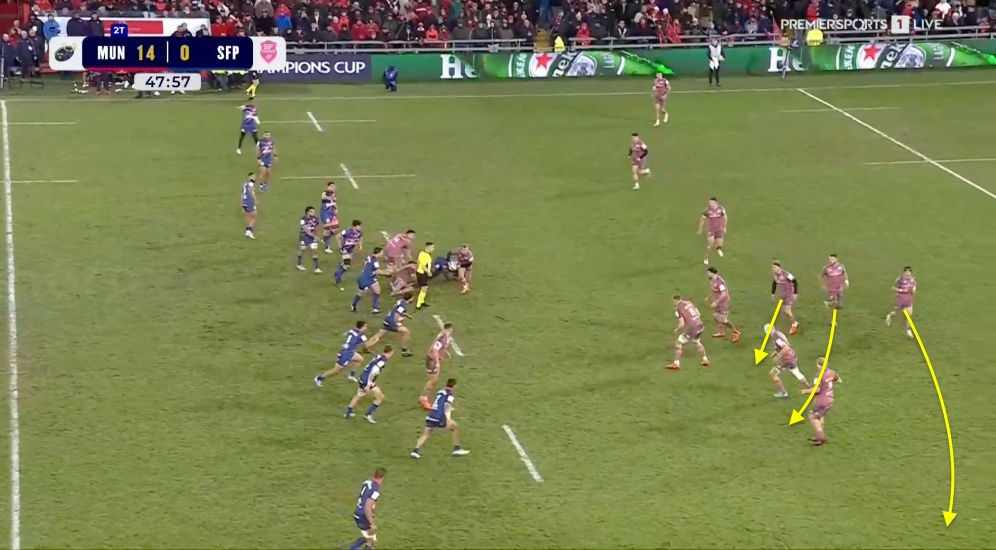
Coombes’ work from screen passer to edge option means that Stade can’t push out on O’Mahony. They’ll know that Coombes can and will offload from this spot and you have to respect his power in contact. Crowley hits O’Mahony and Abrahams’ late arrival opens up the linebreak opportunity.
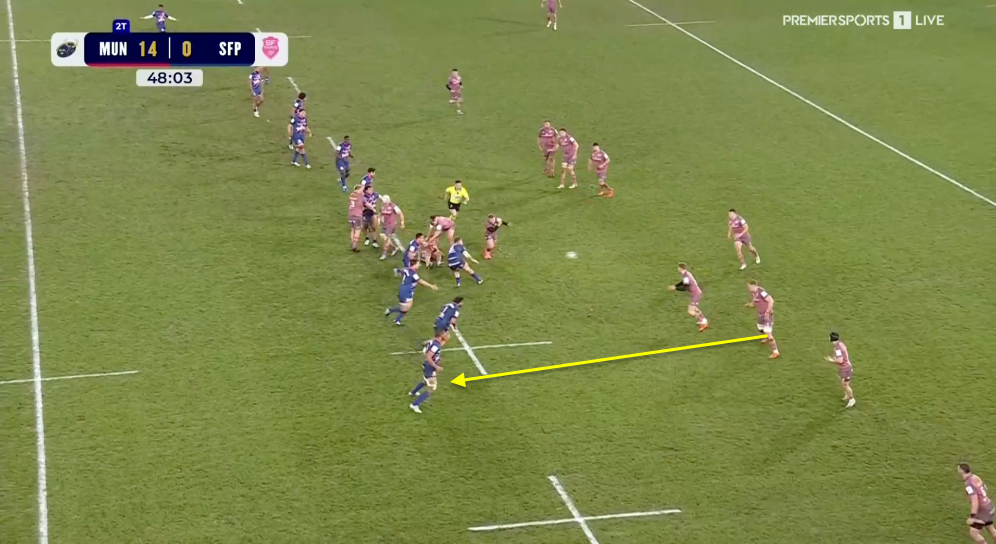
Again, this is an opportunity we probably finish off a few months from now. Creating these linebreaks from deep positions is a great sign of what this team is and will be capable of.
On the downside, we still lack some punch in the tight exchanges but the addition of Jager, Kleyn and Edogbo goes a long way to fixing that up for us. The last 20 minutes when we were playing against 13 ended up being a little more frustrating than we might have envisioned. Stade, to be fair, dropped their PPC ratio completely and basically played keep ball for as long as they could, aided by a scrappy period of indiscipline from Munster that coincided with emptying our bench, more or less.
That depth is an issue against any decent team and highlights the need for guys like Jager, in particular, to get back to fitness sooner rather than later.
All in all, though, lots to like and a meeting with an old enemy to look forward to – if that’s the word – on Friday night.
Europe is back.
| Players | Rating |
|---|---|
| 1. Dian Bleuler | ★★★★★ |
| 2. Diarmuid Barron | ★★★★ |
| 3. John Ryan | ★★★★ |
| 4. Evan O'Connell | ★★★★★ |
| 5. Fineen Wycherley | ★★★★★ |
| 6. Peter O'Mahony | ★★★★★ |
| 7. Alex Kendellen | ★★★★★ |
| 8. Gavin Coombes | ★★★★★ |
| 9. Craig Casey | ★★★★★ |
| 10. Jack Crowley | ★★★★ |
| 11. Thaakir Abrahams | ★★★★★ |
| 12. Alex Nankivell | ★★★ |
| 13. Tom Farrell | ★★★ |
| 14. Calvin Nash | ★★★ |
| 15. Shane Daly | ★★★★ |
| 16. Niall Scannell | ★★★ |
| 17. Kieran Ryan | ★★★ |
| 18. Stephen Archer | ★★ |
| 19. Tadhg Beirne | ★★ |
| 20. John Hodnett | ★★ |
| 21. Paddy Patterson | ★★★ |
| 22. Billy Burns | ★★★ |
| 23. Jack O'Donoghue | ★★★ |
