



The longer you spend on the wrong train, the more expensive it is to get home.
If you felt elation at the end of that game on Friday night, more power to you. I envy you, actually, because you were probably sitting on a three-pint buzz, the most beautiful of all altered states that there is without breaking the law.
If you felt a weird sense of relief mixed with a vague sense of dread, then you’re probably sitting where most other people are. Let me explain why I think this way and why it’s not just weather-vane doomerism. I like to give things space to breathe before I criticize them. Munster beat Connacht at home at the start of the URC season in a thriller that, as it turned out, had many of the issues that would plague the season’s opening rounds.
But that was impossible to know at the time. You could say there were problems there, but you wouldn’t be talking about facts; you’d just be guessing. I’m not paid to guess.
I’ve watched Ireland quite closely this year and, from the England game on, there has been an odd brittleness about this team that defies what we’ve come to know about them over the last few years. Last week’s game against New Zealand was a further example of that brittleness, but the same thing was visible in South Africa too, certainly in the first test against the Springboks, and against England in last year’s Six Nations.
The best performance I’ve seen from this team this year would probably be that away game against France, against 14 men for most of the game.
That doesn’t mean that this team is washed, it doesn’t mean it needs to be torn asunder to start again, it doesn’t mean David Humphreys has to ghost through the HPU like a banshee, but I think it does mean that the squad requires a massive refresh in multiple units of the team.
And by that I mean, multiple different options tried out at loosehead, hooker and tighthead with a variety of specific roles in the back five in need of new options. We also need to start moving on from Gibson Park and Murray in the short to mid-term, with a similar refresh happening in midfield and the outside backline.
Every single depth chart in this team needs new players coming in at the bottom, and older options getting cycled out at the top. This win doesn’t change that, and neither will two more against Fiji and Australia, should we indeed manage to win those games, which is far from the near certainty it might have seemed two months ago.
Andy Farrell has dipped into the cohesion well a little too often in the last three years and, for all the benefits it has given Ireland – and those benefits are undebatable – we are now beginning to see to downsides. Our best players under 32 and over 26 are getting miles upon miles put on their collective collision clock, and even the freakiest freaks only have so many miles they can handle.
Our veteran players north of 32 aren’t being cycled out of the team, rather they’re as important as they’ve ever been, both emotionally as leaders and in key on-field roles.
We are lacking a cohort of around 8/9 players between the ages of 22-26 with 10+ caps in core areas of the team pushing upwards on the 30+ cap guys, who in turn should be forcing the veterans out. This lack of upward mobility is creating a “bubble” of inexperience that’s rising behind the current core of undroppables in the front row, our locking core from a role perspective, and that can be said for almost every department. The last time it was anywhere close to this was under Eddie O’Sullivan in the mid-2000s, as close to prehistoric times relative to the modern game as can be made without essentially talking about a different sport.
Farrell – like every coach – has a core of veterans that he doesn’t seem to want to know what it’s like to play without, and every Category-A game that goes by without actual experimentation in these on-field units, is another stop passed on the train in the wrong direction.
Will we look at where we are in February when France come to town with revenge on their mind and wish we’d spent a few caps over the last year blooding guys?
And the bizarre thing is that the only chart that looks anyway normal in this squad at the moment – at #10, with a 24-year-old established as a #1 over the last year with a utility cover guy and a 21-year-old rookie making his way in the game behind him – is the one chart everyone wants to turn upside down.
It doesn’t make any sense.
Part of the reason for this is that I think core elements of our game have been deconstructed by the better sides in the test game and, aided by the new law interpretation on kick escorting, we look a little like Leinster in 2019; vulnerable to getting pinned by kicking short to mid-range contestables to the back pins and swarming a back three not built to handle that game in any kind of volume.
Ireland’s back three specialises in alternate playmaking, strike running, ruck resourcing and specialist long exiting, alongside the usual offensive expectations of finishing opportunities, and so on.
They were not selected to chase box kicks or defend against aggressive chasers with no escorts, as they have been doing for the last two seasons or more.
Go back and watch this game and you’ll see multiple examples of all three struggling to impact under the high ball, on both sides of the chase.
Lowe is not a natural chaser and lacks elevation off the ground. Keenan is normally quite good under the high ball but has seemed a little lightweight on the drop in the last two weeks.
Hansen’s normal strengths are stepping in as a looping playmaker while also offering all the benefits of a strike playmaker in edge spaces, while also being an excellent finisher. When he is chasing short kicks and trying to bat the ball backwards, he is far less effective.
All three players were perfectly suited – and I mean perfectly – to playing stand-off counter-transition rugby. Ireland would kick long up the field and either;
- Meet the opposition on the gainline and force them into a mistake, or another kickback that Ireland would almost always retain.
- Or, receive the ball back from the opposition on a long kickback and use that space between the transition gainline and defensive press to short pass around the opposition with looping playmakers and forwards that were incredibly good at resourcing transition rucks and passing into screens.
It’s how Andy Farrell solved the 10m of space problem I identified in For Every Wall A Hammer a few years ago, where I hypothesized that rugby league-style attack was the only way to beat blitz defending.
This is the pertinent section;
This is the critical distance between League and Union in my opinion, even bigger than the uncontested scrums and two fewer players. How strange does this screenshot look to you if you mainly watch Union?

When we see League players “blitzing” it’s because they want to take the 10m of offensive space created by the tackle. Two men were involved in the tackle – as is pretty standard in League and League-style Union defences – so that leaves 9 players defending the primary line with two guys in the second layer.
When we move the defensive line up to where they’d be in a Union game, you can see how much more claustrophobic it is.

League gives you 10m of free offensive space after every carry, while Union gives you zero free metres. The minute you make contact with the opposition, they have a distinct advantage because you have to pass away from the gainline – sometimes quite a bit away – to improve your position.
Stuff like the lateral slides, edge kicking and even wide-spaced pods are a regular staple of union these days but back in 2018, I couldn’t work out how to make up for the 10m of space problem. Andy Farrell did – with long kicking. If you kick the ball long, the opposition will almost always return the ball long, especially since box kicking had been successfully nerfed post-2020 with the 50/22 law and the general allowance of escorting the catcher.
When they kick long back to you, you will get your 10m of space on transition and, once Ireland fully settled into that style, we were able to destroy teams like we’d found a glitch in the meta of the sport.
So why is it starting to degrade?
We are getting the ball less often on long transition sets. Opposition teams have long cottoned on to this way of playing but you can’t disrupt it without having very specific skills or you can disrupt Ireland’s lineout which has an outsized importance in our game because of how many lineouts result from our kicking tendencies.
With the tactical importance of shorter contestables now completely outsized based on the game of even six months ago, a lot of what we do well has been taken out of the game.
The law changes of the last six months have hurt this Irish team and, combined with degrading performances in other areas, we’re starting to show the strain.
But at a base level, last season we were able to escort Keenan to this ball and see him retain it 9/10 times. But now in the world of “good access” it’s a 60/40.
Argentina scored off that kick transition. This time last year, that ball is bouncing down towards their 22.
Have a look at how this box exit from Argentina changes the context of Ireland’s attacking scheme.
Teams are giving us the lightning quick ball we want – 61% of our rucks were under three seconds this week, it was 62% last week – but they are only losing one or two players to our offensive rucks max. The rest of their defence is filling the field.
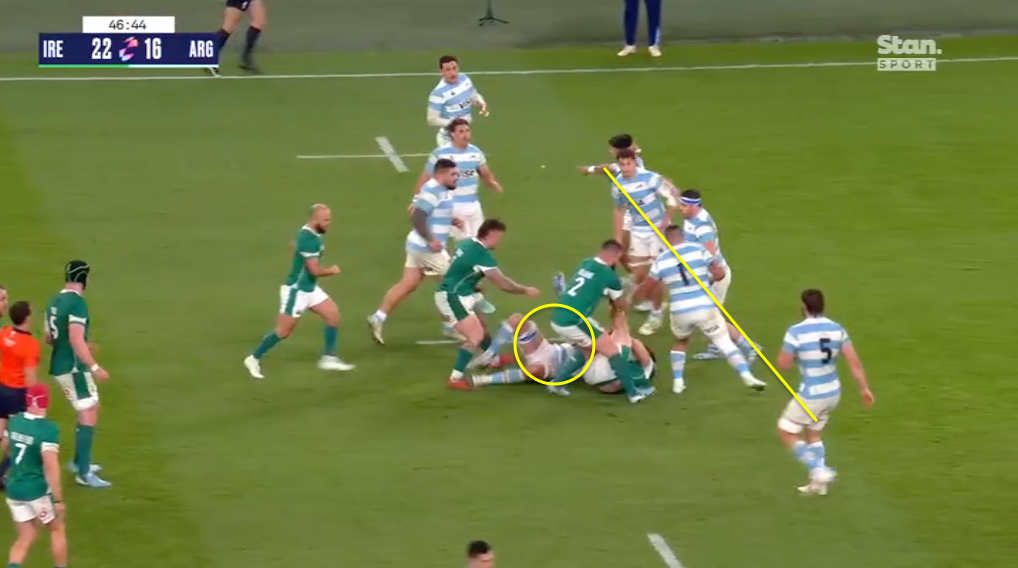
That’s blitz theory, right? Stay out of all but the most obvious rucks, fill the field and get huge line speed.
But it works even more so here because the Argentinian defence is just over 5m away from the Irish attack, who have no depth because they are tied to the collision point.
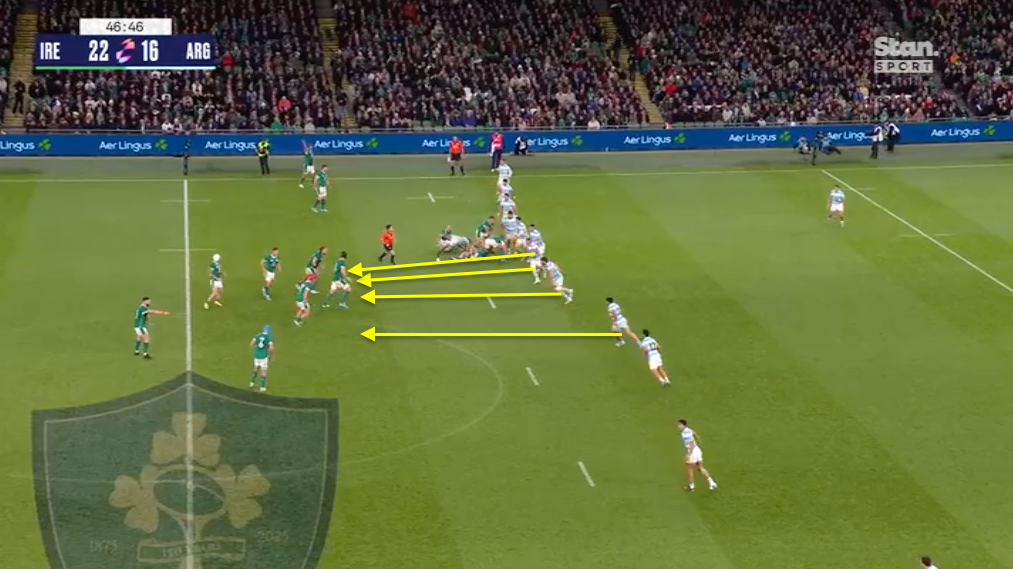
With a shallow collision point, the attack is shallow and because box kicking is now fully engaged, you don’t need to exit long up the field to give the attack a break.
Look at the phase after Ryan got smashed;
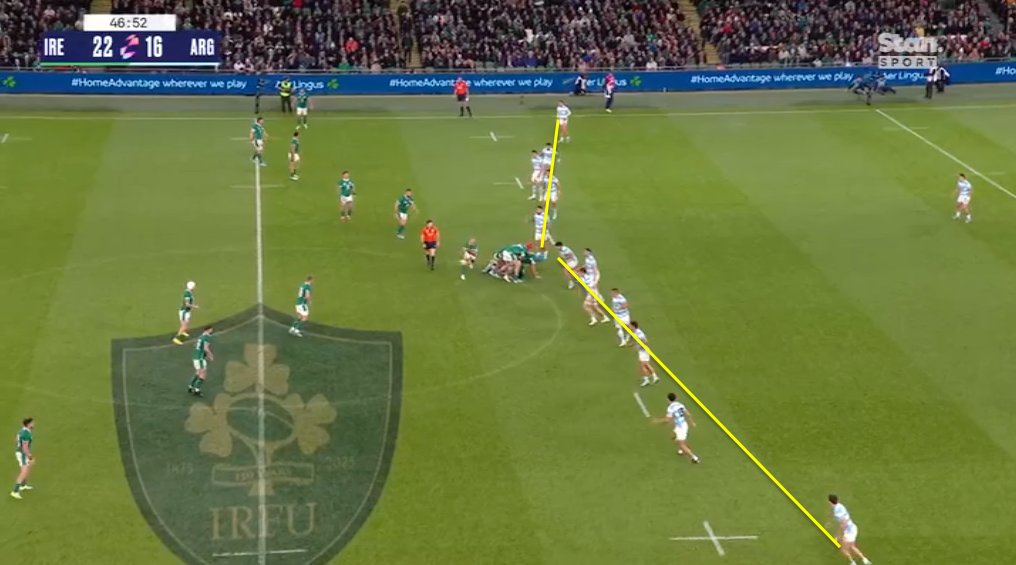
We have nothing at all to work with here so Crowley fumbles at a crossfield kick to try and keep the impetus. He probably should have hoisted this one, but I think he wanted to pull some momentum back. The kick sailed into the stands.
Off the resulting lineout, Argentina moved the ball to the middle of the pitch and box-kicked again.
This one ends up in a knock-on advantage to Ireland but honestly, that’s a 50/50 with the access the Argentinian chase had.
When we had a chance to answer back a few phases later, we landed this.
Not good. We conceded a penalty thanks to Lowe’s shove. When we got long kick returns from Argentina – a rarity in this game – we had to get after those moments in transition. Crowley took up this long exit on kick return and set a ruck in the middle of the field. We normally love this type of action but everything here is very flat with a low percentage pass from Hansen flying into the stands.
Argentina lost one defender to the ruck on transition, we lost three attackers. The field was filled and almost every good pass option was gone.
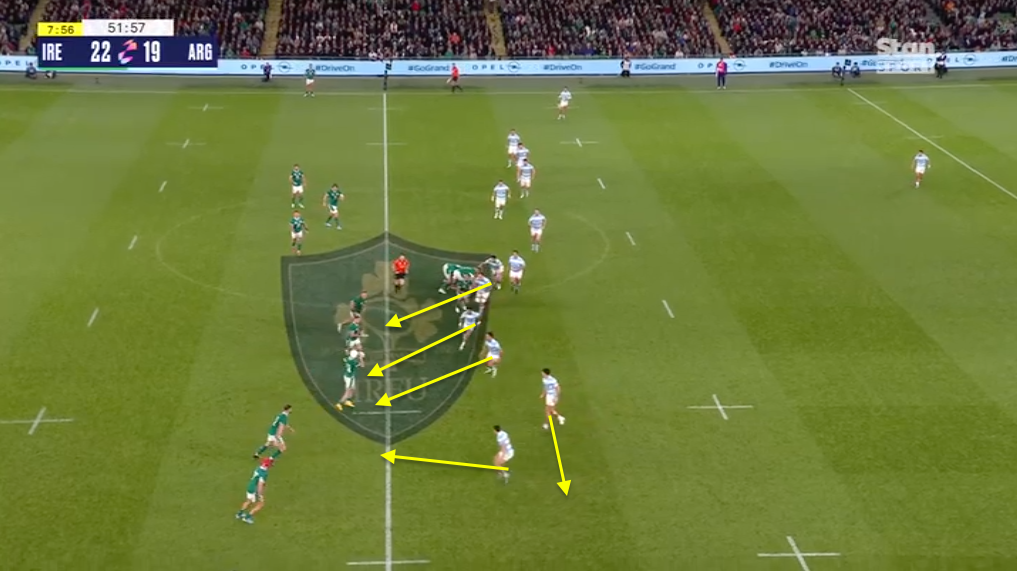
That’s why Jamison Gibson Park has looked so quiet on the offensive side of the ball, in my opinion, because the flow moments on longer transitions haven’t been there in the last few weeks. That, in turn, has brought the focus more onto Ireland’s looping attacking system which splits the handling at first receiver between Crowley, Hansen and Keenan mostly, with Ringrose, Henshaw and Lowe acting more like traditional wingers.
Crowley just doesn’t get his hands on the ball enough in this system. Jack had 16 involvements versus New Zealand divided into 8 passes, 4 kicks, and 4 carries. Against Argentina, he had 16 passes, 6 kicks, and seven carries for 29 involvements.
Against France in the Six Nations, he had 44 involvements. Against Italy? 59 involvements. Wales saw 64 involvements. England saw Crowley with 26 involvements. Scotland saw 48 involvements. All in all, Crowley averaged 48.2 involvements in the 2024 Six Nations when Ireland won the title. The only game we lost saw him involved the least.
Why has the system we’re running now minimised his involvement? Your #10 having just 22.5 involvements across two games when their average in the title-winning season was 48.2 seems like an incredibly radical change.
Is the change because of Mack Hansen? Against New Zealand, Hansen had 13 on-ball involvements, just three below Crowley. Against Argentina, Hansen had 21 involvements to Crowley’s 29 with 11 of those being passes. Hansen was injured for the entirety of the 2024 Six Nations, so I think we’re seeing a mixture of Hansen crowding the passing lane – as part of Farrell’s system – and that extra noise is disrupting the flow of our deeper attacks.
All of this happens outside what has become quite a narrow forward line where we don’t really use edge forwards to hold width because with the transition system we want to use, there is no function for them in that role.
With our forwards taking more heavy, static collisions – that I believe they aren’t suited to after years of counter-transition rugby where they bury themselves in ruck almost needlessly – and Gibson Park chained up by packed pillar lanes, we can’t make our phase play work with the handlers rotating this much.
Want to know why we look so much different than the Six Nations?
There you have it.
All the focus on Crowley and Prendergast post-game completely misses the point. New Zealand, and now Argentina, successfully took our attacking system away from us. The first 20 minutes were great but almost all of our best work was done when Argentina were down to 14 men. When we have a numerical mismatch, the system works as designed originally. When we don’t, our forwards now look underpowered and like they’re burying themselves in rucks that aren’t contested enough for two ruck entries.
I think they’ve worked out that you can choke this Ireland team with quick ball. And that doesn’t bode well for the Six Nations to come. We might need more than new bodies, we might need a more radical change in style altogether.
| Player | Rating |
|---|---|
| Andrew Porter | ★★ |
| Ronan Kelleher | ★★★ |
| Finlay Bealham | ★★ |
| Joe McCarthy | ★★ |
| James Ryan | ★★★ |
| Tadhg Beirne | ★★ |
| Josh Van Der Flier | ★★★ |
| Caelan Doris | ★★ |
| Jamison Gibson Park | ★★ |
| Jack Crowley | ★★★ |
| James Lowe | ★★ |
| Robbie Henshaw | ★★★ |
| Garry Ringrose | ★★★ |
| Mack Hansen | ★★ |
| Hugo Keenan | ★★ |
| Rob Herring | ★★ |
| Cian Healy | ★★★ |
| Thomas Clarkson | ★★★ |
| Ryan Baird | N/A |
| Peter O'Mahony | ★★ |
| Craig Casey | N/A |
| Sam Prendergast | ★★★ |
| Jamie Osbourne | ★★★ |
