



I’m not a religious guy.
I used to be when I was younger, and sometimes I wish I still was. You’re looking at a former altar boy captain, here.
Somewhere in the late 90s, I became one of those early internet atheists when I saw all these killer questions being asked for the first time on different internet pages. It blew my mind. Then I read The God Delusion and, look, I can freely admit that I was very annoying about religion for a while.
Now I’m very annoying about rugby. Time is a flat circle.
My big thing back then was that there was no evidence for any of the things I had believed in prior. There was no data, nothing empirical at all to work with. So why would I believe in a God that couldn’t be proven? Like I said – annoying, immature and missing the point. I wasn’t quite at the “Pastafarian” level of irritating but you get my drift here. And look, as I’ve gotten older, I’ve realised that it doesn’t matter what religion you believe in as long as you’re not hurting anyone or trying to turn your religious beliefs into a legal code of conduct that non-believers have to live by. But back then I was all about “show me the proof” before I’d believe anything again.
Anyway, fast forward twenty years and I’m going to tell you something I deeply believe in that has no empirical evidence but I 100% believe it’s real anyway.
Momentum.
I read a really good article on momentum lately that had this paragraph in it, which completely trashes the idea of momentum in sports;
[…] there’s ample data suggesting momentum isn’t predictive of some new direction for the game but rather a generic description of events that have already occurred. ESPN Stats & Info tracked college football play-by-play data back to 2004 and found approximately 4,800 plays that changed a team’s win probability by at least 20 percentage points (i.e., significant momentum swings). If momentum is real, we might assume the team that gained momentum in those situations would win more often than game conditions would predict. Instead, we find their actual win percentage is just a tick less than the expected outcome, which might be a fluke or might signify that the team that was losing before the big play was likely the inferior team all along and the big play was the fluke.
But I still believe, and I also believe that there is good momentum and bad momentum. For me, momentum is all about a collective or individual feeling in the moment that influences your performance when you are competing with an opponent directly. I think that this momentum – positive and negative – can help or hinder performance levels just enough to matter in key moments.
The data says momentum doesn’t exist but I think that it does, purely in the minds of the players and coaches. And that’s what matters. I think it’s a deeply held, unsaid belief that translates into performances and results. And I think it’s almost impossible to measure in real terms.
Right now, Munster have negative momentum. There’s no point pretending otherwise. Three losses in our last four games, with no real statement performance so far this season, is a bad, energy-sapping run. Sure, those three losses out of four are part of a six-game schedule where we’ve only played two home games and three away (with a fourth to come) but they don’t feel any better knowing that.
You might argue that playing Leinster, the Stormers and the Sharkboks away from home three weeks in a row is arguably the toughest series of games we’ll have this season when you factor in the travel, but the vibes are the vibes. In a way, it’s a positive. After this weekend, no team will have played as many away games as Munster and Glasgow – four each. That means we only have five away games to contend with between November and May.
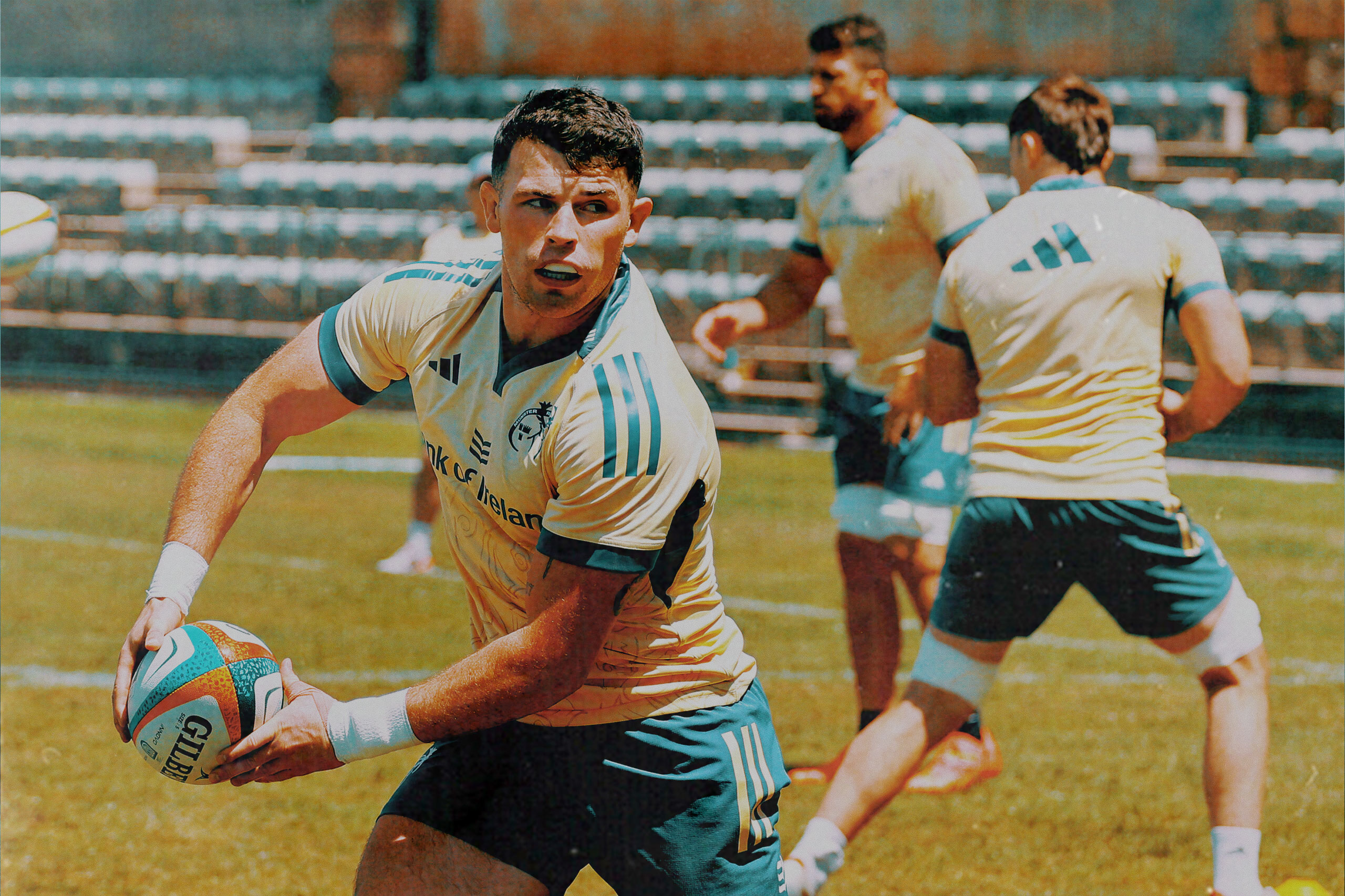
It’s up to this squad and coaching group to pull us out of the nose-dive, so to speak. That means being able to get as much genuine belief and confidence into the group as possible, so much so that they believe they can perform to their potential this weekend. Believing it is the most important thing. That means having belief in our lineout, belief in our attacking structure and belief in your teammates to execute the two-on-ones we keep creating and not executing.
That isn’t to say that we HAVE to win this game but we have to get something out of it. It’s an exceedingly difficult test against what is, essentially, a slight variant of the Springbok side. Four of their starting front five could and have started together for the Springboks. Four of their five outside backs could start for the Springboks and have all played for the Springboks in the recent past.
A bad start and a bad finish cost us a win or, at the very least, two losing bonus points against the Stormers.
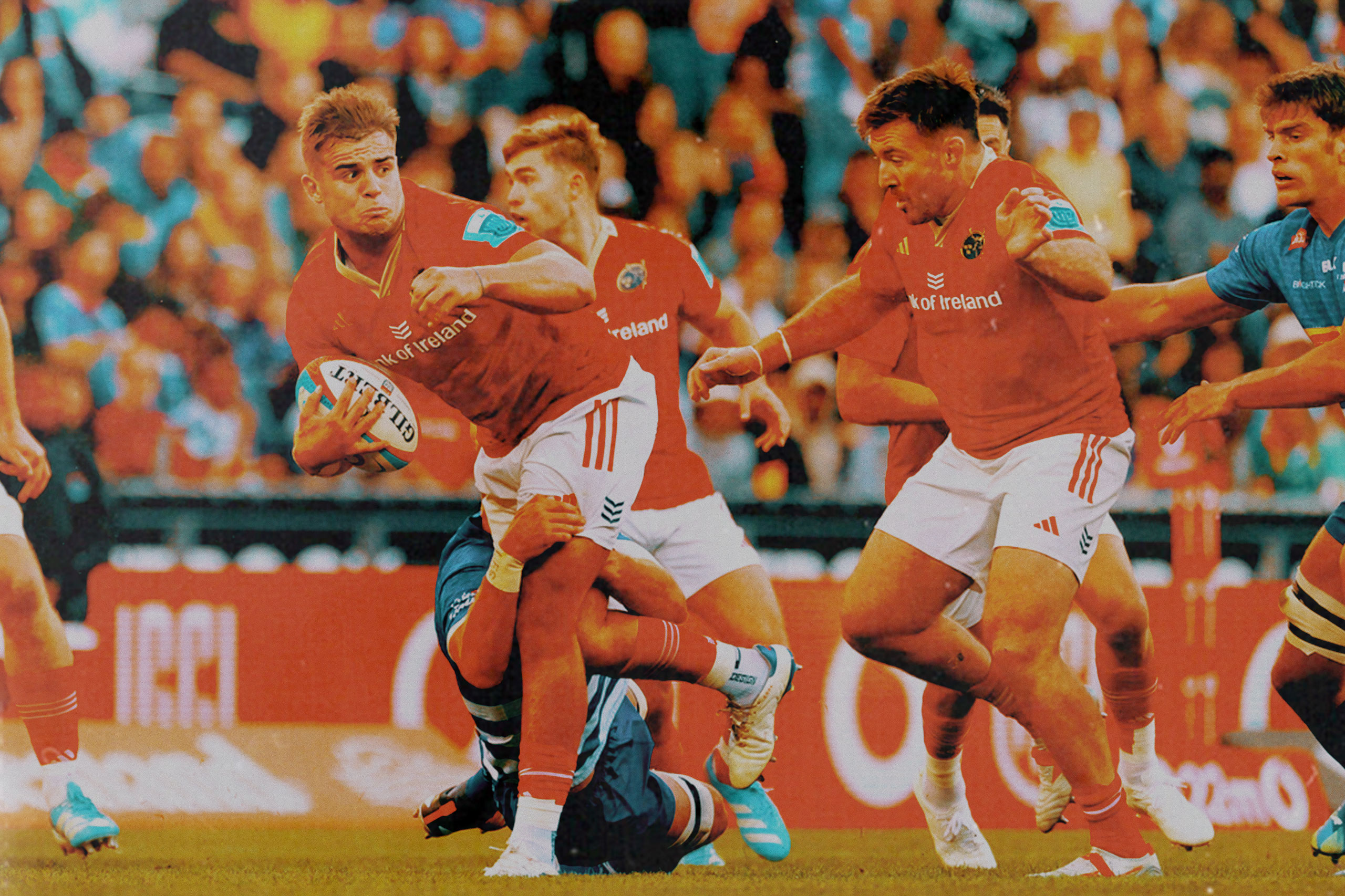
Whatever happens, we have to leave Durban with something. It’s not that a win is impossible but we’re talking about what we need; a competent lineout, a decent start, and coming away with points one way or another. With a good start and a good lineout, we should get points. With neither, I think a hiding awaits.
If ever there was a time to alter momentum, this is it.
Munster: 15. Mike Haley; 14. Calvin Nash, 13. Tom Farrell, 12. Rory Scannell, 11. Seán O’Brien; 10. Jack Crowley, 9. Craig Casey; 1. John Ryan, 2. Niall Scannell, 3. Stephen Archer; 4. Jean Kleyn, 5. Tadhg Beirne (c); 6. Tom Ahern, 7. John Hodnett, 8. Jack O’Donoghue.
Replacements: 16. Diarmuid Barron, 17. Kieran Ryan, 18. Ronan Foxe, 19. Fineen Wycherley, 20. Ruadhán Quinn, 21. Ethan Coughlan, 22. Billy Burns, 23. Alex Kendellen.
The Sharks: 15. Aphelele Fassi; 14. Eduan Keyter, 13. Luhkanyo Am, 12. Andre Esterhuizen, 11. Makazole Mapimpi; 10. Jordan Hendrikse, 9. Grant Williams; 1. Ox Nche, 2. Bongi Mbonambi, 3. Vincent Koch, 4. Eben Etzebeth (c), 5. Emile van Heerden, 6. James Venter, 7. Vincent Tshituka, 8. Siya Kolisi
Replacements: 16. Fez Mbatha, 17. Ntuthuko Mchunu, 18. Ruan Dreyer, 19. Jason Jenkins, 20. Phepsi Buthelezi, 21. Jaden Hendrikse, 22. Siya Masuku, 23. Francois Venter
There’s no sugarcoating it.
This is going to be incredibly difficult. As I said above, this Sharks team are far from unbeatable but we need many, many things to go right for us from the very start of this game to get anything out of it.
The intercept tries, the lineout imploding, the daft penalties, the unforced turnovers – they all can’t happen here but that’s blindingly obvious. Don’t make game-killing mistakes early and often. That’s the headline.

Our front five has an incredibly tough job on their hands to deal with the Sharks’ narrow power and our midfield and small forwards – we have three in the matchday squad – will have to scramble incredibly well on the pace and explosivity in the Sharks’ backline. There are threats everywhere, essentially.
Last week, we got sucked into overplaying by a leaky Stormers defence that then managed to recover well off the back of our sloppiness. That pulled us into a few more phases than, ideally, we’d have liked. We are not a powerful team at the moment – injuries primarily the cause – so the more phases or rucks we have at the moment, the less likely we are to score.
At the moment, Leinster are running at 17 rucks per try. This is generally considered to be a good way to measure efficiency when it comes to your use of possession. They are the benchmark for this efficiency. We’re currently averaging 22 rucks per try which, when you consider that we’ve been giving up size and power to most of the teams we’ve played this season, goes some way to describing how blunt we’ve looked.
When I was looking at the Sharks ahead of this week, one clip gave me an idea of how Munster could potentially hurt them. Look at Eben Etzebeth on this clip.
That’s the exact same defensive rushing role that he plays for the Springboks so it makes sense that the Sharks use him in the same manner. You’ll see him blitzing like this on almost every Sharks defensive set outside of their 22.
The weird thing is, when he blitzes like this, the Sharks defence compresses around the space that he leaves behind. You can see it here against Glasgow when Etzebeth shoots up, Glasgow take another ruck and there’s a gap at the edge of the defence all of a sudden.
That Sharks tight defensive line – Etzebeth, Van Heerden, Nche, Koch and Mbonambi – find themselves in these kinds of advanced positions far more than you’d expect, and often in the aftermath of a lineout or on transition. If you can move the ball beyond Etzebeth after that blitz, you can often find attackable spacing on the edge.
On this example – and it’s of real interest to Munster – look at how the two wide passes stay ahead of the Sharks’ blitz to hit Mbonambi in the middle of the field. This moment was on a kick receipt.
Essentially, can we stretch the Sharks to a point where we hit this space on two long range passes, stretch their ability to fold laterally and then…
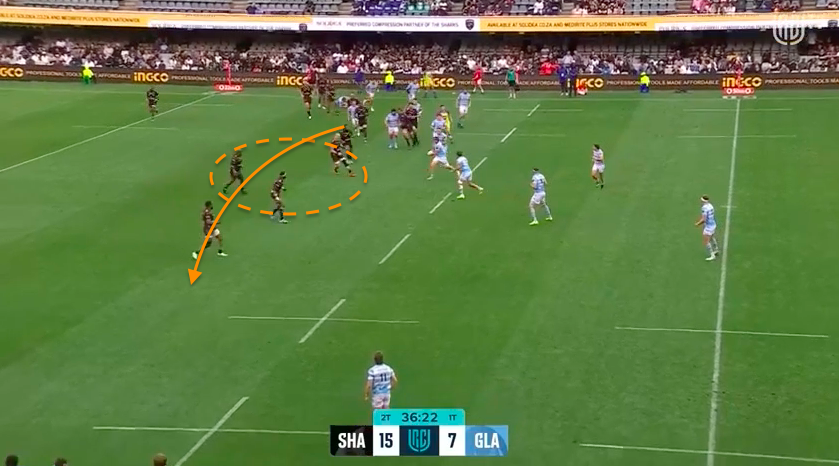
… is it possible to buy this little edge blitz that you’re almost sure to get from Mapimpi and Am?
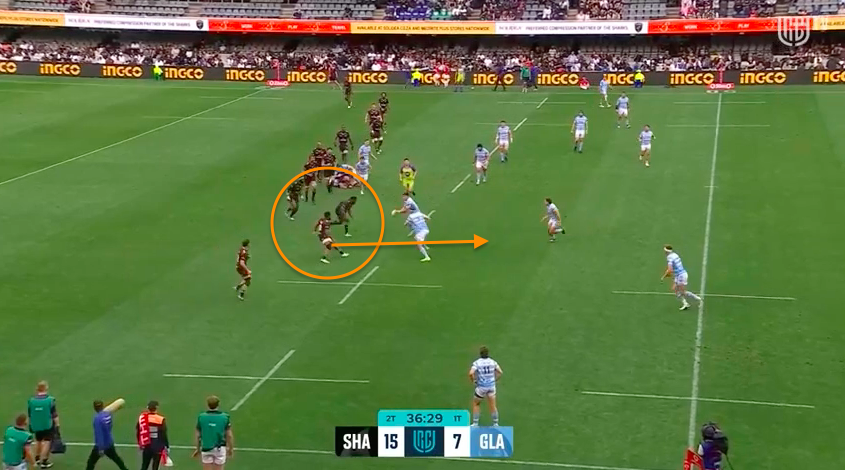
If so, we have the layered attack to take advantage of that corner, although maybe not the speed to finish directly – which is a problem in and of itself.
Glasgow used that double miss pass to the middle on kick transition phases to good effect throughout this game. You just saw what a same-way play looks like, but the space was also there on the reverse. The principle is that the double pass – 40/45m of lateral space – takes Etzebeth and the tight blitz from the tramline and pushes them to the middle of the field, and you can use that “race” to hurt them with a layered attack on the next phase to either wing.
Two passes “surf” the blitz and hit the middle of the field for a set up ruck.
Getting gainline on the middle ruck is unimportant, you simply must not lose it. Glasgow had a workable opportunity on this phase to advance up the tramline.
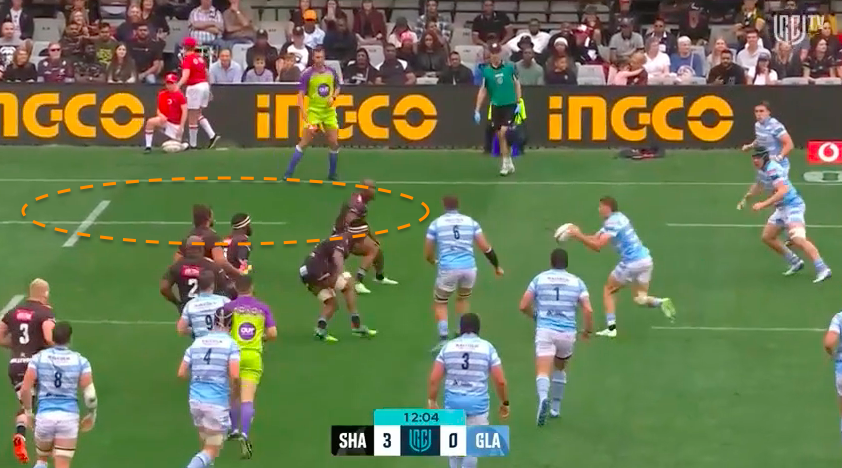
If you know that Etzebeth tight blitz triggers their defensive movement, you can work around it albeit at great risk of getting smashed. This is where we need Crowley and Casey to make excellent decisions and for Scannell to add range to Crowley’s passing.
If our halfbacks can control the game with the boot – aided by Haley and Scannell – I think we have a real chance of frustrating the Sharks and catching them on transition.
Two wide passes on transition will start any opportunity against this Sharks team; if we remember that, we won’t go far wrong.
It’ll take a heroic defensive display, the best lineout display of the season on both sides of the ball and incredible discipline to have a chance, but the chance is there and it’s real.
