


Do you need an intro for this?
Do you need a history lesson on what it means? Do you need a retrospective on 2009? What that meant? The biggest sliding door moment in modern provincial rugby history. No, I don’t think you do.
Dig deep enough into anyone who was around for that game and you’ll find the wound or the healing scar, depending on the colour jersey you wore that day.
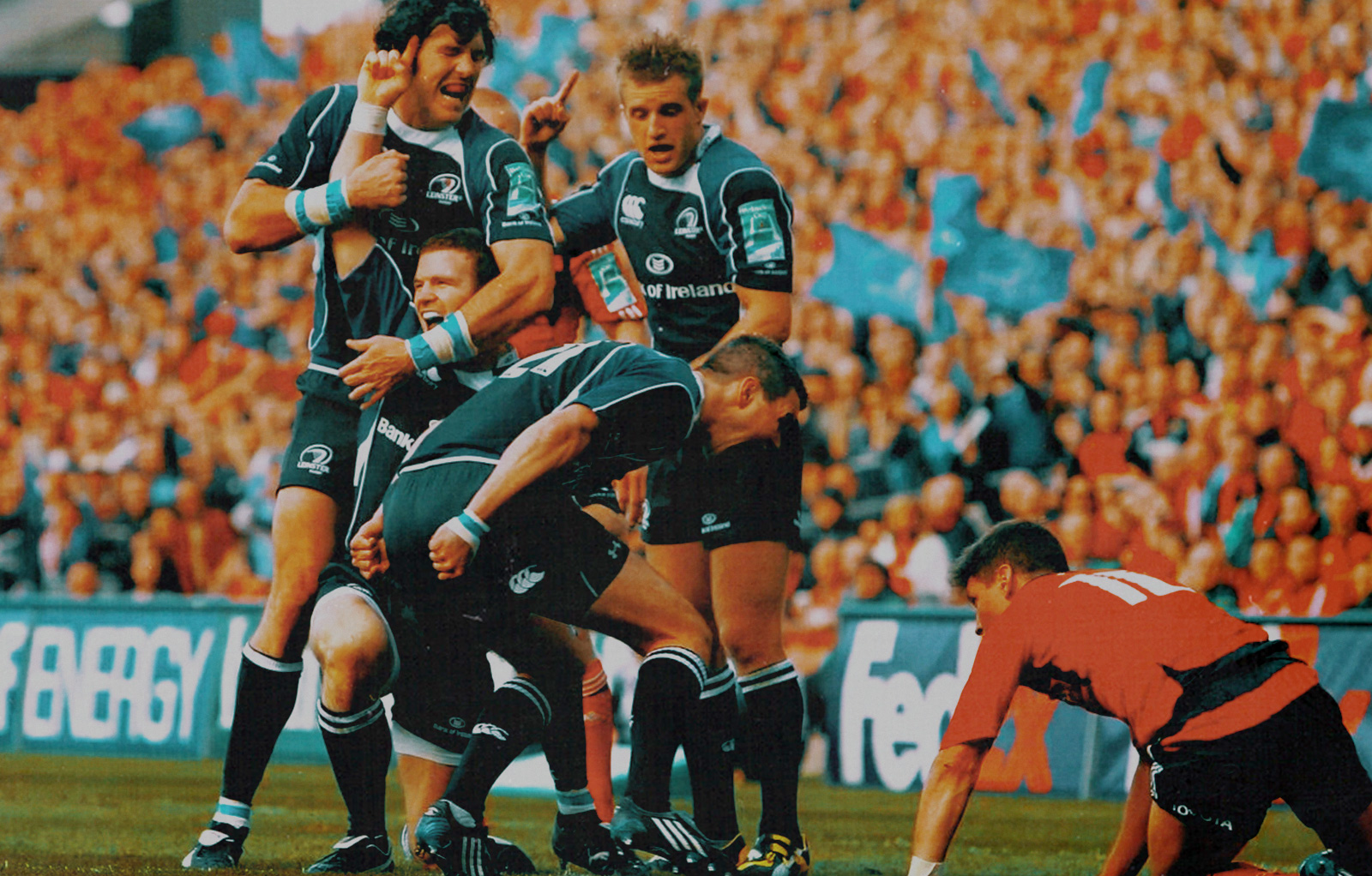
For Leinster; catharsis and a decade of wrongs righted. For Munster; chickens coming home to roost and the first unignorable sign of the great decline that was to follow.
But you know all that. It’s stitched into us at this stage. Old news.
I suppose it’s become relevant again because this is the first time we’ll play Leinster in that very stadium. It’s something of a bookend, 15 years later. But make no mistake; Munster aren’t thinking about avenging ROG this weekend. They aren’t thinking about putting right Rocky Elsom being offside. That’s ancient history. Might as well be talking about the Battle of Clontarf.
Whatever Munster do this weekend has to be rooted in the now. We’ve been here often enough before. The location and the attendance have moved northward – literally and metaphorically – but the game is the same. We haven’t won a regular season game in Dublin since 2014/15 if you exclude the Rainbow Cup win in the RDS, which almost everyone does. So whether this is Croke Park or the Aviva, the job is the same.
It doesn’t feel like it, but it is.
This is a colossal opportunity to shift the perception of the entire season. Change the mood music. Leinster are the red-hot favourites, playing at one of their biggest-ever home attendances; why not play up to that? Why not play the spoiler?
There is no karma. There is no divine balance to the universe.
There is only what you can rip and claw for you and yours.
Munster: 15. Mike Haley; 14. Calvin Nash, 13. Tom Farrell, 12. Alex Nankivell, 11. Seán O’Brien; 10. Jack Crowley, 9. Craig Casey; 1. Jeremy Loughman, 2. Niall Scannell, 3. Stephen Archer; 4. Jean Kleyn, 5. Tadhg Beirne (c); 6. Jack O’Donoghue, 7. John Hodnett, 8. Gavin Coombes.
Replacements: 16. Diarmuid Barron, 17. Kieran Ryan, 18. John Ryan, 19. Tom Ahern, 20. Ruadhán Quinn, 21. Conor Murray, 22. Tony Butler, 23. Shay McCarthy.
Leinster: 15. Hugo Keenan; 14. Liam Turner, 13. Garry Ringrose, 12. Jamie Osborne, 11. James Lowe; 10. Ciarán Frawley, 9. Jamison Gibson-Park; 1. Andrew Porter, 2. Lee Barron, 3. Tadhg Furlong, 4. RG Snyman, 5. James Ryan, 6. Jack Conan, 7. Josh van der Flier, 8. Caelan Doris (c)
Replacements: 16. Gus McCarthy, 17. Cian Healy, 18. Thomas Clarkson, 19. Ryan Baird, 20. Max Deegan, 21. Luke McGrath, 22. Ross Byrne, 23. Harry Byrne.
Leinster have very few weaknesses.
Watching them last weekend against Benetton, especially in the first half, you’d convince yourself that they have none at all. It was 28-0 inside the first half an hour in Treviso and maybe should have been more.
Sure, Benetton were genuinely awful but there’s no worse side in the URC to be awful against. Watching the game back in detail showed me one thing very clearly; when Leinster get position around the 5m line off a set piece, they score almost every time. Leinster had five 22 entries against Benetton and scored a try on every single one of those entries.
The first try came from a typical Leinster pressure play on turnover ball – almost the perfect Leinster sequence under Neinaber. Benetton have lineout possession, hit the middle of the field and get ripped; Frawley takes the spilt ball and boots it deep into the Benetton 22.
They competed at the lineout as you’d expect but Benetton managed to retain possession before committing the cardinal sin against Leinster – blowing a simple exit.
Leinster milked a yellow card and a penalty try from the ensuing 5m lineout position. 7-0.
Off the restart, Leinster used the shortened middle line of Benetton’s defence – they had a prop in the bin – to exploit the easy fear of RG Snyman in the same pod as Tadhg Furlong. That combination of heavy playmakers with any kind of width forced the exact compression you’d expect.
Screen pass. Pop to deep runner into space.
Linebreak.
Try.
You can see the pressure they put on Negri – far from the most agile guy laterally – to cover that space.
It goes without saying but whenever you see Furlong and Snyman standing in the same pod with a player running in the screen, you’ve got to be incredibly worried about that entire triangle. Leinster still use a 3-2-X forward shape in attack – settled phase play and post-transition – and they will want Snyman and Furlong in that midfield two pod as often as possible.
It sounds obvious but three things are required when you want to beat Leinster before you want to do anything else; no dumb penalties to give them easy 22 access, no yellow cards and exit perfectly.
The overall theme of playing them should be denying them the things they build their identity around.
So that means playing zero rugby in your own half of the field unless it’s a kick exit or a kick into that back pin space they’ll leave behind Liam Turner when they’re defending on our 10m line. Deny them the energy they get from those defensive moments. If you have to kick out to give them lineouts, do it. That means contesting heavily at the middle of the lineout where they’ll try to use Ryan or Doris on their five-man schemes because that’s where they do almost all of their maul feint work but back yourself to cover that. Leinster’s strike plays are really good and they’ll use Frawley and Osbourne with Doris as the “pinch” but we’ve got to be very physical there anyway.
For me, the best illustration of how to beat this version of Leinster came in Game Week 2 against the Dragons in the Aviva Stadium. The Dragons played smart, hands-off, half-back-focused rugby that matched Leinster kick for kick.
When Leinster are really comfortable, they’ll kick early and often via Gibson-Park, Frawley, Osbourne and Lowe, in particular, on the edges. So many of Leinster’s 22 entries start with James Lowe getting a grubber kick tumbling up the 15m tramline on transition.
You can deny them these opportunities by kicking just as often as they do and looking to beat them on offensive and defensive transitions, especially if you’ve got a poaching focus in your pack and midfield.
This is a decent example. Dragons got the ball off a 22 drop-out but it was kicked really long; this is a typical Leinster play when they have a free choice of kicking from their half of the field. They always take the territory so they can use their narrow blitz to force errors high up the pitch.
The kick at the edge is the smart play here because it puts a big strain on Leinster’s heavy front five to move up and down the pitch on these transition plays.
This is the ideal shape on transition; a three-pod, layered attack, Liam Turner (in this instance) covering a lot of space.
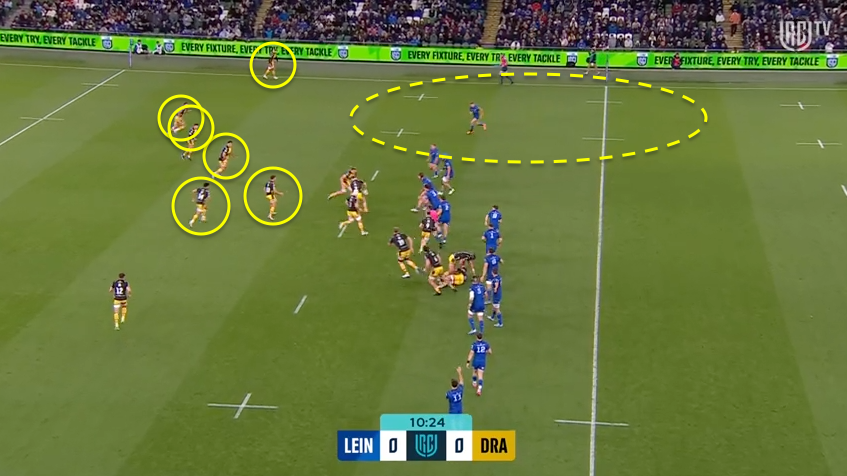
If you keep Leinster engaged via the box kick – again, looking at getting to Liam Turner in the air – on the left side of our attack. You can drag Ryan, Snyman, Furlong and Porter up and down the field, narrow Leinster’s attack and start using Beirne, Hodnett and Coombes as poaching threats with Nankivell and Farrell – two really good poachers – lurking in the midfield if Frawley looks to snatch at an opportunity.
This is a long video but it explains the theory perfectly.
Make Gibson-Park kick off slow rucks, win that contestable, reset, kick in the midrange again, right to the 15m tramline and put the squeeze on Leinster’s front five away from where and how they want to play.
With any kind of lineout possession in their 22, look for the bait layer to hide a flat pass across the face of Ringrose’s blitz.
Crowley to Nankivell, Farrell running a decoy screen with Nash lurking in the pocket, Nankivell hits a wide pass across to Haley – break for the line.
If we keep our discipline, be patient in transition and force Leinster to play more on-ball than they like in their own half – use the pressure of the occasion to force Frawley into overplaying – while bringing the defensive intensity we brought against Ospreys, and we have a chance. Stay close up to 60 minutes and it’ll be a tossup.
