


It seems like every few years club rugby is thrown into tumult.
You get used to it after a while. When the Celtic League was first launched in the early 2000s, we had the tumult of what it meant for the AIL. It turned out that it meant nothing good, as it happens. Then every few years there would be rumours of the Celtic League’s demise, usually with the Welsh teams threatening to flounce to the English Premiership, who never really seemed that interested until those same English clubs wanted something they could use the fluttery-eyed Welsh to achieve, before metaphorically turfing them out into the hotel corridor at 2 am with a fistful of notes for a taxi home to the Celtic League Magners League Rabo PRO12 PRO14 United Rugby Championship.
Then, in the middle of the 2010s, the last great tumult of our times took place when the English and French clubs essentially deposed the ERC, the former union-run organisation behind the incredibly successful Heineken Cup, so that they could create the EPCR and with it a new European Champions Cup that they could control more to their favour.
In the early 2010s, the English and French clubs had serious issues with the structure of the then-Heineken Cup, most notably with the division of revenues earned by the tournament and the manner of qualification. At the time, the Welsh, Scottish and Irish, in particular, didn’t have to qualify for the Heineken Cup every season and also took a percentage of the revenue that the French and English clubs felt did not reflect the reality of how it was earned as far as sponsorship and TV revenues, in particular, were concerned. As far as the English and French clubs saw it, they were bringing the majority of the TV revenue and providing most of the drawing power for the tournament so, as a result, they should take the lion’s share of the revenue. To compound this, they also felt that the Celtic clubs were resting their top players in the league – because qualification for Europe the next season was guaranteed – and then using that “freshness” advantage to regularly beat the French and English.
A five-season spell between 2007 and 2012 saw the Heineken Cup won by Irish provinces four times seemed to be the tipping point for all of these issues. Leinster’s back-t0-back titles didn’t help perception but Edinburgh’s cheese run in 2011/12 was seen as the ultimate example of a club completely disregarding their domestic league to focus fully on Europe, knowing their qualification for the next season was assured. Edinburgh won their pool – beating the likes of Racing 92 and London Irish along the way – to finish third in the overall seedings before sensationally beating Toulouse in the Quarter-final stage before losing in the semi-final stage. Edinburgh finished 11th in the PRO12 that season with only six wins. Ulster, who lost the final that year to Leinster, finished nine points outside the playoff spots.
The Guardian wrote at the time;
Nagging away in the background, though, is an uncomfortable question. Is there a genuinely level playing field in European club and provincial rugby, or does the last eight line-up highlight a flaw in the tournament’s structure? Perhaps you would expect a hint of jealousy from those clubs not involved, but the presence of five clubs from the RaboDirect Pro12 is not impressing many coaches in England and France. There is a widespread view the Irish, Welsh, Scots and Italians benefit from a system spring-loaded in their favour.
In the Premiership and the Top 14 the only way to qualify for the Heineken Cup is to scrap through a season-long league programme and finish in the top half, while simultaneously seeking to avoid relegation. Eleven of the 12 sides in the old Magners League, in contrast, safely made the cut. Finishing bottom carries no real sting.
The word of the era was “meritocracy” and, looking back on it, the English and French clubs did have a point. The 2011/12 season was particularly egregious. The Irish teams did rest players a little too freely around big European weekends. The Premiership and TOP14 clubs rested players too, to be clear, but not as often and often with consequences for defeat caused due to rotation. I’ll also state that the effect was somewhat exaggerated because of a generationally good Leinster side at the time backed up by the strongest Ulster team in the professional era.
The perception was that the Irish teams ghosted through their tinpot league with zero jeopardy – I mean, that part is true – with losses being completely meaningless as long as their best players were fit for Europe. Had a bad season in the league? Didn’t matter. Fuck it. Focus on Europe. Munster did this very thing. in 2012/13. We finished sixth in the PRO12, losing 10 games out of 22 but made the Heineken Cup semi-finals and were a bounce of a ball away from making the final.
Finally, after threatening to leave the competition multiple times, the English and French clubs officially gave notice in 2013 that they would leave the tournament at the end of 2013/14. A few months later, the English clubs signed a huge deal with BT Sports that gave BT the rights to broadcast any European Cup games played in England, a rights package that was then held with Sky by licence with the ERC.
Ultimately, the Celtic nations and Italy would have to go along with whatever the English and French clubs wanted to do. From an Irish perspective, we were in the unique position of being a massive draw for any redrawn European competition while also having no power whatsoever. We had no leverage. A new European Cup without Munster, Leinster and Ulster would be half the tournament but, at the same time, what was the alternative for us? The Celtic League that we had directly and indirectly positioned as being “just the league” almost since its exception?
The writing was on the wall and, surely enough, we would sign up to the new European format because, in reality, we had no other choice. It was the only game in town. A non-French or English club has won just one Champions Cup title in the new EPCR era.
Since then, the IRFU has made concerted efforts to mitigate the over-reliance on the English and French clubs by making huge inroads with the South African Rugby Union by leading the charge to get the Cheetahs and Southern Kings into the PRO12 when they were booted out of Super Rugby in 2017 and then snatched at the opportunity to sign up the Big Four South African teams when Super Rugby booted them out during the pandemic.
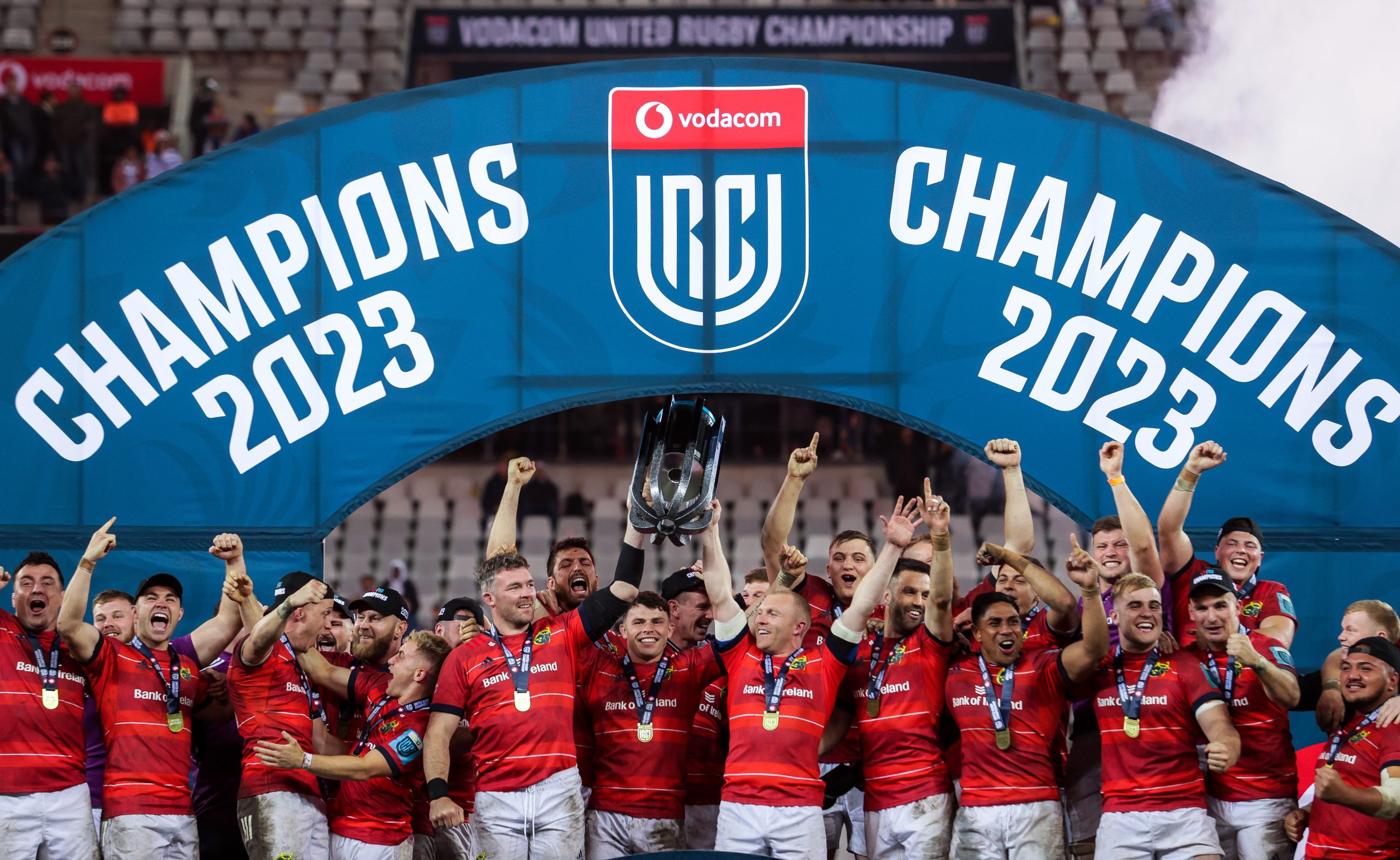
That created the United Rugby Championship and the addition of the South African franchises has brought a new, credible and intense energy to the old Celtic League that has genuinely taken it to a new level.
Sure, the travel is a nightmare and the format is still in need of tweaking, in my opinion, but compared to the old PRO12/14… well, there is no comparison. I’ll freely admit that Europe is still seen as the bigger draw by the casual audience and even the media, but the gap between the URC and Champions Cup is about as close as it’s ever been from a status perspective.
That brings us up to the current tumult, and this entire preamble is worth remembering in that context. This week the Telegraph reported the prospect of an Anglo-Welsh league under consideration before quickly confirming that it was a British & Irish league that the Premiership was “open” to.
A proposal for an Anglo-Welsh league was also considered as part of a strategic review to seek ways of increasing the value, as was the impact of reducing the Premiership to eight clubs, or increasing it from 10 clubs to 12, 14 or 16 teams.
The British and Irish league option is said to have attracted the most interest however, given that it has the potential to drive the greatest commercial value – but it would also be the most complicated to achieve.
As ever, the pulse of these machinations runs to the beat of expiring TV deals and I believe the recently signed deal between the Premiership clubs and Warner Bros Discovery is the driving factor behind these talks.
I think that deal – rumoured to be only for two seasons and at a hefty discount from the rumoured £110 million, three-season deal that expired last season – whatever it is, is untenable for the Premiership clubs going forward.
So, as a result, I also think they need to find at least two new clubs, and fast, before the next TV rights deal comes due and they have to negotiate again, except from an even weaker position.
The rumours are that at least one of the remaining Premiership clubs is struggling financially so time is of the essence. Something big needs to change and I think the Premiership clubs badly want to freshen up the act they’re presenting to potential broadcasters. The United Rugby Championship came out and denied that any discussions were ongoing, but that was to be expected. This isn’t at the point where horses are being traded, but it is “in the air”.
From what I can gather, the IRFU is “open” to the idea of working closer with the English clubs – but only on their terms. The IRFU have long memories and remember well how they were strongarmed in 2013 when they were weak and didn’t have any options. They’d be fools to implicitly trust the intentions of the Premiership clubs ten years later when the IRFU’s position is infinitely stronger today than it was then.
The threat of the Welsh leaving, as it was put to me, amounts to “replacing two mid-range home gates”. The money they bring via TV revenue is negligible and the only loss if they left would be whatever you’d make from playing whatever Welsh clubs you’re scheduled to play at home. Essentially, you could play the Cheetahs, for example, at home instead of the Scarlets and make more or less the same through the turnstiles.

The Welsh could leave and the damage would be fairly easily repaired in the URC format so the usual route of humping and dumping the regions isn’t anywhere near as threatening this time around. Truth be told, I’m not sure Warner Bros Discovery or anyone else is as enamoured with fixtures like Bristol vs Cardiff or Leicester vs Scarlets as certain Welsh journalists are when it comes to remembering an amateur league from 30 years ago.
I think the only position that makes sense is to build on the ties with the South Africans to keep pushing the URC as something that’s equal to Europe. If the Welsh want to stay, cool. If they want to leave… cool. That should be a non-factor in the decision-making. We’ve learned the hard way what being overly reliant on the English clubs and Europe brings; near disaster. The future of Irish Rugby must be built on a strong domestic league outside of the European Cup. It won’t be easy but look at how the URC is perceived today compared to the old PRO14 of just six years ago. The South Africans bring credibility, rivalry, intensity, world-class players, and a diversity of opposition that directly benefits test level.
That isn’t to say that the English clubs playing against the provinces in a season-long league format wouldn’t work as a draw for spectators – it absolutely would – but it can only be done on the IRFU’s terms, while including the South Africans, Scottish, Italians and even the Welsh. The IRFU isn’t the sole decision maker here by any means but we currently have a position of power that we must not squander.
We’ve been humbled by the English and French before because we allowed our domestic league to become so weak that the only show in town was the European Cup. We can’t – and won’t – let that happen again.
