


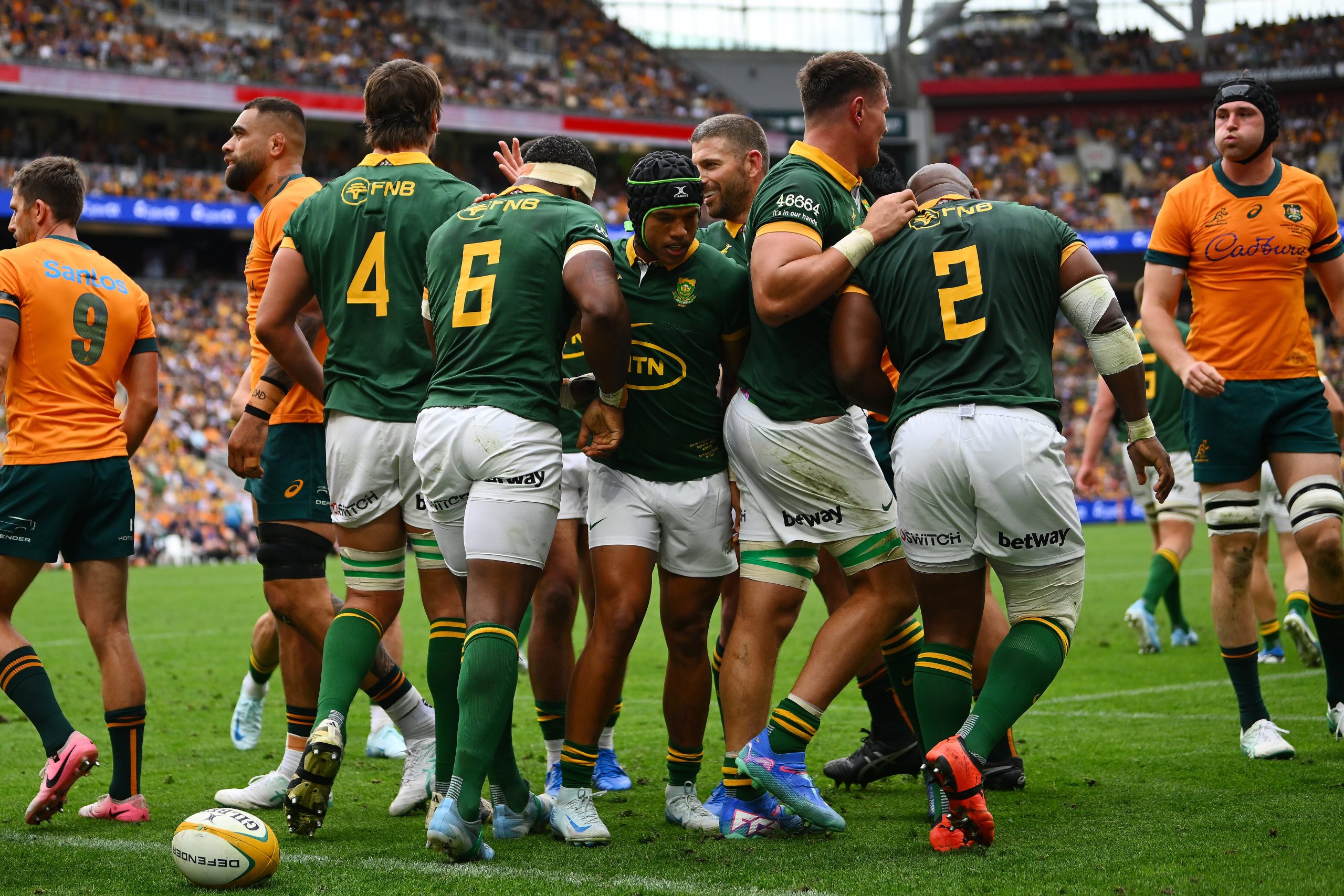
Playing the Springboks is never easy anywhere but, as we know quite well, playing them in South Africa is an entirely different challenge.
The All Blacks are no strangers to this challenge, though. Nobody has a better winning record in South Africa, of course. Still, Scott Robertson’s All Blacks make the trip this time with a rare air of fragility after going 1-1 with Argentina in the first two rounds of the Rugby Championship at home.
“We said all week about looking at ourselves in the mirror and we took it day by day but, you know, we’re All Blacks, we’ve got to bring that every week. We can’t rely on a loss to get that response from us, we’ve got to turn up every week and do that.”
– Ardie Savea after New Zealand’s thumping win over Argentina.
The Springboks that the All Blacks will play this weekend are arguably going through the biggest style shift in Rassie Erasmus’ tenure as Director of Rugby Head Coach. When Rassie first took over the reins of the Springboks in a direct way – once the hapless Allister Coetzee was moved out of the way as was always the plan – he took the relative expansivity that Coetzee had been experimenting disastrously with and stripped the Boks’ game back to basics.
Those basics were; kicking, impact defence and set piece power with lightning-fast transitions as part of an off-ball rugby game plan. It was so effective that it powered the Springboks to a World Cup win in 2019 and more or less the same style did the job in the World Cup knockout of 2023 after experimenting with some different game states in the intervening years. When the pressure came on, the Boks knew they had off-ball rugby to fall back on with the best lineout and scrum in the game as a failsafe.
Complex attacking rugby didn’t come into the equation once the pressure really came on. Kicking. Defence. Set piece producing game levering penalties. That’s test rugby and the Boks know it better than anyone as of late.

Erasmus knew, however, that this could not last into the new World Cup cycle. I think he is very aware that a lot of the new law amendments that World Rugby are bringing in directly attack core elements of how the Springboks won the 2023 World Cup. When I see law amendments that look to nerf the scrum – how many you can have in a sequence, when you can call them – along with tweaks to the law on retreating underneath kicks for big forwards, I see what I think Erasmus sees; a need to evolve.
To do this, he signed Tony Brown as his attack coach. Brown, a former All Blacks flyhalf and one of the most influential attack coaches of the last eight years had been close to signing with the All Blacks multiple times post-2019 but loyalty to his coaching partner and good friend Jamie Joseph saw him stay with Japan up to the 2023 World Cup. Erasmus saw his chance when Robertson and his crew took over the All Blacks post-Foster and it was an almighty coup.
The Springboks of 2018 to 2023 had mostly run off the kicking fuel needed to power Jacque Neinaber’s overlapping cover high edge blitz defence, which repeatedly smothered (and then battered) all kinds of test sides on the way to back-to-back World Cups. But if Neinaber’s particular style of defence is your key point of difference, it demands a certain style of kicking to make it work. Essentially, if a transition and set piece-producing defence is your super-strength, you need to kick the ball often and far. That does not leave much room for more complex phase attacks to grow. Felix Jones was well able to work in this environment because, personally, I think his coaching mindset is defence into attack.
Post Neinaber and Jones, Erasmus went for the most expansive and innovative coach on the market and got his man. Tony Brown was the chief innovator of the 1-3-2-2 attack shape at Japan that became almost every team’s go-to forward structure post-2019 – Andy Farrell’s Ireland included.
It was the perfect system to run off the back of the kicking-heavy game of 2019 by building in the kind of layers and depth off #10 that hurt line-speed heavy defences. Brown’s system took a relatively small and light Japanese side to the World Cup 2019 quarter-final stage with iconic defeats of Ireland and Scotland along the way before eventually losing to the Springboks.
His asymmetrical 3-2-X system hacked defensive norms at the time by staggering forward threats across the field, utilising split pods and blitz lures all while playing with incredible width and tempo. Here’s a good example of a 3-2-X linebreak.
The principle works by having a dextrous forward pod of three running off #9 with an array of screen pass, tip on and split pod options to tug on the inside defence of the opposition while a pod of two forwards run an angled in line off the #10.
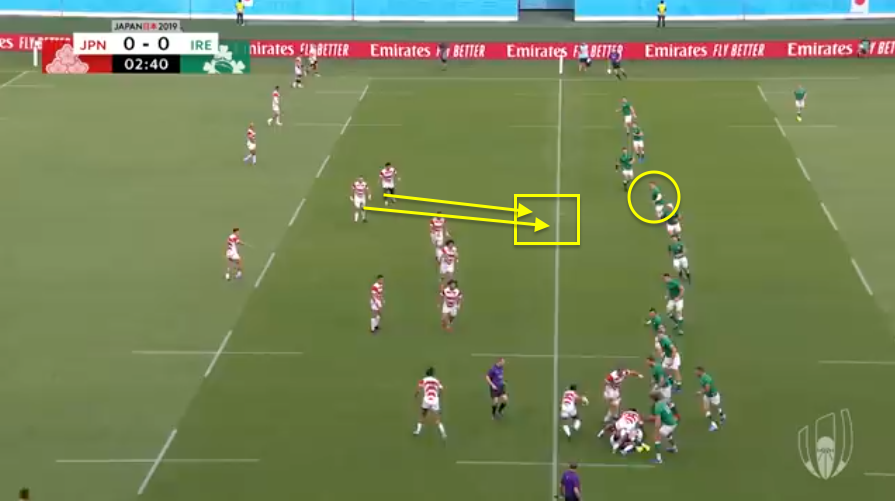
In this instance, the #10 starts level with the inside pod option before sliding out to find the outside two pod runner. The work of the scrumhalf is really important here too because he’s got to get the ball through that split screen while the pod of three forwards blocks and stymies the Irish scramble.
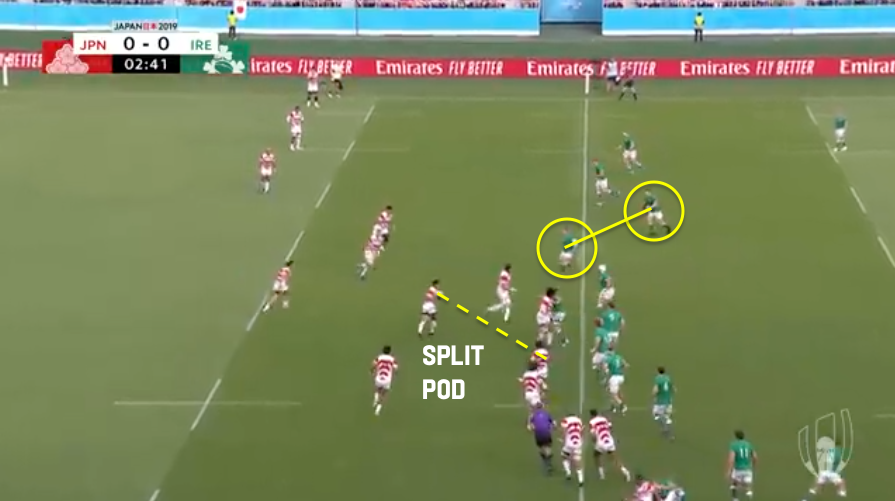
This forward structure was perfect for generating play options to drag defences across the field. If the opposition shut down your central two pods, you could sling the ball straight to the edges or work it through your backline to where your two most explosive forwards were; you could advance up the field, reset and then use the same structure going back across the field.
Brown’s concept was that 1-3-2-2 provided mismatches and gravity pulls in a way that 2-4-2 and 1-3-3-1 weren’t doing at the time. Both those traditional forward structures as generally utilised were very “flat” and played into the hands of defensive line speed.
However, at the Springboks, Tony Brown doesn’t have to worry about compensating for a lack of size like he did in Japan. He’s arguably got the biggest if not the most powerful collection of players in the history of the modern game. So how will he innovate?
With the evolution of 3-2-X.
Welcome to the era of 1-4-1-1-1
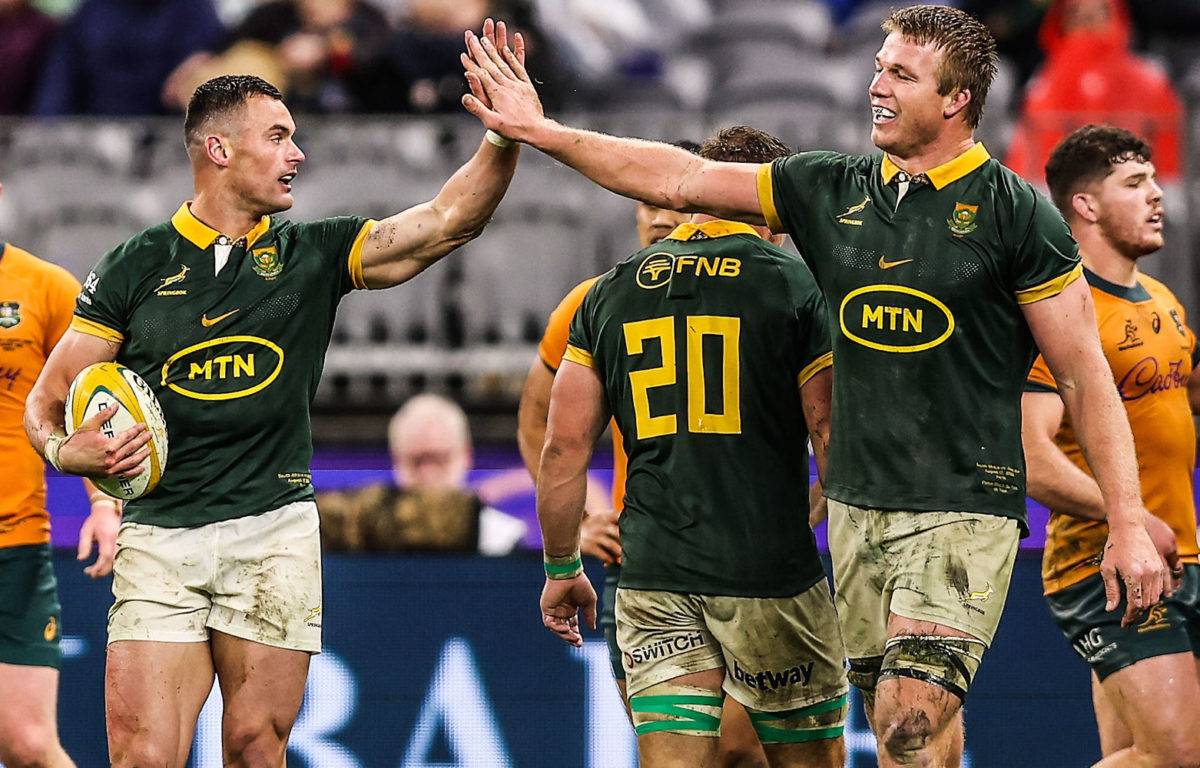
No, it’s not the passcode for your locker at the gym; it’s the new forward structure used by the Springboks with some real innovations how they use their array of power runners.
At its core, 1-4-1-1-1 understands a simple truth of the modern game; absolutely nobody is making ground off #9 anymore without a serious defensive lapse.
Throw in whatever tip-on play you like; elite defences are not conceding ground here anymore and they’re pushing hard off off those three pods to get the screen passes and split pod plays that are now pretty commonplace. If 3-2-X put the pressure on the middle of the field, 1-4-1-1 looks to manipulate the space off #9 with four players “blocking” the defensive progression across the field.
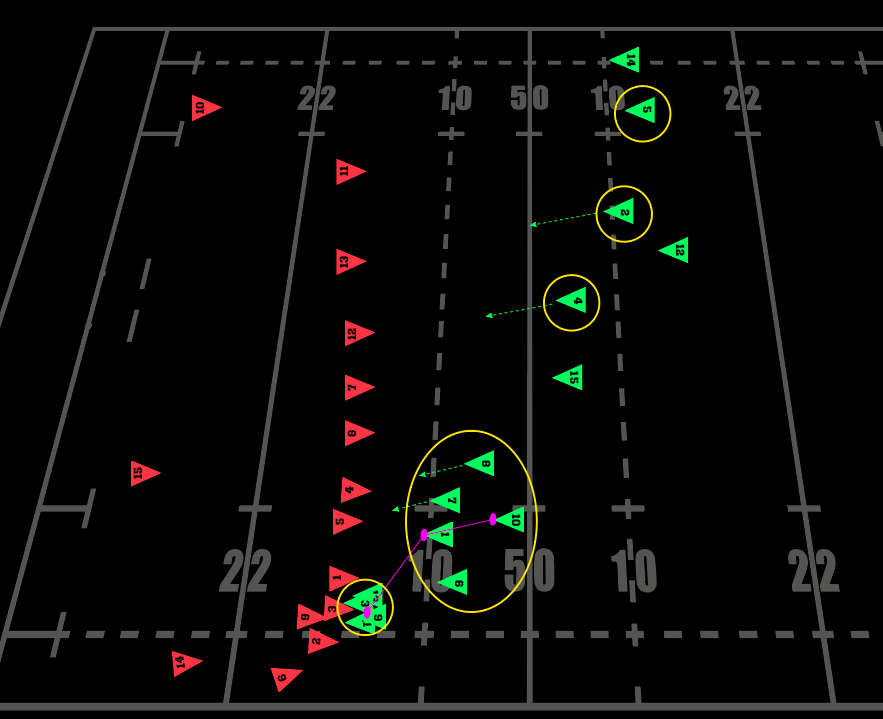
So if we accept that zone off #9 is for set-up play almost exclusively, does it make sense for your “heavy carriers” to carry the ball there? Is one metre over the gainline that valuable? No. It isn’t. Ball retention in that zone is important but what Tony Brown seems to be saying is this; wouldn’t heavy carriers like Peter Steph Du Toit and Eben Etzebeth be even more dangerous in the middle and edge spaces?
The best part about 1-4-1-1-1 is that they can shorten the wider lines if they lose two forwards to a wider set-up ruck. In practice, a 2-4-1-1 works mostly the same. The only key is that the four pod blocks out around 15 metres worth of defenders to enable the Bok backline to use the heavy outside runners.
Those two runners in midfield – Louw and Mbonambi – on the last clip aren’t a traditional two-pod as we’ve come to know them, either. They operate independently of each other and don’t run in pairs as they might do in a traditional 3-2-X.
This all clicks together with the overwhelming pace, speed and agility that the Boks select on the wing almost exclusively. Kolbe, Arendse and Van Der Merwe are the same profile of winger; Erasmus selects two on either wing to balance out the gravity of using Steph Du Toit and Etzebeth in the wider channels.
When the Boks get a full rotation of their locks back, we’ll get a much better look at how they’re running this system. It’s rare in what I’ve seen so far to see both Du Toit and Etzebeth – who were selected as a starting pair against Australia in the clips above – in the wide spaces at the same time. We’ll see how the Boks adjust this weekend with so many injuries to the second row and how the All Blacks try to shut down this new framework.
