


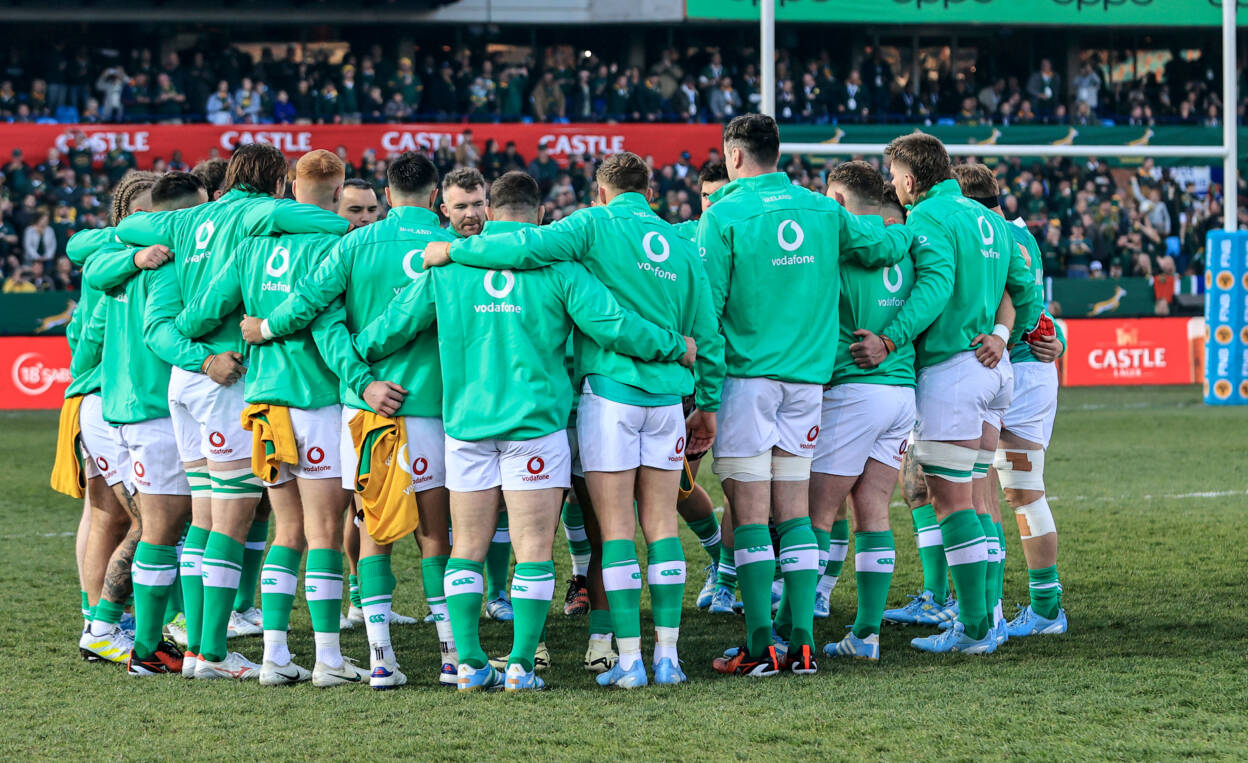
This tour has had revenge slathered all over by the Springboks for months.
Last Saturday, they got a measure of that long-sought-after revenge, albeit not as cathartically as they’d have liked. Ireland have become a genuine bogey team for South Africa over the last few years, which is always a blast for me. I remember when Jake White said that maybe three Irishmen would make the Springboks team way back in 2004 – the week before a game in Lansdowne Road – only for Ronan O’Gara to mug the then-reigning Tri-Nations champions. Sick mind games bro.
That was Ireland’s first win over South Africa since 1965. In the nineteen years since we have played each other twelve times; Ireland have won seven of those games which is bizarre when you think about it. I’ve spent the last week getting 🏆🏆🏆🏆 sent to me exclusively by people who didn’t win one but, for the last twenty-odd years when Ireland and South Africa have played each other, little old Ireland – who have never been beyond a World Cup quarter-final I’ve been reliably informed – have somehow managed to beat the one, two, three, four-time World Champions 58% of the time.
That rankles the Springboks and their fans, even with their one, two, three, four World Cups in the back pocket.
I know for a fact it does.
In fact, before last weekend, South Africa hadn’t beaten Ireland in eight years and never under the revolutionary tenure of Rassie Erasmus. As such, they are heavily invested in dominantly winning this series with a whitewash. It is incredibly meaningful to them and they have been speaking about it as such for over a month. They are demanding a 2-0 smashing and no doubt left in anyone’s mind as to who the best team in the world is. The Springboks had been disrespected enough in The Media since they won the 2023 World Cup with all this loose talk of Ireland being the REAL best team in the world. Titans of the game like Felipe Contepomi, Finn Russell, Ger Gilroy and Ben Smith (not that one) on Twitter that nobody has ever seen or heard on a podcast to the point they might not be even a real person had wronged them for the last time; this incoming series would be the proof of that.
A bogey team that needs putting down; that’s how Erasmus is approaching this tour against Ireland. We saw that last week but we know it for sure with their selection this week; the same matchday squad, no changes, full steam ahead. The Springboks smell blood and know that now is not the time for experimentation. There will be time enough for that against Portugal.
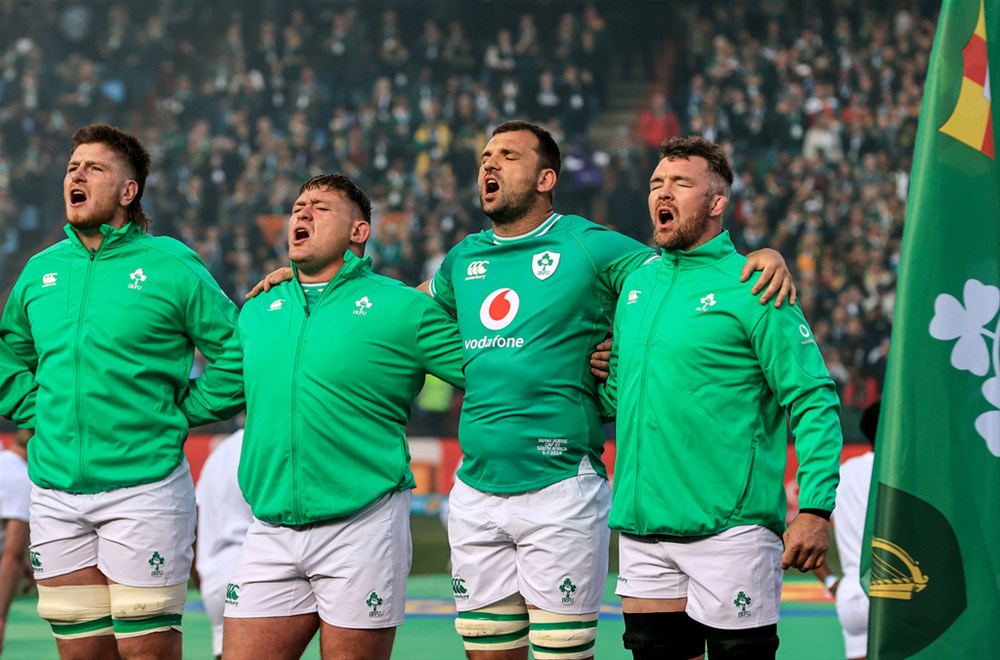
We have seemed to match the Springboks’ intent step for step. At no point has head coach Andy Farrell spoken about this tour as anything other than #1 in the world vs #2 with all the implications that come with that. He’s selected accordingly also with a very experienced touring squad, matchday squad and last week’s game had that high-intensity feeling as a result.
That first test left Ireland bumped and bruised, to put it mildly. A shoulder injury has taken out Bundee Aki, there were question marks over Henshaw and Lowe, while Sheehan and Casey are out completely. That puts Farrell into a place where he is uncomfortable and that’s deviating from his preferred, written-in-stone matchday 23 for a game of this scale. More on that later.
As it stands, this game lies in a weird place with the Boks looking to close out the series like they game-planned while still, arguably, reviewing a game they could easily have lost while Ireland are loading up for one last big push before the majority of this team hit the beach. This Irish team genuinely believe they can spring a shock here and they’ve shown in the past that they are generally better in the second week than the first.
Something has to give but I can’t shake the feeling that something will echo in this game that goes beyond the usual end-of-season fare.
South Africa: 15. Willie le Roux; 14. Cheslin Kolbe, 13. Jessie Kriel, 12. Damian de Allende, 11. Kurt Lee Arendse; 10. Handre Pollard, 9. Faf de Klerk; 1. Ox Nche, 2. Bongi Mbonambi, 3. Frans Malherbe; 4, Eben Etzebeth, 5, Franco Mostert; 6. Siya Kolisi (c), 7. Pieter Steph du Toit, 8. Kwagga Smith.
Replacements: 16. Malcolm Marx, 17. Gerhard Steenekamp, 18. Vincent Koch, 19. Salmaan Moerat, 20. RG Snyman, 21. Marco van Staden, 22, Grant Williams, 23. Sasha Feinberg-Mngomezulu.
Ireland: 15. Jamie Osborne; 14. Calvin Nash, 13. Garry Ringrose, 12. Robbie Henshaw, 11. James Lowe; 10. Jack Crowley, 9. Conor Murray; 1. Andrew Porter, 2. Rónan Kelleher, 3. Tadhg Furlong; 4. Joe McCarthy, 5. James Ryan; 6. Tadhg Beirne, 7. Josh van der Flier, 8. Caelan Doris
Replacements: 16. Rob Herring, 17. Cian Healy, 18. Finlay Bealham, 19. Ryan Baird, 20. Peter O’Mahony, 21. Caolin Blade, 22. Ciaran Frawley, 23. Stuart McCloskey
Adjust to the Adjustment
Adding Tony Brown to the Springboks coaching staff hasn’t brought a revolution just yet but, on the evidence of last week, the evolution that might yet be a revolution has begun. The biggest challenge he will face in taking the Boks where he wants them to go is how he fuels his more expansive gameplan. Brown popularised the 3-2-X attacking shape while coaching Japan and he’s brought that structure to the Springboks but almost exclusively in post-transition phase play.
Kicking fuels every attacking structure. If you kick a lot, it fuels off-ball defensive pressure or counter-transition game plans. If you kick less often, it is a deliberate choice to take the ball through the phases and pressure the opposition that way. Every decision to kick (or not kick) is designed to force a reaction from the opponent that you can then play off.
In the first half last weekend, that was Ireland kicking contestably off Jack Crowley aimed at the opposite side of the pitch to the origin of the pass with a priority on targeting Kolbe, Arendse, Kriel or le Roux in the air.
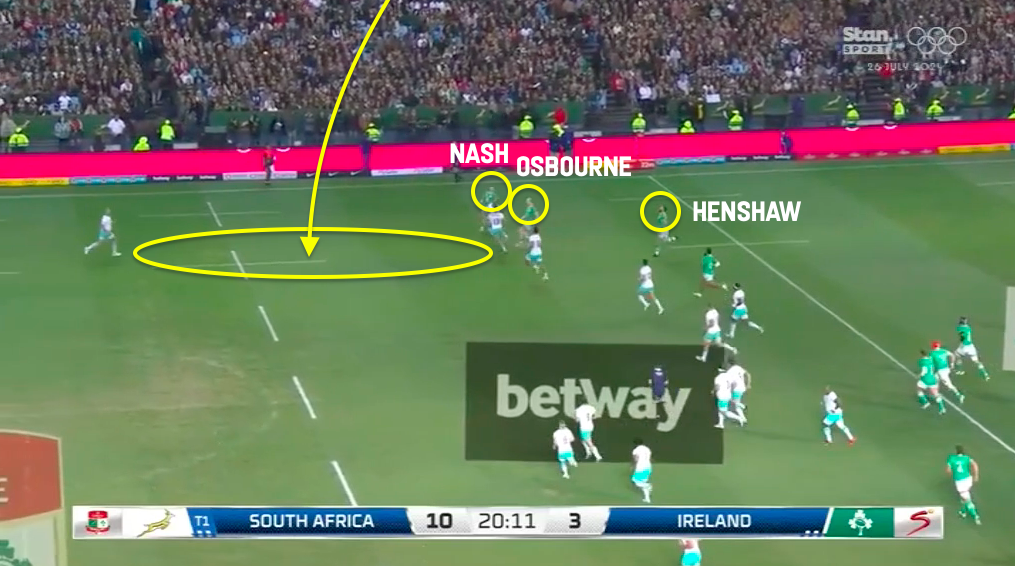
Here’s a good example of one of these angled bombs off a lineout from the middle of the field;
Nash will be kicking himself that he didn’t take this but the principle is what I’m interested in. Crowley is really, really good at these high, hanging bombs. In the Six Nations just gone, nobody got better hang time off restarts than Jack Crowley and this is, essentially, a long hanging restart aimed at a part of a pitch where you can have an even matchup under the dropping ball.
On box kicks, for example, you almost always have one chaser running through or around a screen of three or four forwards who build around the drop zone to allow their receiver an uncontested catch.
When you kick an angled bomb like this, it’s almost impossible to build a kicking screen because it’s often three chasers against three receivers. Ireland loved this particular battle; the incredibly springy and lightning-fast Calvin Nash with two 6’4″ hitters in Osbourne and Henshaw up against a relatively small Springbok back three and #13 where they have no players taller than 6’1″ and two players well under 5’10”. This kick spent 4.24 seconds in the air and landed in the 15m tramline, which is elite ball in air time and good targeting.
We did this multiple times in the first half but never got the purchase we wanted from the tactic despite almost universal good execution. The Springboks seemed to expect the tactic which isn’t a surprise – Munster used it to really good effect against the Bulls in Loftus Versfeld a few months ago.
This kick spent 4.36 seconds in the air and landed in the 5m tramline – elite ball in air time and elite targeting – but Sheehan and Nash just failed to stop le Roux from getting the ball away, while O’Mahony gave up ground to De Allende a little too easily.
But what happened after this is what’s interesting; the Springboks flow through their transition shape, with two visible pods of two off #10. Bongi Mbonambi and Franco Mostert are the blocking pod with Siya Kolisi and Pieter Steph Du Toit, in particular, making a big impact on this transition phase as the edge runners. Ireland really struggled to shut them down and only a big defensive play by Crowley stopped this play deep in the Irish 22.
Ireland used a variant of this tactic against the Springboks in 2022. As I wrote in that episode of the Wally Ratings;
Before the game, I spoke about how Ireland would have to make an adjustment to our kicking game to take Kolbe and Arendse out of long kick transitions. We had been a counter-transition team for most of the last two full test seasons where we kicked long, stopped teams with our transition defence and mopped up their exits with strong kick transition work, intelligent kicking of our own or rock-solid lineout/maul work if they exited to touch.
We tightened our kicking, made it shorter, rode out the scrum and hung in there against their very direct physicality to edge a tight contest by a score.
We did the same in the first test last weekend in the first half but all it was give them more scope to attack us in transition with their new structure. For a time, it was super effective. There is a lot of sense in kicking short onto players like Arendse and Kolbe where we can attack their height with taller players and no kicking shield.
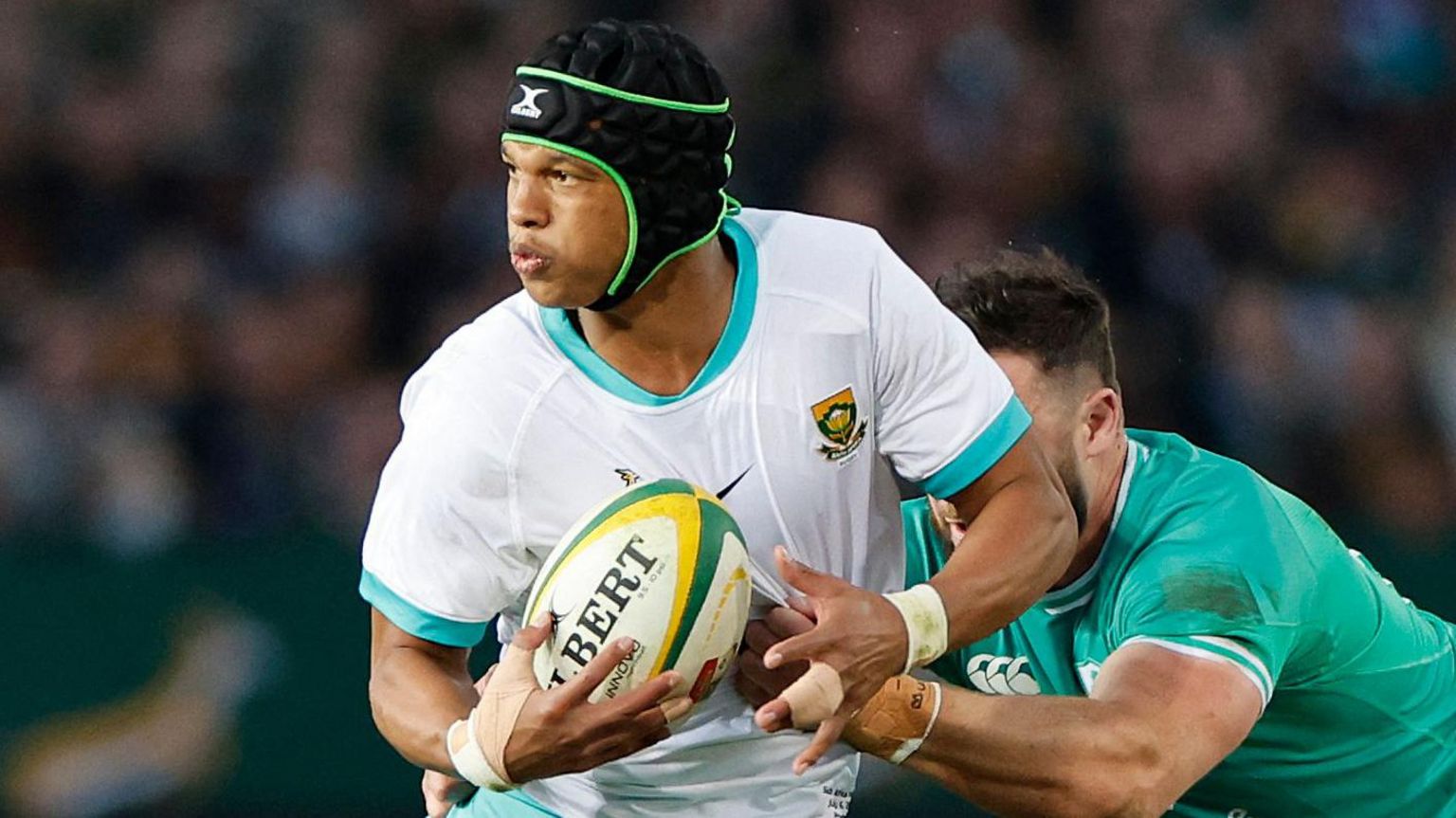
But in an environment where the Springboks attacking game has changed to open up more tip-ons and screen passing after kicks, does that make sense anymore? Should we kick long downfield instead?
Late in the first half we exited long downfield off a 22 drop out and found Kwagga Smith after a pop from le Roux. He attacked back at pace but that first transition ruck was a stretch for the Springbok pack to resource and they couldn’t work their structure off it.
Sure, Kolisi is in the edge space but this is a far more conventional attack that we snuffed out and turned over a few phases later. Any long kick downfield becomes a race between your pack and the opposition’s pack with the transition runner acting as the stopwatch.
Ideally, your defensive transition line will engage the runner before the opposition pack are in place. That is what happened here and, all of a sudden, the 3-2-X breaks down. By kicking contestable to the edge, we were giving the Springbok pack a shorter distance to stack themselves with the depth that a 3-2-X must have to function. We know this ourselves because we played it consistently under Farrell between 2020 and 2023.
In the second half, we kicked long almost exclusively and the Springboks attacking threat evaporated. The tries they scored came from clear unforced Irish errors off kicks downfield.
Even here, you can see the principle working;
Everything is far more direct, there are clear poaching opportunities and the risk of a scrum under the high ball by your kicking is reduced to nil. The Springboks had to kick to the edges themselves and, once again, Lowe will be disappointed not to take this kick comfortably and reset.
There’s always the risk that your long kick ends up with Kurt Lee Arendse or Cheslin Kolbe in open field with time and space but I think it’s a risk you have to take to soak the legs from the Boks pack, challenge their skillset and force them to play from further out the field.
Do it accurately and we have a direct way into this game that challenges the Springboks’ new philosophy head-on.
