


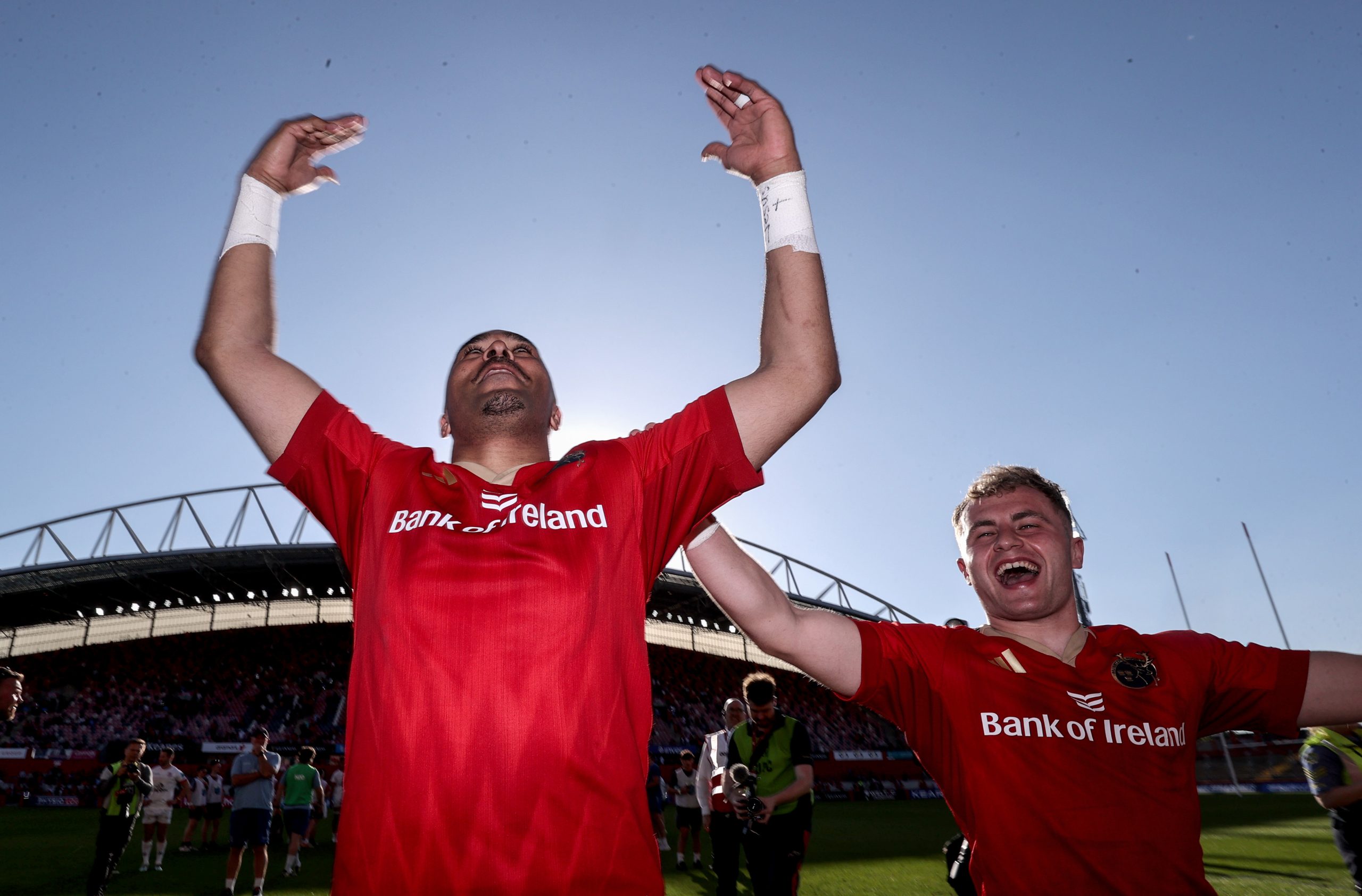
I suppose all that really matters is that Munster won and, in doing so, finished top of the United Rugby Championship.
We’ve played nine league games from February 2024 until Saturday night and all but one of them were won with a bonus point; 44 points out of a possible 45. That is title-winning form but the job isn’t even half done. Finishing at the top of the league is nice, and it comes with certain perks like, for example, a money-spinning home quarter-final, then a home semi-final if you can win that and then a home final if you can win that. But what does it actually mean? Nothing.
The team who finished top of the URC the last two years hasn’t won the playoffs, so while home advantage is nice, we must make it count, which means delivering on expectations.
We will retain the title if we can win three home games in the next month. It’s that simple. That doesn’t mean it’s easy; it just means we have an advantage that we have to use.
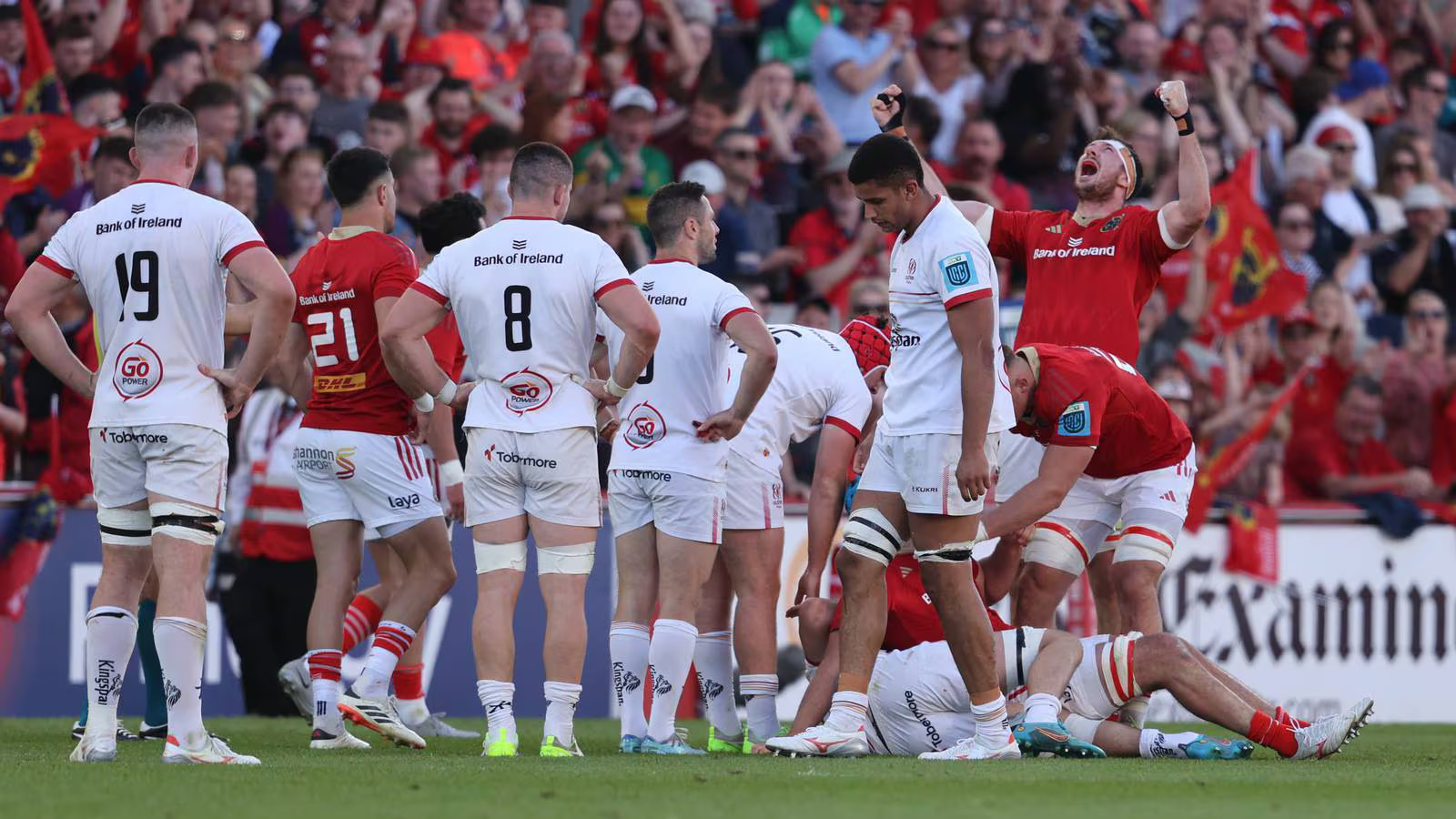
This team has earned expectations. The problem is that expectation means pressure, and pressure can be unpredictable. Ulster, with no expectations and thus no pressure, could approach the game with freedom and they played like it. On the other hand, we looked like a side that knew we had another game coming next week but were burdened by the prize on offer here.
How else to explain playing the worst 40 minutes of rugby since that Connacht loss that started this winning run? The two tries that Munster conceded in that half will rank up there with the worst all season because they featured cascading avoidable mistakes.
I suppose the good thing – great thing, possibly – is that even while we were dopestruck and feeling the pressure against a team who picked up every clanger we dropped and ran with it, Munster found a way to win despite being 10 points down on two different occasions.
That earns the trust of Thomond Park and when Thomond Park trusts you, it helps you rather than hinders you. It turns you into a monster.
***
One of the things I look for in any squad or any player is how they recover from playing like shit, especially #10s. No player plays well 100% of the time in every single game they play. Not Dan Carter. Not Johnny Wilkinson. Not Ronan O’Gara. Not Owen Farrell. Not Johnny Sexton. Nobody. I would say that a majority of all the games you play at #10 in this game will see you drop a stinker for either the entire game or a key segment of a game. The key is how you recover and how quickly.
The best #10s have goldfish memory when it comes to mistakes. They genuinely do look at the next play with no memory of the previous one where they stank the place out. This is the superpower that all really good #10s have because if you’re a good #10 you will constantly be trying to make something happen and that will often lead to mistakes.
Jack Crowley is a really good #10 who backs himself in defence and on the gainline so when he dropped an all-time stinker in the first half, you might wonder how he’ll turn the tide in the second half. But Crowley has shown over and over again in his young career that he won’t let a bad moment keep him from a good moment.
In the first half, Jack Crowley conceded a needless penalty by playing the #9 that led directly to an Ulster try from the resulting close-range lineout position, kicked the ball out on the full on a contestable and then kicked a goal line dropout dead with the clock in the red, which lead to a 5m sequence that Ulster scored their second try on.
That would be enough to trash any playmaker’s confidence. You’ve seen it enough times. What did he do in the second half?
He won the game for Munster.
He wasn’t alone in turning their performance around when it counted but, as it so often does, it comes down to your playmaking lead to make plays. Ably assisted by the excellent Joey Carbery – who rotated in at first receiver with Crowley after Scannell’s injury – Crowley showed up in all the big moments that he needed to. Only the width of a post denied Crowley a perfect record off the tee, with all of his kicks outside the first conversion being in the low percentage make range.
But it’s not just about goal kicks either, it’s about backing yourself to make plays late and repeatedly. He did that when it counted, and it was all the more impressive because of what had come before.
Big players forget quickly and remember who they are even quicker.
***
Tactically I thought Munster had the right idea – and we can see how it should have worked – but it was let down by poor moments of indiscipline.
We kicked a lot in the first half, primarily to the edges and short with the idea that we were comfortable defending Ulster outside our 22. This is a good example of the kick working as designed; Daly winning a mismatch with Lowry and forcing a Munster lineout.
If you look at this defensive sequence you can get a good idea of what the general concept was with this early-game off-ball approach. It’s 90 seconds long but it shows all the key principles. Only blitzing once the ball is on the edges, staying out of the ruck unless a window opens up (or you’re Tadhg Beirne) and soaking up Ulster to the point where they are making and gaining the same 10 metres on back-to-back phases.
I think most refs award the breakdown turnover to Craig Casey here, right before Crowley’s poor discipline and while, sure, this led to Ulster’s first try, I think the work up until then was sound. Two mental lapses meant that our off-ball tactics had to go out the window.
Even during the game, I found that our ability to punch holes in the 3/4 space was reduced quite a bit by Scannell and O’Brien in midfield. I think either player would work with Frisch or Nankivell offensively, but together they lacked a little bit of the punch or playmaking fireworks to hurt Ulster consistently. I had no worries about either man in defence but Nankivell and Frisch provide a different type of physicality on the offensive side of the ball.
That mostly showed off the set-piece. We got stuffed off this maul break on successive hit-ups and got turned over because we were too slow to get set on the next phase, so far backwards had we been marched on O’Brien’s carry.
Later in the half, you could tell that Ulster were already slipping off Scannell’s decoy lines, which was making our passing and angles harder and tighter to work.
Burns is already slipping off Scannell’s option line as Casey makes the pass – this makes it more difficult for Nash to work a compression and possibly release Crowley around the corner.
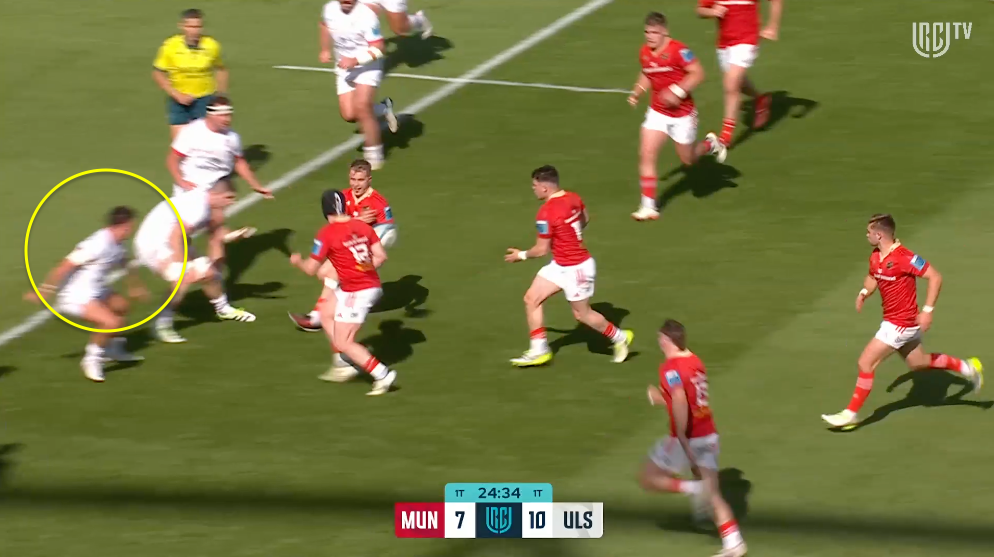
This improved when Crowley went to #12 because he’s quicker and more explosive, even when rotating at first receiver with Carbery but it fully clicked when we added Coombes, Ahern, Jager and Hodnett to our pack build – their addition provided narrow and edge threats to clean up our 3/4 space.
With Hodnett and Coombes on the pitch, all of a sudden O’Brien had more space to work; look at the build-up to Shane Daly’s try for a good example of how those additions cleaned up our 3/4 space options.
A little bit more composure on both sides of the ball probably makes this a more comfortable, less heart-racing victory but even when securing a home knockout run, this team still likes to do things The Hard Way.
I’m sure we’re in for more heart-racing moments in the weeks to come but, for now, it’s job done and knockout rugby in Munster until we lose or we retain the title.
Simple, really.
| Players | Rating |
|---|---|
| Jeremy Loughman | ★★★★ |
| Niall Scannell | ★★★ |
| Stephen Archer | ★★★ |
| RG Snyman | ★★ |
| Tadhg Beirne | ★★★★ |
| Peter O'Mahony | ★★★ |
| Alex Kendellen | ★★★ |
| Jack O'Donoghue | ★★★ |
| Craig Casey | ★★★★ |
| Jack Crowley | ★★★★ |
| Shane Daly | ★★★★ |
| Rory Scannell | ★★ |
| Sean O'Brien | ★★★ |
| Calvin Nash | ★★★★ |
| Simon Zebo | ★★★ |
| Eoghan Clarke | ★★★★ |
| John Ryan | ★★★★ |
| Oli Jager | ★★★★ |
| Tom Ahern | ★★★★ |
| Gavin Coombes | ★★★★ |
| Conor Murray | ★★★★ |
| Joey Carbery | ★★★★ |
| John Hodnett | ★★★ |
