


So. Here we are.
It’s the last game of the regular season and, for the time being, at least, it feels like we’ve got the end-of-season run-in nailed down.
Last year, we earned 32 points in 2023 to go from the bottom half of the table to 5th, which was some turnaround in a season where it looked like we’d struggle to make the top eight at times in the first half of the season. Things didn’t fully turn around for us until Round 11 and it powered us to the title. This season, it wasn’t until Round 10 that we properly got our act together and earned 39 points out of the 40 possible match points up until this weekend. That has powered us to the top of the table with the last regular season game to play.
Before the Cardiff game a few rounds back, I wrote that the average points tally for a home quarter-final was 60 points, which is exactly what Leinster and Glasgow sit on now in third and fourth. The average points total for a top-two finish has been 64 points – Munster currently have 63.
The average points total that has earned a top-four finish in the URC in the first two seasons is 60 points. The average points tally for second place has been 64 points. Both seasons were distorted in one form or the other; year one was distorted by the South African sides playing at home for the last six months of the season and year two was distorted at the top end by Leinster losing one game all season.
This year, given how the season has shaken out I think 62 points will be enough for a home quarter-final in fourth. If we can win this game [Cardiff at home] with a bonus point, that would give us five games to accrue the 18 points that I think will be enough to get us to 62 points.
We didn’t win that game with a bonus point. Still, we followed it up by earning an unprecedented 10 match points in South Africa which, along with Leinster’s “collapse” in the last few months, has put us in a position to finish the regular season in first place and with a home knockout run in the bag if we can keep winning. The last time we managed that in non-conference league play was 2016/17. Leinster losing so many games relative to their usual regular season dominance this year has bumped the required points for that elusive top-two finish. You’ll need 66 points this season to guarantee a top-two finish, while the 60-point mark is still the hard ceiling for a home quarter-final.
Any win here and we finish top. Lose, though, and we could still finish as low as fourth depending on results elsewhere, with the nightmare trip to Pretoria on a week’s notice waiting as the booby prize for anyone finishing in third.
Standing in our way from top spot? Ulster.
We are, quite rightly, treating this as a knockout game because that’s what it is. If we are to retain the URC title (#AndStill) we will have to get used to delivering at home, starting this weekend. The last few seasons have seen the aura of inevitability around Thomond Park disappear. We might not like to hear that, but it’s true. Leinster beat us in Thomond Park every year, it seems, Glasgow did it in the regular season last year, as did Ulster. This season Bayonne rocked up with no fear and could have beaten us – the draw felt like a loss regardless. Northampton edged us out by three points in January.
If we can regain that aura for pressure games, nobody will beat this Munster team in the knockouts. But we have to earn each opportunity to establish it, both on the field and in the stands. That starts tonight.
Munster Rugby: 15. Simon Zebo; 14. Calvin Nash, 13. Seán O’Brien, 12. Rory Scannell, 11. Shane Daly; 10. Jack Crowley, 9. Craig Casey; 1. Jeremy Loughman, 2. Niall Scannell, 3. Stephen Archer; 4. RG Snyman, 5. Tadhg Beirne (c); 6. Peter O’Mahony, 7. Alex Kendellen, 8. Jack O’Donoghue.
Replacements: 16. Eoghan Clarke, 17. John Ryan, 18. Oli Jager, 19. Tom Ahern, 20. Gavin Coombes, 21. Conor Murray, 22. Joey Carbery, 23. John Hodnett.
Ulster Rugby: 15. Ethan McIlroy; 14. Mike Lowry, 13. Will Addison, 12. Stuart McCloskey, 11. Jacob Stockdale; 10. Billy Burns, 9. John Cooney; 1. Eric O’Sullivan, 2. Rob Herring, 3. Tom O’Toole, 4. Kieran Treadwell, 5. Alan O’Connor (c), 6. Cormac Izuchukwu, 7. David McCann, 8. Nick Timoney
Replacements: 16. Tom Stewart, 17. Andy Warwick, 18. Scott Wilson, 19. Harry Sheridan, 20. Matty Rea, 21. Nathan Doak, 22. Jude Postlethwaite, 23. Stewart Moore
Under Richie Murphy, Ulster have transitioned from a solidly on-ball team to an upper-range counter-transition outfit and done so mostly successfully mid-way through the season.
Most of Ulster’s game state change hasn’t happened in their kicking tendencies – they are kicking mostly the same as the start of the season – but in their phase play, where they have upped their Pass Per Carry ratio incrementally as Murphy has gotten his feet under the table. That brings with it more risk and more turnovers – Ulster are 13th in the league for turnovers lost – which is something Munster will look to get after in the early and mid-game.
One look at that Munster side tells me that we’re looking at a primary off-ball state to start with a strong counter-transition/on-ball build to finish off the bench.
That starting pack is filled with players who can make it sticky for Ulster on post-transition sequences, where Murphy’s men run into a classic 3-2-X formation with Izuchukwu as their primary wide threat.
On this linebreak, you can see the 3-2-X shape with Addison stepping in as the first receiver off-screen and cutting against some pretty average Leinster defence. It’s fairly typical of Ulster’s transition phase play.
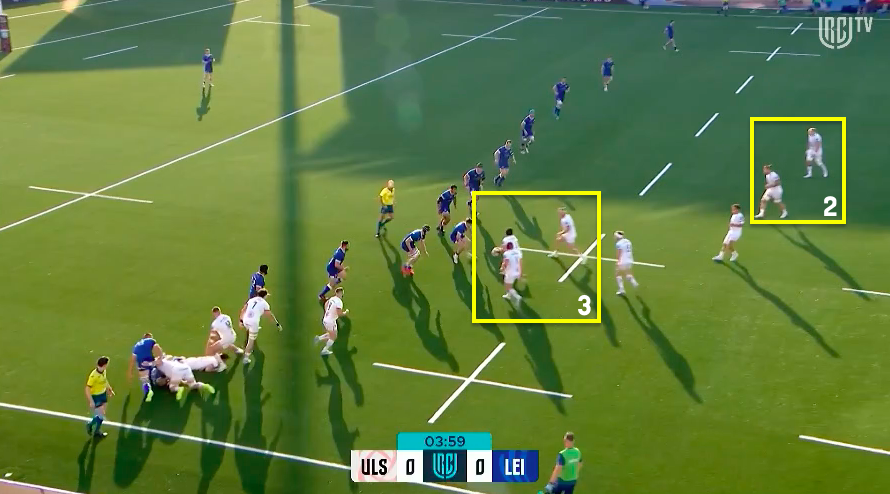
Addison, McCloskey and Burns will rotate around those transition screens quite a bit and they all add something a little bit different. Ulster’s improvement under Murphy has come from these players having more freedom to make plays. Addison is a slashing runner, McCloskey is a bulldozer with offloads and Burns is a slashing playmaker with really good kicking to the outside edges. Ulster always look for this kicking option if they have the ball anywhere near the 10m lines.
For Munster, I think we’ll kick quite a bit shorter to Ulster – primarily at McElroy and Lowry – and bring them into close-range phase play quite early. We win more turnovers per tackle than any other team in the league and Ulster concede an above-average number of turnovers – I think this is a matchup we want in the early to mid-game.
I also think we’ll be quite willing to get the ball off the field too – Ulster’s maul isn’t the weapon it was even earlier this season and they have one of the worst lineout completion rates in the tournament. In the last few weeks, Ulster have tried to mitigate this by throwing the vast majority of their lineout possession to the front or the front of the middle. Rob Herring helps their lineout completion but I do think they can be got at and we have a starting back five built to be very sticky if we choose to go after Treadwell and O’Connor in that front zone of the lineout.
Our off-ball build hasn’t really put too much energy into lineout contesting – more making a mess of the ruck off the break – but as part of a kick-heavy early game strategy, it could be a good way to get at Ulster. Clermont effectively played a high kick volume counter-transition game against Ulster in the Challenge Cup and were quite comfortable giving Ulster multiple lineout positions to play off. Ulster ran at 87% that day – above average for them on the season – but it was still a weak point.
We’ll also look to go after them in the scrum as Benetton, Cardiff and Clermont have done to quite a bit of success in the last few months. Ulster concede an above-average number of scrum penalties and I think there’s the potential – referee’s interpretation allowing – to use this as a nice add-on to our short and contestable kicking game.
In the second half, I expect Jager and Ryan to pressure Ulster’s replacements in this area while we switch to a strong on-ball game.
RED EYE DIGEST
EARLY & MID GAME STRATEGY:
- Box kick or high bomb in the contestable mid-range.
- Play off-ball rugby to get at Ulster’s phase play game in transition; big early ruck focus that we can always pare back if needs be.
- Look for Daly vs Lowry on the crossfield bomb off Crowley.
- Get the ball off the field to get at the Ulster lineout even if it means exposing our midfield to McCloskey.
LATE GAME STRATEGY:
- Put extra energy into scrummaging for penalties and pressure on their bench transition. We want to switch our props before they do to set the tone that we’re dominant so that when they switch, we’re still fresh and using Ryan to go after Wilson technically.
- Use Jager, Coombes and Snyman to compress Ulster off #10 – look for offensive kicks to the tramlines for Hodnett and/or Ahern.
- Get Ahern and Snyman on the field together with Beirne for at least 5/10 minutes before switching. Snyman for Hodnett. Ahern to the second row for scrummaging, O’Donoghue to our #6 role and Coombes in for O’Mahony.
