


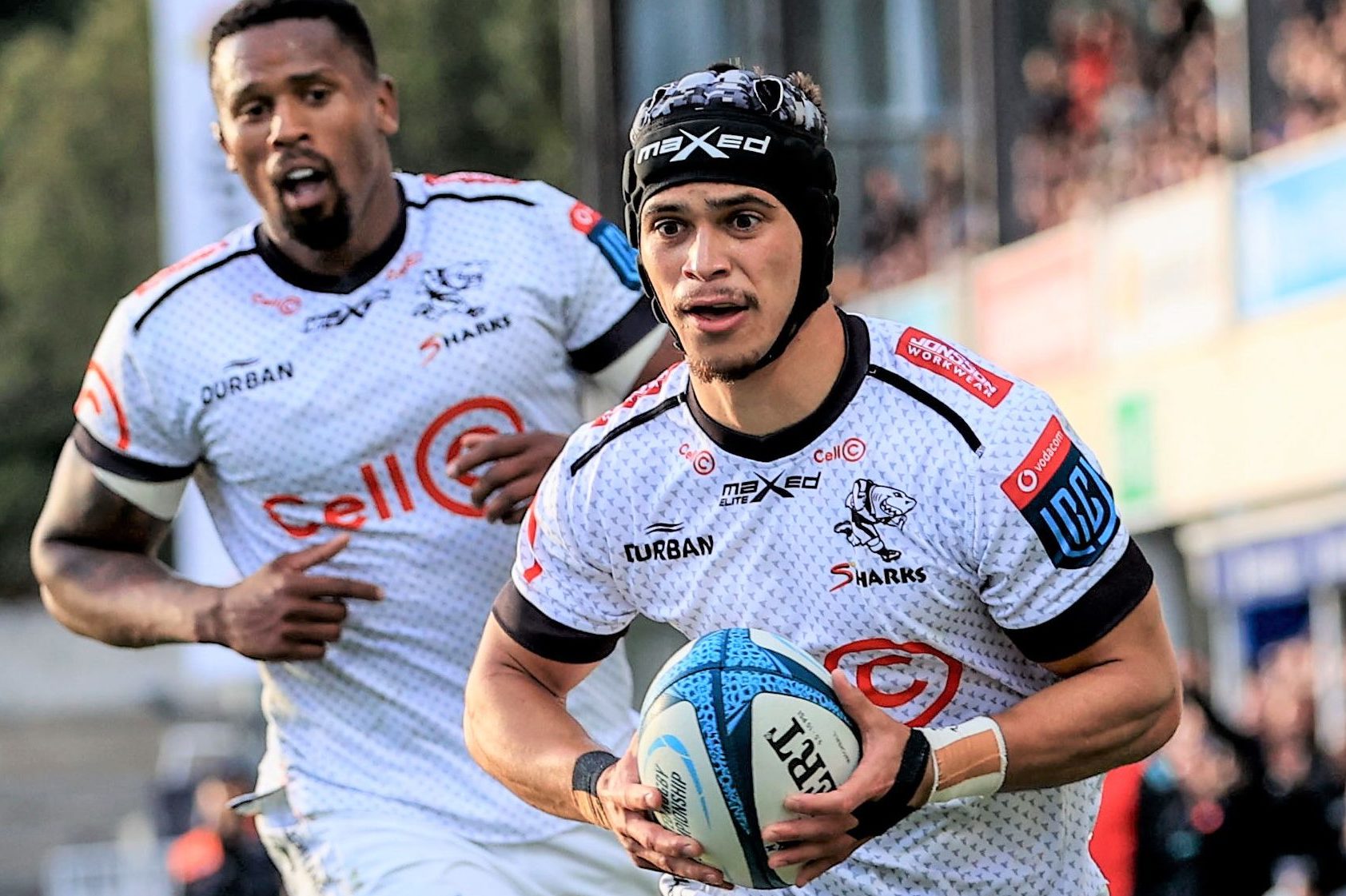
Speed kills.
That’s what they say, anyway, and if it’s true, in Thaakir Abrahams, Munster have signed one of the most dangerous men in the game.
He’s 5’9″, 76kg, and part of a new wave of killer slashing outside wingers that, in some ways, we are well used to at Munster. Abrahams is slightly smaller and lighter than Keith Earls but in the same general archetype. When thinking about the Slashing Outside Winger you need to visualise Cheslin Kolbe, Arthur Retière, Kurt-Lee Arendse, Ange Capuozzo, Edwill Van Der Merwe and Thaakir Abrahams.
You’re probably wondering where you remember Abrahams from – let me remind you.
He is ridiculously fast, has the best acceleration you’ll see outside of prime Cheslin Kolbe and he’s an elusive, agile runner with a great kicking game and who is as dangerous in the second layer as he is in the 5m tramline. He’s deceptively strong in the carry – like Arendse and Van Der Merwe in that regard – and he’s comfortable playing fullback, which I think he’ll do a fair bit for Munster next season.
He’s lethal on the outside, as you’d expect, but he uses that speed really well in central areas too – drawing out blitzes and then just ghosting around them.
But the first thing you’re probably thinking is; why a back three player? Why not a prop, hooker or lock to replace Snyman, for example? As you’ll probably know at this rate, dispensation from the IRFU isn’t available for a front row and signing a NIQ lock is a no-go because of Jean Kleyn. A lot of bandwidth has been taken up discussing Munster’s need for front-row power but if the right guy isn’t there – or you don’t have permission to sign the right guy – then you have to be creative. How can you improve Munster’s overall game without slotting in 125kg worth of beef into the front row rotation?
First, you have to look at the talent Munster have lost from the back three this season already; Andrew Conway, Keith Earls and, just last week, Simon Zebo announced his impending retirement so there is scope there to bring in someone who can play all three of our #11, #14 and #15 rolesets, which Abrahams does.
Secondly, if we go back to the four moments of phase play – settled attack, settled defence, offensive transition and defensive transition – we know that you can supercharge one of those moments to compensate for issues you might have elsewhere. If you’re primarily an on-ball team, what will most teams try to do to stop you? Overload your phase play by kicking the ball to you at a high volume and usually over a long distance, too.
What kills a team that kicks the ball like this? Runners like Thaakir Abrahams. He can destroy teams on the first phase of transition, whether they kick loosely to him or not.
He’s got such a low centre of gravity that, coupled with his freakish acceleration, agility and top-end pace, he’s almost impossible to get a solid shot on if he’s got any space to work with. And that’s before you factor in how explosive he is stepping off both feet at speed.
With Abrahams in the Munster backfield – either positioned centrally or arriving up on the wing – we have a player who can break open even the best transition defences.
Oyonnax do not have the best transition defence – to be clear – but they have Abrahams covered pretty well on this kick upfield and he has absolutely nothing to work with inside or outside.
He still gets the linebreak.
Munster’s offensive system is producing a lot of linebreaks on the right-hand side of the field and we aren’t converting them at the same rate that we’re creating them. Some of this comes down to a lack of top-end pace in our back three, bar Calvin Nash. There have been plenty of times this season where we’ve got the ball to space on the left wing and found that, unless it’s Calvin Nash on the receiving end as a loop runner, we don’t quite get the separation we were looking for.
Adding Abrahams (and Kilgallen) immediately solves that and puts us up there as one of the quickest teams in European rugby, including the South African franchises.
Abrahams is a comfortable passer, too, and has a good kicking range, allowing him to easily settle in to our system. That system fit has eluded him at Lyon, who seemed to sign Abrahams because of what he could do without knowing how to utilise him in their system. In Munster’s on-ball structure, he offers the same kind of progression up the edges as a power winger, while supercharging our work in transition and off the set piece with elite pace and acceleration. On the negative side, elements of his defensive work are still a question mark but that is less visible in an on-ball team.
As signings go, he’s right up there for me as a player who can take our system and move it to another level as a finisher, linebreaker and transition specialist.
