


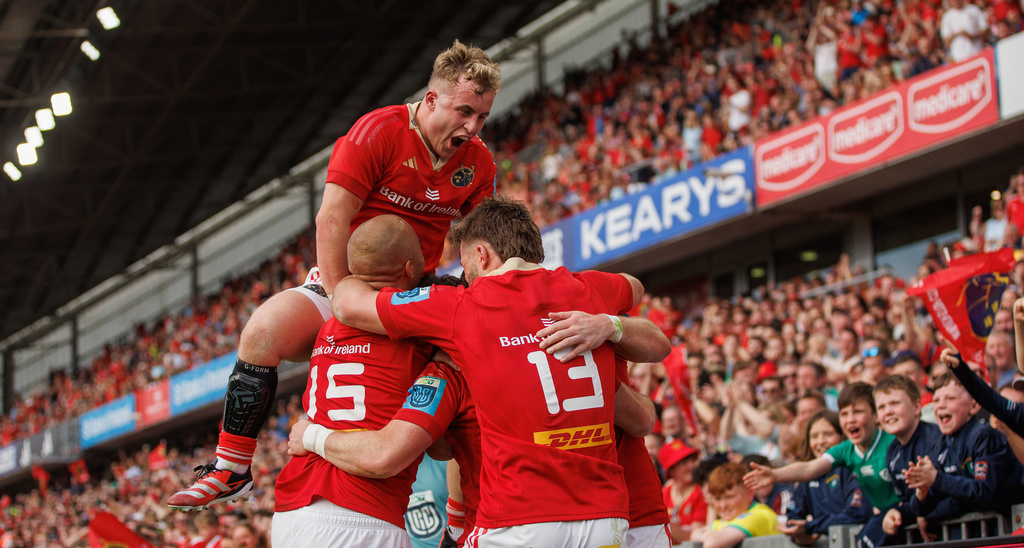
I was late coming into Thomond Park by my standards. I like to be in there early, right when the media gates open, so I can sit back and watch the stands around me and the terraces beneath me fill up with people. I see Dads and Mams with kids holding their hands as they clamber up the concrete steps looking for row numbers and seats. I see teenagers cluster together to try and reach a critical mass of scutology and fool-acting. I see lads out on the beer with their friends. I see people sigh in relief as they take their seats because this is the 2/3 hours of the week where they don’t have to think about real life, only what happens on that deep green field.
I missed all of that on Saturday because I was rushing from a Communion after scarfing down turkey and ham like a starving dog would have. I pulled into the LIT car park and scuttled over to get my media pass off the woman at the door before flying up the stairs to land at the press box… an hour before kickoff. Late by my standards, I said.
Dan slid two packets of jellies from his bag across the table. “Pick one,” he said. I went with the jelly babies, because the other option was those gummy bears that I, somehow, always manage to choke on for an awkward half a second.
We realised pretty quickly that we were both already sunburnt, despite both of us being warned separately beforehand to take steps to avoid that. The balmy sun in Thomond Park was not going to make the sunburn any better over the next few hours. We were rugby lobstermen and we had radio to… radio. So radio we did.
Right before we went live, we wrote out the teamsheets on a sheet of A4 paper. Dan jabbed his pen at the paper after we were finished. “That team,” he said pointing at the Munster side before sliding it over to the other, “should beat that side”. And he was right but, as of late, that has proven difficult to establish. Injuries played a part in January, sure, as they did last season too but I often got the feeling that all Connacht needed to do to get us off kilter was to grab a few collars, fire in a few dog shots and we’d lose every volt of energy we had trying to stay focused on the game.

That was Connacht’s great advantage in the last few games of tight wins and tight losses; they felt the freedom to shithouse and play with proper aggression while we were still looking at the notes on our wrist tape to stay on plan. Almost immediately, you felt this game was different. We’re healthier than we’ve been all season and we’re now comfortable playing different variants of the game that took so long to bed in last season.
So when Connacht inevitably started shithousing inside the first 10 minutes, we felt free to return fire like for like. They couldn’t handle the heat.
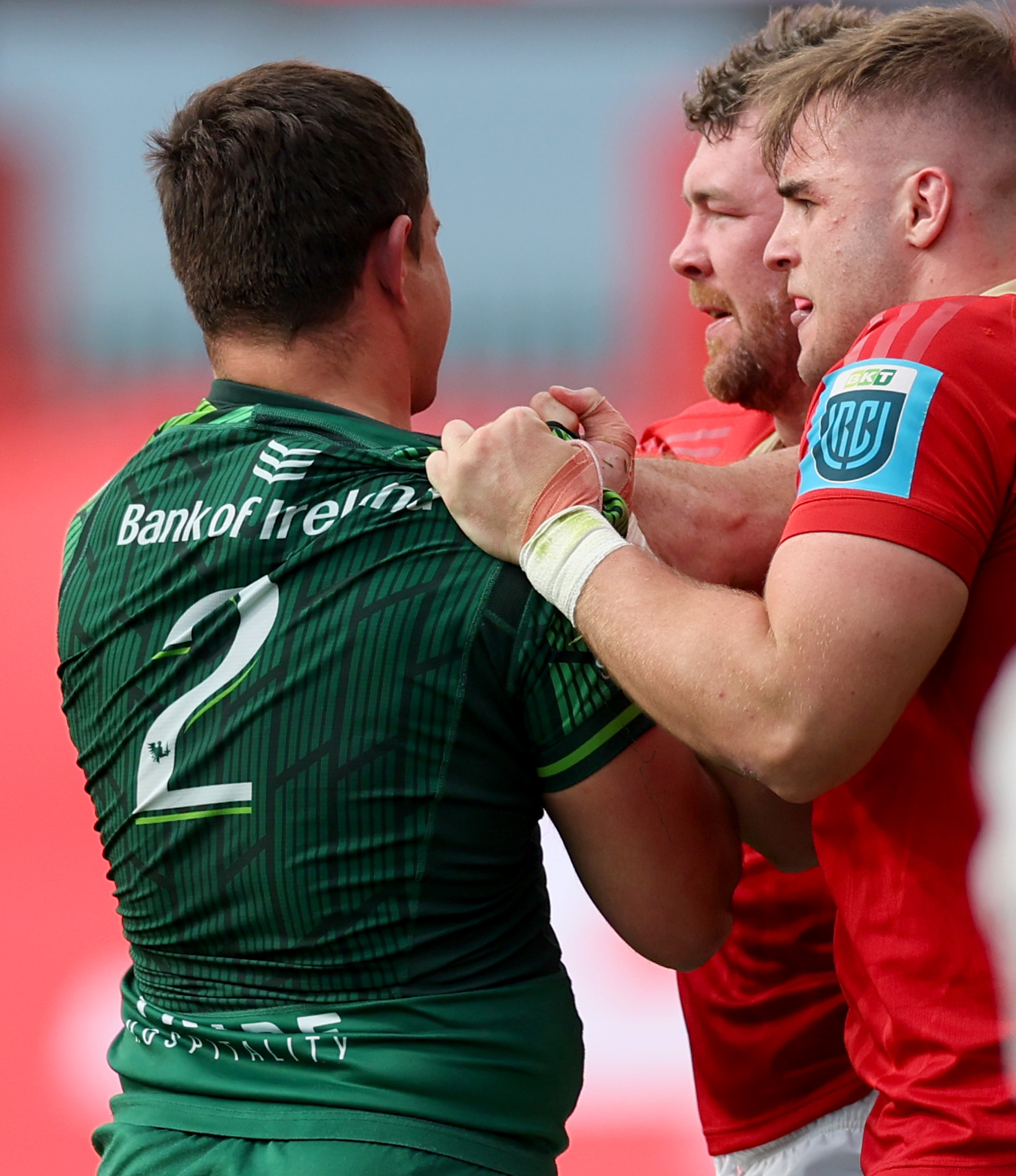
Last week, Connacht’s head coach spoke about a need to deliver “physicality”, while former Munster player Conor Oliver spoke about how eager he was to put this game into his calendar at the start of the season. To me, this is the same as Caelan Doris talking about how much he loves playing in Thomond Park when it comes to insults dressed up as platitudes. Lads should be fucking dreading coming here.
Conor Oliver maybe won’t be so eager to get Google Calendar out after the treatment he got on Saturday evening, to be fair;
But this is only the start of the job this team has to do when it comes to building up the fear factor of Thomond Park again. Injuries killed us this year, as did an under-the-radar nightmare pool in Europe sending an ascendent Northampton side right when the injuries were biting the hardest. There’s plenty of time left this season to start building that aura but it’ll only happen as long as we can get this kind of bite, aggression and power on the field for the full 80 minutes.
It’s a long time since the “win if you can, survive if we let you” days but there’s more than enough evidence that this new Munster can turn Thomond Park into the boneyard it has been in years gone by once again. The House of Pain on the Cratloe Road was open for business once again.
***
Before the game, I wondered whether Connacht’s enforced changes at #10 would lead to a change in approach. They have been verging on an on-ball side – or at the very least a lower kick volume counter-transition side – this season with JJ Hanrahan as the primary creator. Hanrahan’s season-ending injury in the last round meant a return for Jack Carty and with him, a conundrum for Wilkins. Do you continue to play the game best deployed by Hanrahan or revert to what Carty is best at; namely, kicking long and often to tie up the opposition territorially while Connacht’s midfield and back row pile in with a tonne of double tackles and breakdown entries to play classic counter-transition rugby.
In the first 30 minutes of this game, it was the latter. Connacht made 81 tackles inside the first 25 minutes. Munster’s answer to Connacht’s approach was very much “Oh so you wanna tackle? Cool”.
We played heavy on-ball rugby in the first half an hour and looked to tire out Connacht’s tight defence with overwhelming carry pressure.
Connacht kicked the ball willingly in the early game to get the most out of their hard-tackling pack build and midfield. Hurley-Langton, Oliver, Dowling and Heffernan were constantly tackling Munster carriers and we pressed them hard. We scored two tries but I’d wager that Connacht would have been delighted with how that first half an hour went. They only conceded 14 points and even lost a man for 10 minutes. When they scored a sucker punch try a few minutes before halftime to make it 14-7, I think they felt like they were right where they needed to be.
They started the second half really well and had the ball right up to the Munster tryline – only very good defence kept them out. A few minutes later, Munster landed a sucker punch try of our own to make it 21-7 and, from there, Connacht had to settle into an on-ball pattern to try to get back into the game. They couldn’t just kick the ball to us because they knew we’d hang onto it. They started to rack up the phases and their Kick to Pass Ratio went way up from where it had been in the first half. They were in and around one kick for every five passes in the first 50 minutes but by full time it was one kick for every 15.3 passes.
When Connacht have had a KtP ratio higher than 12 this season, they’ve lost by an average of 31 points against Bordeaux, Lions and now Munster. Why? Because Connacht’s attack structure is pretty basic. When they aren’t kicking at a high volume, they are pretty easy to defend in settled phase play. Basic pass options, basic structures and basic ideas. If you stay error-free, they’ll go back and forth phase after phase without ever really challenging you with something you haven’t seen or overwhelming power. Their system is very Irish – 3-2-X shape with a lot of tip-on action but if you stay out of the rucks and track the flow of the ball, you should always have numbers.
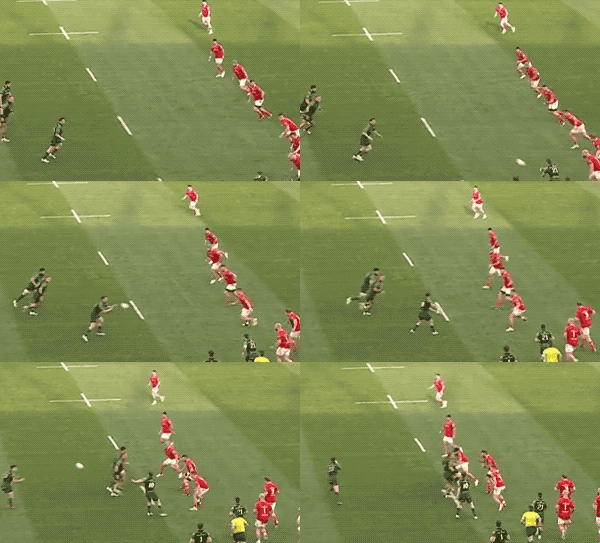
In this example, we had this attacking passage covered all the way right up until Beirne – who was excellent – blew a read on Carthy’s pass. I think he got spooked by how tightly packed that two-pod was but he stepped in and that gave Farrell the gap to attack.
You can see the misread here – a few needless steps inside opens up a lane for a dangerous runner.
They had an 83-second long passage of play later in the half that almost saw Hurley-Langton score in the corner. That came about when Jack Crowley slipped off a tackle at the edge; up to that point, we kept them hemmed in around the 10m line for multiple phases.
Our attack, on the other hand, was smooth, efficient and very hard to defend.
Here’s one example – a three-phase strike play off a scrum launch;
This one was really nice. You can see Nash at the start of the strike on phase 1 as a blindside option with Coombes adding weight to draw a few Connacht defenders to that side. You can see Oliver reacting to the move because, on scrums, the Connacht scrumhalf always follows the ruck.
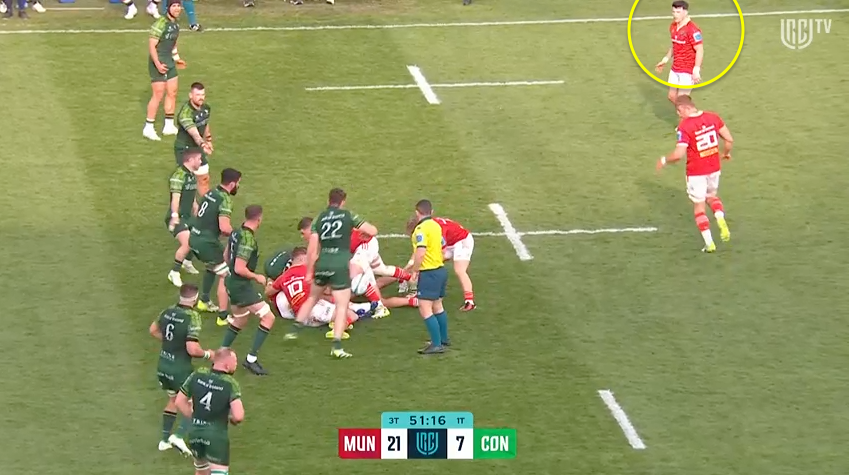
Munster hit it up tight through Snyman with Jager cleaning on the inside. Nash and Nankivell get on a very quick loop route to provide a screen runner and pass option as late as possible so Connacht have nothing to blitz on.
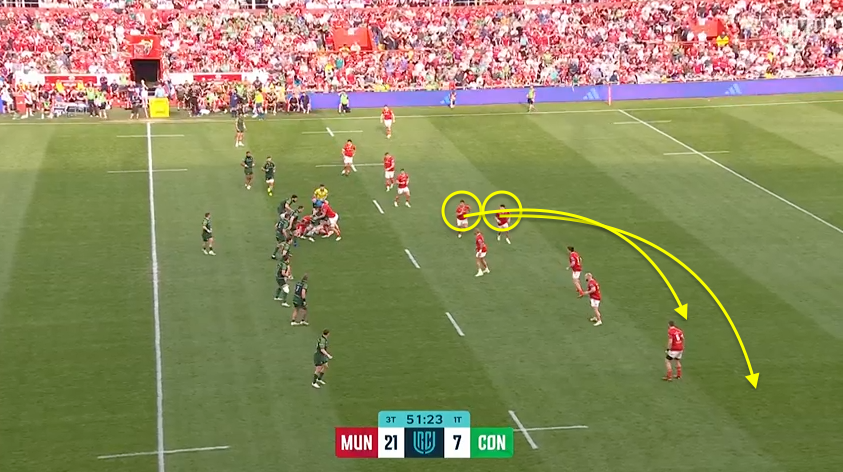
How do you deal with a high-edge blitzing team that wants to funnel you back inside for their breakdown threats? You give them nothing to blitz on until it’s too late.
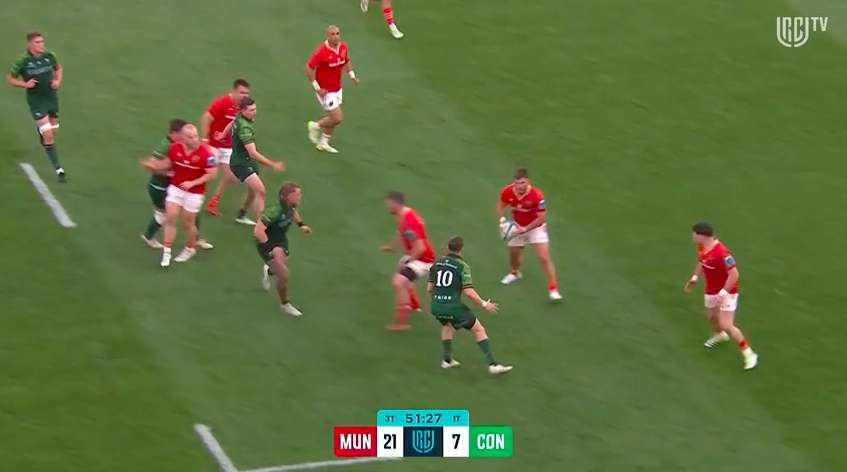
Nash was able to attack into space and attack Blade as he tried to scramble. Something to remember for the next time we play a team that has such a high-edge blitz. That concept of screen runners and release options arriving late is also present in our settled phase play. Look at this beauty off a super slow ruck in the second half.
Frisch starts the play outside the “frame” of the three-pod arrayed outside Carbery. Zebo looks like the most likely player to receive a pass off this three-pod when Connacht would be picking their targets.
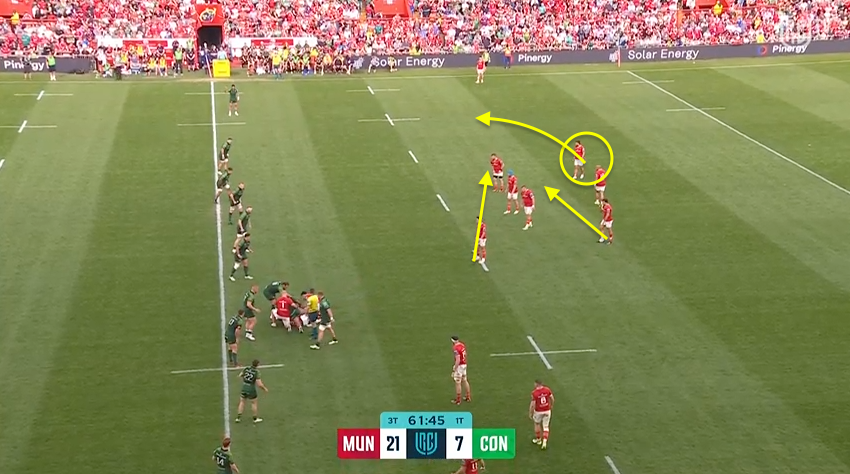
When the ball releases though, Zebo darts to the third layer of the attack, Carbery hits O’Mahony at the outside of the pod to draw up the Connacht edge blitz and when O’Mahony swivels the ball in the screen, Frisch is arriving so late that he’s got an automatic isolation to work with on the edge. Hurley-Langton shoots in on Frisch, and Ralston is drawn up and in, reacting to Nankivell and Zebo drifting around in the third layer.
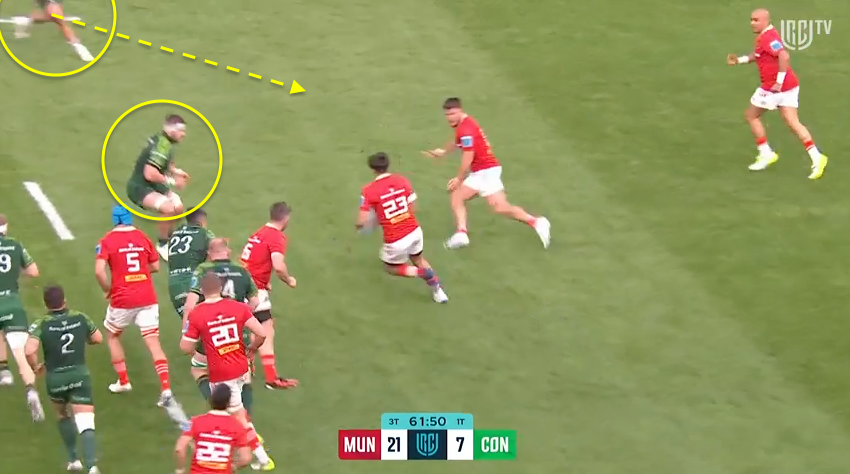
Again, this structure doesn’t just happen; it’s a play designed to attack a team that shoots up at the edge by smuggling numbers outside of the blitz late in the movement.
Connacht’s two-part line speed – Butler on O’Mahony and then Hurley-Langton/Ralston on the edge – was blown up by this play and when we got the ball into that space, we let ballers ball and find a way to the tryline. That score killed the game and knocked the stuffing out of Connacht, who scored another consolation try before coughing up three scores in the last fifteen minutes.
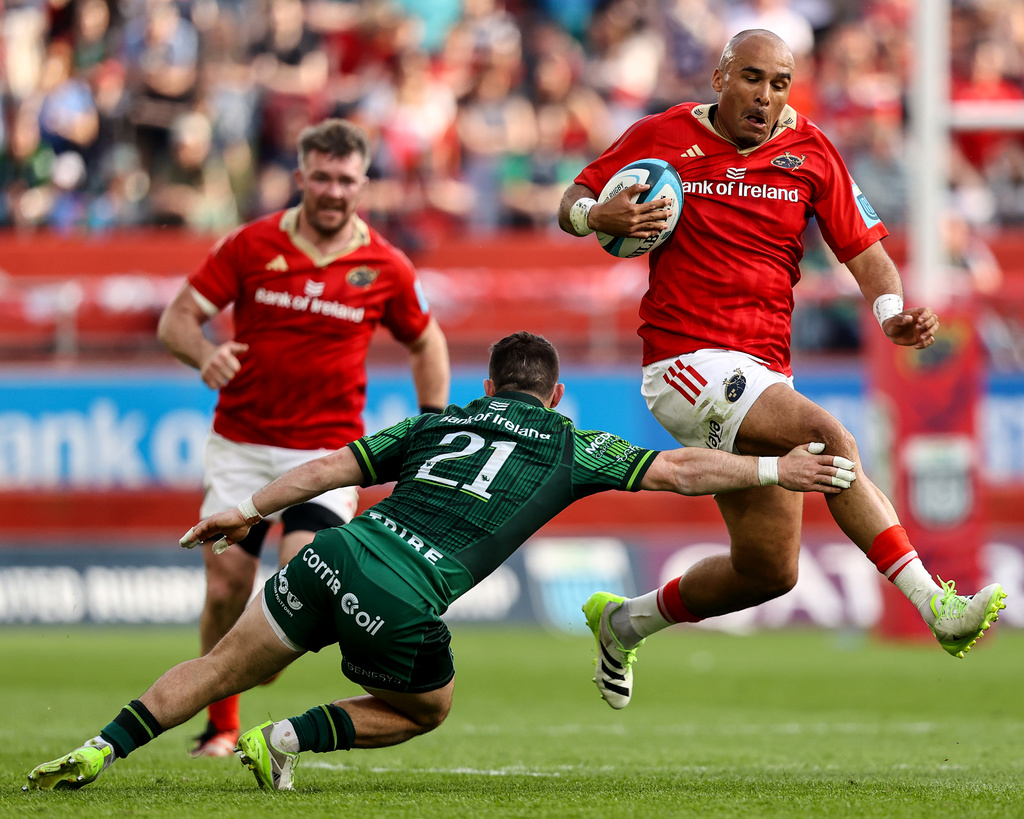
It would be a mistake to throw too much emotional energy at this win one way or the other. Connacht have been something of a bogey team for us, yes, but our season should not be defined by finally getting a cathartic result over them. This was five points in the bag on the hunt for a top-two finish, nothing more.
That isn’t to say that I didn’t enjoy it, though. I enjoyed it a lot. Even more than the turkey and ham, and that’s saying something.
| Players | Rating |
|---|---|
| Jeremy Loughman | ★★★★ |
| Niall Scannell | ★★★★ |
| Stephen Archer | ★★★★ |
| RG Snyman | ★★★★★ |
| Tadhg Beirne | ★★★★ |
| Peter O'Mahony | ★★★★ |
| Alex Kendellen | ★★★★ |
| Jack O'Donoghue | ★★★★★ |
| Craig Casey | ★★★★ |
| Jack Crowley | ★★★★ |
| Shane Daly | ★★★★ |
| Sean O'Brien | ★★★ |
| Alex Nankivell | ★★★★★ |
| Calvin Nash | ★★★★ |
| Simon Zebo | ★★★★ |
| Eoghan Clarke | ★★★★ |
| Mark Donnelly | ★★★ |
| Oli Jager | ★★★★ |
| Tom Ahern | ★★★★ |
| Gavin Coombes | ★★★★ |
| Conor Murray | ★★★★ |
| Joey Carbery | ★★★★ |
| Antoine Frisch | ★★★★ |
