


This game has a level of needle that goes beyond what we traditionally expect from an Interpro between Munster and Connacht.
It wasn’t always like this, but it’s like this now. I can’t think of the exact turning point in the relationship.
Maybe it was 2015/16 when they beat us in Thomond Park for the first time in 30-odd years? Maybe it was their PRO12 win that same season?
Perhaps it’s that we’ve gone pretty much 50/50 with Connacht since 2020/21? Or maybe it’s the numerous dust-ups, flashpoints and contentious wins and losses over the last 10 years?
Maybe it’s all of these things layered on top of each other combined with the fact that our last three games in the Sportsground have been season-low performances. In January 2022, Johann Van Graan’s Munster lost a dour game 10-8 in pelting wind and rain that triggered the “should he be put on gardening leave” nonsense in the media. You remember that. In October 2022, a janky, somewhat injury-hit Munster side lost 20-11 to Connacht in the Sportsground with a fairly tasty series of bust-ups and scraps all the way through.
In January 2024, an injury-ravaged (nice word, that) Munster side got beaten 22-9 by Connacht at the Sportsground in a yellow weather warning – our biggest margin of defeat of the season so far – with a real feeling that Connacht could have two or three red cards shown during the game. That was the game where Gav Coombes started in the second row, Tony Butler started at #10 and we couldn’t secure a lineout if our lives depended on it.
You remember that.
In every one of those three seasonal losses in the Sportsground, we’ve been denied catharsis in the return fixture. In 2021/22, we barely scraped over the line in Thomond Park, thanks to the most onside a player has ever been – Tadhg Beirne – hacking through a spilt ball. In 2022/23, we mauled Connacht to pieces for a winning bonus point but we left them in late in the game and it finished far nervier than it had any right to.
With three games left and a home playoff run to shoot for, there’s only one palatable outcome here. A win. Catharsis. Revenge. Whatever you want to call it. From a statement perspective, we have to impose ourselves physically on this Connacht side; we did to the Bulls and the Lions, and now we need to do it against Connacht.
If we can win with a bonus point and deny Connacht anything we can (a) keep pace for a top-two finish and (b) weaponise Connacht against our top four rivals, Stormers and Leinster, by putting them outside of the top eight with two games to play. We know that the Connacht that often loses to teams they aren’t expected to are different to the Connacht that shows up in Interpros against Munster.
They’ll be up for this; we have to match that energy and then some. We have scores to settle, and some needle to break.
Munster: 15. Simon Zebo; 14. Calvin Nash, 13. Alex Nankivell, 12. Seán O’Brien, 11. Shane Daly; 10. Jack Crowley, 9. Craig Casey; 1. Jeremy Loughman, 2. Niall Scannell, 3. Stephen Archer; 4. RG Snyman, 5. Tadhg Beirne (c); 6. Peter O’Mahony, 7. Alex Kendellen, 8. Jack O’Donoghue.
Replacements: 16. Eoghan Clarke, 17. Mark Donnelly, 18. Oli Jager, 19. Tom Ahern, 20. Gavin Coombes, 21. Conor Murray, 22. Joey Carbery, 23. Antoine Frisch.
Connacht: 15. Tiernan O’Halloran ; 14. Shane Jennings, 13. Tom Farrell, 12. Bundee Aki, 11. Byron Ralston; 10. Jack Carty (c)
9. Matthew Devine; 1. Peter Dooley, 2. Dave Heffernan, 3. Finlay Bealham; 4. Joe Joyce, 5. Oisín Dowling; 6. Shamus Hurley-Langton, 7. Conor Oliver, 8. Paul Boyle
Replacements: 16. Dylan Tierney-Martin, 17. Jordan Duggan, 18. Jack Aungier, 19. Niall Murray, 20. Sean Jansen, 21. Caolin Blade, 22. Cathal Forde, 23. Jarrad Butler
Connacht are a tough team to work out this season.
From a metrics perspective, they look like a team that could be comfortably in the top five, instead of bouncing between 6th and 11th as they have been all season. When you look at them during interpro games, you often wonder how they can drop games like they did at home to the Lions and twice against Benetton, never mind the absolute pumping they got in the Champions Cup this season home and away.
Connacht beat us 22-9, lost by a point against Ulster away from home, beat them by two points in Galway and should have beaten Leinster in the Sportsground if not for a last-minute try concession.
To understand how Connacht play this season, the first place to start is by looking at their selection patterns at #10. Why has JJ Hanrahan started almost every single game of consequence for Connacht at #10? Because Connacht have moved from being a high kick volume counter-transition team to an on-ball team in the off-season.
Last season, Connacht were second in the league for balls kicked and first in the league for distance kicked. They were the prototypical counter-transition team in their set-up. Results and performances varied but they were very tough to beat with that set-up at their best, led by Jack Carty at #10. Jack Carty kicked the ball 200 times in 2022/23 which was 33 times more than Manie Libbock in second place, while he kicked the ball 7568 metres – which was the guts of 3km metres more than Manie Libbock. They had the lowest kick retention in the league because nobody kicked longer per kick than Connacht. They launched the ball down the field through Carty, Blade, Porch or Hansen, chased, harried and forced defensive errors. They made a tonne of tackles and defensive breakdown entries in that counter-transition style – as you’d expect – and they were good at it; nobody made more tackles than Conor Oliver last season and only three players won more turnovers than him.
This season, Connacht are fourteenth for kick volume. They are kicking way, way less per game than they were last season and they’ve gone from kicking in the long-range (37m per kick in 2022/23) to kicking in the mid-range (30m per kick so far this season). Connacht are playing more phases, carrying more ball and offloading way more this season than last. They were 16th in the league last season for offloads by volume, this season so far they are 9th.
If you are moving from heavy kicking counter-transition to the lower end of on-ball rugby, there is only one decision to make at #10 and that is to move away from your kick-dominant #10 with a huge turnover rate with the ball in hand (Jack Carty) and go with the player more comfortable running longer sequences of play with a far lower turnover rate per balls played while at the Dragons, JJ Hanrahan. That’s what Connacht did this season, changed their offensive structure to match and it’s had some middling returns.
Connacht beat Munster in January in despicable weather conditions with a Kick to Pass (KtP) Ration 1 kick for every four passes. Munster’s ratio was much higher, as that was our primary style at the time. When Connacht almost beat Leinster, they did it with a KtP ratio of 1:5, while Leinster had 1:7. The only games where Connacht had a higher KtP ratio and still won (or almost won) were against Ulster home and away. When they got hammered against Bordeaux in Europe and Lions at home in the URC in Europe, they had a KtP ratio of 1:25.3 (not a typo) and 1:26 respectively.
With JJ Hanrahan out for the rest of the season due to an ACL injury, that means Jack Carty is back in situ as their #10. Will they stick with the same on-ball build? Or revert to a high kick volume counter-transition game that Carty is more comfortable with?
I think for this game, they’ll go back to kicking very long to get their small forward build back row into the game defensively, both in the tackle and over the ball – at least initially. They have injuries, sure, but I look at that back row plus Aki in midfield and I think – the only way they get into this game early is defensively off the back of a longer kicking game from Carty.
We’ll have to box clever with the kicks they give us. We can’t give Hurley-Langston, Aki or Oliver too many opportunities over the ball on the first, second and third phases of transition.
That means, initially at least, kicking quite conservatively even if I do think we can catch Ralston and Farrell on their edge of the field on that first phase of transition.
When you box kick to Connacht in and around that middle 20m space between the 10m lines, they will typically go into their transition structures. They stack Bundee Aki on the edge of these structures and try to work the ball across to that zone in that Irish 3-2-X shape.
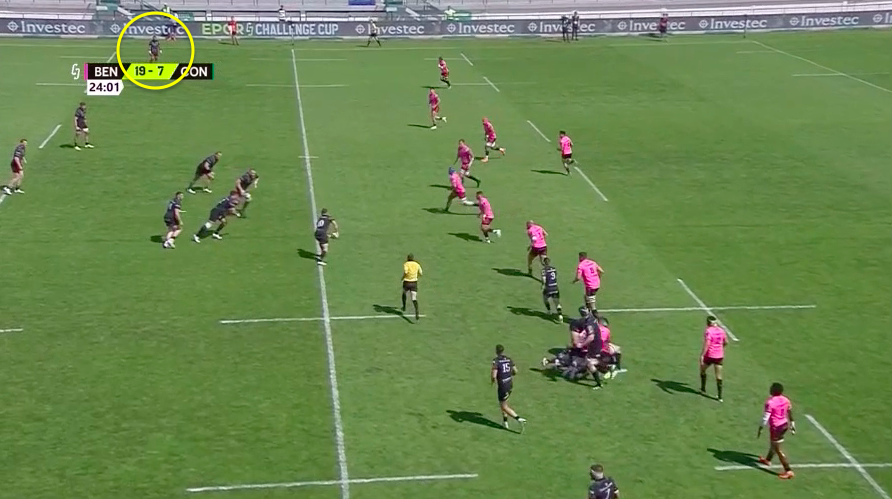
The issue is that Connacht don’t really have anyone to punch holes in that pod off #10. In this example, the looping winger Andrew Smith made up the two pod with Jennings in the screen and Prendergast as the lone forward. This was because Connacht keep a small forward on the blindside as an option so if they lose a few players to that first transition ruck, it leaves them vulnerable to poach in that 3/4 space.
This is where Bundee Aki might be really useful as a ruck-cleaning midfielder but it feels like Connacht are trying to make sure he’s more open to receiving the ball and carrying rather than getting lost in rucks. We really need to get pressure on Charlie Devine – their young, inexperienced scrumhalf. If we can interrupt the flow between him and Carty, there are intercepts and fumbles there for us. We don’t need to overdo it at the ruck either – we just need to make our shots and let Connacht play in front of us, before guarding the reset kick.
This is a very Irish set-up, with lots of inside ball options, tip-ons and screen work. We need to stay active on these and only commit to the poach when we see space – usually when Connacht hit off #10. When we get the kick, that’s when we get to work.
Offensively, I think we can really get after them in the lineout. They have a really good defensive lineout that we’ll need to manage but there’s no harm whatsoever in making them throw into the lineout more often than normal and going after Heffernan’s throw and their shorter-than-usual back five.
For that reason, I think our maul could be hugely effective here from further out than normal. In the second half, I think there’s a lot of road in a play like this that goes after their scrumhalf on the second or third phase off the lineout. Off scrums, the Connacht #9 usually tracks the play as an extra tight defender covering holes around the ruck. Off the lineout, though, they stack the #9 on the touchline of the lineout.
The first part crashes Nankivell into Carty to commit Aki to the shot. The late pass from Crowley here – enough of a carry threat himself to draw in Aki – will be best.
Come back against the grain and look what Saracens have isolated – their big #6 on Caolin Blade. We can do the exact same with Ahern;
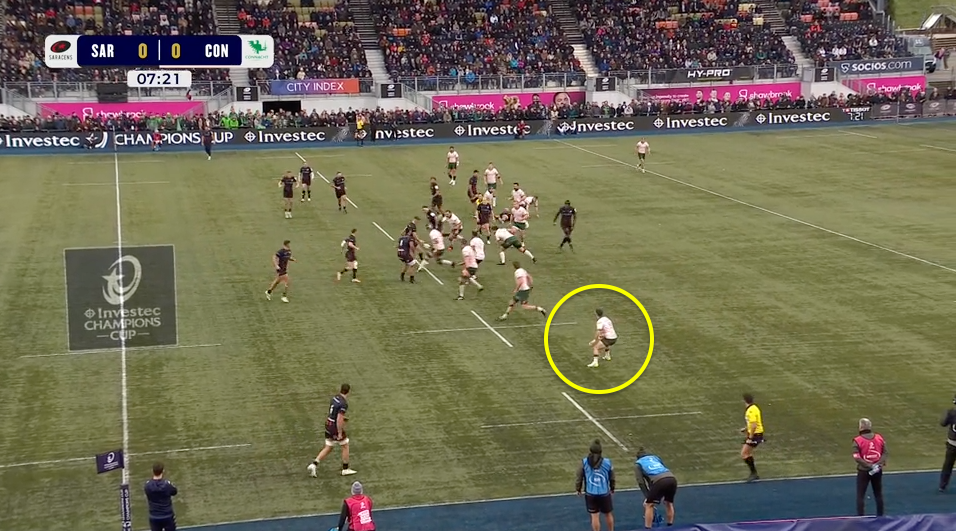
Saracens play the ball through with a kick and it immediately bothers Blade and O’Halloran on the track back. We can get at both players in the air on their defensive structure from outside the 22.
The kick from Farrell here isn’t even that clean and it does the job.
We tried this against the Lions but didn’t have the possession with Ahern on the field to use it. I think the same structure will apply here and there are tries for us.
RED EYE DIGEST
Early Game Strategy:
- Box kick or high bomb in the short to mid-range.
- Stay out of rucks and stick with one-man tackles on Connacht’s setups. Go for poaches only when obvious.
- Pressure Devine ruck to ruck, pressure Carty’s passing lanes.
- Get the ball off the field, and use Snyman, Beirne and O’Mahony to pressure Connacht’s throw.
- Maul as the first option off any lineout position around our 10m.
End Game Strategy:
- Heavily contest rucks.
- Get Jager after Dooley and Duggan in the scrum.
- Move to an on-ball structure once Coombes, Ahern, Jager and Frisch are on the field.
