


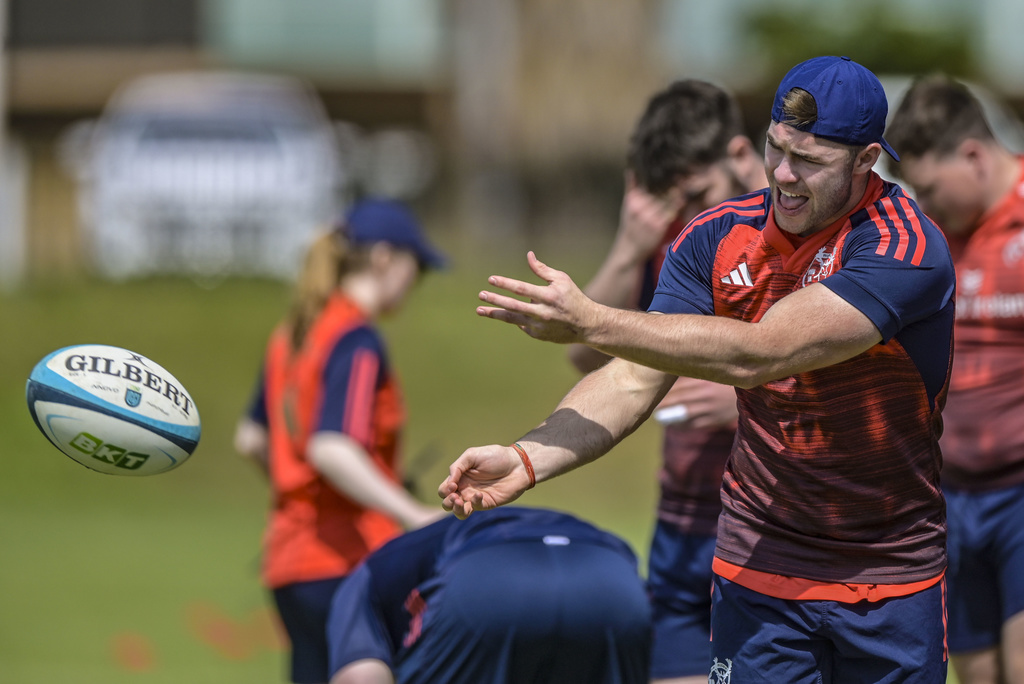
“It’s like playing on the moon.”
Altitude does funny things to you. The Vodacom Bulls know this, of course, and lean into it. On the walk out to the pitch at Loftus Verfeld, there is a sign that you really can’t miss – Altitude. 1,350 metres. It matters.
It matters so much that the Bulls have one of the most imposing home records in the league over the last two and a half seasons. Unless you’re a South African side, it’s shown to be almost impossible for northern hemisphere teams to climb up the mountain, so to speak, and put the Bulls down in Pretoria.
You might ask yourself, does altitude really matter?
We know that it does from our last tour on the high veldt. We were 26-3 down at halftime against the Bulls last time out after getting blown away inside the first 20 minutes – a common enough trend at altitude – before gradually steaming back into the game as we got our breath back. We lost 29-24 in the end but we finished strongly enough that we could have won. In Loftus Versfeld in 2022, our start killed us, but we finished strong. A week later in Johannesburg (higher up again) on a much hotter day – evening kickoff vs midday – against the Emirates Lions we started really strongly. Still, we slowly began to wade through waist-high wet concrete as the game entered the last half an hour and we were lucky to leave with a bonus point.

Two games at altitude, one with a bad start and a good finish, one with a good start and a bad finish. What have we learned? You’ve got to finish strongly in an evening game at altitude. But our own experience alone isn’t the only thing that will tell us this.
In 2015, the Journal of Sports Science and Medicine published a study on the then Super 12 rugby teams’ performance levels at altitude. Their findings were interesting.
The study found that while playing at altitude (1271-1753m), the teams were more likely to miss tackles (mean ± 90% confidence interval, 1.4 ± 1.7) as well as score fewer points in the first half of the match when compared to matches played at sea level.
The study also found that during the second half, the teams also made fewer gain line breaks (-4.0 ± 2.7) than matches played at sea level.
More likely to miss tackles in general, and more likely to score fewer points in the first half while linebreaks become more difficult to create in the second half.
In that scenario, it feels like the correct approach, knowing what we know, to play an energy-conserving off-ball game with your stickiest, highest-volume defenders – set piece and phase play – in the first half to cut down on offensive errors, before finishing very strong and very quickly.
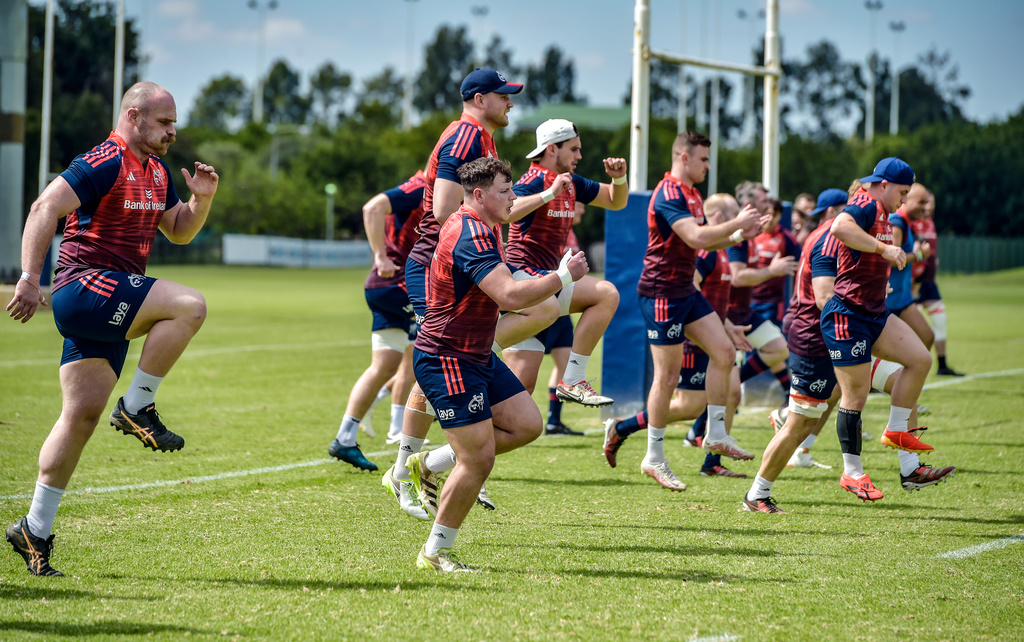
Realistically, we need a point from this game to keep us on track for the 19 points we will likely need to accrue to stay in the top four and, perhaps, have a crack off of second if other results go our way. Regardless of that though, we know that 19 points between Bulls, Lions, Edinburgh, Connacht and Ulster should be enough for us to secure a home knockout game in the playoffs.
We can get that 19 points in any order that works, but we will have to get them. No better place to start than here, on the moon.
Munster: 15. Simon Zebo; 14. Calvin Nash, 13. Antoine Frisch, 12. Alex Nankivell, 11. Shane Daly; 10. Jack Crowley, 9. Conor Murray; 1. Jeremy Loughman, 2. Niall Scannell, 3. Stephen Archer, 4. RG Snyman, 5. Tadhg Beirne (c), 6. Peter O’Mahony, 7. Alex Kendellen, 8. Jack O’Donoghue
Replacements: 16. Eoghan Clarke, 17. Josh Wycherley, 18. Oli Jager, 19. Tom Ahern, 20. Gavin Coombes, 21. Craig Casey, 22. Joey Carbery, 23. John Hodnett
Vodacom Bulls: 15. Willie Le Roux; 14. Kurt-Lee Arendse, 13. Canan Moodie, 12. David Kriel, 11. Sebastien de Klerk; 10. Johan Goosen, 9. Embrose Papier; 1. Gerhard Steenekamp, 2. Johan Grobbelaar, 3. Wilco Louw, 4. Ruan Vermaak, 5. JF van Heerden, 6. Cameron Hanekom, 7. Reinhardt Ludwig, 8. Elrigh Louw (c)
Replacements: 16. Akker van der Merwe, 17. Simphiwe Matanzima, 18. Mornay Smith, 19. Janko Swanepoel, 20. Mpilo Gumede, 21. Zak Burger, 22. Chris Smith, 23. Devon Williams
The Bulls present a simple problem with a complex answer.
They can be beaten – even at home – if you can stop them from building momentum. They build momentum in three main ways; through their kicking game, through winning scrum penalties and through playing incredibly direct through their massive pack.
The Bulls kick a lot of their possessions, especially against higher-quality teams, and look to bait poor kick returns or scrummaging situations from those kicks. They are a high-kick volume, low-pass-per-carry counter-transition team. What does that jibber jabber mean? It means they kick early on most of their possessions outside the opposition’s 10m line – mostly in the midrange and contestable – to bait low-quality kick returns. This is where they look to kill you in transition through le Roux, Moodie and Arendse.
Kicking long to the Bulls is, for me, a mistake.
Anything that gives Le Roux time or Arendse and Moodie space is a mistake. When the Bulls settle into their phase play game, it’s normally played incredibly directly off #9 with forwards offloading once they’ve gotten over the gainline.
The clip I showed you above with the long exit punished directly on first phase happened directly after Leinster stuffed the Bulls off a lineout starter play.
When the Bulls hit a lineout around your 10m line, they’ll go into their phase structure and Leinster smothered their low PPC set ups with aggressive line speed and double tackles, where possible.
You can a typical Bulls offload scheme at 33:22 minutes on the game clock. Look at Arendse moving towards the space outside Steenekamp for a potention offload and linebreak.
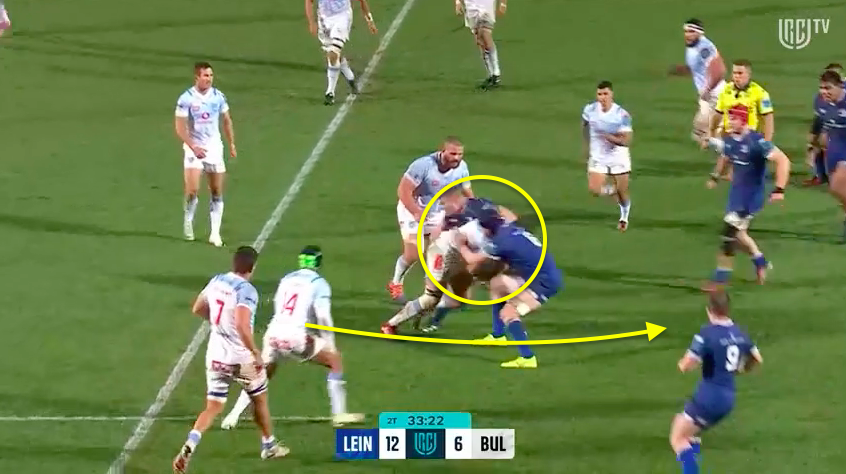
Leinster’s double tackle action prevents this and you’ll notice they don’t really commit any players to jackal attempts, more counter-rucking where they draw more Bulls forwards out of their attacking structure.
The more Bulls forwards that are out of the line, the more chance there is that the next play will be a kick-off Papier or Goosen.
When it comes to our own possession, I’d box kick early and often against this Bulls side to create transitions, yes, but to mainly keep their pack marching backwards and constantly resetting. We also should be comfortable getting the ball off the field to give the Bulls plenty of deep lineouts. We want to get after their throwing structure, especially with Nortje out of contention.
The key for Munster is to be within striking distance of the Bulls as we hit the 55th minute. That’s when the Bulls will switch to their players who played in Franklins Gardens last weekend. That’s when we move from a stand-off-ish kicking game to full-on-ball rugby. That’s when we can start pushing the pace through Casey and with explosive edge forwards like Ahern and Hodnett to stretch the Bulls and get after their midfield defence.
