


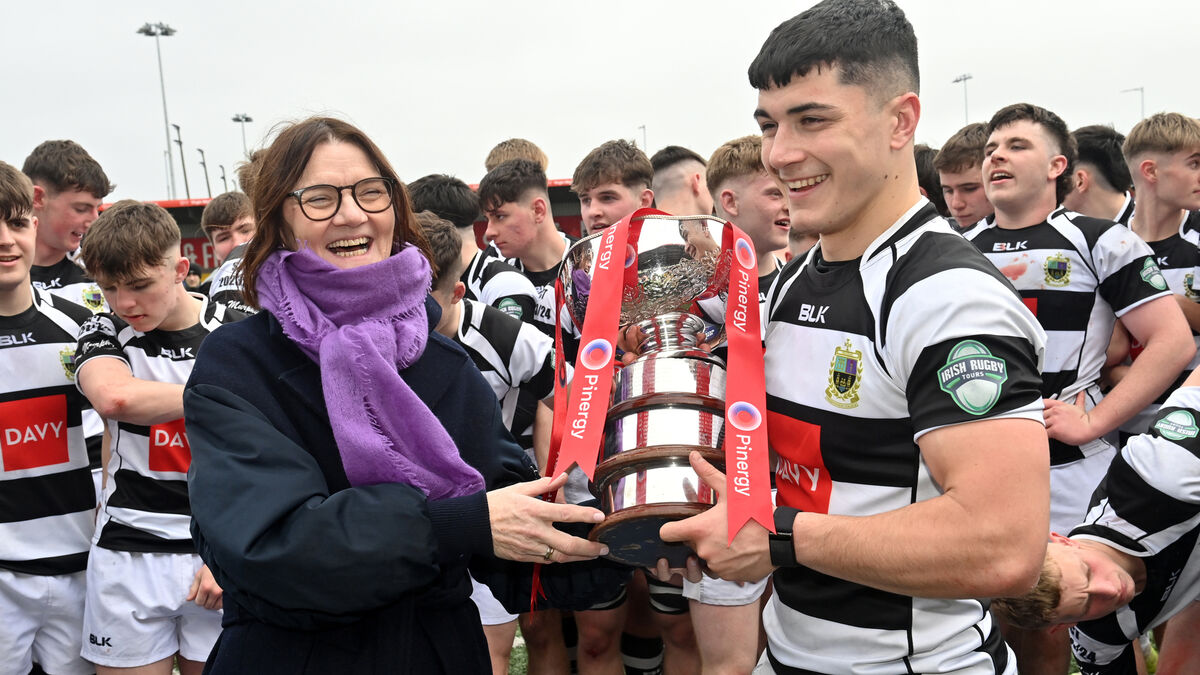
In May 2023, Munster won a trophy for the first time in twelve years when they beat the Stormers in the Cape Town Stadium to lift the URC title.
It feels like a long time ago because it is. You are a champion for about a week in my opinion. In that week, you can bask in the triumph of it all but after that week passes, the season ticks over and you’re right back to zero. It’s a cliche, but it’s true. When you put boots on the ground for preseason, you’ve actually won fuck all but now everyone is gunning for you. If you don’t match that hunger, they’ll eat you alive.
Ultimately, falling in love with one trophy win ensures it’ll be the only one you’ll lift until you fall out of love with it.
We’re out of Europe at the round of 16 again and face five games in the URC to determine our final placing for the knockouts. Realistically, everything from second to seventh or eighth is on the table, but it’s all in our hands, which is all you can ask for at this stage in our search for the next trophy.
You’re in a good spot when you can settle your business on the field.
This week, however, the focus has shifted to what’s happening off the field.
My position on NIQ players has been consistent for years. They do not block talent because any talent that can be blocked either isn’t of the level required or they weren’t ready for the opportunity at the time the player was signed. Plus, a lot of the time, the effects of the “blocking” are wildly overstated. Munster were pilloried for signing Jason Jenkins a few years ago because the fear was that he’d “block” Thomas Ahern. Take a guess who played the most minutes of those two players for Munster that season.
My issue with Jordi Barrett isn’t that he’ll block Leinster’s talent because he won’t. My issue isn’t even with RG Snyman joining Leinster or their rumoured tighthead prop.
My issue, such as it is, is with the central contract system that allows space for Leinster to defy the physics that normally follow a team stacked with current internationals, while also creating a double-down effect that only serves to concentrate more central wealth in the province for years to come. It is, in essence, an infinite money glitch.
The issue comes from the IRFU Central Contract concept, which dates back to the very early stages of professionalism in this country. A central contract is paid directly by the IRFU to the player, with the player then “loaned” to the province in question for “free”. I say “free” here to denote that it is essentially free, but there is a framework in place to charge “rent” for the player, although it’s not always applied in practice.
Throughout the 2000s, there were up to 30 players on central deals, and these were mainly split between Munster and Leinster with Ulster having a decent few towards the latter end of the decade. Connacht, at the time, were not really at the same level they are today so central contracts didn’t apply to them that much.
Post financial crash of 2008, news began to leak that the IRFU wanted to trim their central contract spend to around 20 players and to let the rest be covered by provincial budgets or by teams abroad – at the time, players could play abroad and still get selected for Ireland, something which would change post-Sexton in 2014.
By 2013, the number of fully central deals had fallen to around 16 central contracts in total after Ronan O’Gara, John Hayes, Jerry Flannery and Denis Leamy retired.
I’ve done a bit of digging around and I think the centrally contracted players at the start of 2013/14 were;
Leinster
Mike Ross
Rob Kearney
Cian Healy
Jamie Heaslip
Gordon D’Arcy
Brian O’Driscoll
Ulster
Andrew Trimble
Tommy Bowe
Rory Best
Tom Court
Munster
Conor Murray
Peter O’Mahony
Donncha Ryan
Donncha O’Callaghan
Paul O’Connell
Keith Earls
So the breakdown was 37.5% at Leinster and Munster, with the remaining 25% at Ulster. A notable omission from this list at the time was Johnny Sexton – who left Ireland that season when he couldn’t agree a central contract with the IRFU before leaving for Racing in the summer of 2014, and Sean O’Brien who was on a provincial deal by his own request.
At the end of this season, O’Callaghan, Court, O’Driscoll and D’Arcy were off their central deals.
Two years later, in 2015/2016, there were 14 central contracts.
Leinster
Mike Ross
Rob Kearney
Cian Healy
Jamie Heaslip
Johnny Sexton
Sean O’Brien
Devin Toner
Ulster
Andrew Trimble
Tommy Bowe
Rory Best
Munster
Conor Murray
Peter O’Mahony
Donncha Ryan
Keith Earls
Munster had 28% of the contracts, Ulster had 22% and Leinster had 50%. Mike Ross would come off his central deal at the end of this season.
Two years after that in 2018/2019, we still had 14 contracts;
Leinster
Rob Kearney
Cian Healy
Johnny Sexton
Sean O’Brien
Devin Toner
Robbie Henshaw
Tadhg Furlong
Jack McGrath
Ulster
Rory Best
Iain Henderson
Munster
Conor Murray
Peter O’Mahony
Keith Earls
CJ Stander
Leinster had 57% of the central deals, Munster had 28% and Ulster had 15% with Tommy Bowe finishing up before the World Cup that year and Jared Payne having to retire.
At the start of 2024/25, we’re down to 13 central contracts at the time of writing;
Leinster
Caelan Doris
Josh Van Der Flier
Jamison Gibson Park (heavily rumoured but not confirmed at the time of writing)
Robbie Henshaw
Garry Ringrose
Hugo Keenan
Tadhg Furlong
Andrew Porter
Dan Sheehan
James Ryan
Ulster
Iain Henderson
Munster
Tadhg Beirne
Connacht
Bundee Aki
77% of the contracts are in Leinster, with 7% in Ulster, 7% in Munster and 7% in Connacht. All three of the non-Leinster central deals are in danger of being removed when they are renegotiated in mid to late 2024. Munster lost three central deals this season with Earls retiring and O’Mahony/Murray getting bumped down to PONI deals.
***
The impact of central contracts on a province’s budget is significant.
Every single centrally contracted player you have means an increase in the power you can get on the field without paying for it and increases your ability to recruit from outside your province or retain down-chart players or young prospects who might otherwise be tempted by better offers elsewhere.
All of the three bigger provinces – Ulster, Leinster and Munster – get the same base level of funding from the IRFU per year. The difference then comes in central contract funding, which doesn’t come with any strings on the backend. Essentially, the IRFU dictate when you can use “their” players but there are no structural limits on what you can do with the extra wage space that these players give you.
What do I mean by this? Well, in the last two years, Leinster would have been paying approximately 200/300k per annum each on Dan Sheehan, Josh Van Der Flier, Caelan Doris and Jamison Gibson Park. When those players then progress to central contracts with the IRFU, you can then use those funds to retain the guys who aren’t on central deals.
A good example would be the Sheehan/Kelleher dynamic. Ronan Kelleher is, arguably, worthy of a central contract himself given his performance level over the last four years but if there was only going to be one, it’s hard to argue that Dan Sheehan shouldn’t get it.
Both guys would be close enough to that top-end 250/300k range of provincial deal. If you were to pay both their market value this year – both men have expiring contracts – you could arguably spend €300k on both if there were other bids on the market from outside. That €600k would take a significant chunk out of your base provincial wage bill and, arguably, a tough decision might have to be made.
But now, with Sheehan on a central deal, Leinster can bump Kelleher to the very top of their provincial pay structure without even having to think about it because Dan Sheehan is now off their wage bill. A €600k problem just became a €350k slam dunk with change left over.
This applies in a cascading fashion throughout their squad for every centrally contracted player.
So while Leinster’s funding from the IRFU at a base level is the same as Munster and Ulster, the central contract spend means that Leinster are spending almost all of their base funding on non-core players.
If we weigh them on their closeness to the starting Leinster XV, we see where the advantage starts to take hold. Green names are Ireland-funded, and blue names are currently Leinster-funded.
Porter – Sheehan – Furlong
Ryan – McCarthy
Baird – Doris – Van Der Flier
JGP – Byrne
Barrett – Ringrose
Lowe – Keenan – Larmour
Replacements: Kelleher, Healy, NIQ Tighthead, Snyman, Conan, McGrath, Byrne, Henshaw
If nine of your category A squad are being paid for by the union, that means Leinster pay for just 40% of their best starting XV. In practice, this means that they can pay incrementally more for their 1B and 2A layers. In the Irish system where you can’t outbid the home province for a player, that essentially means the prospect talent drain that would normally follow a team with 17/18 regular internationals doesn’t happen.
If we take that same metric to Munster’s squad, we find the following;
Loughman – Scannell – Jager
Beirne – Kleyn
Ahern – Coombes – Hodnett
Casey – Crowley
Nankivell – O’Brien
Kilgallen – Haley – Nash
Replacements: Barron, Wycherley, Salanoa, Edogbo, O’Mahony, Kendellen, Murray, Burns
This means that Munster, in whole or in part, is paying directly for 93% of their starting XV. That might change if Crowley goes on a central deal next season, but for now, it’s pretty stark reading. Ulster and Connacht are at the same level.
Ultimately this means tighter budgets and tougher decisions.
I should also stress that none of this is Leinster’s fault. Under the current system, all of those players deserve those central deals and the unintended budgetary consequences of their central contracts increasing while the other provinces decrease are outside of their control.
The central contract system does benefit the national team but the financial side effects of that are only felt in one province. How long until that tilted financial situation starts to lean on interprovincial competitiveness? You could argue that it’s already happening. When’s the last time that a fully loaded Leinster team lost an interpro?
That isn’t hurting Ireland at the national level – yet – but how long can we feed the golden goose €50 notes and hope he doesn’t choke?
***
For Munster, there is no easy answer as to what the future holds.
Our funding level is stable and the finances are tight but manageable. We do, for example, have funding for NIQ front-row forwards (if dispensation was available) but for the most part, we have to be creative when it comes to signings. Kilgallen, for example, was rated higher at Munster than he was at Connacht.
Peter Wilkins, the Connacht head coach, said so himself;
“He had the opportunity to go to Munster, the opportunity to stay here as well, and he’s chosen to go. We are disappointed he is going but also understand his reasons. Our back three is hugely competitive. Obviously, we have had injuries there, but when you are looking at a back three of Cordero, Hansen, Porch, Smith now on the radar, Bolton has established himself as well, I get it if he is looking for more rugby and in a position group it’s probably looking a bit emptier there in terms of Munster.”
Billy Burns, too, was a smart pickup. Ulster were releasing him at the end of the season anyway so there was no question of bidding against them – they had decided to move on from Burns and we felt that his skillset would be valuable in our system, for several reasons.
There are more signings on the way, but the important thing for Munster is to double down on the one area where we’re outperforming all the other provinces right now – our underage system and academy output.
Go back to 2020 and look at the u20 team from then until now, and watch the number of Munster players who played prominent roles.
Tom Ahern, Jack Crowley in 2020. Alex Kendellen in 2021. Edwin Edogbo would have featured in 2022 if not for injury but that year also had Shay McCarthy, Tony Butler and Ethan Coughlan. In 2023 we ended up with George Hadden, Ronan Foxe, Ruadhan Quinn and Brian Gleeson as prominent figures.
Evan O’Connell, Ben O’Connor, Sean Edogbo, Luke Murphy and Danny Sheahan were top guys in 2024. In 2025, we’ll be talking about Gene O’Leary Kareem, Michael Foy, Emmet Calvey, Éanna McCarthy, Dylan Hicks, Jed O’Dwyer and more. The year after that, more again.
Despite the received wisdom, Munster have done a really good job of converting u20 talent into first-team players in the last five years. Four of the key guys from the 2019 Ireland u20 side – Craig Casey, John Hodnett, Tom Ahern and Josh Wycherley – are either Cat A players for us or close enough to it in Wycherley’s case. It’d be six if you counted Ben Healy, who is a capped Scottish international and Jake Flannery who is a Cat A regular for Ulster.
Jack Crowley was the standout #10 for Ireland at u20 level in 2020 and within three years, he was starting for Munster. Alex Kendellen has 63 caps at 23 after being the standout player for Ireland u20s in 2021. This coming season feels like the moment for Gleeson, Quinn, Hadden, Foxe, O’Connell, O’Connor and both Edogbos to start pushing into the Category A squads, with Danny Sheahan and some of the younger lads getting valuable pro-exposure before launching themselves next season.
This is how we compete with ten central contracts in Leinster – by winning the future coming in four years. With a URC trophy in our back pocket and, who knows, maybe a second one this season, we can double down on Munster becoming a place where young guys progress into Category A squads quicker than anywhere else in the country.
