


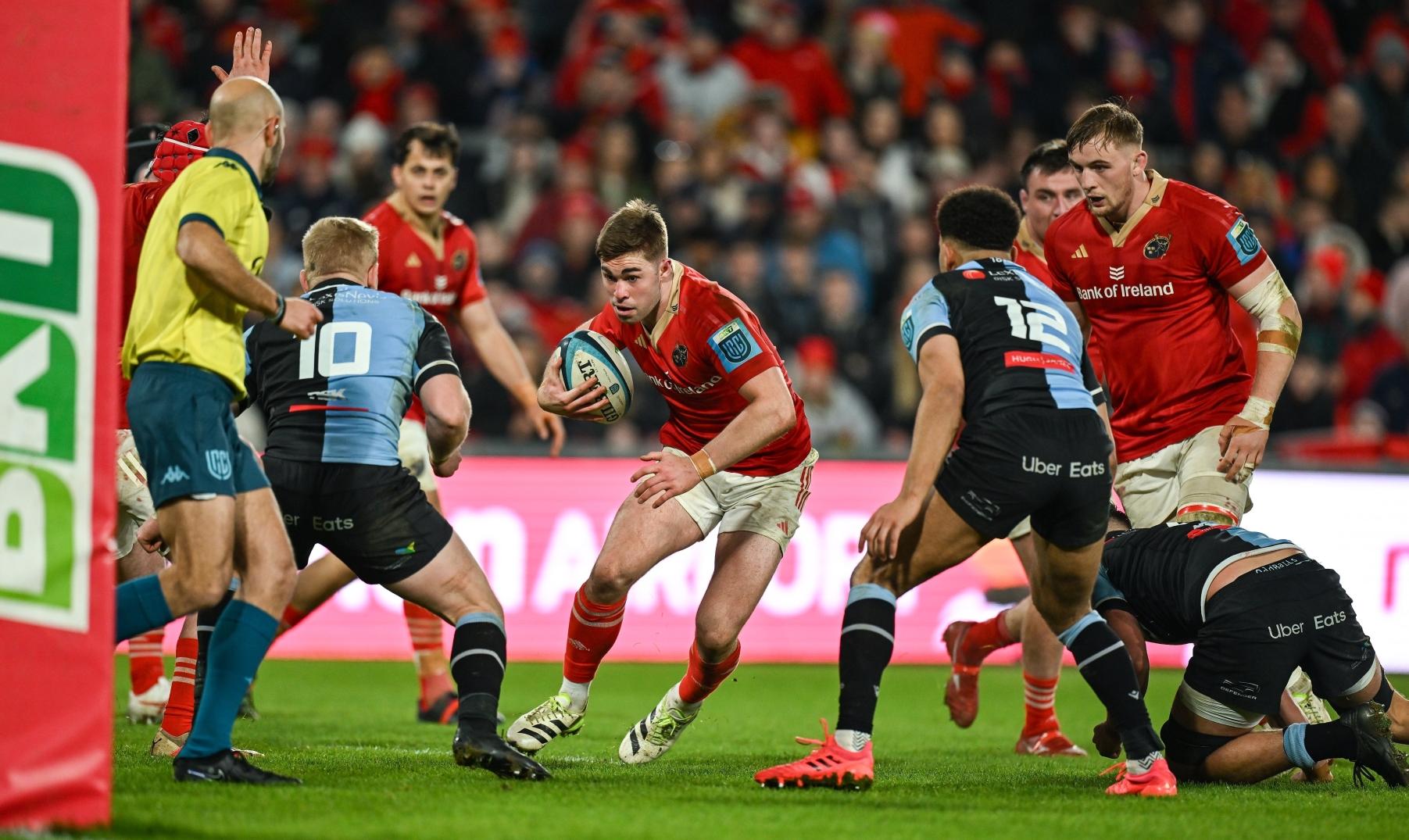
I suppose your final read of this game is based on how you rate this Cardiff side.
I’m not saying that Munster weren’t janky, inaccurate and flat-out bad for long spells of this game but that shouldn’t take away from a really good defensive performance from Cardiff – especially at the breakdown – that showed just how sticky they can be. Cardiff are an incomplete team; they don’t have a great lineout, their half-backs are pretty limited and they also drop out of games in the last 15 minutes due to their high-energy output approach on both sides of the ball. Make no mistake about it though, they are a bloody tough side whose league position doesn’t accurately reflect their quality. It certainly didn’t in this game with outstanding performances from several players, especially Ellis Jenkins. He showed anyone watching this game that, if it weren’t for a string of catastrophic injuries, he’d be considered up there with the likes of Kwagga Smith, Josh Van Der Flier and Ben Earl when it comes to modern-day elite small forwards.
But again, that isn’t to say that Munster were not Off It, we absolutely were, but combine that Off-Itness with Cardiff’s outstanding defensive breakdown work – best in the league – and you get this game, which was scoreless for almost the entire first half for that very reason.
The best way to describe Munster’s Off-Itness – a very real word that I have just invented – is probably a combination of core players coming back from test camp and all the jank that brings with it and Snyman pulling out pre-game. Those two issues were the biggest problems, for me, because they fed into each other.
First, Snyman’s illness pre-game meant that Munster went into this game against a defensive breakdown-dominant team with only one power forward to force compressions in the middle of the field; Gavin Coombes.
That meant Cardiff had only one direct heavy gainline threat to worry about when Munster wanted to play with simplicity. This phase is a good example of Munster trying to play directly to provide easily hittable rucks but Cardiff do a good job of stuffing our carries and generally denying us any kind of momentum.
Casey tries to inject a bit of pace there towards the end but Cardiff isolate him, Adams does a good job of blocking Ahern’s cleanout and Jenkins wins a big breakdown penalty. This sequence ran for 30 seconds with six rucks and every carry after the initial ruck point lost gainline until we were eventually turned over.
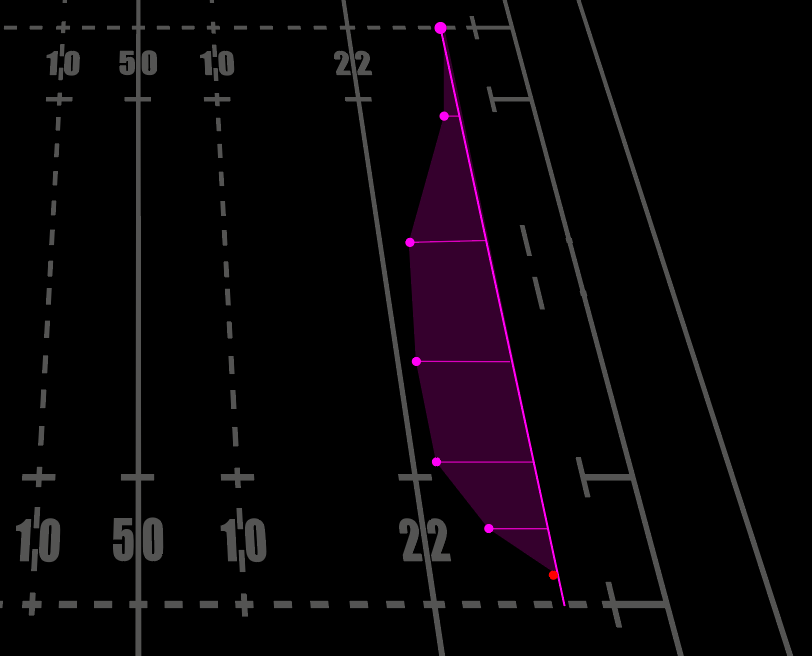
That’s an average of five seconds per ruck in around 58 metres of lateral space with Cardiff taking way too much ground for us on successive rucks.
If RG Snyman is carrying on that second or third ruck in the sequence, I think we win back space AND time on the subsequent ruck (or go-go-gadget arm offload that might follow). With Coombes as our one power forward build player, it allowed Cardiff more room to target him and commit more resources to the defensive breakdown.
This is another really good example; Munster get around the corner well, Hodnett makes a great break but Cardiff go after Coombes with a big chop and stop tackle and poach combo. Archer and O’Mahony being a hair too slow at the breakdown is a sign of that jankiness and Off-Itness I spoke about, too.
If the next phase has RG Snyman lined up in centre-pod, do Cardiff commit two men to this tackle like that? Maybe they do, maybe they risk it, but this game is proof to me that if you only have one power forward playing, you have no power forwards playing.
As a result, we had to play with more width and complexity to get around the trouble we were having generating momentum off #9 and flat off #10.
But we were a little janky there too. This is a nice variation on a three pod split screen, for example, where insread of slicing the ball through the first and second pod runner, Crowley finds Ahern right at the edge.
Ahern runs right into Jenkins – who was likely trying to blitz behind the screen – and the unpredictability of the option seemed to catch him by surprise. Another turnover.
The half wore on and on like this. Crowley’s passing ryhtym with key running options wasn’t where it needed to be. Beirne and O’Mahony looked to be a half a second off the pace and Cardiff were getting decisions at the ruck.
Now, to be fair, we had a try ruled out for a knock-on in the build up that would have changed the vibe of the half. Watch Crowley’s break here off the pinch line – he shapes outside and cuts inside when the defender drifts off him, expecting the pass.
You can see the knock-on by Haley right at the end of that clip. Munster won the ball back off this transition by Cardiff – effectively a counter-transition play because of how it pulled Cardiff out of shape – and when the ball comes back, Munster finally have numbers to work with because Cardiff clustered around the carry in a panic.
Watch Crowley feint the cut in again before passing when he sees the defender rock on his heels.
But the try was rightly ruled out for a knock-on and on we went into the second half with a narrow 3-0 lead.
Eventually we crabbed ahead by 10 points with a close range maul before a proper 14 point swing moment that came at the end of Munster’s best passage of play all game, won off a turnover.
It’s harsh, but I keep looking at that break from Daly and thinking “we need a little more gas here”, especially given how perfect Frisch’s pass was.
When the ball comes back across, Crowley nails a great pass into the compressed space the turnover created. One of those situations where you’d nearly want anyone but Scannell in that spot – as good as he is in his role, he’s not a breaking threat at this point in his career – but this is a very good example of the kind of windows the 3-3 shape produces on this moments.
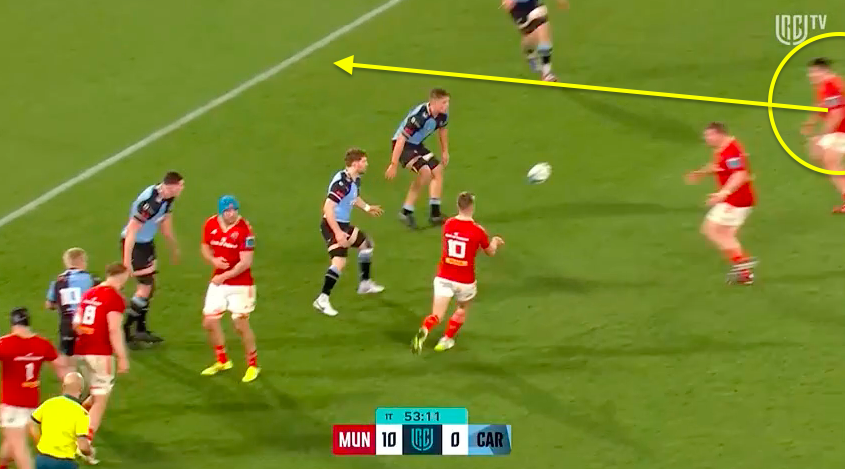
A few phases later we were on the tryline, with numbers and Cardiff on their heels. A try here probably buries this game and opens up a possible bonus point. 17-0? I don’t see Cardiff getting back into the game and this one probably ends 29-5 or something like that. Instead, Cardiff intercepted us on the 5m line and ran the length of the field to make it a three point game.
The scrumhalf always gets the blame for these but in this instance, I think the issue is (1) Nankivell stepping out towards the posts instead of in on the first phase.
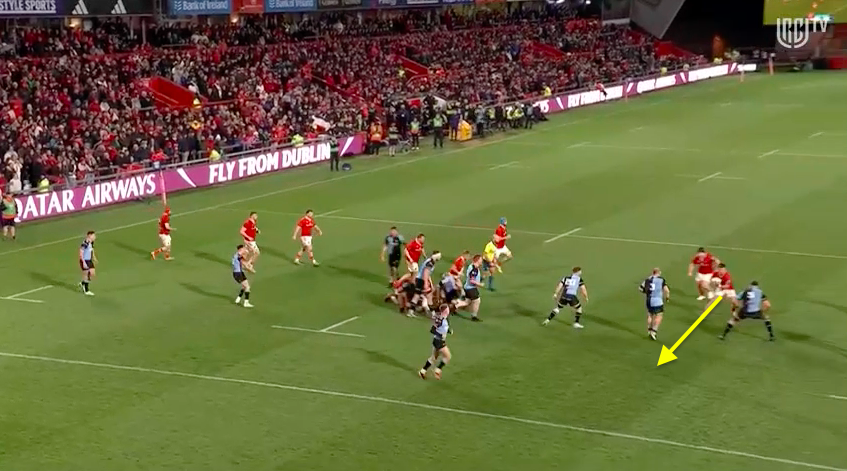
If he engages Assiratti, I think we resource that ruck quicker. On the next phase, I think Beirne takes too long a route to get into a ball carrying perspective. Munster use Casey’s pass quality and range to find those gaps in a defensive line. In theory, when ran right, it allows Munster to force cascading compressions when defenders have to step in to plug the space and Munster can then tip the ball along or just carry straight in. It’s how we look to play against bigger front fives – which is most front fives.
Beirne is looking to get outside the potential Cardiff press but he’s still arcing out when the ball leaves Casey’s hands. Does he expect Frisch to run a switch line under his run?
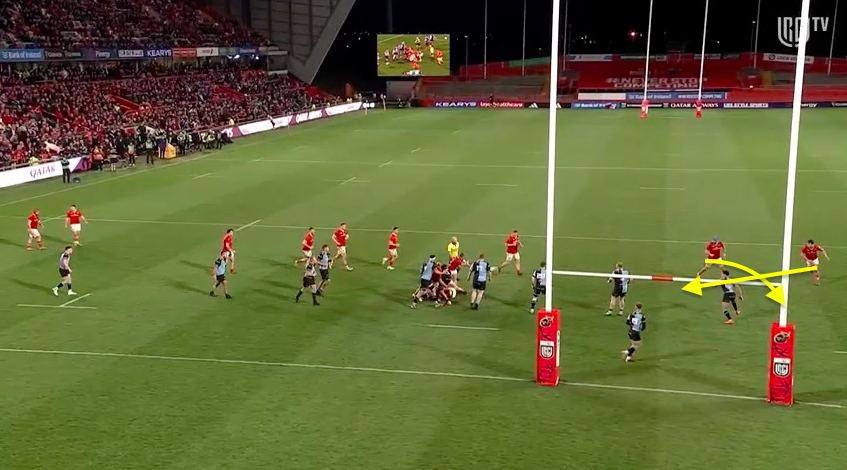
Either way, we ran out of numbers offensively so the next action was likely a turnover regardless given how isolated we were in the moment.
We needed something big, so the next time we got up to the 5m during John Ryan’s yellow card sin bin – which should have been a red card, in my opinion – we needed to execute. Up stepped Jack Crowley, with a partial assist from John Hodnett.
I think Crowley spotted this speed mismatch as a possible option before the ball came out of the ruck – Rhys Carré guarding space next to Tinus De Beer. De Beer is a weak tackler but he’s significantly quicker than Carré so, if the ball comes to Crowley, I think Jack has that gap eyed up.
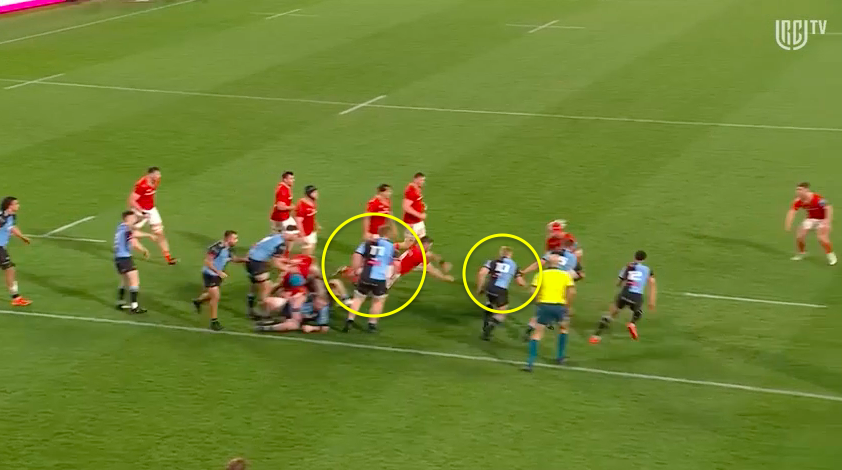
When the play progresses, Jack sells a pass outside before cutting back in to have a go off the space and it’s as he would have expected. De Beer has moved away from Carré to follow Crowley’s expected pass and Cardiff’s outer defenders have swarmed to cut off that pass option.
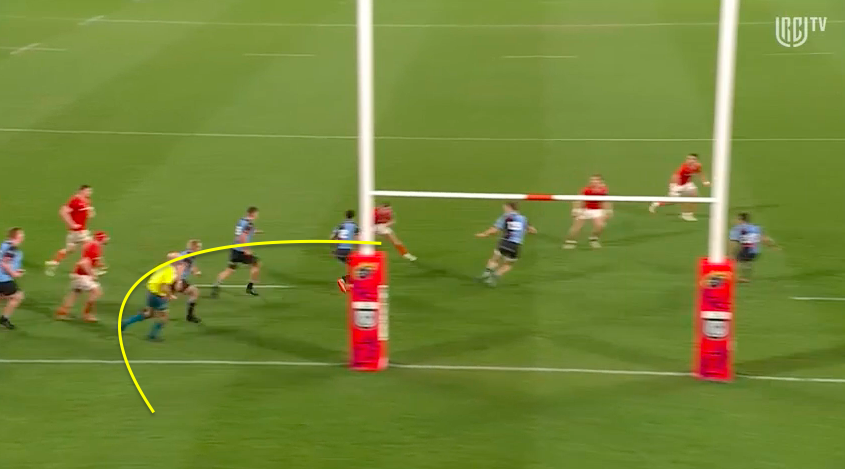
It was a crucial score and it opened up a lead that Cardiff could not win back and end this block with 19 points out of a possible 20. Not as good as possible, but more than passable. Enough to see us end this Six Nations block clear in fourth place with a buffer and the possibility of some upward mobility.
Sure, we didn’t play well and arguably left multiple scores out there in a way that has been a common theme all season long, along with the very real feeling of being seriously underpowered in the front five without Snyman, Jager, Salanoa, Edogbo or Kleyn.
But we’re still alive in this tournament, we’ve got a home knockout game in reach and we came through a game that we could have easily lost earlier in the season while fielding a weaker team on paper relative to our opponents.
We’ll take it.
Stiffer tests await, but we know that too.
| Player | Rating |
|---|---|
| Jeremy Loughman | ★★★ |
| Niall Scannell | ★★ |
| Stephen Archer | ★★★ |
| Tom Ahern | ★★★ |
| Tadhg Beirne | ★★ |
| Peter O'Mahony | ★★★ |
| John Hodnett | ★★★★ |
| Gavin Coombes | ★★★ |
| Craig Casey | ★★★ |
| Jack Crowley | ★★★★ |
| Shane Daly | ★★ |
| Alex Nankivell | ★★★ |
| Antoine Frisch | ★★★ |
| Sean O'Brien | ★★★ |
| Mike Haley | ★★★ |
| Eoghan Clarke | ★★★ |
| Josh Wycherley | ★★★ |
| John Ryan | ★★ |
| Jack Daly | N/A |
| Alex Kendellen | ★★★ |
| Ethan Coughlan | ★★★ |
| Joey Carbery | ★★★ |
| Simon Zebo | ★★★ |
