



The last stop before Northampton, before Europe, and we have a sliding doors moment in Thomond Park. Win with a bonus point and everything from second to fourth is in our reach and control, with home knockout games as the reward.
This time last year, as I wrote last week, we had this very same sliding door moment in Thomond Park – albeit against playoff-tier opposition in Glasgow – but we blew it before going down to Durban to play the Sharks in the European Cup and blowing that too.
Ultimately, it didn’t matter because we won the URC title regardless, but on April 2nd 2023 that looked incredibly unlikely and, let’s be honest, unlikely to be duplicated ever again. If we want to win things again this year, we need home knock-outs domestically and something of a miracle run in the Champions Cup.
Our pool performance in December and January – a core part of our nightmare run to that point – is what it is and can’t be influenced anymore. The URC can, though, and must be.

That means a win and five points to launch us into what comes next in the Champions Cup but also into what comes after that when we tour South Africa. Doing that tour with 44 points and sitting in fourth makes anything possible.
Doing it in sixth – which is possible with a loss here – cranks up the pressure, especially if we’re fighting on both fronts at that point.
The average points total that has earned a top-four finish in the URC in the first two seasons is 60 points. The average points tally for second place has been 64 points. Both seasons were distorted in one form or the other; year one was distorted by the South African sides playing at home for the last six months of the season and year two was distorted at the top end by Leinster losing one game all season.
This year, given how the season has shaken out I think 62 points will be enough for a home quarter-final in fourth. If we can win this game with a bonus point, that would give us five games to accrue the 18 points that I think will be enough to get us to 62 points.
Five points on the South African tour – one win, one losing bonus point – would leave us with three games to get to 13 points, with two of those games at home to Ulster and Connacht, with one away to Edinburgh.
Four points against Cardiff means 19 points. Two points means 21 points. One point means 22 points.
Zero points mean earning 23 points in five games with two of those being on tour in South Africa.
You know what it means, in reality, and Munster know it too.
It means this game – a home game – has to be a win and has to be a bonus point, in reality.
Munster: 15. Mike Haley; 14. Seán O’Brien, 13. Antoine Frisch, 12. Alex Nankivell, 11. Shane Daly; 10. Jack Crowley, 9. Craig Casey; 1. Jeremy Loughman, 2. Niall Scannell, 3. Stephen Archer; 4. RG Snyman, 5. Tadhg Beirne (c); 6.Peter O’Mahony, 7. John Hodnett, 8. Gavin Coombes.
Replacements: 16. Eoghan Clarke, 17. Josh Wycherley, 18. John Ryan, 19. Tom Ahern, 20. Alex Kendellen, 21. Ethan Coughlan, 22. Joey Carbery, 23. Simon Zebo.
Cardiff Rugby: 15. Cam Winnett; 14. Owen Lane, 13. Mason Grady, 12. Ben Thomas, 11. Josh Adams; 10. Tinus de Beer, 9. Ellis Bevan; 1. Corey Domachowski, 2. Liam Belcher (c), 3. Keiron Assiratti, 4. Ben Donnell, 5. Seb Davies, 6. Alex Mann, 7. Ellis Jenkins, 8. Mackenzie Martin.
Replacements: 16. Evan Lloyd, 17.Rhys Carré, 18. Will Davies-King, 19. Rory Thornton, 20. Thomas Young, 21. Matthew Aubrey, 22. Jacob Beetham, 23. Theo Cabango
Cardiff pose the same issue that Ospreys did, stylistically.
Ahead of last week’s game in Swansea, my default assumption was that Munster’s back five selection – with two small forwards starting in the back row – was to deal with the Ospreys long range and high-volume kicking game from an offensive transition perspective. As it transpired, Kendellen and Hodnett were selected for their high-impact defensive game as low, choppy tacklers and breakdown menaces because we took an off-ball approach over to Swansea.
Our read of them was that their base defensive breakdown game mixed with their kicking would lead to sticky moments that would break up our usual on-ball flow.
If anything, Cardiff provides more of those problems. They kick more often, the most in the URC in fact, and they also kick the furthest, mostly off their #10 Tinus de Beer. As a result, they have the third-highest tackle count in the league and the most turnovers won to date.
So playing on-ball like we normally do comes with the same risks as it did against the Ospreys.
But, unlike the Ospreys, they have a far more dangerous attacking game which means that playing off-ball comes with a great risk. They are punchier in transition and more effective during their phase sequences.
Look at this sequence off a quick tap free kick against Glasgow.
Cardiff kick to get opportunities just like this, and when they get them they will run through long sequences using the likes of Carré, Martin and Grady.
So what approach do we take?

Well, we have a good look at what Glasgow looked like when they played a 9:1 Pass-to-kick ratio. Cardiff showed played a jockey defence with a high edge to hem Glasgow in and give Young, Carré, and Belcher opportunities to get in over the ball. Cardiff always – always – fire bodies in at the ruck to slow the transit of the ball. There is penalty risk there but they take that for the narrowing effect it has on the opposition’s forward pods.
Watch them in this sequence;
They exert line speed on the pod with a “C” profile on the edge highlighted by a high-edge blitzer to cut off that outside pass option.
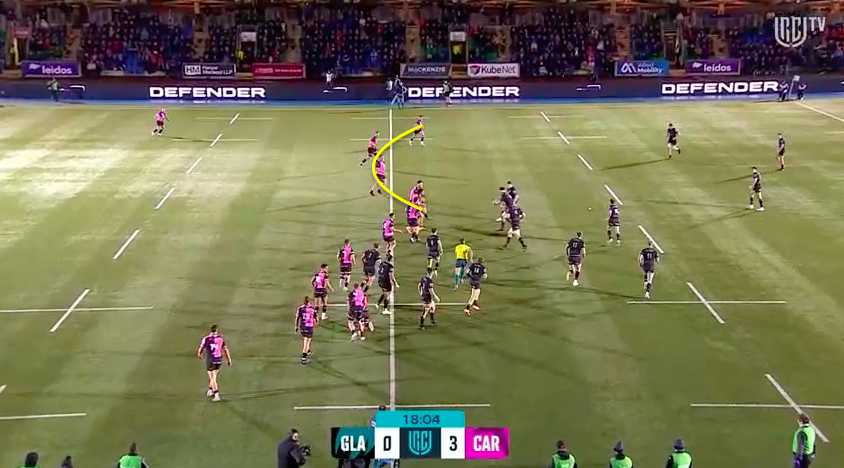
If they get the slowdown they want at the ruck, they’ll keep you boxed in until you’re forced into a low-percentage kick play when you force things.
You’ll see the narrow advance – not a blitz – to meet the pod head-on with the rest of the line holding a passive position to absorb any action that moves beyond. They aren’t looking to kill you with line speed, they want to swallow you up, slow your ruck transit and make multi-phase possession very sticky.
They’re very good at this.
Offensively, they are also quite good and they’ll go through long multi-phase sequences themselves, rotating through their power carriers and big outside backs.
So what’s the problem? Why are they so far down the table? Well, they’ve had a brutal Six Nations window with almost all of their top players playing a large role for Wales but the biggest issue is that their play style burns them out.
Every game they’ve lost since December has featured a period where they’ve been ahead at a critical time before tiring out and losing. The loss to Glasgow last week, Leinster before that, Connacht, Ospreys and Scarlets all featured Cardiff leading a key points only to fall off in the second half.
Essentially, it is incredibly difficult to play off-ball rugby with the frequency they do, combined with the high-volume defending and breakdown work they do if you then also play massive stretches of tight, on-ball rugby after every turnover.
Do we play off-ball and tire them out with phase play, knowing the risks given the size they have? Or do we play our usual game, make a big focus on the offensive breakdown and wait for Cardiff to drop off with a big volume of defensive work in the second half? That’s the trick and it’s where this result hinges, I think.
