


I was on Joe Nash’s show on Limerick’s Live95 two weeks ago and in it, he asked me why there is such a nasty relationship between Ireland and Scotland at test level these days.
In a general sense, don’t Ireland and Scotland have a lot in common outside of rugby? Absolutely.
But when it comes to rugby – especially in the last few years – the relationship has soured and, as I told Joe Nash, a lot of it goes back to Gregor Townsend’s Glasgow Warriors side of 2012 to 2017 but, specifically, that side from 2014 to 2017. They set themselves up as a team who, when it came to the Irish provinces, were sick of being beaten as a matter of course, as had been the way for the previous decade or more. So whenever they played the Irish provinces, they seemed to save their most spiteful and niggly performances just for us, aided by the quality of Finn Russell, Stuart Hogg, Leone Nakawara and others. It wasn’t just Munster either – who they beat us out the gate in the 2014/15 league final in Belfast – they had needle with all of the Irish provinces equally.
That game to a head in the 2016/17 season – Townsend’s final season in charge – where Munster and Glasgow would play each other four times in the one season, given we were drawn in the same European Cup pool. Then there was the Axel game and everything that came with it – Munster felt that Fraser Brown made a meal of the tackle that Earls got a red card for – and numerous instances where Conor Murray’s standing leg was targeted directly by Glasgow at the ruck when he box kicked. As Murray himself told the 42 back then;
“I’m properly p*ssed off about that. I don’t see any benefit in charging down someone’s standing leg. I only see it as a danger or as a potential to get injured. I don’t think it’s a good tactic. You could put another label on that type of tactic, but they did it to us at Thomond Park, they got our scrum-half Te (Aihe Toma) with it in the league game and they almost got me a couple of times. So, luckily my leg came out of the ground and I managed to fall over, but if my leg stayed in the ground — especially on that surface — you’re looking at syndesmosis, you’re looking at cruciate.
“I’m not blaming the players. I don’t know who told them to do it but it’s dangerous. It’s very dangerous and thankfully I didn’t get injured but if I had have been injured I would have been going on more of a rant.”
Who do we think masterminded this? Well, if it wasn’t Gregor Townsend himself he certainly didn’t put a stop to it. Glasgow lost all four ill-tempered games against Munster that season. When Townsend became Scotland coach in May 2017 – the end of that season – it was inevitable that the heat he’d built with all four Irish provinces would continue at test level, and so it would go.
But that’s not the true source of all the ire we know now, either, it’s just part of it.
In the 2019 and 2023 World Cup, Ireland would play Scotland twice in the World Cup and the scale of those games – with Scotland as dark horses looking to upset the apple cart a little – naturally brought a lot more focus from Ireland’s media, who seemed to revel in the idea of Scotland as bumbling plucky upstarts who talked a big game but could never deliver. And, because everyone sees everyone else’s media now, Scotland fans got to see every scoff, every scornful dismissal, every chortle at “delusional” Scots who ever thought they could beat us, the Mighty Ireland.
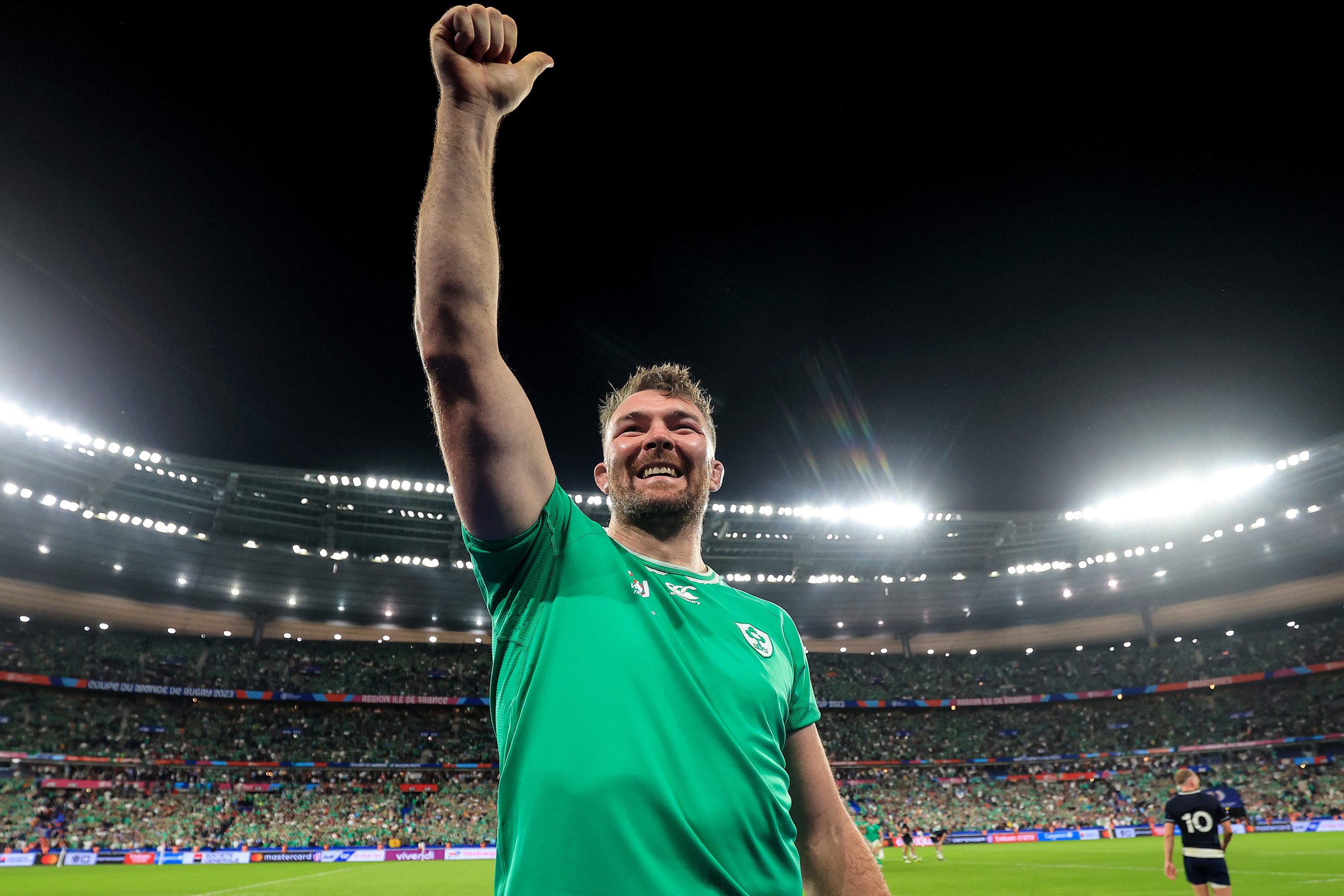
So why is there so much heat?
Well, ask yourself this, if all you ever saw of Ireland was them beating you year after year and the only media voices you heard afterwards were Eddie O’Sullivan, Shane Horgan and Matt Williams – the third worst Scottish coach in modern history – clowning on you, wouldn’t you’d hate Ireland too?
In some ways, this is the relationship we had with the All Blacks for years. We were the plucky upstarts who fancied upsetting the apple cart but we could never get over the line – until we did. The Kiwi press would take every softball question pitched at an Irish player and twist it so that we sounded as delusional as possible.
I remember in 2015, right before the World Cup, a Rob Kearney interview getting chuckled around New Zealand because he said;
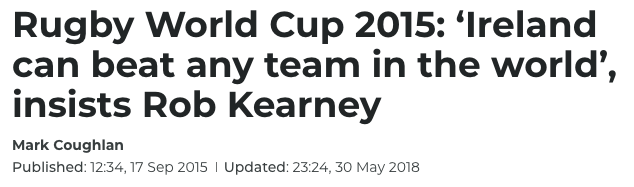
“Ireland can beat any team in the world????” was the thing that amused the Kiwis. At that stage, Ireland had never beaten New Zealand (ever) so the idea that Rob Kearney “insisting” – nice stitch-up by the headline writer there – that Ireland could beat New Zealand when they had never done so was yet more examples of Irish delusion.
When you look at the quote, though, it’s got more qualifiers than the new Champions Cup knockout format;
Q: A big question to end with: can this Ireland squad do something special?
RK: “Yes. I genuinely believe that, on our day, if we perform to our best, we can beat any team in the world. You need a lot to fall into place for it to happen. But, if you prepare as best as possible, and keep improving every week, anything can happen.”
Far from delusional when you look at it. And, besides, what’s he going to say in answer to that question? “Nah, we’re not winning no World Cup this year lmao are you for real, getting to a semi-final would be nice ffs”?
Scotland are the same. Any interview you’ve ever seen with a Scottish player or coach being “delusional” is more than likely a player responding to a question like this with the default confidence you have to have. If they’re asked ahead of a tournament if they think they can win it, what are they supposed to say? “Lol no, we’re happy enough to beat England?”
Come on.
I mean, you’ll inevitably see someone on Irish TV talk about Finn Russell referring to himself as “rugby Messi” this weekend. They’ll qualify it as “tongue in cheek” but the isolation of an obvious joke as a talking point, a joke which itself was isolated by the producers of the documentary it was taken from, will be used to sell the idea of Scotland being delusional.
So yeah, obviously they hate Ireland in a rugby sense. We’ve beaten them year in and year out, in the Six Nations and at World Cups, and then our media has laughed at them relentlessly for thinking there would be any other outcome.
And what do you think of people who hate you? You hate them right back.
***
For Ireland, this game has the feel of finding €20 right after you realise you’ve lost €50.
A win, draw or a losing bonus point here means a sixth Six Nations title – moving us equal with France in the Six Nations era – our 11th outright win of this tournament overall. The thing is, Six Nations championship wins that aren’t Grand Slams have the equivalent feeling in the modern era of winning a game without a losing bonus point. It’s that feeling of potential incompleteness that might be holding back some of the excitement you might usually be feeling this week, on top of last weekend’s chastening loss to England. I say “chastening” in this instance with the knowledge that you know I’m not talking about the scoreboard, more so the concerning notes present in the performance.
Andy Farrell has spoken this week directly about that feeling of anti-climax to… middling success.
“Anti-climax? How many times have we won the Six Nations? Everyone would love to be in our position, we’ve got to make sure we are loving that challenge as well. Paddy’s weekend again, a chance to win a Six Nations, it doesn’t get… well, it could have been a little better.”
You can see him go through the same process you probably have this week mid-sentence. It doesn’t get any- well, it could have been a little better. It’s a perfect distillation of the last two weeks.
That’s a tough place to be, mentally, for a team tagged as “the best team in the world” just seven short days ago in my opinion. Farrell has picked a team to “put it right” against a Scottish team who are in the same place. Nothing would be sweeter for Scotland than winning a Triple Crown in Dublin on St. Patrick’s weekend. Ireland will have to ensure a hangover doesn’t send this season into a spiral.
Ireland: 15. Hugo Keenan; 14. Calvin Nash, 13. Robbie Henshaw, 12. Bundee Aki, 11. James Lowe; 10. Jack Crowley, 9. Jamison Gibson-Park; 1. Andrew Porter, 2. Dan Sheehan; 3. Tadhg Furlong, 4. Joe McCarthy, 5. Tadhg Beirne; 6. Peter O’Mahony (c), 7. Josh Van Der Flier, 8. Caelan Doris.
Replacements: 16. Rónan Kelleher, 17. Cian Healy, 18. Finlay Bealham, 19. Ryan Baird, 20. Jack Conan, 21. Conor Murray, 22. Harry Byrne, 23. Garry Ringrose
Scotland: 15. Blair Kinghorn; 14. Kyle Steyn, 13. Huw Jones, 12. Stafford McDowall, 11. Duhan van der Merwe; 10. Finn Russell (cc), 9. Ben White; 1. Pierre Schoeman, 2. George Turner, 3. Zander Fagerson; 4. Grant Gilchrist, 5. Scott Cummings; 6. Andy Christie, 7. Rory Darge (cc), 8. Jack Dempsey
Replacements: 16. Ewan Ashman, 17. Rory Sutherland, 18. Elliot Millar-Mills, 19. Sam Skinner, 20. Matt Fagerson, 21. George Horne, 22. Cameron Redpath, 23. Kyle Rowe
Scotland’s big evolution since the World Cup has been to transform into a high-kicking volume, high pass-per-carry counter-transition team that kicks so often they are on the verge of playing off-ball rugby. Quite simply, Scotland has become really good at minimizing their own errors with the ball in hand by volume and outright excellent at disrupting all facets of the opponent’s possession.
Their Kick Per Pass ratio in the first three rounds was right on the verge of that conceptual line between counter-transition and off-ball styles.
- Wales (3.6 passes per kick)
- France (3.5 passes per kick)
- England (2.7 passes per kick)
They should have won all three games. Against Italy, however, that KPP ratio was 10.6 – a wild aberration on what came before. This was because most of the second half was spent running through multiple ball-in-hand sequences to fruitlessly chase down an Italian lead, which bumped their ratio to on-ball rugby levels. Italy’s KPP ratio in that game, by the way, was 4.6 – their second lowest of the tournament so far, with the lowest against Ireland).
Scotland lost to France in Round 2 by the skin of their teeth but it was notable that their two losses in this tournament to date have come against teams who have kicked more conservatively than them. They are better without the ball now and with players like Russell, Van Der Merwe, Jones, Steyn and Kinghorn, they have the firepower in transition to sting any side.

I think I’d be comfortable saying that what Scotland does really well right now is kicking long – through box kicks and long, angled contestables to the wings by Russell – and then competing incredibly well on the ensuing opposition transition run-backs in the tackle and at the breakdown. Four of their tries have come off the back of turnovers – the highest in the Six Nations – and the back row they’ve selected is essentially two heavy wing forwards (Christie and Darge) with a tackle and carry focus combo-flanker in Jack Dempsey.
At the lineout, they have the best percentage of turnovers and ineffective lineouts forced on the opposition with Cummings, Skinner and Gilchrist amongst the best in the tournament for lineout takes and steals.
If we look at the known route to disrupt this Ireland team what do we see – hurt us at the lineout (take the completion ratio to 85% or below) and at the breakdown (take the completion ratio below 95%). Scotland have the tools to do just that if they can get their discipline right.
In our two home games to date, we have played solidly on-ball rugby. Against Scotland, I expect us to do the same, especially with the volume of kicking that we know they’ll use. So this game will be decided by our ORW scoring relative to Scotland’s breakdown defence, which has produced the second-highest number of turnovers per game on average in the Six Nations so far this season, only a hair behind Ireland.
For me, the biggest issue for Scotland against Italy was an unusually high number of turnovers in attack – due to going off-scheme – in both handling errors and at the breakdown, with an above-average penalty concession count compounding the pain.
If they can cut out those errors and take advantage of the sloppy offensive breakdown performance that Ireland produced against Italy, for example, then there is an opportunity for Scotland to hurt us in a way that might buck the last few years of non-stop winning.
