


Losses are painful but, analytically, they are more useful than wins when it comes to improving a squad.
If nobody ever beats you, it’s more often due to their failings than your superiority. I have two counter-examples to this; the All Blacks’ undefeated run of 22 games between June 2013 and October 2014 and their 20-game unbeaten run between September 2011 and December 2012. That All Blacks side of the early 2010s was arguably the best test side of all time. The Springboks of 2019 to 2023 are knockout rugby monsters but they’re far from unbeatable – almost by design in some ways. That All Blacks side is probably the gold standard of test rugby when it comes to that “we have no weaknesses, good luck lads” aura.
For everyone else bar that All Blacks side, the best way to learn where you’re going wrong is to feel the sting of loss.
In the first three games of this Six Nations, Ireland’s mistakes have not been punished. Italy did not have the game plan to punish our sloppy breakdown performance against them. France played Ireland with seven forwards for 50+ minutes.
Our best performance at the offensive breakdown was against Wales, who were arguably the greenest, least experienced team in the Championship this season.
The assumption was that Ireland would continue that improvement against England but, as we know now, that didn’t happen. That brings us to the really interesting question in this game. Why? Why did we lose?
We lost for multi-faceted reasons.
A poor defensive transition performance on a much heavier kicking game that we played in the previous two rounds is one reason. When we look at the Kick to Pass ratio for this game, we find that it’s almost identical to the France game, in which we won away from home with a bonus point.
Did we transplant a plan that worked against a 14-man France to this game? It seems so. But key metrics were different. The first, obviously, is England playing with 15 men for the entire game compared to France doing that for 22 minutes. The second is Ireland running at 100% at the lineout against France compared to 85% against England. The third, and most important, is Ireland playing with less possession against England compared to the French game and, as a result, being unable to pressure England with our phase play.
Our lowest CORW score in the first three rounds was 343 against Italy. Italy didn’t have a game plan built to attack the sloppiness that Ireland showed them in that area of the game.
Against England, our CORW score was 321. Let’s have a look at the ORW chart and see what we see.
IRELAND’S OFFENSIVE RUCK WORK SCORE vs ENGLAND
- A Dominant Clean is an action that decisively secures possession when the ball carrier takes contact. A Dominant Clean does not have to be the first arrival at the breakdown but it is rewarded in the context of effectiveness. We will assign this action 3 points.
- A Guard Action is where a player plays a role in helping to retain possession after we have “re-won” the ball on the floor. Sometimes this can happen on a carry/ruck point where there is no active contention by the opposition. Let’s assign this action 2 points.
- An Attendance can be anything from standing as a “kick shield” on a ruck to adding a bit of bulk to ward against a counter-ruck to extending your leg to make space for a box kick. I’m marking this down as being worth 1 point.
- An Ineffective Action is a blown cleanout, a lean, a breakdown penalty or an action that I couldn’t see any direct benefit for. This will be worth -2 points.
| Player | Dominant Clean | Guard Action | Attendance | Ineffective | Ruck Work Score |
|---|---|---|---|---|---|
| Porter | 1 | 13 | 8 | 2 | 33 |
| Sheehan | 1 | 7 | 1 | 2 | 14 |
| Furlong | 2 | 10 | 3 | 29 | |
| McCarthy | 1 | 6 | 10 | 5 | 15 |
| Beirne | 2 | 12 | 2 | 1 | 30 |
| O'Mahony | 2 | 10 | 1 | 27 | |
| Van Der Flier | 1 | 8 | 1 | 20 | |
| Doris | 6 | 9 | 1 | 19 | |
| Gibson Park | 3 | 6 | |||
| Crowley | 2 | 4 | |||
| Lowe | 1 | 2 | |||
| Aki | 1 | 5 | 13 | ||
| Henshaw | 5 | 10 | |||
| Nash | 0 | ||||
| Keenan | 1 | 7 | 1 | 15 | |
| Kelleher | 1 | 3 | 2 | 2 | 7 |
| Healy | 3 | 6 | |||
| Bealham | 4 | 2 | 4 | ||
| Henderson | 7 | 1 | 15 | ||
| Baird | 2 | 1 | 5 | ||
| Conan | 1 | 1 | 3 | ||
| Murray | 0 | ||||
| Frawley | 2 | 4 |
Top Five ORW Scorers
- Andrew Porter – 33 points
- Tadhg Beirne – 30 points
- Tadhg Furlong – 29 points
- Peter O’Mahony – 27 points
- Josh Van Der Flier – 20 points
Notes
• O’Mahony’s ORW was much higher than I initially thought, in part due to how narrow Ireland’s forwards were playing. O’Mahony is typically an edge forward with Van Der Flier following the rucks across the pitch but it seems that Ireland’s forward line narrowing has brought more traffic to O’Mahony, who is more than capable of mopping up that contact. Van Der Flier’s numbers were lower than expected so I’ve dropped his Wally Rating score to two stars as a result.
• The ORW output from midfield and fullback was drastically lower than our previous three games, which tells us that Ireland didn’t hit the edges with the same regularity.
This is directly related to our lack of punch in the middle of the field where our forwards consistently failed to get over the gainline in settled phase play. How do we know this?
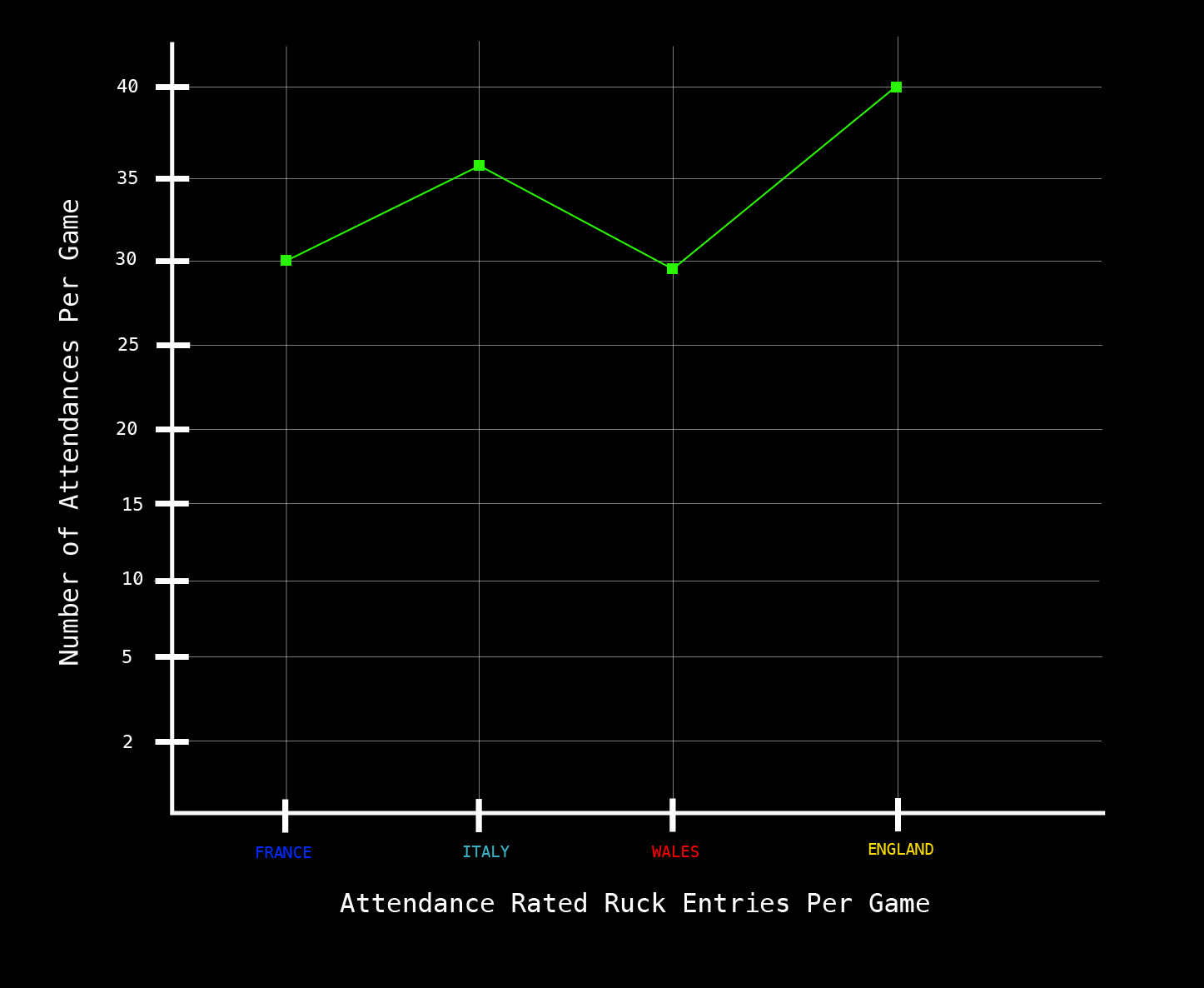
We can track the number of Attendances at the breakdown where players typically cluster after passive carries. This is often a better judge of a team’s carrying than ineffective entries. Against England, we had 40 ruck entries marked as attendances which tells you more about the contact point than ruck speed, in my opinion. An attendance is usually either someone lengthening a ruck for a box kick – and we had a lot of that in this game – or it’s someone in a pod who’s had to check their advance when a carry got stopped dead and they end up as a passive entrant to the ruck.
We can see the uptick relative to the other games here.
• Joe McCarthy, Caelan Doris and Andrew Porter have way too many Attendances for me. Doris’ numbers in this game were about as low as I’ve ever seen from him in a green jersey. The closest I have to this performance was his 24 ORW points scored against Samoa in the World Cup warmup game in 2023. It felt like the game bypassed Doris, especially as he seemed to be our primary forward carrier in the absence of Joe McCarthy who got completely dominated in three of his four carries by the English forward defence. He increased his ORW numbers when he switched to Van Der Fliers role for the last third of the game.
• With no targets to hit outside of the unbelievable ball-carrying of Bundee Aki, our ruck work had no flow so attacks ground to a halt.
When we look at the CORW mapped across the 80 minutes we, once again, see aberrations.
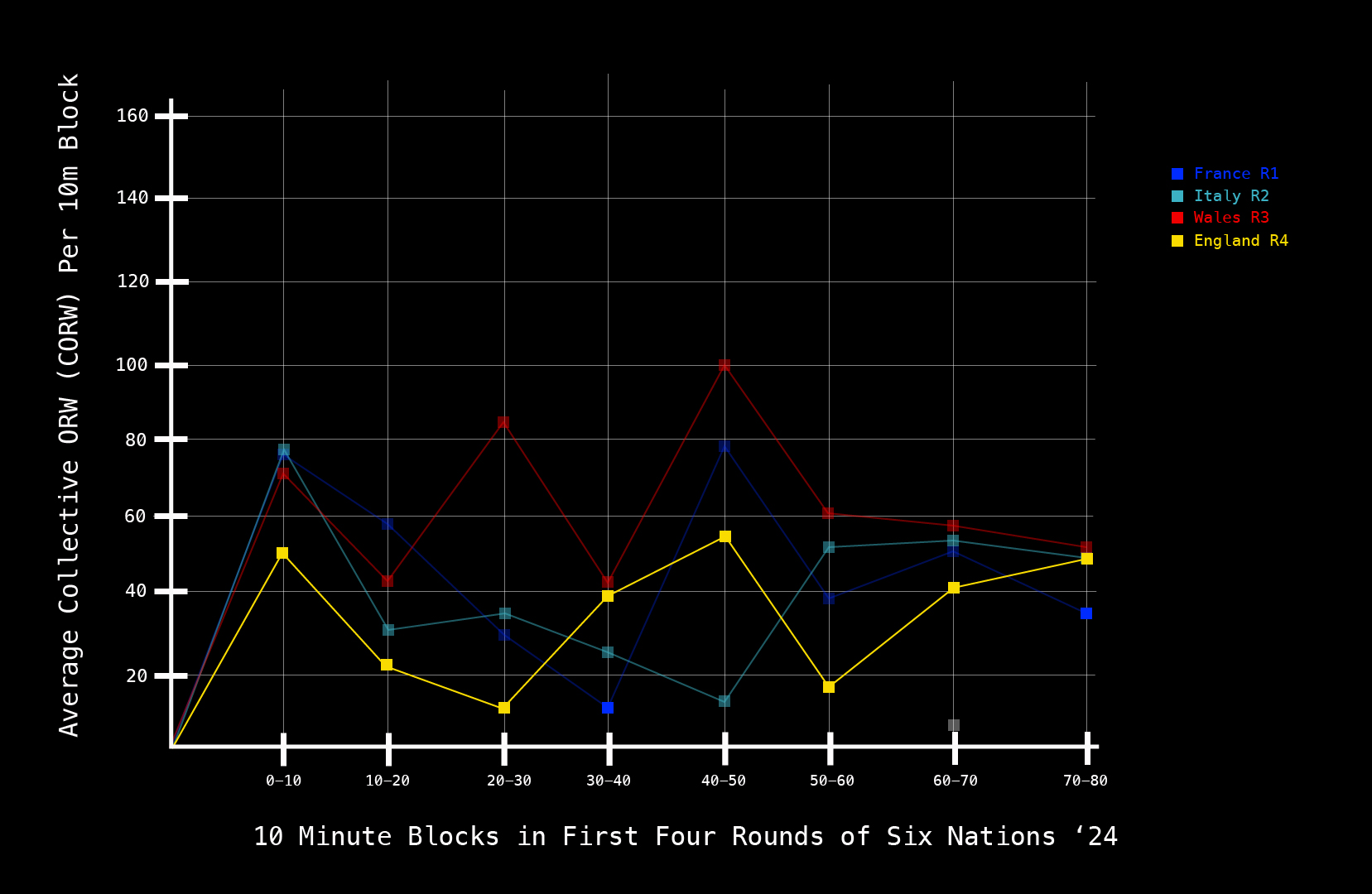
Three of the five lowest 10-minute blocks for ORW scoring in the Six Nations so far happened in this game, which gives you an idea of the problems we ran into when it came to advancing the ball through the forwards.
When you combine that with the high volume of kicking we had, it meant we never managed to build consistent pressure on England. It was the other way around. We tried to kick to a position where England would surrender possession to us the way wanted it but that plan didn’t work – our defensive transition was too porous and England’s offensive transition was much better than we assumed – so we lost time, momentum and scoring windows playing a game that we weren’t playing in the previous two rounds.
The big learning here?
Having one approach for physically dominant away games won’t work when the plan for home games is wildly different.
