


I believe Ireland is moving to a different style in this Six Nations.
I think that change is visible on-field too, even just from an eye-ball perspective, it feels like we’re playing more phases, passing the ball more and kicking the ball less often.
But do the facts support this?
Last year, Ireland were third in the Six Nations for Kicks In Play; 153 total for an average of 30.6 kicks per game. This season we’re fourth with an average of 28 kicks per game which is a drop but not a massive one.
Is it rucks? No, not really. We have more average ruck arrivals per game this season but only by a small amount – an average of 252 ruck arrivals per game in 2024 compared to 247 in 2023.
Then what is it?
It’s the passing between the rucks.
In 2023, Ireland averaged 179 passes per game for a Six Nations PPC of 1.28 across all five games. In 2024, we’re averaging 227 passes per game for a seasonal PPC to date of 1.55, which is a massive jump season on season. That is almost entirely down to a change at #10. Before the Six Nations everyone – including me – had questions over (1) whether Jack Crowley was going to be the #1 guy for Ireland in this championship and (2) if he was, whether or not he’d be able to step into the shoes of a player who owned that team for 10+ years.
There was no need to worry. Crowley is already putting his stamp on this team and the game plan is shifting around him.
In 2023, Johnny Sexton made 94 passes across the entire championship. That’s 18.8 passes on average per game and 10.48% of Ireland’s total passes going through him, with 4.2 kicks on average per game. That comes in for a personal Kick Per Pass ratio of one kick for every 4.47 passes personally while not being in the top 30 for carries or metres gained.
Jack Crowley has made 113 passes across the 2024 championship – so far. That’s 37.6 passes on average per game, 16.54% of Ireland’s total passes, with an average of 6.6 kicks per game. That’s a personal Pass-Per-Kick ratio of one kick for every 5.69 passes while also being ranked in the top four for carries made and top ten for metres gained.
That is a massive change in the involvement of the primary playmaker.
Crowley is passing more, playing more passes in between kicks and carrying way more often. In every department, Crowley is a far more active playmaker than Sexton was. More inefficient too, but that comes with more involvement on-ball. With more involvement comes more scope for error. By 2023, Sexton was a master of floating around Ireland’s 3-2 central shape and stepping in as required for a killer pass. It was self-preservation, to a certain extent. At 38 years of age, he could not afford to be in the top 20 for carries attempted, never mind the top four.
That wasn’t his game.
With Jack Crowley, Ireland have a #10 who can do both and the increase in Ireland’s attacking potency from depth – an average of 10 linebreaks per game in 2024 compared to 7.8 in 2023 – is reflected in this change of activity, as well as more ball carrying oomph in the pack and midfield.
So how does this affect our ORW?
I think when the team hits their peak, we’ll see Ireland consistently hitting Combined Offensive Ruck Work scoring of 450+ per game. Our first-choice unit hit 541 last time out against Wales but that was a particularly efficient performance against a team that struggled to impact Ireland physically.
Against France and Italy, the combined ORW numbers were below 400 but those scores were dragged down by a lot of poor, inefficient work around the breakdown.
- Wales – 15 Ineffective Actions (-30 points)
- Italy – 45 Ineffective Actions (-90 points)
- France – 19 Ineffective Actions (-38 points)
If we add those 38 points back to the France game, we hit CORW 412. If we add those 90 points back to the Italian game we have CORW 433. It’s for this reason that I think 450 will be a good baseline number to work from. Against Wales, we had our most consistent performance at the breakdown to date.
IRELAND’S OFFENSIVE RUCK WORK SCORE VS WALES
- A Dominant Clean is an action that decisively secures possession when the ball carrier takes contact. A Dominant Clean does not have to be the first arrival at the breakdown but it is rewarded in the context of effectiveness. We will assign this action 3 points.
- A Guard Action is where a player plays a role in helping to retain possession after we have “re-won” the ball on the floor. Sometimes this can happen on a carry/ruck point where there is no active contention by the opposition. Let’s assign this action 2 points.
- An Attendance can be anything from standing as a “kick shield” on a ruck to adding a bit of bulk to ward against a counter-ruck to extending your leg to make space for a box kick. I’m marking this down as being worth 1 point.
- An Ineffective Action is a blown cleanout, a lean, a breakdown penalty or an action that I couldn’t see any direct benefit for. This will be worth -2 points.
| Player | Dominant Clean | Guard Action | Attendance | Ineffective | Ruck Work Score | ||
|---|---|---|---|---|---|---|---|
| Porter | 2 | 18 | 6 | 1 | 46 | ||
| Sheehan | 1 | 11 | 1 | 26 | |||
| Furlong | 2 | 17 | 4 | 44 | |||
| McCarthy | 3 | 7 | 4 | 5 | 17 | ||
| Beirne | 15 | 3 | 1 | 31 | |||
| O'Mahony | 2 | 13 | 2 | 34 | |||
| Van Der Flier | 2 | 19 | 1 | 1 | 43 | ||
| Doris | 2 | 22 | 4 | 1 | 52 | ||
| Gibson Park | 2 | 6 | |||||
| Crowley | 1 | 8 | 2 | 15 | |||
| Lowe | 1 | 6 | 1 | 16 | |||
| Aki | 1 | 11 | 25 | ||||
| Henshaw | 1 | 15 | 33 | ||||
| Nash | 1 | 4 | 11 | ||||
| Frawley | 1 | 12 | 2 | 2 | 25 | ||
| Kelleher | 13 | 1 | 27 | ||||
| Healy | 1 | 2 | |||||
| Jager | 4 | 6 | 24 | ||||
| Ryan | 3 | 2 | 2 | ||||
| Baird | 1 | 4 | 11 | ||||
| Conan | 1 | 5 | 13 | ||||
| Murray | 1 | 2 | |||||
| McCloskey | 1 | 3 | 9 |
Top Five ORW Scorers
- Caelan Doris 52 points
- Andrew Porter 46 points
- Tadhg Furlong 44 points
- Josh Van Der Flier 43 points
- Peter O’Mahony 34 points
Notes
• My first and second watch read on Ciaran Frawley’s performance at fullback was wrong. He racked up the highest ORW score of the Six Nations from fullback in this game. Sure, he played a different role from Hugo Keenan and the quality of his playmaking was still, for me, a little rudimentary but his effectiveness at the breakdown in key periods was beyond question.
I do feel that Henshaw and Crowley ended up having higher ORW scores than would be ideal because of Frawley’s passing involvements, but this was a minor issue. With Keenan at fullback, I would expect both Crowley and Henshaw to have five fewer ruck involvements each at least.
• Tadhg Furlong has successfully channelled the physicality that used to mark out his ball carrying into his ruck work. He was always super physical at the breakdown but now that his carrying and passing load has decreased, he has upped his ruck involvements with brutal efficiency. As a side note, Oli Jager looked incredibly similar to Furlong at the breakdown. Here is one of his dominant entries where he arrives second but “wins” the ruck by ensuring the Welsh jackal goes to ground.
And in this one, his first offensive involvement of the day, he gains another two points for absolutely steamrolling Will Rowlands out of the contact zone. Bang. Dominant.
If not for the knee flareup of the pre-existing injury he had from New Zealand, I think he’d have had a good shout of making the bench against England. His 24 points off the bench were really impressive for his test debut.
• Joe McCarthy had 32 ruck involvements against Italy and had a really poor day at the offensive breakdown in my opinion. Not enough to lose Ireland the game but the number of times he took himself out of the next phase for no reason – when he’s our sole ball-carrying power forward in the pack – was maddening. Against Wales, McCarthy only played 54 minutes but they were much, much better from an efficiency perspective. He only made 19 ruck entries and looked much better as a result. Some of his dominant entries were fantastic – look out for Porter stepping across as a block to the defensive fold too – but he did tire as the game went on into the end of the first half and opening quarter of the second.
The key to building Joe McCarthy into a proper test player is keeping him under those 20 ruck involvements to maximise what he does with the ball in hand. He won’t always get over the gainline but he doesn’t have to – we just need him to commit defenders.
• Our CORW map for this game showcases how much better we were relative to the two previous games. That is, in part, because of how poorly Wales handled the ball – they couldn’t stop us from building long sequences of possession by either winning it back or by hanging onto the ball themselves. As a result, our average CORW per block was 64.8 – the highest of the Six Nations so far by some distance.
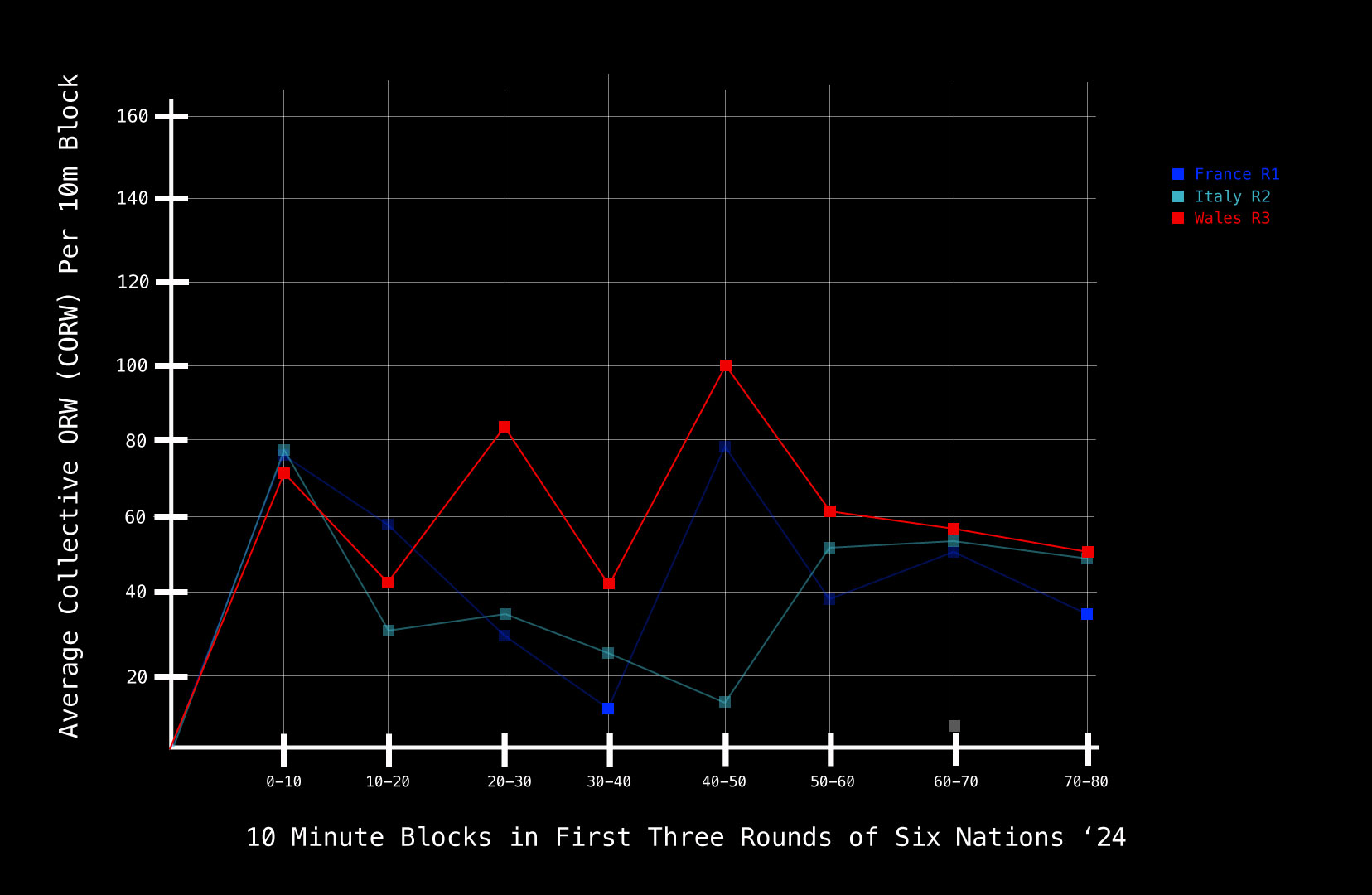
• Beirne’s lowest ORW numbers of this Six Nations so far are entirely related to his 10 minutes in the sin bin. What’s interesting though is that Ireland’s best 10-minute block for ORW scoring came in the 5 minutes of the 40 to 50-minute block that Beirne was in the bin. We racked up the guts of 100 CORW points in that period and locked Wales out of the game when they were primed to make a comeback.
