


Coming into this game, I thought I had a good idea of how Wales would approach it, based on what they had been good at in the previous two games in this Championship and what we had been less than stellar at. I was wrong.
I thought they would kick short and contestable, work Ireland in the air and, if they were unsuccessful in forcing a turnover, they would stick Ireland at the breakdown and make it difficult for us to build the flow of possession that tears teams up. In their previous two games, Wales had kicked in the mid-range. In Round 1, they kicked the ball 27.9m on average. In Round 2, they kicked the ball 27.8 metres on average. Against Ireland, a team with the least efficient ruck completion rate of the previous two rounds, Wales kicked the ball an average of 34m per kick.
What was the thinking behind this? Well, I think there were a few factors at play on why I misread their possible kicking plan.
The main one is their scrum completion rate, which averaged 66% completion on 11 attacking scrums in the games before this. If they kicked shorter, that would likely increase the volume of scrums they would have to engage in. Either way, it turns out they met their undoing on the road they took to avoid it because they had a scrum completion rate of 63% on 8 put-ins. A disaster. Never mind what Ireland managed to do on their put-in. The Welsh scrum performance in the first half, in particular, lost them any chance at keeping Ireland in arm’s reach for the kind of scrap they showed in the opening 10 minutes of the second half.
Right from the first minute, Wales seemed to want to force Ireland as far back up the field as possible, even if it meant giving Ireland more space to transition into.
That space between the receipt of the ball and the chase line is really important because it’s essentially a count-down timer on the window you have to really attack Ireland on defensive transition – that is to say, you’re transitioning from the team with possession into the team without possession.
This is a good example, albeit from a deep exit off a 5m scrum. Again though, the decision to keep this infield is a specific tactical decision that we’ll get to later.
When Frawley takes that initial exit, there is 23m between him and the nearest chasing Welsh player. It takes exactly 5.15 seconds – including a long lateral pass – for Wales to make contact with Calvin Nash in midfield after Frawley takes possession.
That 5.15 seconds allows Doris, Beirne and Van Der Flier to get near the chase line to support Nash. I think Warren Gatland wanted to keep the ball in play for as long as possible to burn out Ireland’s ruck support on these kicks to really push the pace in the second and fourth quarter.
The issue, for me anyway, was that Wales’ kicking wasn’t accurate enough to properly punish with an aggressive chase and harry strategy. This is a good example of that principle.
That angled crossfield bomb is a staple of Wales’ game under Gatland and they couldn’t exert any real pressure on Crowley in the backfield, either directly or at the breakdown. Van Der Flier was able to drop back, along with Frawley, and secure the ruck. Once you see this picture with Van Der Flier over the ball, that ruck is secure 18 times out of 20.
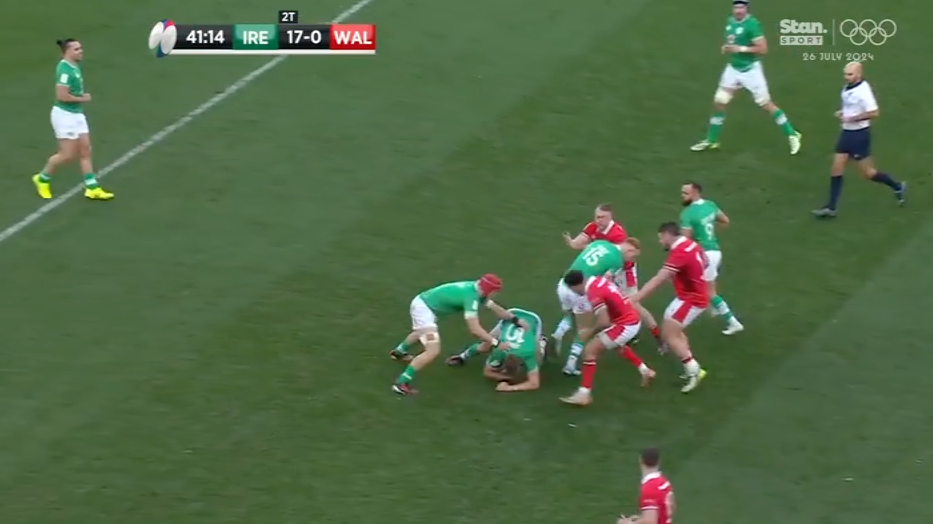
Without a kicking strategy to produce opportunities, Wales had to rely on their attacking framework, which was understandably rudimentary at this stage in their cycle as a group. That isn’t intending to sound hubristic – it’s just the reality with so many new, inexperienced players and combinations playing at this level en masse. The easiest – and shortest – things to coach into a group are defence and kicking strategies, as they are interlinked. An attacking framework more involved than three-piece strike plays off the set piece can often be ugly and basic as they are bedding in.
I think Wales – rightly – were concerned about their scrummage so, as a result, decided to kick long and on to beat Ireland to the transition breakdown over 35m, rather than try to scramble in a more claustrophobic 25m shorter kicking game and risk too many scrums.
I also think they kicked the ball infield for long stretches – nearly 43 minutes – to (a) try to burn out Ireland’s ruck support over a longer distance with the hope that their younger team might catch a bigger, heavier Ireland side over long sequences and (b) minimise the damage Ireland’s lineout could cause as it was the origin point of nine tries for us in the previous two games.
It didn’t work, and they lost heavily as a result despite some gutsy defence.
***
Ireland are in the middle of a style change.
In last year’s Six Nations, Ireland played an average of 6.1 passes per kick across the tournament. That was backed up with the two serious pool games against Scotland and South Africa in the World Cup where we played an average of 5.9 passes per kick.
In this year’s Six Nations, that average has ballooned to an average of 8 passes per kick in the three games to date. Adding an extra two passes per kick – while also dropping our number of kicks by volume – is a distinct and deliberate style change that doesn’t just happen accidentally.
Ireland are playing more phases from further out the field than previously and, to support this, we’re playing a very narrow 3-2-X forward shape that we’ve traditionally used with our counter-transition style. At times, it almost resembles the 3-3-X that Munster play in their on-ball style of rugby.
You can see it here with O’Mahony as a technical 2+1 on this shape but he’s so close to the second pod it’s essentially a three pod.
That sequence looks very similar to something Munster have and would do at the moment. It ends with a poor pass from Crowley into the second layer that he probably gave himself too much to do on – he’s become really good at selling passes one way with his body shape and then leaving himself with a very difficult technical pass to execute on the feint. When it works, linebreak every time. When it doesn’t, passes sweep away from the target at pace.
It’s still a work in progress, however, with both the forwards and backs getting used to running a game on this little kicking. One of the keys to on-ball rugby is accepting that inefficiency is part of the plan and this is an Ireland side used to efficiency.
One of the main issues I found was the enforced selection of a second playmaker at fullback instead of Hugo Keenan. Ciaran Frawley had a decent game but I found his fit in the attack to be a little janky. Keenan is the best fullback in the world, in my opinion, because of the completeness of his game and how much of a mechanic he is in attack. He’s not just an incredibly dynamic carrier in space, he’s an incredibly accurate offensive breakdown player who secures a tonne of wide ball at pace. The benefits to this are massive in that if he’s securing those rucks, wider forwards don’t have to.
As a result, Hugo Keenan rarely passes more than 10 times per game. His offensive involvements are heavily tilted towards carrying in that 3/4 zone off #10 or in the wider channels.
Against Wales, Ciaran Frawley’s ORW numbers were way down and his passing numbers were way up. Frawley passes the ball 16 times against Wales, which is fine but… it’s not what Hugo Keenan does. In the Irish system, if Keenan isn’t doing it his replacement shouldn’t either, if the system is to run as they drew it up.
Frawley began to step in a lot as first receiver – especially in the second half – to mixed results. This sequence here at the start is, essentially, step and sling. He takes the ball static, hits a pre-picked target and just runs the ball across the field.
Crowley adds some variety to the action at first receiver on the way and creates a high-quality pass that opens up the space for a linebreak. This isn’t “helping” Crowley – it’s taking yourself out of the zones usually patrolled by Hugo Keenan to take up space used by Lowe, Aki and Crowley.
Frawley didn’t play poorly by any means, but I found the value he added at first receiver to be limited when he took up more reps there in the second half. He was better when operating in the second layer, even if it meant bumping Aki and Henshaw into different, wider zones and limiting Lowe’s involvement on-ball. In the first half, when he was playing in the zones normally used by Keenan he didn’t really see much involvement at all. His work under the high ball is still a question mark as Wales didn’t test him in that manner as expected, for whatever reason.
All in all, Ireland were pretty good with some really good individual performances but the overall group is not as cohesive as they might yet be as they adjust to kicking less often and playing from further out. In the longer term – South African tour, I think – we might yet see Ireland move to a 3-3-X phase play shape.
Questions remain, though.
McCarthy’s emergence as a core component of this team is directly correlated to his role as Lock Power Forward. When McCarthy is not on the field, however, things become a little static which deepens Ireland’s need to find another power forward build player to use off the bench. That is not James Ryan as of now, so in the mid-term, that is something that needs to be unearthed to ensure we stay balanced.
But that’s for another day; take the bonus point, take the good vibes and roll onto the next.
| Rating | |
|---|---|
| Andrew Porter | ★★★★ |
| Dan Sheehan | ★★★★ |
| Tadhg Furlong | ★★★★ |
| Joe McCarthy | ★★★ |
| Tadhg Beirne | ★★★★ |
| Peter O'Mahony | ★★★ |
| Josh Van Der Flier | ★★★ |
| Caelan Doris | ★★★★★ |
| Jamison Gibson Park | ★★★★ |
| Jack Crowley | ★★★★ |
| James Lowe | ★★★ |
| Bundee Aki | ★★★★ |
| Robbie Henshaw | ★★★ |
| Calvin Nash | ★★★★ |
| Ciaran Frawley | ★★★ |
| Ronan Kelleher | ★★★★ |
| Cian Healy | ★★★★ |
| Oli Jager | ★★★★ |
| James Ryan | ★★★ |
| Ryan Baird | ★★★ |
| Jack Conan | ★★★ |
| Conor Murray | ★★★ |
| Stuart McCloskey | ★★★ |
