


Every team you see at the elite level has a “build” in their pack and midfield that balances out core aspects of their game. This build goes beyond the shirt numbers that we traditionally associate with classical jersey jobs from years gone by. You know this, though, because I’ve spoken about it repeatedly. As the game shifts and evolves with law changes and tactical innovations, terms like “openside flanker” and “blindside flanker” have become functionally meaningless.
There are only the tasks that the team needs to be fulfilled to win games and that’s that. Your pack build is the clearest expression of these tasks because the roles you create (and the players to fill those roles) determine the success and failure of your pack and your team at large.
In this year’s Six Nations, Ireland have been experimenting with a different build in their pack that is quite a departure from what went before and it almost all hinges around the addition of Joe McCarthy.
Why is this such a big deal? Well, because it’s the natural evolution of Ireland using one or both of our second rows as ball-carrying outlets supported at the breakdown by the back row. This was always an inversion of the classical way teams were constructed with the back row carrying, to be supported at the breakdown by the front five. A lot of Ireland’s success since 2017/18 has been built on moving that ball-carrying load into the second row (Ryan and Henderson initially, and then Beirne) and midfield (Aki’s emergence as a central contract-tier talent is directly linked to this) from the back row (Stander and O’Brien’s retirements and role shifts due to wear and tear at the end of their run) all played a part in this as we headed into the early 2020s.
But it’s all about balance and finding the right guys to take the right load.
Peter O’Mahony has been a crucial part of this for Ireland and a core member of the two Slam winning teams at the end of the 2010s and early 2020s for a reason. The other part is that Swing Lock – the lock that can balance the ball-carrying load with high levels of Offensive Ruck Work required to balance out a more direct, Power-Forward build partner.
In 2018, that Swing Lock was Henderson. As an aside, it’s no surprise that these Swing Locks are often half-locks or players who have significant time spent in the back row at different points in their careers. That’s true for Henderson, it’s also true for Beirne.
Henderson and, latterly, Beirne were initially there to support the ball-carrying and defensive stopping power of James Ryan. When Ryan originally broke through, he was a powerful, dynamic 10+ carry/10+ tackle/5+ lineout takes a game player. As he has progressed through his career – adding and subtracting multiple KGs along the way – Ryan’s effectiveness in this role has plateaued.
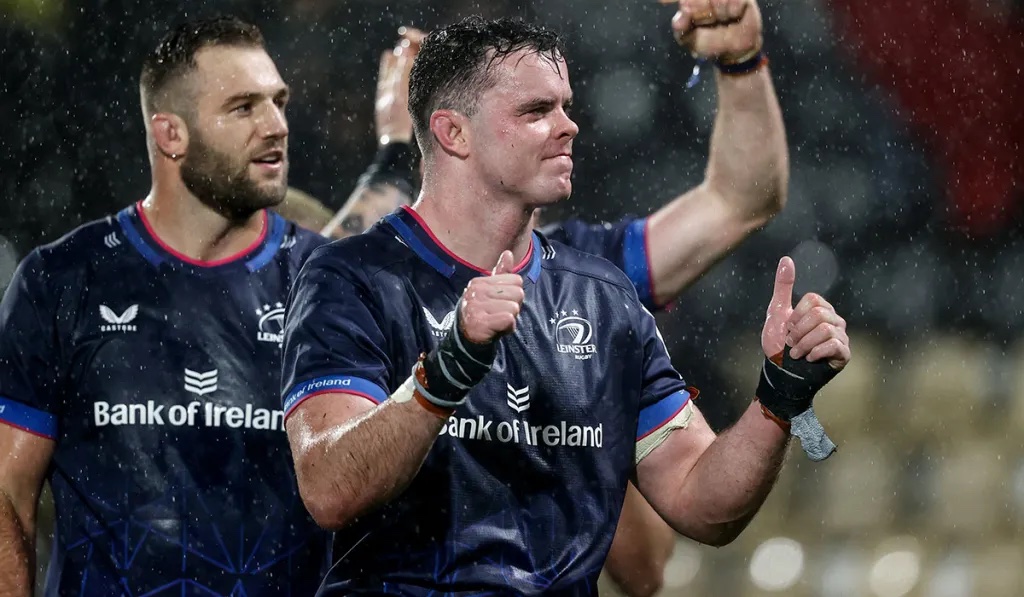
As another aside, Ryan was listed at 118kg in 2021. He’s now listed as 107kg on the Leinster and Irish Rugby websites, which would make him 4kg lighter than he was when this picture was taken back when he first broke through.

Something doesn’t add up there when you consider this is James Ryan from this season.
My point is that Ryan fell victim to role shift, in my opinion, which took away a lot of his natural, rangy dynamism to turn him into a heavyweight tighthead lock with the scrummaging heft Ireland would need at the 2019 World Cup.
That role shift – along with the natural wear and tear of injuries that come with this sport – blunted Ryan’s impact as a regular ball carrier so he tried to transition his role, somewhat. Beirne’s emergence as an elite Swing Lock alongside him helped to ease that transition but it seemed to me at least that what James Ryan was truly elite at became more focused on the defensive side of the ball. Ryan was – and is – a fantastic tackler and defensive counter-rucker with great timing on the counter-launch at the lineout for a guy of his size but the offensive side of his game has fallen away.
His ball-carrying and his offensive ruck work have degraded considerably, in my opinion, in both volume and quality.
As a result, I think Ireland’s desire to upscale Joe McCarthy to that Power Forward role in the second row became a real priority after the World Cup. Why? McCarthy wins offensive collisions, forces compressions in the defence and gives the team go-forward energy in a way that Ryan used to but doesn’t do to the same level as of late.
But there’s a problem.
McCarthy’s output at the offensive breakdown is poor.
There’s no other way to describe it. In that area of the game, he looks as raw as raw can be to the point that Ireland have to wildly amend the roles of the pack to accommodate it. That was true against France – when McCarthy played really well – and it was doubly true against Italy, where he had a genuinely poor performance in every facet of the game outside some big defensive moments.
Does this mean McCarthy should be dropped? Absolutely not. The collision-winning he brings on the offensive and defensive side of the ball really works for this team and, if anything, he just needs clarity on his role to ensure he’s not wasting energy on an area of the game where he should be minimizing his involvements.
How does that combine when paired with James Ryan playing, essentially, as a Swing Lock in this amended Irish system? Well, against Italy, we got a look. Here’s the ORW scoring.
IRELAND’S OFFENSIVE RUCK WORK SCORE VS ITALY
- A Dominant Clean is an action that decisively secures possession when the ball carrier takes contact. A Dominant Clean does not have to be the first arrival at the breakdown but it is rewarded in the context of effectiveness. We will assign this action 3 points.
- A Guard Action is where a player plays a role in helping to retain possession after we have “re-won” the ball on the floor. Sometimes this can happen on a carry/ruck point where there is no active contention by the opposition. Let’s assign this action 2 points.
- An Attendance can be anything from standing as a “kick shield” on a ruck to adding a bit of bulk to ward against a counter-ruck to extending your leg to make space for a box kick. I’m marking this down as being worth 1 point.
- An Ineffective Action is a blown cleanout, a lean, a breakdown penalty or an action that I couldn’t see any direct benefit for. This will be worth -2 points.
| Dominant Clean | Guard Action | Attendance | Ineffective | Ruck Work Score | |
|---|---|---|---|---|---|
| Porter | 15 | 6 | 4 | 28 | |
| Sheehan | 1 | 8 | 3 | 22 | |
| Bealham | 1 | 11 | 9 | 1 | 32 |
| McCarthy | 2 | 8 | 7 | 15 | -1 |
| Ryan | 2 | 13 | 4 | 4 | 28 |
| Baird | 1 | 15 | 1 | 2 | 30 |
| Doris | 25 | 3 | 44 | ||
| Conan | 2 | 16 | 2 | 34 | |
| Casey | 1 | 1 | 5 | ||
| Crowley | 1 | 3 | -4 | ||
| Lowe | 5 | 10 | |||
| McCloskey | 8 | 3 | 3 | 13 | |
| Henshaw | 9 | 1 | 19 | ||
| Nash | 7 | 14 | |||
| Keenan | 5 | 1 | 11 | ||
| Kelleher | 2 | 5 | 1 | 14 | |
| Loughman | 5 | 2 | 6 | ||
| O'Toole | 1 | 6 | 15 | ||
| Henderson | 1 | 5 | 1 | 2 | 10 |
| Van Der Flier | 2 | 4 | 14 | ||
| Gibson Park | 0 | ||||
| Byrne | 1 | 2 | -1 | ||
| Larmour | 1 | 1 | 0 |
Top Five ORW
- Caelan Doris – 44 points *upgraded to a ★★★★★ performance
- Jack Conan – 34 points *upgraded to a ★★★★★ performance
- Finlay Bealham – 32 points
- Ryan Baird – 30 points
- Andrew Porter – 28 points
James Ryan – 28 points *downgraded to a ★★ performance
The first thing that will jump out at you will be Joe McCarthy earning a negative score, the first time a forward who played 80 minutes has done so since I’ve been doing this metric. As a result, I’ve downgraded his Wally Rating to a ★★ performance.
How did it happen? I don’t know. Scoring -1 off 32 qualifying entries is genuinely poor and there’s no other word for it. The killer for him was 15 ineffective entries for a total of -30 ORW points.
Here’s a quick sample of what I’m talking about – entries that either aren’t needed (because the ball was already retained and all he did was take himself out of the next phase for no reason, are inaccurate (they miss the target), are just standing around, or actively hinder our possession (like getting cleaned out into the scrumhalf passing lane).
Does McCarthy need to be making 32 ruck entries though? He should be making 25 max. I think the biggest thing he needs is clarity on his role to maximise what he’s good at and minimize what he isn’t.
It worked in this game against Italy because, to be honest, they played really poorly and without the sustained defensive breakdown pressure to take advantage of one of the sloppiest games I’ve seen from this team in that area of the game.
I wondered before the game if Ireland’s back five was “too heavy” for this game given our usual breakdown champions – Beirne, O’Mahony and Van Der Flier – either didn’t play or didn’t start. It didn’t really matter in the end because of a narrower forward layout that put the back row in the range of our hit-up zones, firstly, but mainly because of a top-class ORW performance from Baird, Doris and Conan. The work of Doris and Conan, in particular, carried the majority of the ball retention we enjoyed across the full 80 minutes. Ryan Baird’s performance was also of the highest quality and he demonstrated that he can be an immediate successor in the core roles worked by Peter O’Mahony.
You’re probably wondering why I downgraded James Ryan when he was in the Top Five ORW scorers.
Here’s why.
In the first two ten-minute blocks, James Ryan earned 23 ORW points with two dominant cleans and super-solid middle field guard work. Here’s one of those dominant cleans for +3pts.
That nudge beyond the ruck opened the space for Casey to surge into, so it led directly to a try being scored. Is James Ryan a Heavyweight Swing Lock? I was ready for it. He was on track for a 40+ point game.
But then he scored 0 points on zero entries in the next 10 minutes. That happens when you’re a swing lock. Sometimes the ball doesn’t come to your zone or you end up defending for a four or five minute spell and, sometimes, you flat out need to take a breather. Beirne does that all the time – in five-minute spells. The problem for Ryan here was that after he scored those 23 points, he didn’t get another qualifying entry for 21 minutes.
When he went off the field on the 60-minute mark, he only scored five more points after that massive burst in the opening 20 minutes. That will not be sustainable against higher-level opposition.
You can see a collective fast-start and drop-off on the Combined Offensive Ruck score map for this game.
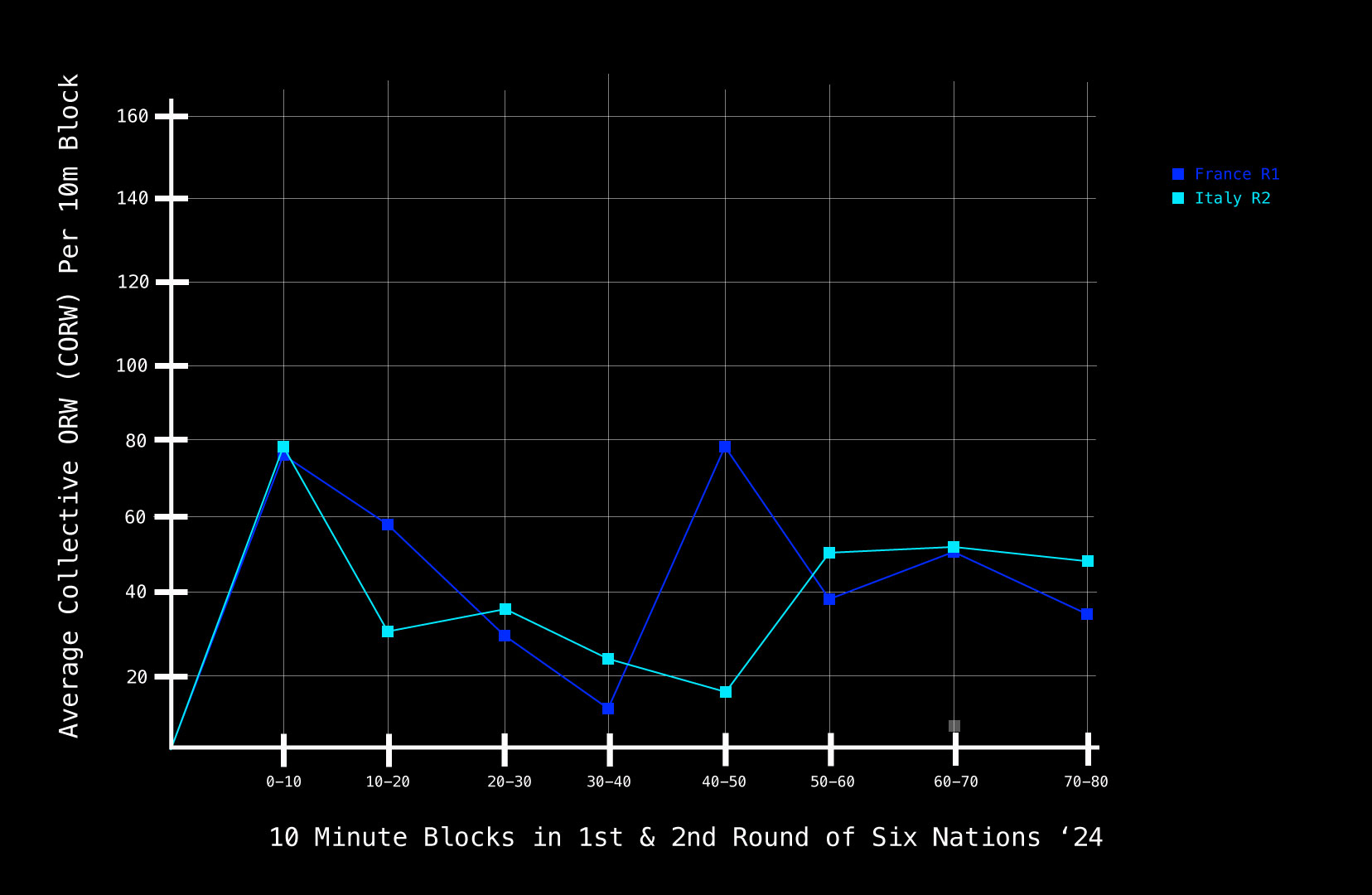
Against Italy, Ireland usually don’t need to rack up big ORW numbers to win the game. Now, I will also say that we scored two of our five tries from close-range set piece conversions (and two from high ORW scoring multiphase sequences in the first 20 minutes) but, for me, fluctuations like that start of the second-half drop-off and the big dip in the second 10-minute block can’t be accommodated against serious opposition.
