



It’s good to be back.
Rugby played during test windows was one of the main bugbears amongst critics of the old PRO12/14. Me? I loved them and I often wished for them back. To some, playing a heavily rotated Welsh region or Italian club during the November test window or the Six Nations was the very picture of boring, one-sided tripe. I loved the new combinations, squad players getting minutes and young guys starting in their first proper games at that level. It was new! It was exciting! And for guys like me, it was an opportunity to talk about guys that maybe weren’t a big deal at the time but who would be, down the line. Craig Casey, John Hodnett, Jack Crowley, Tom Ahern, Gavin Coombes – all these guys and more got their first few breaks in these test window games.
Of course, I got a curled finger on my magical monkey paw when it came to my test window wish in the last two seasons. It seemed like everyone who even thought about being a senior player for Munster ended up getting a two-month-long groin injury or something like it. Oh, you’re a player who starts for Munster in the front five? Tough luck, you have the dancing plague from the Middle Ages now and must go for a scan.
I ended up seeing all the young prospects and squad guys I wanted, just not in the context I wanted.
In an ideal world, these test window games would be anchored by squad veterans and NIQ signings with the other spots being taken up by squad players (your 2/3rd in the chart guys in high body positions). Then you’d add in some of your high-potential young players in spots where they can just play and gain good experience, hopefully winning along the way too.
What am I talking about?
A young #10 paired with a crafty veteran #9.
A young #9 with a test-quality #10.
A big bullock of a young lad given a simple “run over everyone” job in a back row with experienced pros who could cover other parts of the job.
A young hooker with two or three experienced jumpers to run him through the game and a veteran loosehead to scrummage with.
A newbie tighthead prop with a proper senior tighthead lock scrummaging behind him.
A young back three prospect surrounded by experience and communication in the other two wing spots.
That’s how you give young players every chance to be successful in these games against rotated sides. It’s the best and most reliable way to do it. Sure, sometimes you strike it lucky by throwing guys in at the deep end but, again, ideally you’d have the squad available to layer in your inexperienced guys with seasoned professionals.
***
This season so far has been dominated by a wave of brutal mid-to-long-term injuries to one key player after another to the point where it felt like every teamsheet in that 13-game run between the 21st of October 2023 to the 20th of January 2024. That’s one game every seven days for 91 days. There was simply no time to recover and it got to the point where injuries in the front five were actually causing other players to get injured with the accumulated wear and tear. At one point we had 21 starting-level players injured for at least 2+ game weeks to come.
We still have a raft of injuries, to be clear, but we’re starting to see some light in the tunnel. At the moment we have Diarmuid Barron, Edwin Edogbo, Roman Salanoa, Paddy Patterson, Jean Kleyn, Paddy Campbell and Dave Kilcoyne on the long-term injured list with John Hodnett and Simon Zebo on the mid-term list.
But, on the positive side of the ledger, we have RG Snyman, Mike Haley and Joey Carbery back in action, as well as Niall Scannell, Fineen Wycherley and others settling into regular action after coming out of long-term injuries of their own.
The break of the last few weeks since the Northampton game has given the group a chance to rest and recover after a mentally and physically draining block of games that started well but then degraded to a five-win, two-draw and six-loss run in those 91 days from hell. That isn’t to say that we didn’t play in that time – at home vs Sharks, at home vs Glasgow, a really gritty win in the rain against Stormers before the performance of the season to date away to Toulon – but the majority of those games fell down along similar lines. A bright start, with some good moments and, if the weather was bad against good teams, a killer power drain in the last 20 minutes.
Against good teams, or big teams, or good big teams that will cost you – as it almost always did for Munster – and that left us with work to do.
Namely, an away tie in Europe against the team who beat us in Thomond Park in our last competitive game.
And ground to make up in the United Rugby Championship.
Winning the title The Hard Way last season was nice and all but, for several reasons, the club needs some home playoff games. The URC is the easiest path earning at least two as it stands – a potential quarter-final, semi-final and final – but that will only happen with a top-two finish.
That might seem a little unlikely as it stands in that we’re currently 11th but we’re only eight points off second – that’s two regular wins – and we’re in prime “moving” position.
In the last 91 days, Munster have played almost all of the super difficult fixtures in this league. Since the start of the season, we’ve gotten rid of the following fixtures win, lose (or draw) in the first half of the year.
- Sharks (H) – we played them without their Springboks, something most sides will not be able to do for the rest of the regular season. Last season’s quarter-finalists.
- Benetton (A) – we drew away to Benetton which seemed like a bad result at the time but we’ve seen since how good they are this season.
- Leinster (H&A) – we’ve played Leinster home and away before Christmas in two games they targeted with selection. Last season’s semi-finalists
- Ulster & Connacht (A) – we’ve played two of our hardest scheduled interpro games before the halfway point of the regular season. Ulster and Connacht away are two of the hardest fixtures in this league. Last season’s quarter-finalists and semi-finalists.
- Stormers (H) – we beat a rival side in Thomond Park in a game they 100% targeted on their tour. Last season’s finalists.
- Glasgow (H) – we got a bonus point win on our only scheduled regular season game over this rival side. Last season’s quarter-finalists.
The only “easy” game in that schedule was Dragons at home. Every other league game in that nine-game run was either against a playoff team from the year before or the side that is currently second in the log this season with the same number of wins as Leinster.
In the second half of the season, we have Connacht and Ulster to play at home, the Bulls to play away (the hardest fixture of the remaining regular season), Edinburgh at home and then, in the next four games, we play teams currently sitting in 8th, 12th, 13th and 14th.
These next four games are must-win. A return of 18 points is far from unrealistic, with the most difficult fixture being Ospreys on current form and top player availability. That isn’t to minimise the threat of the Scarlets – who can absolutely cause us trouble in this fixture – but we need to be beating a team with one win at home all season.
If we can start this run well, especially with the schedule some of our rivals are taking on in the second half of the season, shooting up the table is more than possible, as well as teams like Benetton coming unstuck.
But none of that works without the win.
Munster: 15. Mike Haley (Sale); 14. Seán O’Brien (Mullingar RFC), 13. Antoine Frisch (Rugby Sud 77), 12. Alex Nankivell (Tasman Mako), 11. Shane Daly (Highfield RFC); 10. Joey Carbery (Athy RFC), 9. Conor Murray (Garryowen RFC); 1. Jeremy Loughman (Athy RFC), 2. Niall Scannell (Dolphin RFC), 3. Oli Jager (Naas RFC); 4. Tom Ahern (Dungarvan RFC), 5. RG Snyman (Blue Bulls); 6. Ruadhán Quinn (Ballina-Killaloe RFC), 7. Alex Kendellen (UCC RFC) (C), 8. Gavin Coombes (Skibbereen RFC)
Replacements: 16. Eoghan Clarke (Seapoint RFC), 17. Josh Wycherley (Bantry RFC), 18. John Ryan (UCC RFC), 19. Fineen Wycherley (Bantry RFC), 20. Jack O’Sullivan (UCC RFC), 21. Ethan Coughlan (Ennis RFC), 22. Rory Scannell (Dolphin RFC), 23. Shay McCarthy (Thomond RFC)
Scarlets: 15. Johnny McNicholl (Sydenham), 14. Tomi Lewis (Gwernyfed), 13. Joe Roberts (Burry Port), 12. Eddie James (Carmarthen Quins), 11. Ioan Nicholas (Pontyberem), 10. Dan Jones (Carmarthen Quins), 9. Archie Hughes (Tenby), 1. Kemsley Mathias (Narberth), 2. Eduan Swart (Pumas), 3. Harri O’Connor (Dorchester), 4. Alex Craig (Stewartry), 5. Sam Lousi (Bay Roskill Vikings) (c), 6. Jarrod Taylor (Western Province), 7. Dan Davis (Llandeilo), 8. Vaea Fifita (Lions – Tonga)
Replacements: 16. Harry Thomas (New Dock Stars), 17. Wyn Jones (Llandovery), 18. Sam Wainwright (Rhyl), 19. Jac Price (Carmarthen Quins), 20. Teddy Leatherbarrow (Knutsford), 21. Efan Jones (Wrexham RFC), 22. Charlie Titcombe (Stanford Rugby), 23. Steff Evans (Felinfoel RFC)
This has not been a great year for the Scarlets so far but, to be fair, they’ve had a similarly rotten schedule to ourselves as well as a broadly similar injury list.
However, this familiar woe must be looked at through the prism of Welsh Regional Rugby Woe, which is a level of misery and anguish that we can only imagine. The Scarlets’ problems this season are almost all related to the hollowing out of their squad last season. This past July they lost Javan Sebastian, Sione Kalamafoni, Aaron Shingler, Dane Blacker, Rhys Patchell, WillGriff John, Leigh Halfpenny and Samson Lee. This coming off-season they’re likely to lose the imposing Vaea Fifita – their highest-paid player by some distance – with captain Sam Lousi also a potential flight risk.
Does that mean the Scarlets can’t cut you up on transition or a strike play? Absolutely not. That was and remains a core part of the Scarlets’ DNA. It’s everything else that’s the problem. Elements of what they do on phase play with their forward shape are the very definition of “going for broke”.
That’s a 3-2-2-1 with all their forwards on the openside of the wide ruck, a position won and cleaned by their outside backline.
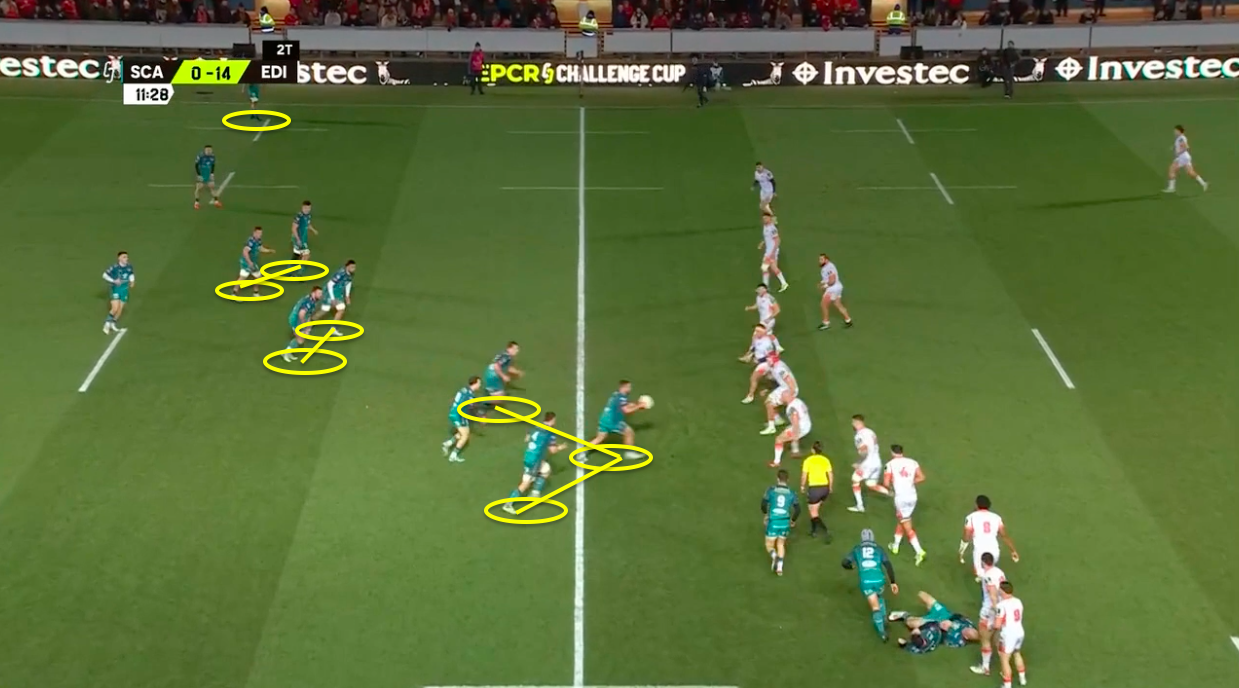
They play with real depth on these progressions across the field and they will stagger those four forwards off #10 with enough space from the gainline that poor reads are punished by deep outside breaks.
The problem, as far as I can see it, is that the Scarlets so far this season have been playing with on-ball rugby levels of possession retention and Kick Per Pass metrics while playing with a forward shape and general playing philosophy that makes them easier than most to turnover at the breakdown.
A 3-2-2-1 system or a 3-2-X is usually used by teams who play counter-transition style rugby. Why? They kick long and are conditioned to play over long range so when they look to play post-transition phases, the depth of a 3-2-2-1 pulls the opposition defence out of shape while they’re on the run.
But it works best when used in 3/4 phase bursts before kicking for position again.
The Scarlets don’t play counter-transition rugby though. They play on-ball rugby. On-ball rugby styles tend to gravitate more towards flat 1-3-3-1 or 1-4-2-1 shapes. Why? Because when you play flat it’s easier and more efficient to retain rucks for 6/7 phases at a time because the ruck support is right on the gainline with you. When you release to the backs in this system, they always have numbers.
You can see how the depth on this 3-2-2 shape (with the second pod of two losing a forward on the pass) led to a spot where the Scarlets should really have been turned over.
Do you think Alex Nankivell misses this turnover opportunity?
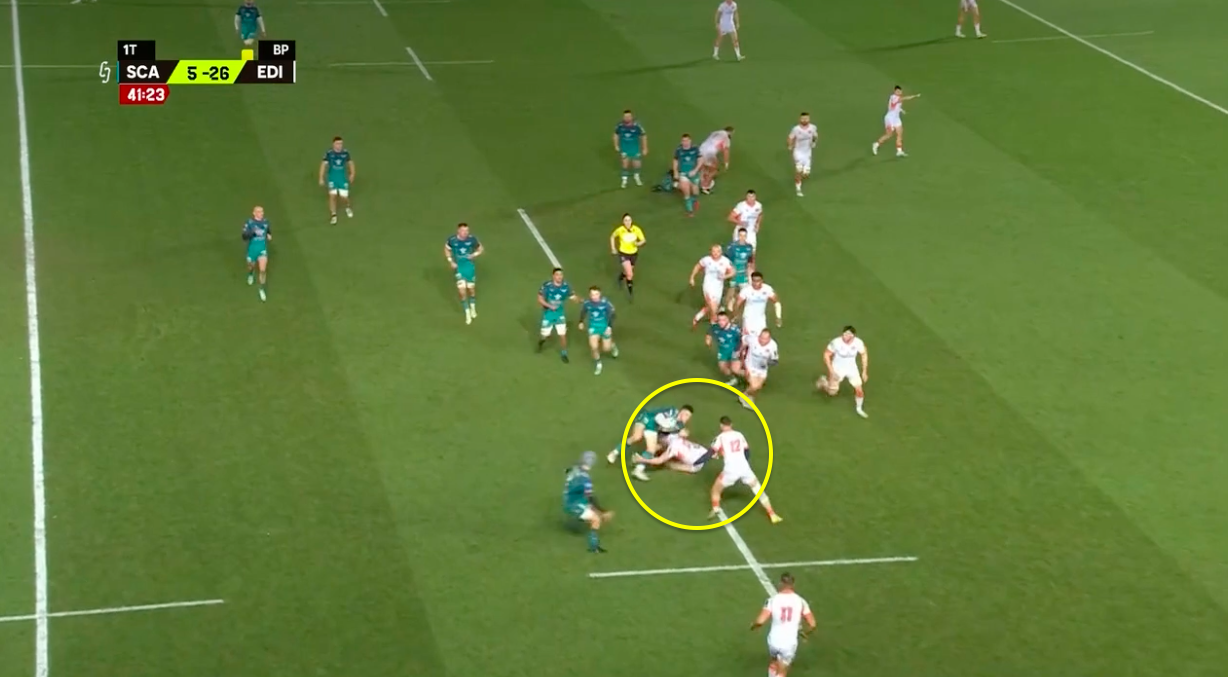
And that’s before the pressure you put on your forward runners to throw accurate 5m passes into the screen to maintain the depth that the Scarlets start with by default.
Needless to say, there are a tonne of opportunities for deep intercepts, long kick-throughs on dropped balls and turnovers in their second and third layer of attack on phase 4/5.
They kick slightly longer than they should too so not only do they play one kick for every 7/8 passes more often than not – which burns your team’s cardio to retain rucks – but when they do kick, they ask an awful lot of their wingers and midfielders to retain kicks that move around 31m on average. They are 15th in the URC for retained kicks which means that when they look to move the ball up the field through the boot, they give away far too many transitions directly.
So, for a team that’s playing on-ball rugby, they end up defending way more than they should do because they kick too long to manage the space. On-ball teams don’t want to defend for long periods without the ball, they want to defend with the ball in hand.
One of the other core parts of an on-ball team is having a scrum that can handle the excess knock-ons that come from your chosen style of play. Munster, for example, have faced the most scrums so far in the URC this season – an average of 7 per game. We concede a penalty on 32% of the scrums we take part in but that’s with the most amount of scrums in the tournament. The Bulls, the best scrum in the league, concede a penalty on 19% of their scrums which is elite-level stuff. For Munster to be at 32% while scrummaging the most while being down our two first-choice hookers and tighthead for much of the season is pretty good.
Scarlets concede a penalty on 60% of the scrums they engage in. Are you shocked that we’ve gone with our heaviest tighthead lock power forward to start, our best and heaviest scrummaging tighthead and the best scrummaging loosehead/hooker combination in Ireland to start? You shouldn’t be. It’s an area of weakness for the Scarlets that we can attack because if we play the way we usually do and they play the way they usually do, there’ll be plenty of opportunities to get at them.
