


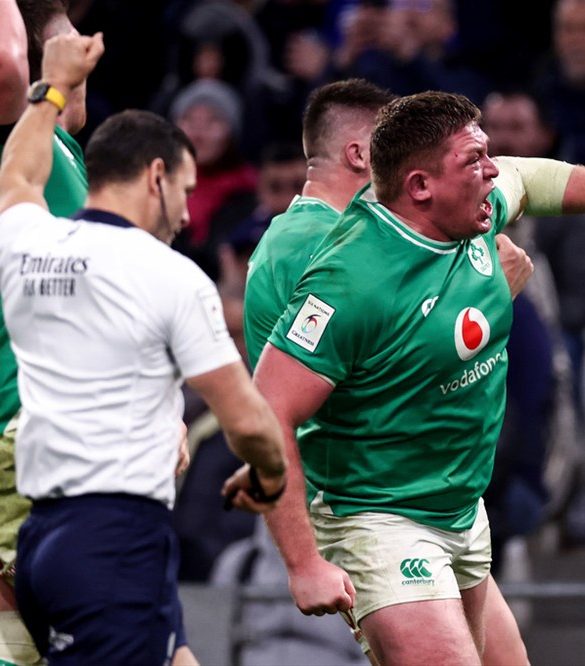
Ireland’s emphatic win over France in Marseille on Friday night – and it was emphatic – felt very much like hesitancy and anxiety encountering certainty.
The last time these two teams met, you could frame it as a battle between Antoine Dupont and Johnny Sexton, if you were that inclined. It would be reductive and dumb to write that, but you could start the story of Ireland vs France with that hook to the groans and eye rolls of the people who stumble across your content when all they wanted to know was what channel the game was on.
This season, Antoine Dupont is taking time off to play Sevens (SVNS?) so he can be eligible to play for France in the Paris Olympics and Johnny Sexton is retired. Maybe he’s making pots somewhere or taking meetings with marketing agencies on how to launch his craft cider business but he’s not playing rugby for Ireland in the Six Nations for the first time since the iPad was launched.
Two generational talismans missing, so who would feel it more? Before the game, I assumed it would be Ireland because of how much our game has evolved around what Sexton was good at. How do you replace Sexton in a system you could arguably call The Sexton System?
France’s system, by comparison, was quite simple. Heavy kick pressure off-ball rugby with a big lean on playing on kick transition. I thought France could run this without Dupont relatively easily.
But I was wrong.
In his absence, France looked like a team with a freshly amputated arm. They would look to throw the punches they usually do only to find a ghost limb in its place. Dupont, just like Sexton, is a system all of his own. He just lends France some of his attention for stuff like off-ball kicking sequences so he can do Antoine Dupont Stuff™ later on that wins you the game.
Without Dupont, France looked like a driver trying to mount a comeback in a race only to find the gearstick and steering wheel fell out the window a few laps before. Now, to be fair, we can’t disentangle their massive underperformance from Paul Willemse’s astonishing lack of discipline that saw him get two yellow cards (one upgraded to red but both could and should have been) either. Losing Dupont for the tournament is one thing but losing your tighthead lock eight minutes into the game for ten minutes only to lose him permanently fifteen minutes after he ran back onto the field is a result-killer.
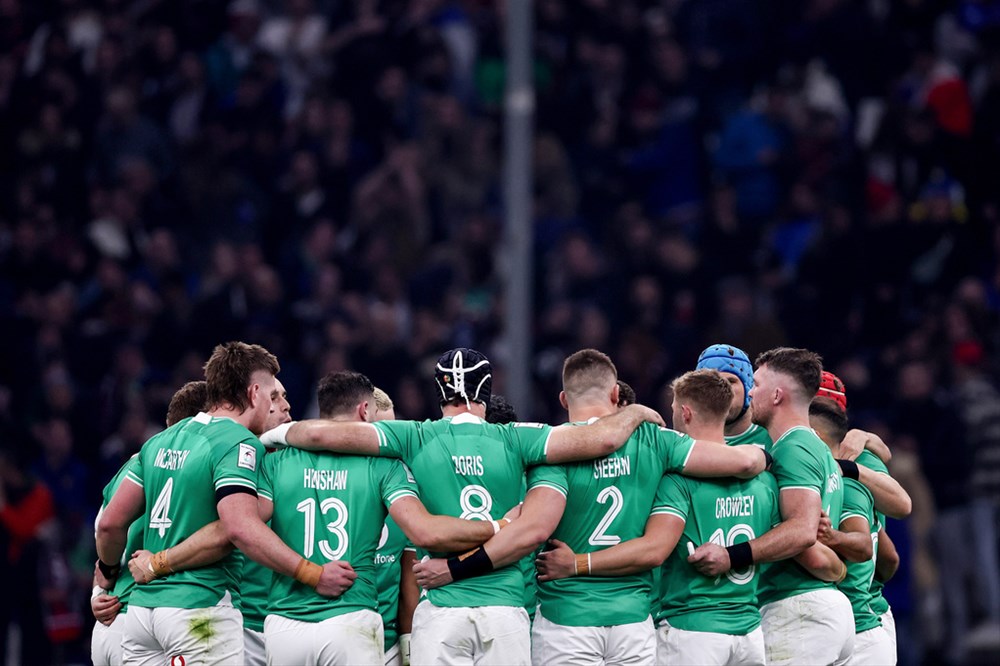
Ireland, on the other hand, should have been riven with uncertainty all things being equal, but they’re not all equal. This Irish team are a tight collective that knows exactly, to the footstep, what each individual should be doing at any given moment. This Borg-like rugby hive mind has its strengths (and weaknesses) but when it really works against a team playing badly, it can look like they’re playing a different sport.
Would three relatively new faces – with one of them sitting in the seat so used to Johnny Sexton you could nearly make a plaster cast of him out of it – disrupt this hive mind?
No.
Because We Are Borg.
***
Ireland’s offensive system is witheringly complex but there are a few key principles that you need to understand.
The first one is a factoid you’ll have probably heard quite a bit. Ireland plays beyond #10 more than any other team in the Six Nations. In this game, 32% of all our possessions moved through the #10 to other players. When you visualise this, you’re probably thinking that means Ireland spread the ball quite wide. You’d be right to think that. Ireland’s system is based on moving the ball away from tighter areas where we often give up size and power to opposition like France, England and South Africa.
As a result, our scrumhalf has to pass the ball quickly from the ruck but also pass it long. Against France at the weekend, Jamison Gibson Park passed the ball 77 times and, on average, he passed the ball 8m per pass at an average speed of 39 KM/h per pass (joint fastest of the weekend).
When we compare that to France, Maxime Lucu passed the ball 33 times for an average of 6.4m per pass at an average speed of 34.1 KM/h. Nolan La Garrec passed the ball 20 times for an average distance per pass of 7.2m and at an average speed of 33.1 KM/h.
So what does this tell us? That Gibson Park passed more times individually than both French scrum halves, that he passed further than them in total and on average and that he got the ball moving much, much quicker.
When we look at France’s Pass Per Carry rate – the number of passes relative to the number of times they carried into contact – we can see 1.27 passes for every one carry. This gives us a picture of France playing quite tight, on average. They had 50 passes fewer than Ireland but the number of passes they made that went shorter than 5m is 48% of their total passes.
For Ireland, 38% of our passes were 5m or shorter. A whopping 46% of our passes were in the mid-range between 5 and 10m in distance, which is only slightly less than the number of short passes France made in total. So Ireland passed more than France, passed more of those passes in the mid-range and when you read the number of passing metres in total (1051 metres to France’s 666 metres) know that this is the ball moving laterally.
Every time the ball moves, the defence must follow and with France down a tight forward – who’ll defend close to the ruck – it puts massive pressure on their other heavier forwards to literally cover the space that Ireland makes you defend. France’s heavier pack on average would be negatively affected by that anyway but when you add in Willemse’s red card, it stretches them to breaking point.
Look at this segment in the build-up to Nash’s try. The headline moment is Atonio falling over as he tries to tackle McCarthy after looking like he needed to lean on the previous ruck but how did it get that point?
On the very first sequence from Gibson Park to Crowley to Henshaw – Ireland move the ball around 30 metres. That’s already creating spatial pressure in that middle line of the French defence. This is where they keep their heaviest defenders so when you can pull that spacing open like this in the 45th minute, the pressure is seriously beginning to tell.
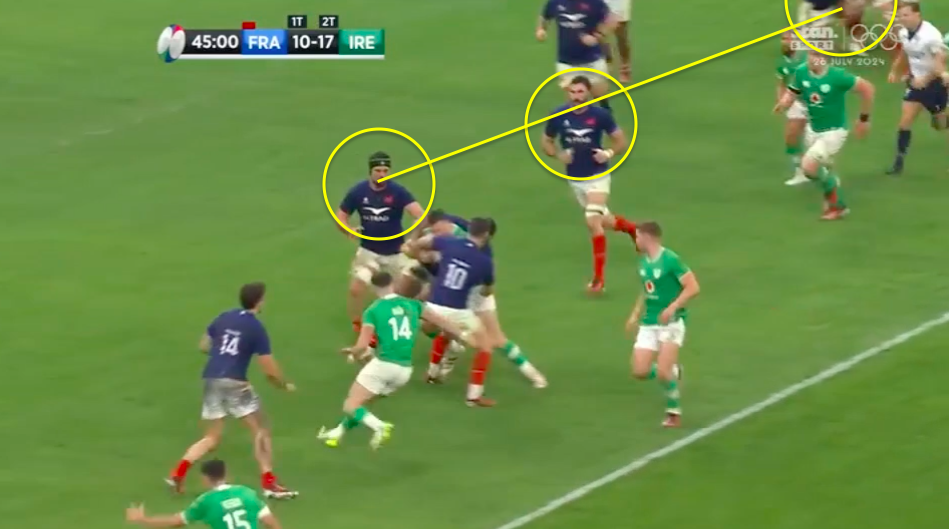
Five seconds later, Ireland have two French forwards pinned in the ruck, one forward getting up off the ground and a growing gap around Atonio who has way too much ground to cover.
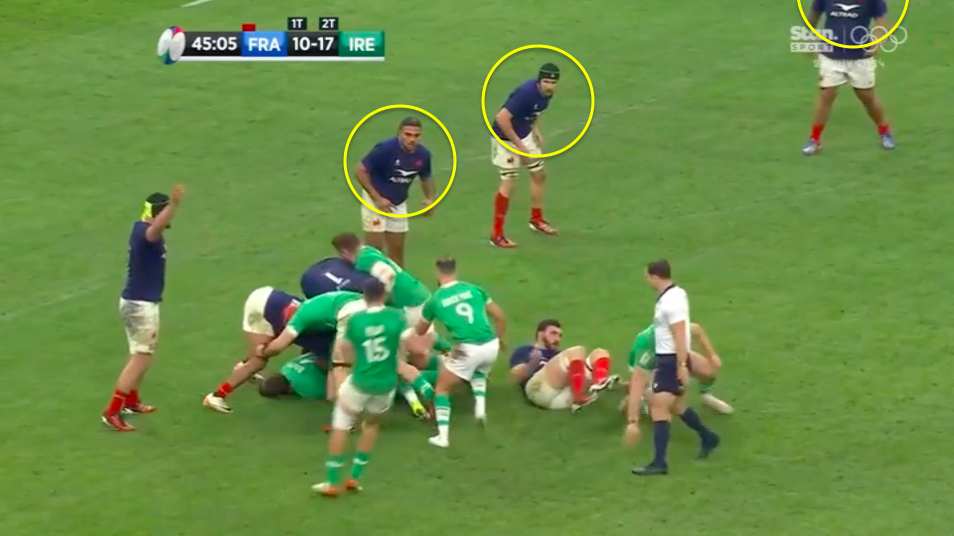
When Doris cut back towards the ruck on the next carry – Ireland does that a lot to preserve spacing like we’re seeing here – the gap around Atonio is even more pronounced. France flow to fill these spaces, of course, but the effort expended to close those gaps at speed has a cost.
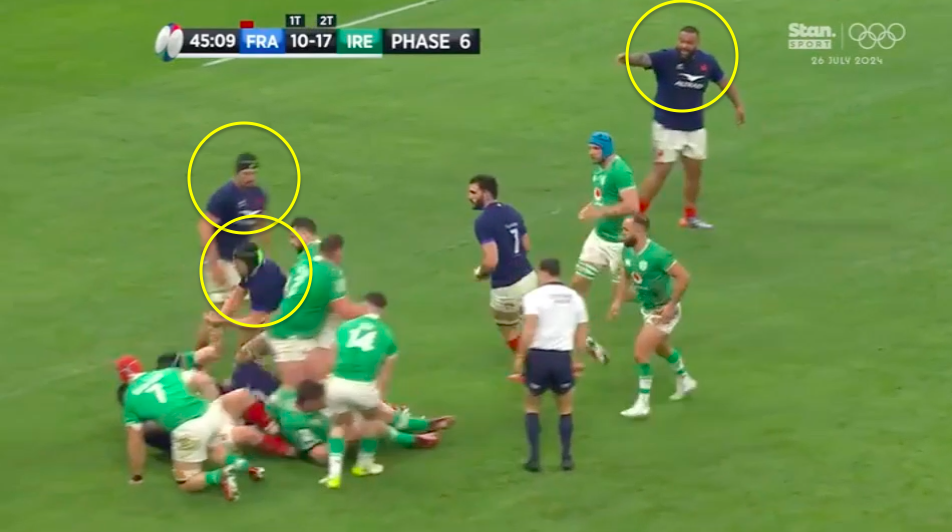
The killer passing sequence here is the next phase; I’ve cut it out here so you can see the distance, around 25m from JGP to Crowley to O’Mahony.
Ollivon and Aldritt are covering so much ground to keep the fold active that it locks Ramos in place behind the ruck to cover any snipes or late attack lines from deep by Nash/Lowe/Keenan.
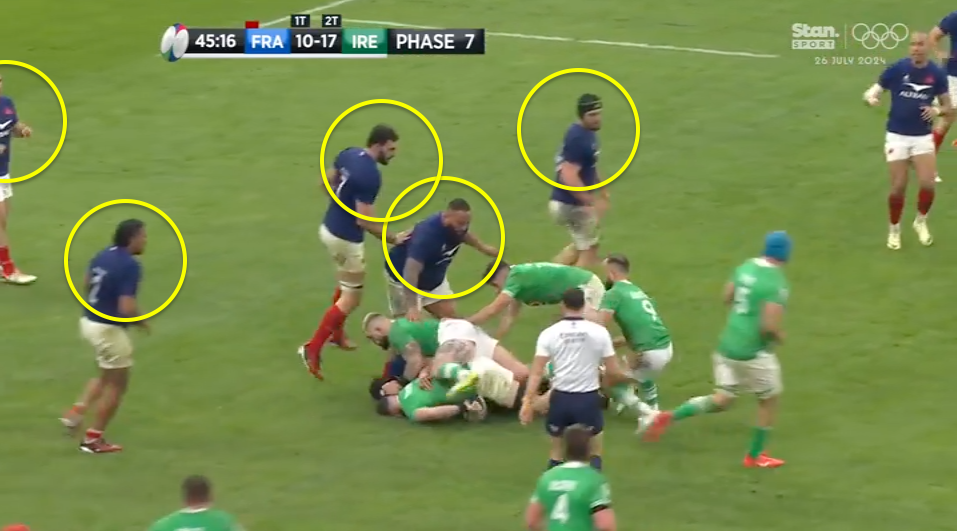
But that also affects the next phase after McCarthy bullocks past Atonio and Ollivon. Ireland used width again to stretch and break the French defence.
Those 20/30m sequences – all done within the 40m space between the 15m lines – draw the opposition out of shape and when they lose players to the wrong 15m edge space, Ireland have the pace of passing and comfort playing long to expose them.
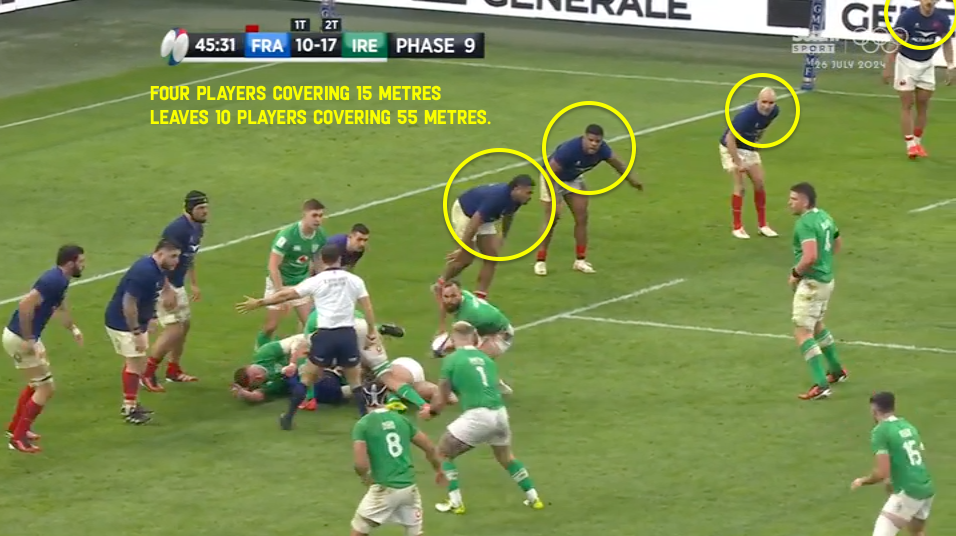
In general, the Irish #9 passes long while the Irish #10 keeps their passing range to between 5/7m on average with a premium being placed on accuracy and speed. As a general rule – and this follows on from Sexton’s time – the Irish flyhalf doesn’t have to throw long-range passes in this system. Unless the situation specifically calls for that as the only option, the Irish #10 specifically shouldn’t be making long-range passes if everything is working as it should.
Jack Crowley, just as an aside, passed the ball quicker than any other #10 in the Six Nations this weekend with an average ball speed of 33.1 KM/h. He had the joint highest pass distance by total (156 metres passed) but he was middle of the pack on average distance per pass (5.6m). This game was a good illustration of Jack Crowley running the system exactly as he should when it comes to what he does with the ball in hand while, at the same time, adding his touch to the established framework.
There’s only so much scope for experimentation, though, before you start going off scheme. However, I think Crowley knows that well and if he continues to play around with the system as we saw here he can nail down that #10 shirt in the long term.
***
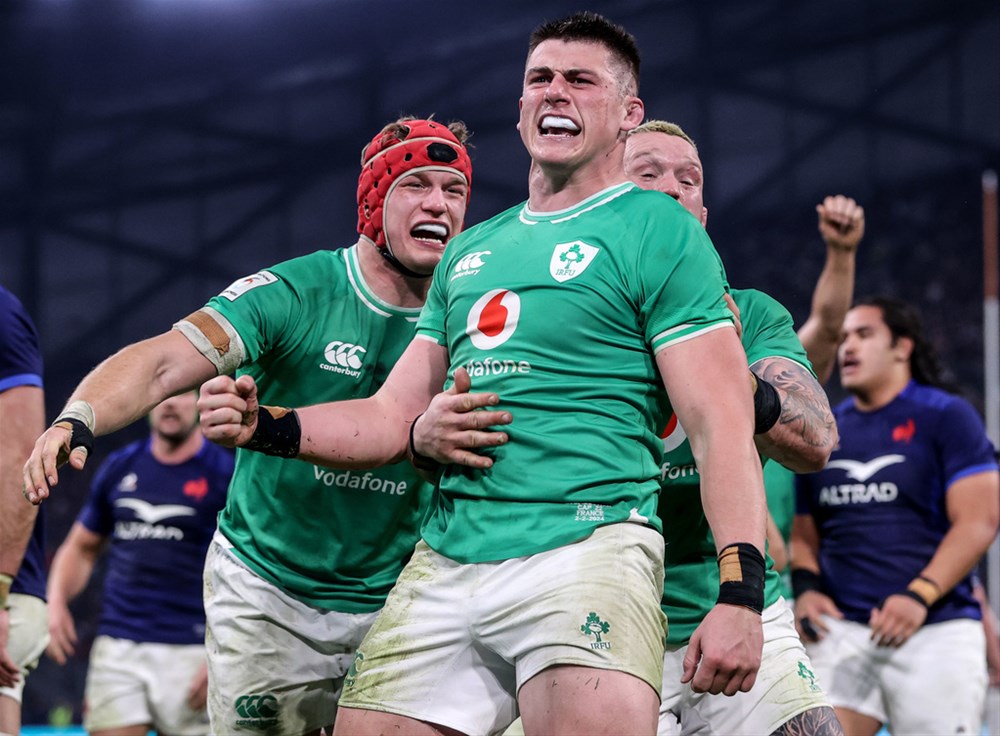
Ireland are the red-hot favourites to win this Six Nations. A Slam will be difficult, given how England look to be building as the kind of 0ff-ball team that typically gives us problems. Winning that one in Twickenham will be an achievement up there with this one.
Keeping the vibes going this week against a sticky-looking Italian side will be crucial to build on the momentum started here. That probably means sticking with more or less the same matchday 23 barring injury but that’s OK too. I think that if Andy Farrell can win a Slam while building in a new long-term starter at #10 for the first time since 2011 in Jack Crowley while also establishing Joe McCarthy as a new platform setter in the front five, he’ll look at that as being most of the heavy lifting done heading into a Lions year.
Make no mistake, even with France’s red card, this was a truly outstanding performance that showcases what this team can do against big, physical opposition. Remember it.
| Names | Rating |
|---|---|
| Andrew Porter | ★★★★ |
| Dan Sheehan | ★★★★ |
| Tadhg Furlong | ★★★★ |
| Joe McCarthy | ★★★★ |
| Tadhg Beirne | ★★★★★ |
| Peter O'Mahony | ★★★★ |
| Josh Van Der Flier | ★★★★ |
| Caelan Doris | ★★★★★ |
| Jamison Gibson Park | ★★★★ |
| Jack Crowley | ★★★★ |
| James Lowe | ★★★★ |
| Bundee Aki | ★★★★ |
| Robbie Henshaw | ★★★★ |
| Calvin Nash | ★★★★ |
| Hugo Keenan | ★★★★ |
| Ronan Kelleher | ★★★ |
| Cian Healy | ★★★ |
| Finlay Bealham | ★★★ |
| James Ryan | ★★★ |
| Ryan Baird | ★★★ |
| Jack Conan | ★★★ |
| Conor Murray | N/A |
| Ciaran Frawley | N/A |
