


The best thing about this December to January stretch of the season, the dreaded mid-block, is that it’s over.
Seven games. Two wins. One draw. Four losses by an average of just over a score. That average was inflated by a late try in the Sportsground, too, not that it matters. The L still feels the same.
All of the losses – bar the Leinster game – have the same flavour, too. Winning in the second half… right up until we weren’t. In the days since this loss, I’ve seen several outlets questioning why this is happening in a way that suggests it’s either unknowable or it’s the result of some nebulous leadership vacuum.
Of course, it is knowable. You just have to know what to look for.
First things first, this is the fourth game in the last two months that we’ve played in as good as a yellow weather warning for wind and rain. Bayonne, Leinster, Connacht and, this weekend, Northampton. This is important because it exposes two areas that we’re struggling with at the moment that are exaggerated in weather conditions like we experienced in Limerick on Saturday night.
Our tactical kicking game only works in fits and starts and is overly reliant on Casey and Crowley to execute.
Munster don’t kick very often or very far, on average. In the URC this season, for example, Munster are 14th in the league for kicks made and 15th for kick distance. Almost every other team kicks further and more often than we do. Munster’s kicks are usually either crossfield kicks into space or short/mid-range box kicks to advance the ball to a distance where we can contest in the air or get our jackal threats into the game on the phases right after the kick. We’re good at winning turnovers or forcing errors in these situations and that’s mostly why we kick in that way.
We’re a team who want to play with the ball so our kicking is designed to get it back immediately, but in a better position. Mostly, though, we decide to keep the ball in hand and when you see our other outside backs kicking, it’s either on one of the rare kicking exchanges that we don’t run back or it’s a stab down the field after a series of passes after a turnover. A lot of the kicking focus falls onto our #9 and #10.
Against Northampton, we definitely kicked more in the conditions but the execution was unpredictable and varied wildly in quality.
In the first half when we played with the wind, our box kick starters drifted 5/10 metres away from the target so Saints got a free transition without aerial or defensive pressure. When we chose to kick off #10, it felt a little reactive and was done from deep enough in our half to require an excellent kick to make it worthwhile.
Here’s a good example of that – a box kick feint that we slung to #10 but Zebo, who has to advance to put everyone onside, drifts away to the backfield after the kick so no one can advance.
A free transition for Northampton under zero pressure that didn’t move the chains for us in any tangible way.
With such a strong wind at our back, it felt like a wasted opportunity to pressure Saints deep in their half but, to be fair, they mopped up our poor kicks quite well, hung onto the ball well in the first 20 minutes and took their chances when they presented. We defended their phase play quite well but they caught us with this off a lineout – a massive latch and drive through #10 and #12 and then a bad fold by Niall Scannell.
That was the key score for the Saints in this game and gave them something to work with in the second half, regardless of what happened later.
When we did have decent field position, we were already behind and didn’t want to risk kicking the ball away during our first few phases of decent attacking momentum.
In the second half, Saints kicked way more freely in these advanced positions and essentially deprived us of any usable possession from 60 minutes on.
***
I probably have to speak about the red card.
Firstly, it was a red card in my opinion, and one of the clearest you’ll see of this genre. There is absolutely no accidental or bio-mechanical reason why Langdon’s right knee moves forward in the manner it did in this instance.
It’s a knee directly to a prone man’s head while his arms are pinned elsewhere. I’m sure that Langdon didn’t intend to knee Ahern in the face but if he had intended to, it would have looked identical to this so the officials were left with no option but to send him off.
Down to 14 men, Saints were sure to lose, right?
It seemed so when Munster scored a try from the resulting penalty but, no, it wouldn’t be that simple.
Firstly, they were only down to seven forwards for five minutes in the second half when they had to switch out their winger Sleightholme because of a scrum. Going down a winger only hurts you critically when you can’t cover the backfield or close the door on multi-pass phases that find the edge.
In these conditions – that Munster were kicking into – there was very little to worry about in the backfield, even though we didn’t test them as much as we might have.
It also made handling in a sequence incredibly difficult so it wasn’t about 14 vs 15, it was about Munster’s eight forwards vs Northampton’s eight and replacements.
This is the second problem I was speaking about; we had no bench impact to speak of.
Well, actually, let me qualify that – Brian Gleeson was freakishly impressive in his 40 minutes off the bench for Ahern – but he was the only man with the size and power we needed in these conditions that could have realistically shifted the momentum of this game.
If you subscribe at the €10 tier, you’ll have seen my article last week on Munster’s Offensive Ruck Work output and how you can see it degrade completely when the opposition makes their forward replacements between the 45th and 60th minutes during this run of games. I made it available to all tiers, so you can read it now if you haven’t.
When you map all the games over each other, you see the same dips after extended periods of on-ball action but you see a massive dip in the last 20 minutes when the opposition can make bench replacements with like for like, or close to it, forwards and we can’t.
This is where the injuries to Edogbo, Kleyn, Salanoa and Snyman bite hardest. With those tight power players fit and available, we could just about live with having minimal impact from our replacement front-row – more on that later – but without them, we always lose power relative to the opposition’s fresh forwards.
Essentially, our starting forwards have to play harder for longer and when their time on the field intersects with fresher, more powerful forwards, our breakdown slows down and loses efficiency while our scrum and lineout also degrade.
With just Edogbo, Kleyn and Snyman available we could deploy one of these heavyweight locks from the start and then replace our entire pack core with Snyman and, say, Edogbo, around the same time the opposition makes their changes. It wouldn’t be a guarantee of victory but would we see the same 45/60 minute collapse week after week after week?
I don’t think so.
Let’s have a look at our ORW totals first and then go from there.
Munster’s OFFENSIVE RUCK WORK SCORE VS Northampton
- A Dominant Clean is an action that decisively secures possession when the ball carrier takes contact. A Dominant Clean does not have to be the first arrival at the breakdown but it is rewarded in the context of effectiveness. We will assign this action 3 points.
- A Guard Action is where a player plays a role in helping to retain possession after we have “re-won” the ball on the floor. Sometimes this can happen on a carry/ruck point where there is no active contention by the opposition. Let’s assign this action 2 points.
- An Attendance can be anything from standing as a “kick shield” on a ruck to adding a bit of bulk to ward against a counter-ruck. I’m marking this down as being worth 1 point.
- An Ineffective Action is a blown cleanout, a lean, a breakdown penalty or an action that I couldn’t see any direct benefit for. This will be worth -2 points.
| Player | Dominant Clean | Guard Action | Attendance | Ineffective | Ruck Work Score |
|---|---|---|---|---|---|
| Loughman | 18 | 2 | 2 | 34 | |
| Scannell | 1 | 19 | 7 | 4 | 40 |
| Jager | 8 | 8 | 2 | 42 | |
| Ahern | 1 | 3 | 1 | 10 | |
| Beirne | 5 | 16 | 4 | 2 | 47 |
| O'Mahony | 2 | 9 | 6 | 5 | 20 |
| Hodnett | 1 | 12 | 27 | ||
| Coombes | 1 | 16 | 1 | 1 | 34 |
| Casey | 1 | 1 | 5 | ||
| Crowley | 6 | 12 | |||
| Daly | 2 | 11 | 1 | 26 | |
| Nankivell | 1 | 2 | 7 | ||
| Frisch | 1 | 9 | 1 | 19 | |
| Nash | 9 | 18 | |||
| Zebo | 2 | 1 | 2 | ||
| Clarke | 1 | 3 | -4 | ||
| Wycherley | 1 | 2 | 1 | 2 | |
| Ryan | 4 | 1 | 1 | 7 | |
| Gleeson | 3 | 7 | 1 | 21 | |
| Kendellen | 1 | 1 | 3 | ||
| Patterson | 0 | ||||
| Carbery | 0 | ||||
| O'Brien | 2 | -4 |
The first thing you notice is that we’re below 400 Combined ORW points which is not ideal for an on-ball team. This tells us that we didn’t have enough possession or didn’t win the ball back effectively enough.
The second thing you notice is that we left our starting front row on about as long as we possibly could. Jager’s numbers are unbelievably good for a tighthead prop and you can see why on this midfield clean off a lineout.
That’s remarkable for a 6’4″, 135kg prop.
Loughman and Scannell were troopers as well. Scannell had several ineffective entries but the sheer volume of entries kept him high up on the scale.
Beirne’s numbers are high, as you’d expect, along with Coombes. O’Mahony’s numbers are a good bit lower than his usual. The number of ineffective entries is an outlier for him but what was most concerning was that when he was in our Big Six across the middle of the park for the first three blocks of the game, he didn’t rack up the usual numbers.
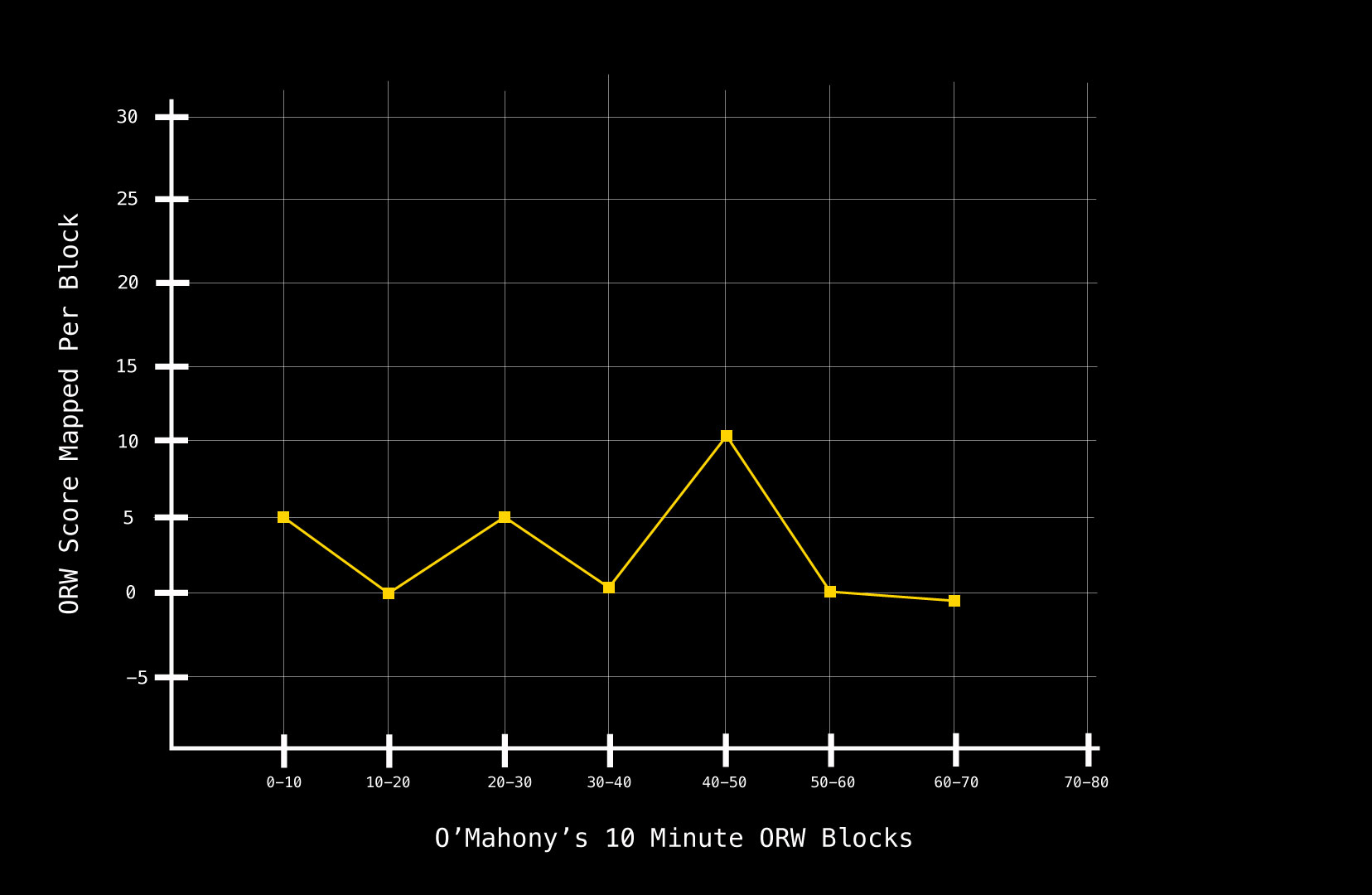
Having four blocks – 35 minutes, essentially – pass by without his usual breakdown involvements and some set-up carries where he got dominantly stopped, it was a poor performance overall, even allowing for his well-taken try in the corner. What worked on a dry day in Toulon didn’t work in a yellow weather warning in Limerick, ultimately, but that can be levied at a lot of players.
You only get a true picture of the game when you put the Combined Offensive Ruck Work scores together for each 10-minute block and then map them out.
What you see is probably the clearest example of Munster’s power drain yet.
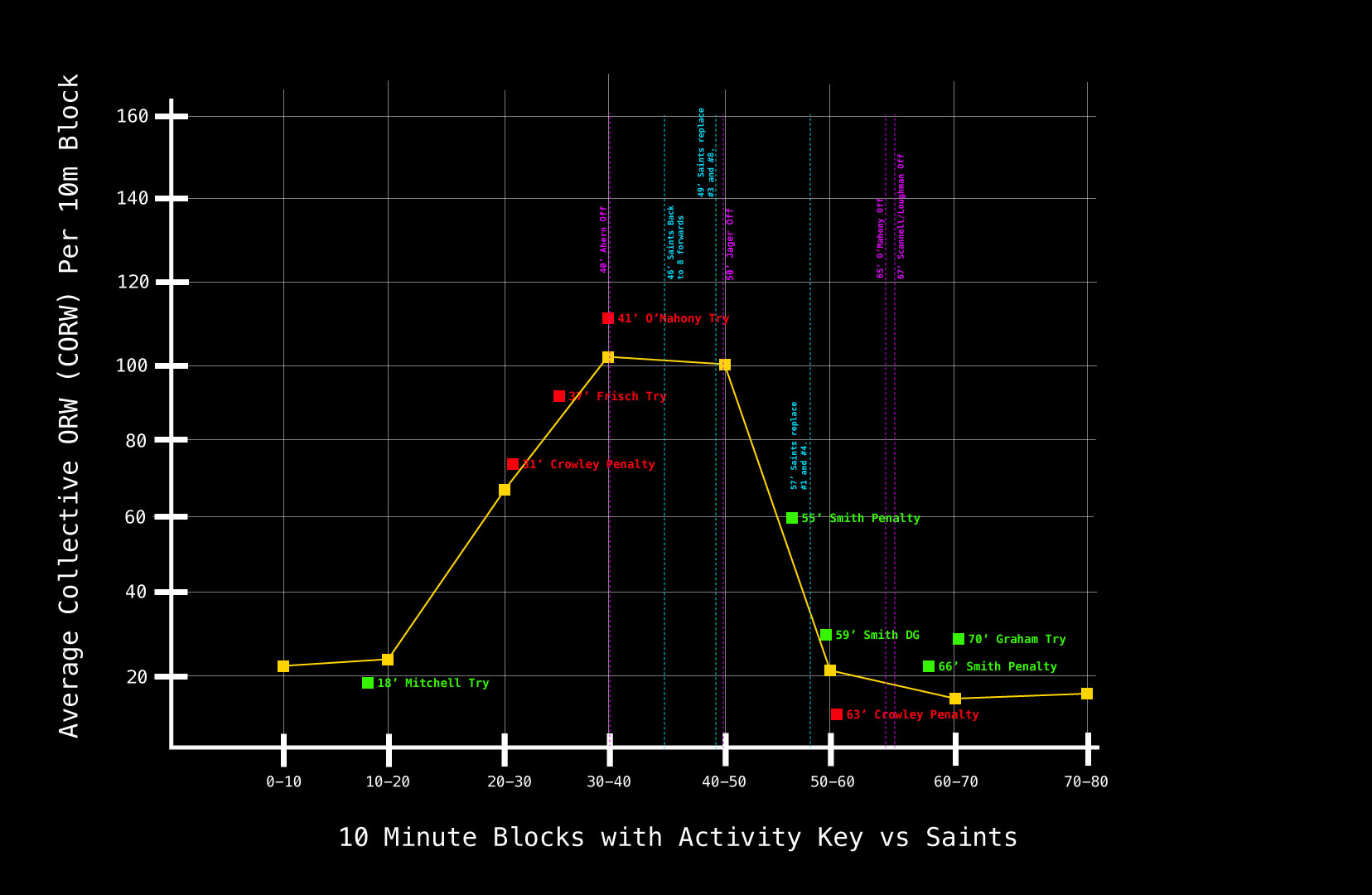
You can see our bad start – influenced by some poor kicking and Saints strong ball retention – across the first two ten-minute blocks but once we get a handle on the ball, our numbers skyrocket for three blocks in a row for a return of 15 points.
Once we pass through some key markers, however, you can see the drop-off. We lose Ahern, the CORW numbers drop slightly, we lose Jager and it plummets, especially in combination with Saints making all five of their forward replacements in the first 20 minutes of the second half.
We brought off O’Mahony on 65 minutes – the right call given he was likely injured at that point because he wasn’t producing anything worthwhile – and then Loughman/Scannell on 67 minutes.
Essentially, as the weather got to its worst between 55 and 80 minutes, our overextended and underpowered front five collapsed. We conceded key scrum penalties and maul try that will give us nightmares for weeks. We got a total of 5 ORW points from our replacement front row. Decent players – very good players in Ryan’s case – but when you combine them with Beirne and Coombes trudging through the last 20 minutes because of the intensity of their workload, we had no way of turning the momentum around when we needed it.
How did we lose a 10-point lead? Exactly like that. We didn’t control the ball, Saints pressured us really well and our lack of bench impact relative to theirs saw us wither as the game played out to its end. Until we can bring on power like-for-like against good teams – and Northampton are a very good team – this will keep happening. We’re good enough to generate leads against good teams (Bayonne, Exeter, Connacht and Northampton) but we don’t have the bench to see out wins against those good teams unless we manage a freak score out of nowhere to help us eat the clock with enough of a buffer to win the game.
We have a break now to refresh the minds, work on the issues that have hurt us and, most importantly, get some players back fit. Even the additions of Haley and Snyman would be game-changers at this stage.
I still feel that on a good track (or even just a decent track without a named winter storm in the vicinity) with just those two players fit and available, this Munster team can rattle any team in this competition.
But that’s just a feeling right now and a faraway one.
For now, the most important thing is rest and space.
| Name | Rating |
|---|---|
| Jeremy Loughman | ★★★ |
| Niall Scannell | ★★★★ |
| Oli Jager | ★★★★★ |
| Tom Ahern | ★★★ |
| Tadhg Beirne | ★★★ |
| Peter O'Mahony | ★★ |
| John Hodnett | ★★★★ |
| Gavin Coombes | ★★★ |
| Craig Casey | ★★★ |
| Jack Crowley | ★★ |
| Shane Daly | ★★ |
| Alex Nankivell | ★★★★ |
| Antoine Frisch | ★★★ |
| Calvin Nash | ★★★ |
| Simon Zebo | ★★ |
| Eoghan Clarke | ★★ |
| Josh Wycherley | ★★ |
| John Ryan | ★★★ |
| Brian Gleeson | ★★★ |
| Alex Kendellen | ★★ |
| Paddy Patterson | DNP |
| Joey Carbery | N/A |
| Sean O'Brien | ★★ |
