


Munster’s December was… tough.
Actually “tough” probably doesn’t even cut it when you consider Munster had four games in four weeks and it seemed like every game brought new knocks and injuries which meant Munster going ever deeper into our squad for the most important games of the mid-block of the season.
As I’ve written repeatedly on these pages, injuries – especially multiple injuries in one or two core positions – will hurt your ability to play at your best. Every December we know that you’ll be playing high-level games with the European Cup and then Leinster on St Stephen’s Day.
Sure, you’ll still field 23 players every week but as injuries pile up you start to go down to second-choice guys, third-choice, and fourth-choice in some cases, and the performance levels start to drop. It can’t not. Against Connacht on New Year’s Day – coming in January’s ORW round-up – Munster were down to the fourth and fifth-choice senior hookers.
There’s a reason your top players are your top players and effective depth only covers a few well-distributed injuries, not seven injuries in your Category A pack and replacements.
The interesting thing is that we can see the impact of this lack of depth showing up in the ORW scoring in 10-minute blocks. Here’s our graph from December.
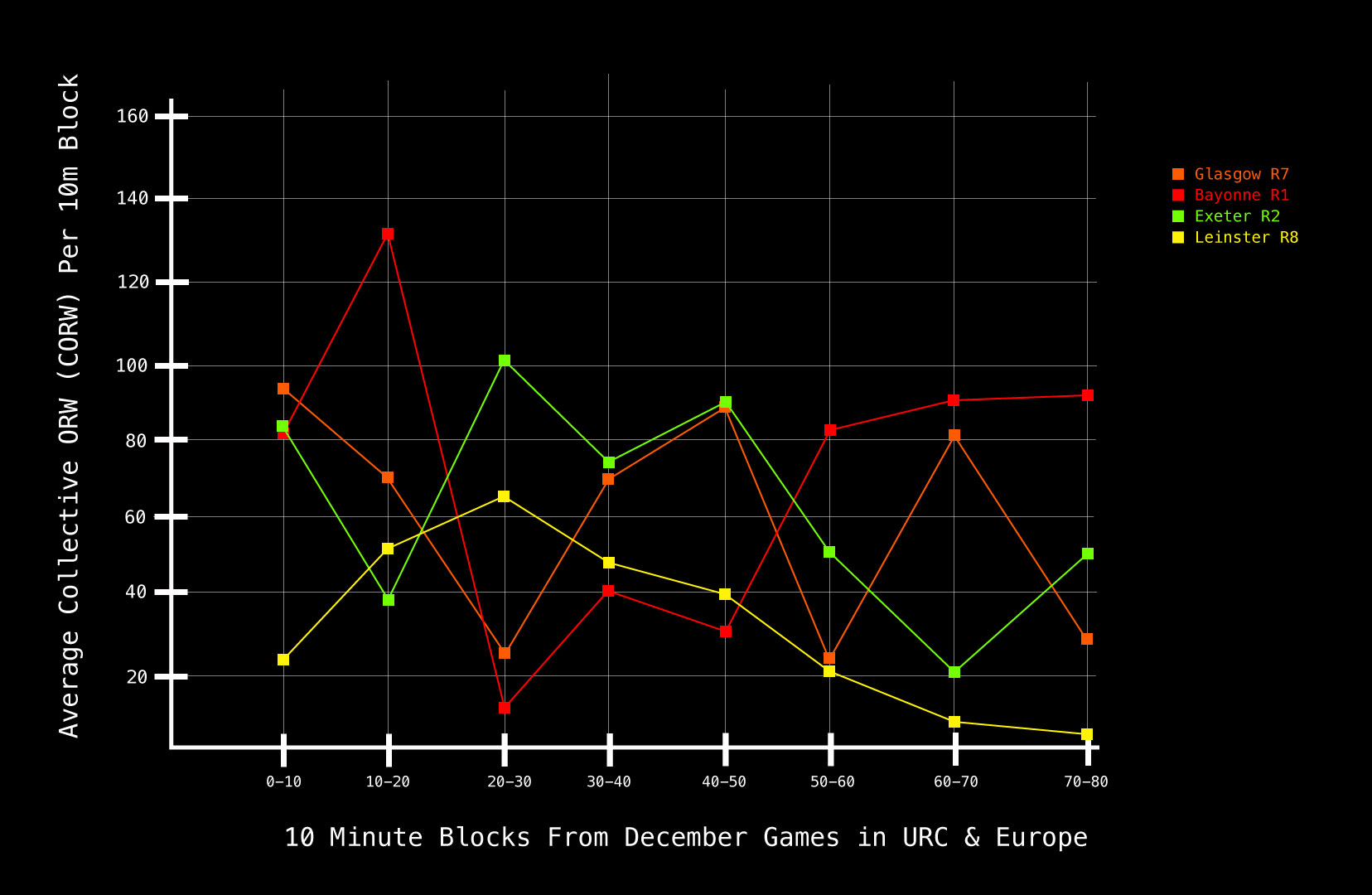
If the first six games were notable for Munster’s Big Finish in the last 10 minutes of games, this next block was notable for almost the exact opposite.
Let’s have a look at some interesting trends;
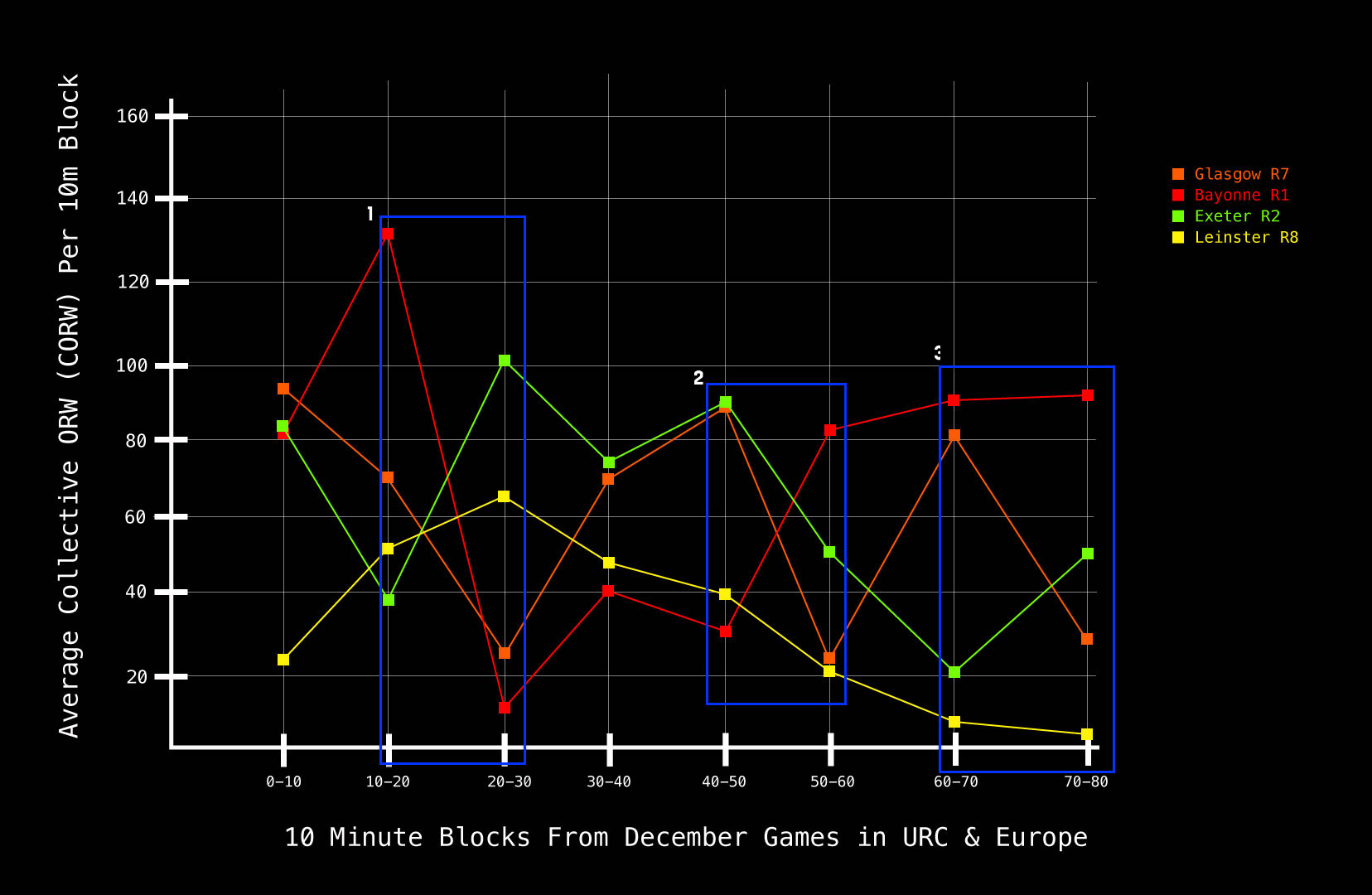
Box 1: After a good start in almost all the games (75%) we’re seeing a dip in the next two blocks or, if the line holds, the dip comes in the block right after. What does this tell us? That Munster’s playstyle is physically demanding so, after a period of high exertion ORW scoring, we tend to fall back to a more passive state.
Some of these low-scoring dips in ORW scoring are a direct result of blown lineouts at a rate that increased in frequency as the month progressed. As our injuries at hooker and in the second row piled up, our ability to use the lineout as a starter play for long ORW sequences decreased with every injury.
Box 2: In every game bar Bayonne, we suffered a massive drop in ORW output after the 50th minute, where all of our opponents made mass replacements in the forward pack that we couldn’t match. As a result, our ability to hang onto the ball began to decrease incrementally for the next 10/20 minutes.
Box 3: In the last 10 minutes we’re typically quite strong in our ability to retain the ball, build phase pressure and, as a result, rack up big ORW scores. I think we’ve tried to supercharge that Big Finish in these four games by making a lot of pack replacements in literally the last 10 minutes to match up our freshest forwards against what we hope will be a tiring opposition. It hasn’t worked but the logic is sound.
The Glasgow game looks like an outlier here but it’s a little deceiving – the ORW racked up in that 10-minute block game from one sequence where we scored a decisive try.
That Exeter line shows the complete collapse from 55 minutes on pretty starkly. We had no possession and, as a result, conceded 14 points. The ORW increase you see in the last 10 minutes was Munster desperately trying to get back into the game before an intercept killed it off.
Bayonne was somewhat similar in that our ORW there was almost all in the last five minutes as we pushed for a drop-goal winner. The games against Glasgow and Leinster are fairer reflections of our inability to control the ruck – and the ball – in the last 10 minutes of these games.
When you don’t have a full roster of power and quality to bring off the bench around that 50-minute mark, the opposition overwhelms you. The Connacht game will show the same trend. This is almost entirely down to injuries. Instead of replacing Jean Kleyn on 50 minutes with RG Snyman, we’re keeping the likes of Beirne and Coombes on for a full 80 minutes.
Interesting Notes
Here are some of the bits that stood out to me week to week in these four games when it came down to the individual ORW scoring.
Munster’s Fullback Roleset
One thing is for certain, Munster’s overall attacking potency works a lot better when the fullback is Mike Haley or Shane Daly. Daly is probably the closest player we have to Haley’s role set and it’s most apparent at the breakdown.
Having a fullback who is breakdown-dominant in this system is hugely important for our overall ball retention but it’s got a hidden benefit – it keeps Jack Crowley out of the breakdown.
When Nash and Zebo played at fullback in these four games, Crowley’s ORW score was 18 on average on 18 entries across two games.
That’s 18 phases that our flyhalf isn’t involved in. In both games, Nash and Zebo scored a combined ORW total of five.
When Daly played at fullback, he averaged an ORW score of 24.5 in both games and Crowley only had to enter nine rucks. Essentially, when Daly plays fullback, Crowley gets on ball more often.
Power vs Ball Retention
When Coombes moved up to the second row we only saw a small drop in his ORW production. He averaged an ORW score of 34 points per game when he played in the second row from the start as compared to 40.5 when he started at #8.
He carried the ball an average of 10.5 games per game in the second row as compared to 14.5 at #8 but that drop is explained by the extra responsibilities he has as a core lineout lifter on shorter schemes and the scrummaging load he has to take on.
When Jack O’Donoghue slotted in at #8 he matched Coombes ORW output quite well – an average of 39.5 across the two games in December – but he didn’t bring the same weight in the carry, not by a long shot.
One of the clear advantages of Munster’s system at full strength is that you have Coombes and Snyman as a two-way threat with massive ORW output from the other lock and your front row. It allows you to bounce between the 15m lines through multiple phases.
This allows Ahern and Hodnett as the edge forwards to be more threatening as they are often running into open ground or finding mismatches against backs.
One thing shows up for me again and again on these charts – we badly need a power winger to advance the ball on the edges. Nash is typically our least involved ORW scorer in the backline when he plays on the wing. Our #11 typically has a pretty high usage at the offensive breakdown – O’Brien and Daly in particular – but neither are particularly threatening as compressors in those edge spaces. Sure, Ahern helps in his new role but this team looks like it could do with a Nandolo-type heavyweight winger sooner rather than later to release the pressure on our middle block carriers.
Jager is the Guy/ Front Row Mixed Bag
Everything we assumed about Jager in open play has turned out to be the truth. His breakdown work is incredibly powerful and he mixes that up with strong, physical carries of his own. He’s already a core part of this team and, when we can pack size behind him, he will look world-class.
Archer’s breakdown work has actually been really strong over these four games but his ball-carrying and scrummaging seem to have gone backwards. Buckley and Clarke have been willing deputies at the breakdown in their appearances with strong numbers in the 20s off the bench and a decent outing from Buckley against Bayonne. Unfortunately, both have been let down – Buckley in particular – by their lineout throwing.
Barron’s ORW numbers are at an elite level and it’s at the point where he’s establishing himself as a top-class ball-retaining hooker in open play with a decent lineout game that should improve with better options.
