


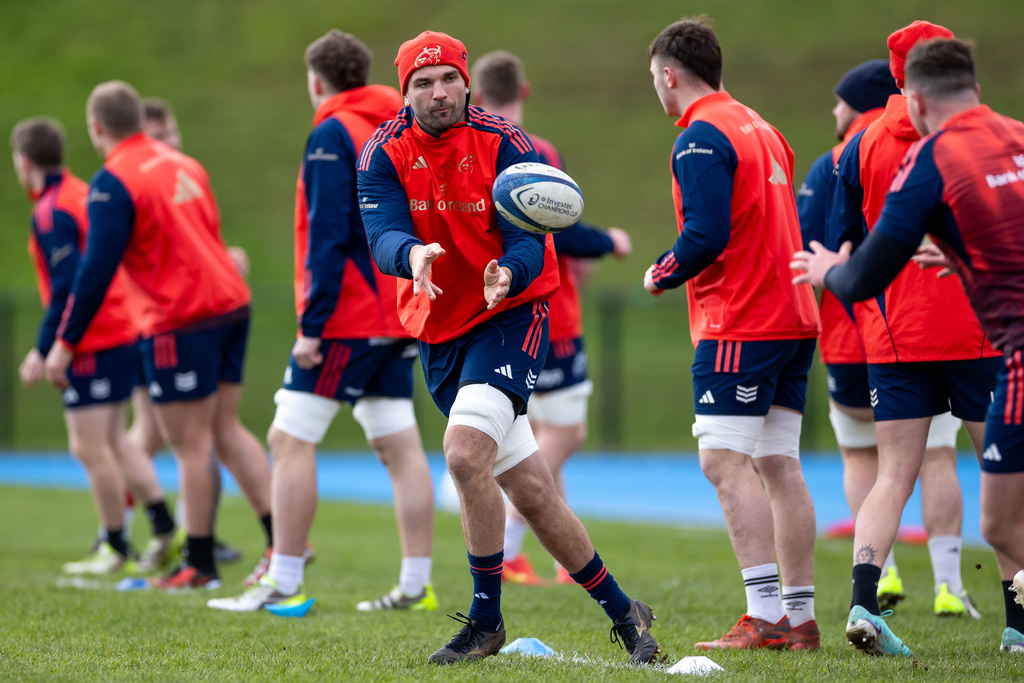
Given the vibe shock of the last two rounds of the Champions Cup, it would be pretty easy to conclude that Munster’s European season was on life support. It is – kinda – but the more practical approach is to accept that four teams qualify from this six-team pool. Three points from two games at the start of this four-game series is not a killer. It’s disappointing, of course, and makes a home Round 16 fixture very difficult to achieve, but it’s far from a fatal position as far as qualifying is concerned.
We’re only a point behind Glasgow in third – we’re in fifth – and all of the teams currently ahead of us play each other in this round. In an ideal world, Northampton and Exeter would both win this weekend (against Bayonne and Glasgow) which would open up a pocket for us to shoot in behind them on the last day depending on how this weekend goes against Toulon. Of course, if Munster were to win the next two games with a bonus point, that would make things very simple but this is Munster we’re talking about.
It’ll be the Hard Way, and that’s that.
Long story short, we need five points at least from the next two games to be sure of going through to the knockouts. Five points means we get a dog of an away draw, six to eight points gets us slightly better, and ten points might sneak us a home draw. Four points or less and we’re in danger of dropping into the Challenge Cup or, depending on how this game goes, being out of Europe altogether.
The last time that happened was back in 2015/16 – a disastrous season also derailed by injuries (to Bleyendaal, O’Mahony, Ryan and O’Donnell) along with the departure of O’Connell – so the threat looming in the background is something the HPC is well aware of.
Munster have been unfortunate – to comically understate it – with an unprecedented and historic raft of injuries to core players. I’ve been over all that before. Unfortunately, that doesn’t put an asterisk next to the winless streak we’ve been on since the 1st of December 2023. The reality is that, injuries or not, results have nosedived and, if that continues for the rest of January, we will be out of Europe when it’s never been easier to be in Europe come the Spring.
It’s beyond time to turn it around.
Munster: 15. Simon Zebo; 14. Calvin Nash, 13. Antoine Frisch, 12. Alex Nankivell, 11. Shane Daly; 10. Jack Crowley, 9. Craig Casey; 1. Jeremy Loughman, 2. Niall Scannell, 3. John Ryan; 4. Tom Ahern, 5. Tadhg Beirne (C); 6. Peter O’Mahony, 7. John Hodnett, 8. Gavin Coombes.
Replacements: 16. Eoghan Clarke, 17. Josh Wycherley, 18. Stephen Archer, 19. Brian Gleeson, 20. Alex Kendellen, 21. Conor Murray, 22. Joey Carbery, 23. Seán O’Brien.
Toulon: 15. Melvyn Jaminet; 14. Jiuta Wainiqolo, 13. Waisea Nayacalevu, 12. Duncan Paia’aua, 11. Leicester Fainga’anuku, 10. Dan Biggar, 9. Ben White; 1. Danny Priso, 2. Christian Tolofua, 3. Kieran Brookes, 4. Matthias Halagahu, 5. Dave Ribbans, 6. Cornell Du Preez, 7. Selevasio Tolofua, 8. Facundo Isa
Replacements: 16. Jack Singleton, 17. Bruce Devaux, 18. Beka Gigashvili, 19. Brian Alainu’uese, 20. Jules Coulon, 21. Jules Danglot, 22. Jeremy Sinzelle, 23. Seta Tuicuvu
Toulon have looked a lot like ourselves over the last few months. They’ve lost both their opening games, suffered injuries to important players (Dan Biggar, essentially, and now Charles Ollivon) and they’ve had a misfiring lineout/scrum at different points in both the TOP14 and in this tournament.
Since December, their lineout has fluctuated almost as badly as ours has but one thing they can always come back to is their size and power in the front five, midfield and wings. The addition of Melvyn Jaminet this season from Toulouse has given them rock-solid backfield coverage as well as an automatic goal kicker.
Their size and power in the front five, in particular, means that we do not want to be enduring multiple scrums in the Mayol regardless of the put-in because they’ve got one of the best prop rotations in France at the moment. They are a super-heavyweight team and that comes with massive advantages – ball retention, scrummaging and mauling – but it comes at a drawback of their defensive coverage on multi-phase possession and their ability to finish out games, even with a decent bench rotation.
From a style perspective, they play with around three passes per kick and with a Pass-Per-Carry ratio of 1.2/1.3. They aren’t really a counter-transition team – too heavy in the pack to play that style – so the kicking they do is mostly in the short to mid-range to punish you with that big pack in defence. They will have a sniff with their phase play too, but mostly from around your 10m line. They aren’t a truck-the-ball off #9 team either, at least not most of the time, even if they have the size and power to play that way.
I’ve noticed something interesting about their defensive structure off the lineout – the positioning of their #10 and inside winger Gabin Villiere.
Here are two screenshots from their two games in the European Cup to date on deep-lying lineouts against Northampton and Exeter.
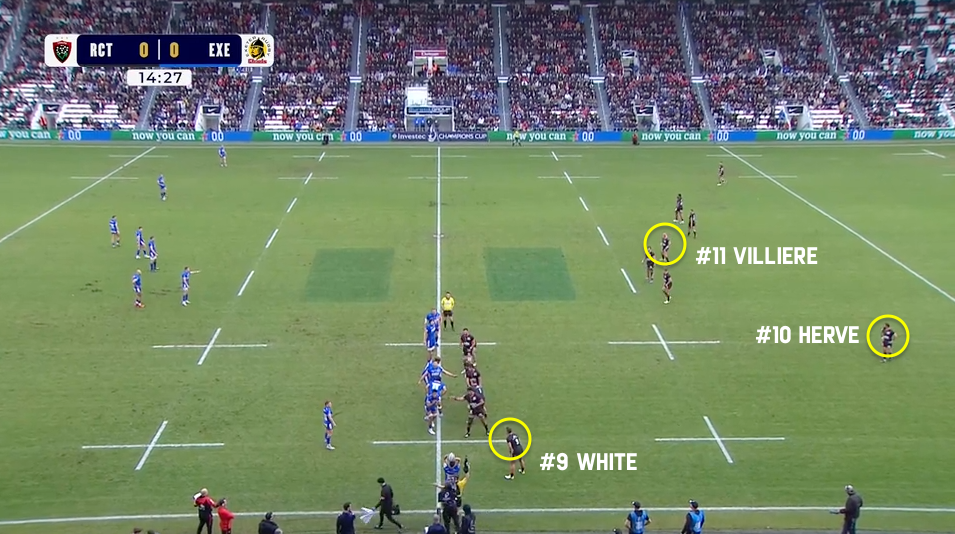
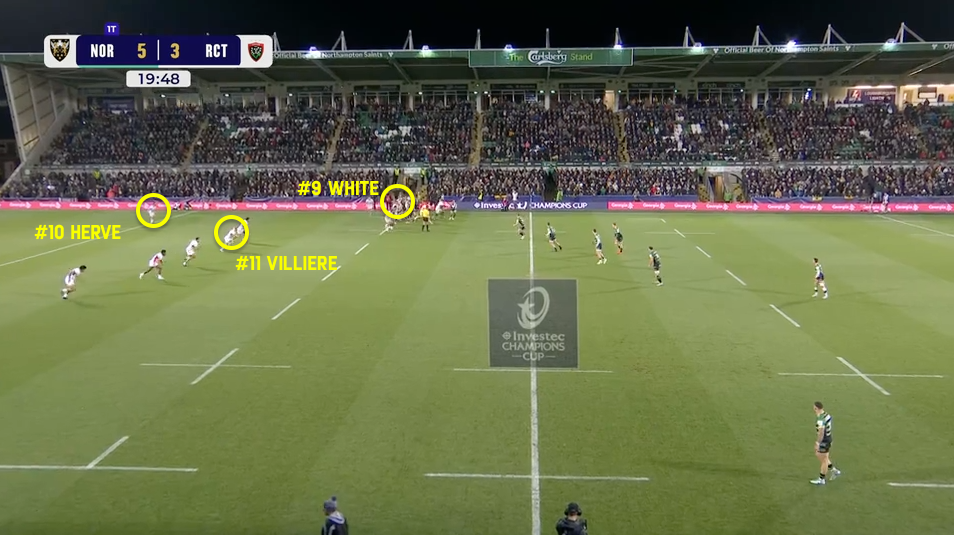
So what are you looking at? Toulon put their scrumhalf, Ben White, in the 5m channel on these lineouts, move their #10 to the back pin cover spot (away from the traditional spot in the line) and put Gabin Villiere, their left winger, in that spot alongside their hooker and one of their flankers.
I think this is a set structure they use because when Baptiste Serin replaced Ben White against Exeter but later got injured, their #10 Herve replaced Serin at #9 and Jaminet went to #10.
Look at how they set up on a late Exeter lineout;
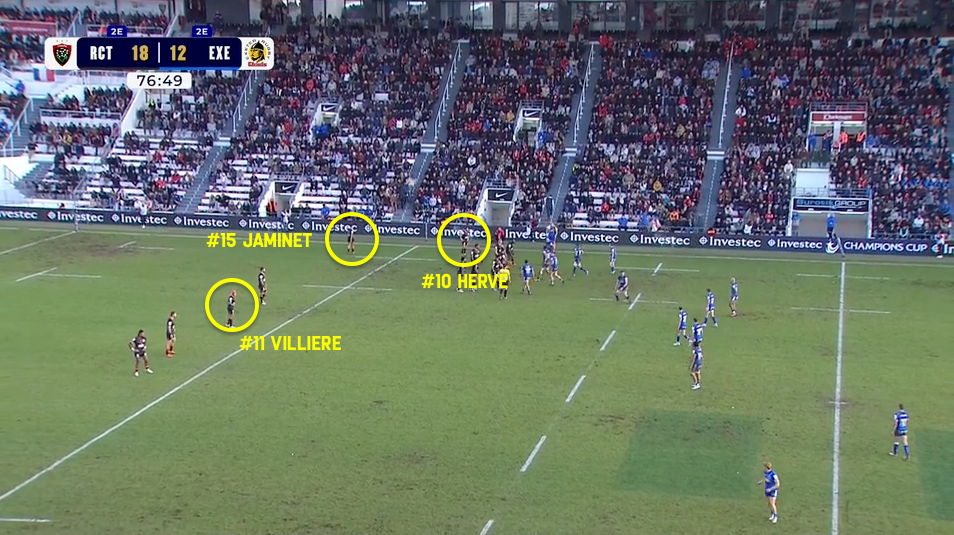
They use this structure to keep the #10 – Herve in this instance, later Jaminet and normally Biggar – out of heavy traffic off the lineout and I imagine they’ll do the same here. Villiere is an incredibly quick and strong defender for his size, as well as a dangerous defensive breakdown operator. He can and will win breakdown penalties but, at the very least, he will slow down your ruck progression off these lineout positions.
They also love the cover Villiere gives them with their ageing core of senior midfielders alongside, in an ideal world, Dan Biggar. Sinzelle and Nayacalevu, who they started against Saints in the last rounds, are both heading towards their mid-30s and you can see how Villiere covers for their lack of adjustment here.
But moving Villiere means that they don’t have a natural winger covering their touchline tail of the defensive line once you transition into post-launch phase play, at least for two or three phases. They cover for this – and their aggressive blitz off the set piece – by having their #10 and #9 drift infield after the launch to cover the space behind the defensive line but they have to be careful.
What do you see here?
I see massive space in the space their #10 and #9 leave behind when they have to drift across to cover the chip.
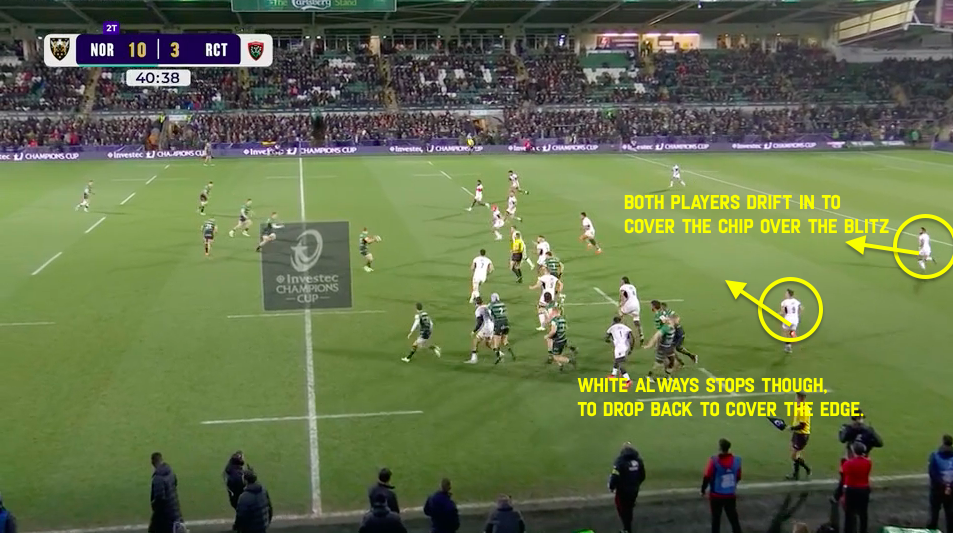
Now, White always drops back after the first phase plays out to cover the edge and the back pin but what if we lined up someone like Ahern on that wing and targeted White in the air with a crossfield kick?
Exeter accidentally stumbled onto that scheme with a box kick that almost produced an indirect try.
Look at that spacing on White’s side as the box kick launched.
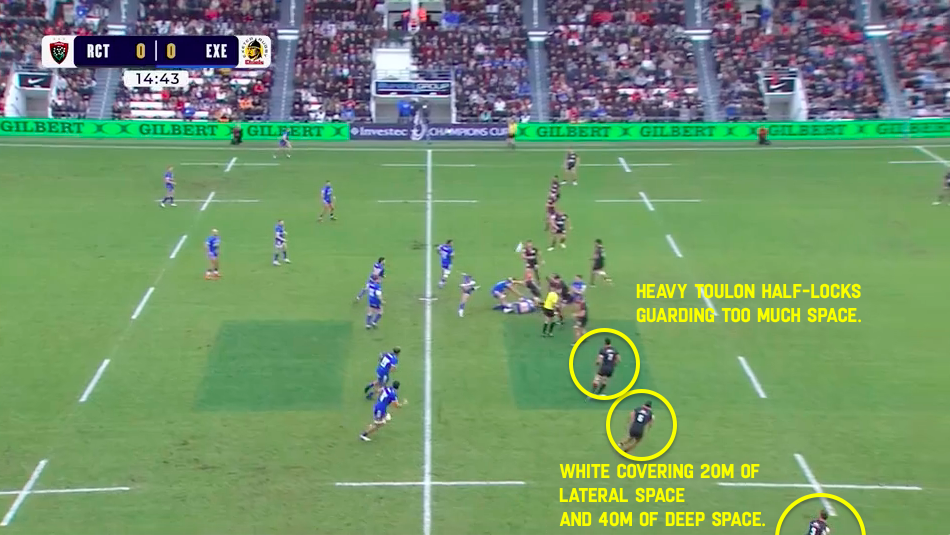
We can get at this space repeatedly if the lineout functions and we can engage Toulon in the middle of the field to the point that we draw their front five in and compress their centres.
In a way, Villiere doesn’t matter. If he isn’t playing, the guys they have to replace him either aren’t as good in the air or as good positionally. All that matters is that Toulon keep White and Biggar out of heavy traffic in that back space behind the lineout. If they are, that isolation on their scrumhalf will be there all game on these lineout platforms.
