


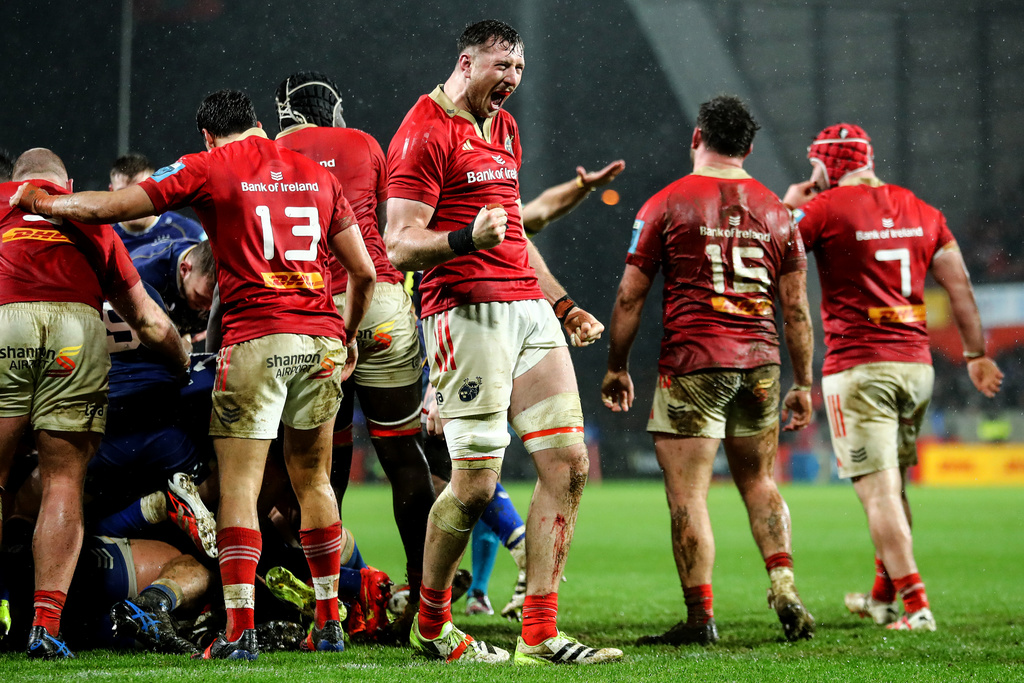
On the one hand, Munster didn’t really deserve to win this game.
Our kicking wasn’t accurate enough in conditions you wouldn’t put a rat out into and, when we did get chances, we couldn’t take them. In addition to this, our general lack of size meant that, in slugfest conditions, we were always playing uphill. Essentially, we hurt Leinster in the Aviva Stadium with the high PPC offensive structure we’ve been building for the last 18 months. The weather in this game made that rugby impossible so, as it often does around this time of year, it comes back to the old classics; size and power. Do you have it? And, if you do, do you have enough of it?
Right now Munster do not.
When you can barely pass the ball twice between rucks, rugby becomes less about skill and more about physics. How easily can you progress the ball up the field and how much energy does it take to retain it? Leinster had the size and quality to manage retention and relatively simple progression. To counter this, we needed to kick well but we didn’t. It was almost as if we thought we could play out of the conditions before realising that was impossible.
Some of that was bad luck. This, for example, was a really good example of what we should have been doing more of in the first half when the rain and wind were blowing diagonally across the pitch from bottom right to top left as you’re watching it here.
This is just an unlucky bounce.
But I felt our kicking as the first half progressed got tougher as the half went on – primarily as we were kicking off #9. The wind in Thomond Park is legendary at this stage for its unpredictability but even with this, I felt like we kicked as if we were the away team at times.
I feel that Casey should have kicked less and Crowley a little more in these periods but the conditions made slinging a long pass back for an exit just as dangerous so maybe it’s a case of picking your poison. Leinster didn’t necessarily kick better, either – because, to be clear, underfoot and wind conditions were almost impossible to navigate – but they did kick more often.
We played a little bit too much rugby in our half and it cost us in the one or two moments that decide games like this.
Nothing about this is “wrong” if we look at the decision in the moment. Play another phase, maybe isolate Ahern on Ringrose at the edge, maybe set up for a high bomb exit but it becomes a bad decision – again, in hindsight – once O’Donoghue can’t get his knee to the deck and McCarthy can scrag through on him which exposes the ball for the penalty turnover. Yes, it’s technically a maul so McCarthy collapses it, but we allowed ourselves to be vulnerable in a dangerous area of the field.
Ultimately, this was three points to Leinster in a game we lost by six.
Small moments, big outcomes. I suppose the lesson to take from this is that you just have to kick those possessions in your half. We played 64% of our possessions in our half. Leinster only played 35% of their possessions in their half. When it comes down to it, that’s the winning and losing of this game in these conditions.
***
The most fascinating thing about this contest was, without question, the battle in the scrum.
Before his move, Oli Jager’s scrummaging was something that was a bit of a question mark. Super Rugby Pacific isn’t noted as a scrummaging hotbed – rightly or wrongly – so Jager’s bona fides as a tighthead scrummager were under suspicion. On the evidence of this, they shouldn’t be; not anymore.
Andrew Porter is a deeply flawed scrummager, in my opinion, but he is really good at simulating the appearance of dominance. This scrum is a good example;
Ala’alatoa drives in on Kilcoyne and Barron – I think this is where Barron gets hurt, actually – with the referee watching Leinster’s loosehead side, which happens a lot these days given the focus opposition teams put on Porter in the scrum. The assistant referee is in a weird spot and can’t really look at the action side-on.
When Barron and Kilcoyne dip under diagonal pressure from Ala’alatoa, Porter and Kelleher go with them. Watch Porter arch his back and pull Jager down to his knee.
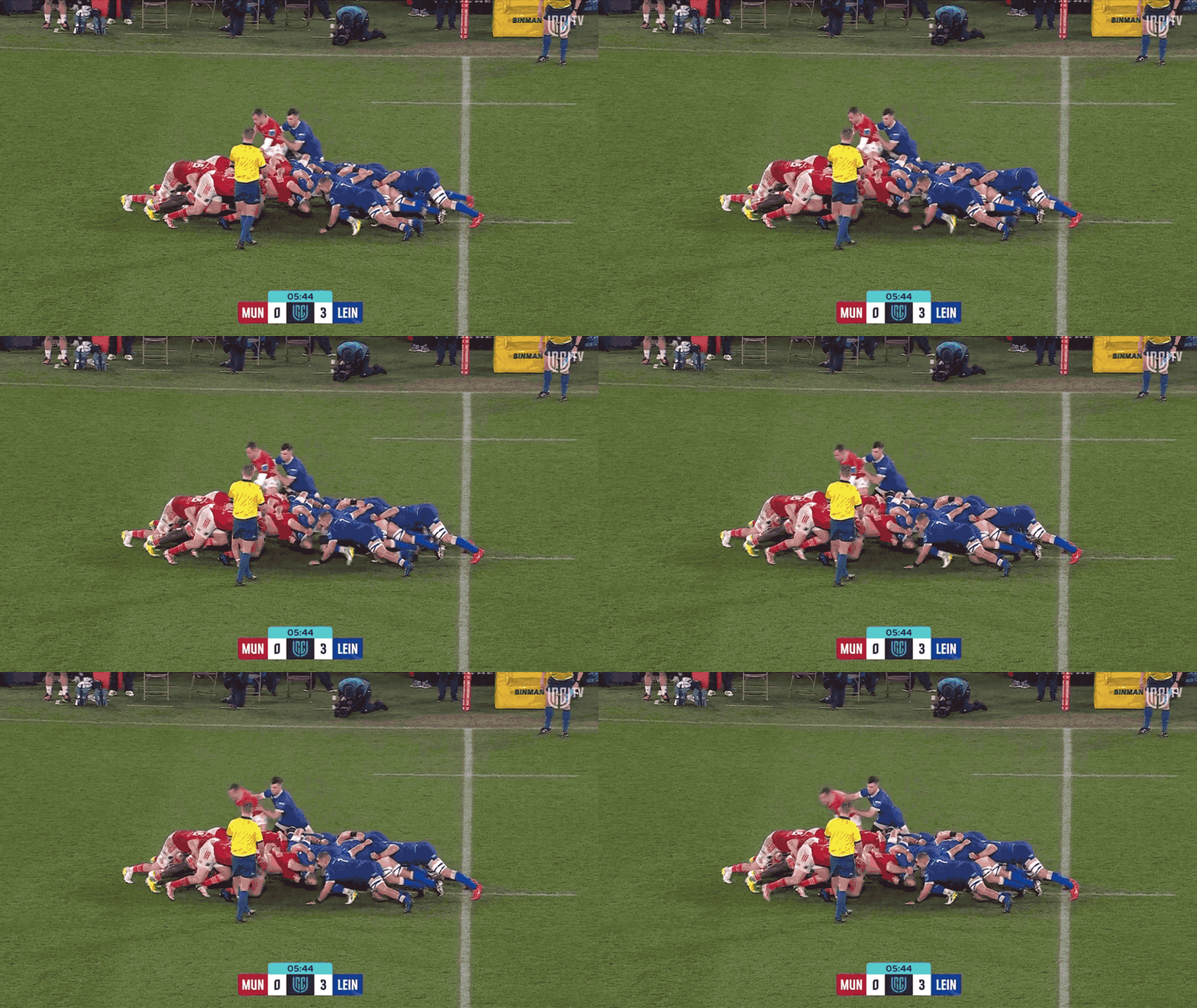
Porter’s elbow is a dead giveaway here, as it usually is. He’s actively pulling Jager down and hinging his hips and back to pop the pressure. Without this, it would be Jager and his tighthead unit – tighthead lock and flanker – angling in on an isolated Porter. This happens pretty regularly when Leinster are defending the put-in.
In the scrum directly previous to this one, when Leinster were putting in the ball, Porter can’t be as aggressive with his boring in because the ball has to be struck by Kelleher, who he’s bound to. Without that initial strike and swing by Porter, he’s forced to scrummage squarely on the initial hit so a strong-framed tighthead can hold him in place. You can see it clearly here.
This is the action we’re looking at from Jager – that low lockout and the squeeze. You can see Porter having to adjust his outside leg inwards to handle the pressure because if he steps out, Jager will drive right through him and turn his natural angle (that all looseheads use) into a drive backwards.
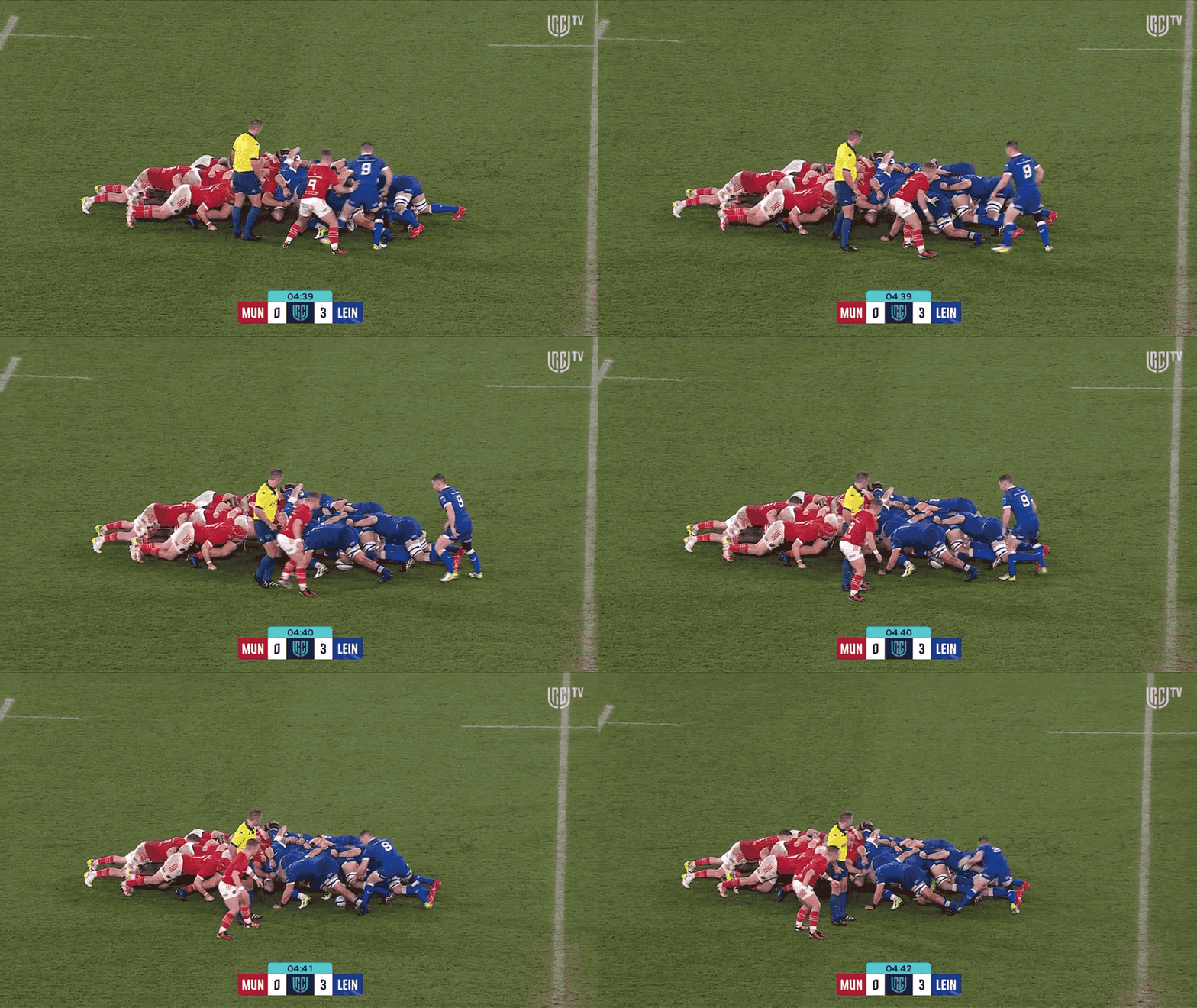
As an aside, Munster’s scrummaging unit is really nice here – look at the connection across the middle four and how long O’Donoghue can bind backwards.
On the next Munster put-in, our front row had learned the lesson of the previous penalty given against the head. A much better hold by Kilcoyne on Ala’alatoa meant that Porter was left with the role of chief disrupter. It did not go well for him.
Jager catches Porter’s initial swing in – Porter shifts his hips out and his torso in – and pins him with a really strong bind…
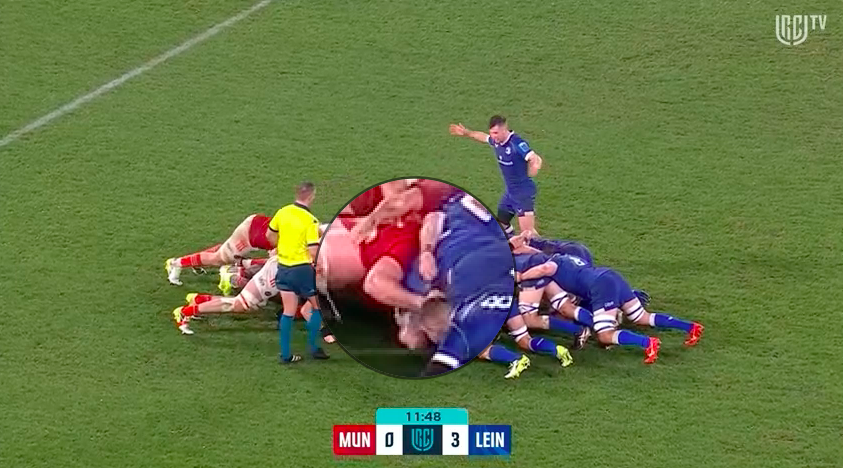
… and he then follows that up with a really strong frame that turned Porter’s bore into a weak side drive through opportunity.
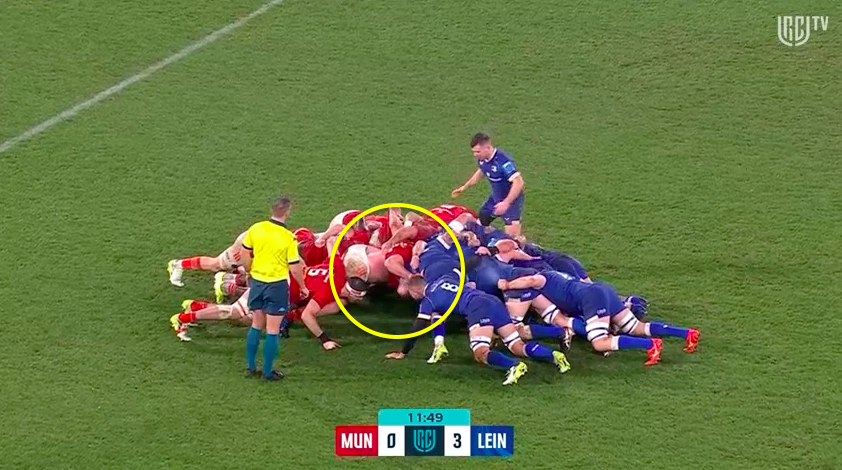
Porter’s elbow is down once again but all that does is give Jager more leverage to drive straight through. It’s not a hard and fast rule but, in general, a tighthead wants to keep the loosehead locked down and low, while the loosehead wants to drive up diagonally. Porter’s scrummaging technique on the loosehead side runs the risk of this very thing happening over and over again but he needs to do it to expose the tighthead to his power.
Porter played tighthead during his formative years as a professional scrummager and they are fundamentally different positions with different roles and objectives. Porter took to the tighthead side ridiculously well as a young lad – way earlier than most other pros – because he’s freakishly strong with bold shoulders on. In my opinion, he tries to turn that “holding” power as a tighthead into destructive loosehead scrummaging by pulling down his tighthead, shifting a bore with his squat upper body and long wingspan before then getting both shoulders on so he can drive right through the opposition scrum.
But when he can’t do that – when he feels like he’s under pressure from a big tighthead who can lock him out low – Leinster have become very good at dropping scrums and rolling the dice on the referee defaulting to the middle ground. This example is the same as the very first example I showed you in that it’s a Munster put-in. Look for Porter’s elbow pointing down, look for his back arching and then pulling Jager down before letting the shove from the locks simulate the impression of forward motion.
Porter is always angling down on the put-in. His elbow is the giveaway, as is the locks hopping forward instead of planting square – they are making sure they don’t face plant.
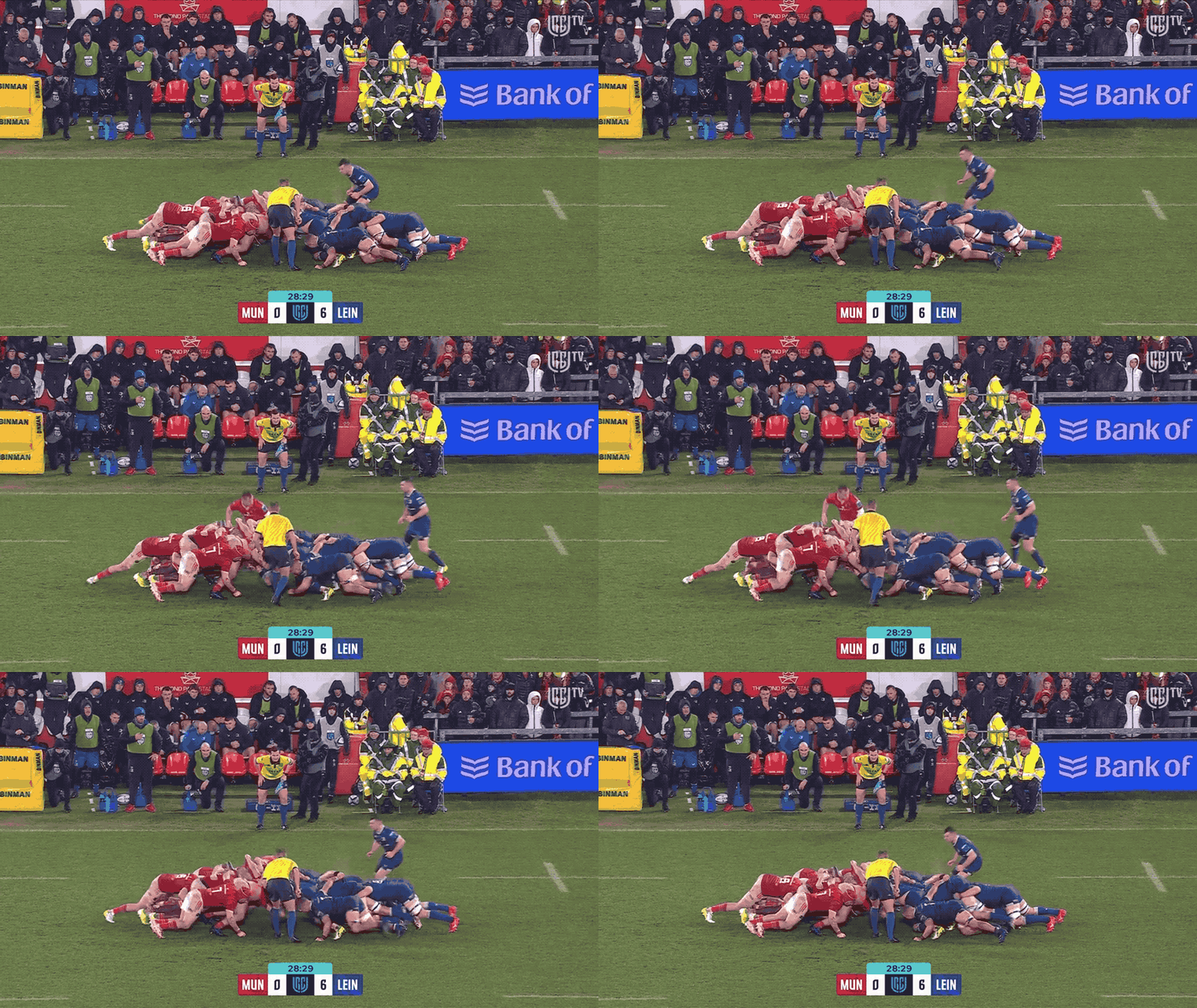
There was a really great example just inside the second quarter where we got an up-close look at Jager and Porter in action. Now, to be clear, the scrum is about more than just these two players but a lot of the penalties focused on them so I felt it would be interesting to look at it.
Porter starts wide and tries to create that natural starting angle that all looseheads go for – you’ll notice this by the outside boot fixed behind the planted arm of the flanker. The tighthead will usually fix that foot inside the flanker’s arm right before the engage.
Straight away, you can see Porter looking to pull down Jager by angling in, hinging at the waist and pulling down with the hope that the locks behind him will exaggerate the forward motion and make it look like Jager “can’t handle the power”.
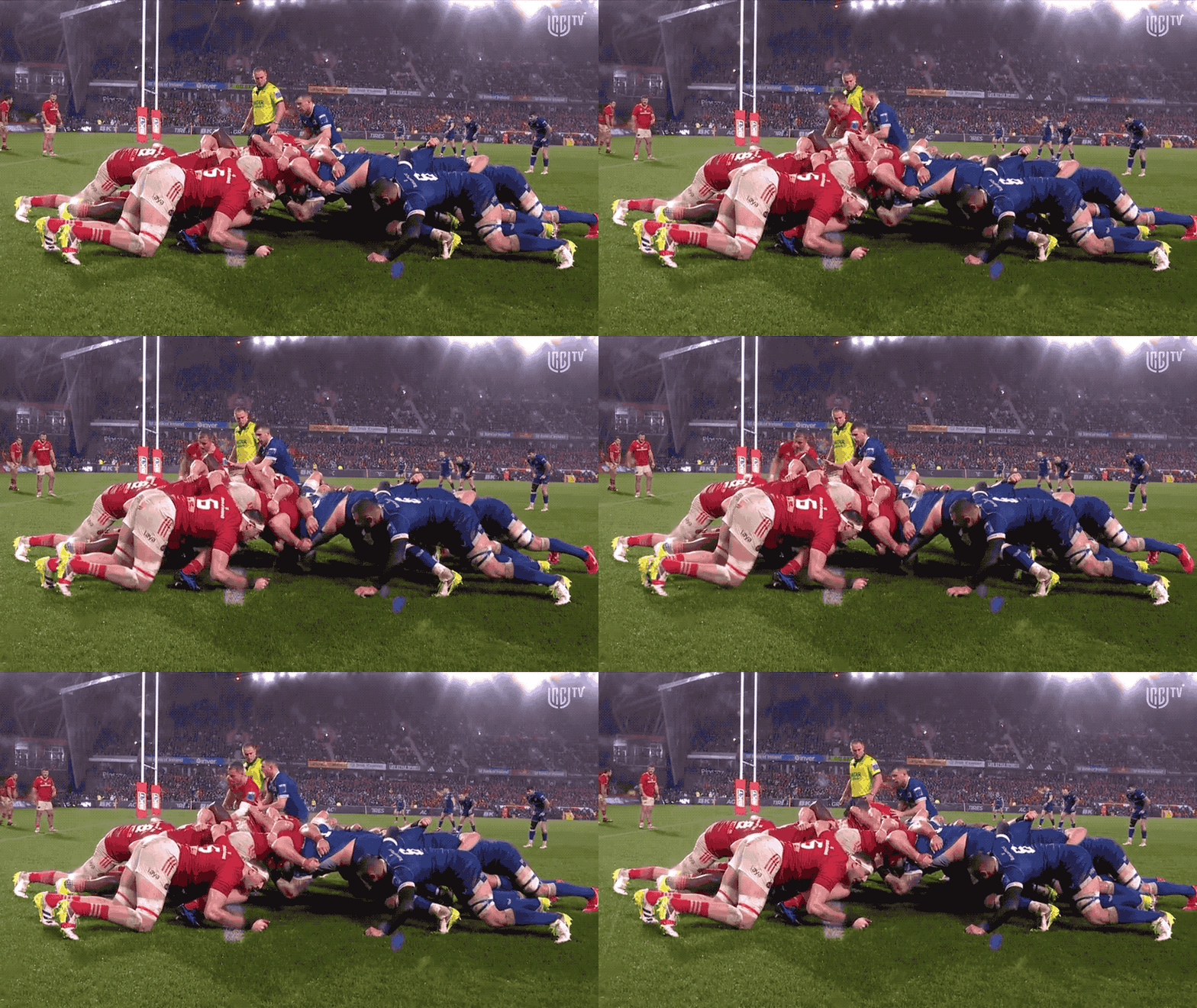
But it’s Jager who’s in the strong body position. This is a classic 45-degree Jason Ryan scrummaging shape and it makes a bored drop look like what it is. The biggest giveaway to these planned drops, bailouts and wheels is the locks. You can tell who’s looking to pack down and push and who’s looking to shoot forward on a moving target like a trailer catching up with a truck.
When Jager went off the field, our scrum just couldn’t handle Porter or Ed Byrne. If anything, we imploded when Byrne came on the pitch for whatever reason. Leinster get an angled shove on here – again, on our put-in – and Archer can’t lock out Byrne. As a result, we implode.
And the game was gone gone.
But the tantalising thing is that even though we lost this game, even though our lineout failed at key points (again), we managed to hold a stronger (on paper and physically) Leinster side with 14 forwards to our 13 amid a near-unprecedented injury crisis on a day where a lack of power kills you stone dead.
I truly believe that this Munster team can beat any team put in front of us as long as we have a relatively normal injury list. If we play Leinster again this season and we have a full squad to pick from, I think we win on the evidence of both games I’ve seen 10 times in the last three weeks. Watching this game back was the proof of it.
We didn’t play well, we didn’t deserve to win but in a game of physics played out in a yellow weather warning that we should been destroyed in, we were two ropey penalties away from a win that wouldn’t have been undeserved either.
We just need to get healthy but that’s way easier said than done.
| Name | Rating |
|---|---|
| Dave Kilcoyne | N/A |
| Diarmuid Barron | N/A |
| Oli Jager | ★★★★★ |
| Gavin Coombes | ★★★ |
| Edwin Edogbo | ★★★ |
| Tom Ahern | ★★★★ |
| John Hodnett | ★★★★ |
| Jack O'Donoghue | ★★ |
| Craig Casey | ★★ |
| Jack Crowley | ★★ |
| Shane Daly | ★★ |
| Alex Nankivell | ★★★ |
| Antoine Frisch | ★★★ |
| Calvin Nash | ★★ |
| Simon Zebo | ★★★★ |
| Eoghan Clarke | ★★★★ |
| Jeremy Loughman | ★★★★ |
| Stephen Archer | ★★ |
| Brian Gleeson | ★★★ |
| Alex Kendellen | ★★★ |
| Paddy Patteron | ★★ |
| Tony Butler | N/A |
| Sean O'Brien | N/A |
