


This has been a weird week.
The flat second half against Bayonne with the missed drop goal felt like a dropped birthday cake in matchday experience form. Munster’s run to the URC title last season has raised expectations to a point where a battling draw against a game and sticky but limited Bayonne side just won’t cut it. It felt like a loss on the night because, in a way, it was a loss. We expected five points but had to settle for two. Those missing three points could be costly in meeting another expectation: finishing our pool with enough points to earn home knockout games.

Success breeds expectation, which breeds pressure, which breeds… mistakes, guys looking off, units not performing. All fun stuff. Are Munster feeling the pressure of that expectation as Champions during a grinding middle bloc of the season? Perhaps. We can’t write it off as a non-factor. There’s also the thing you can’t speak about; injuries. Munster are currently missing three starting second rows based on our usage this season and last.
Every team has injuries – you have to say that – but what Munster seem to have perfected in the last few seasons is getting burned down to the ground in one or two core positions. Most elite sides can handle four or five injuries as long as those knocks are spread out. You could be missing your 1A tighthead, your 1A tighthead lock, your 1A #10, your 1A centrepiece midfielder and your 1A fullback, for example, and still expect to win most of your games.
What Munster has at the moment is a situation where two of our three 1A locks are injured, along with two 1B options which means we’re starting a 1C option in the second row this week – our half-lock power forward Gavin Coombes. The knock-on effect of this is that our other 1A option, Tadhg Beirne, almost has to get overused because of the injury issues elsewhere which increases his injury exposure as he goes week to week. Injuries beget injuries when you’ve got a tonne of injuries in a certain spot.
As an on-ball team, Munster need the heavy ball carrying and ruck retention of our specialist profile second rows to run our system exactly as designed. When we don’t have those players available, we have to adapt as best we can.
“It’s not the X’s and the O’s but the Jimmys and the Joes.” – Darrell Royal
Against Bayonne, we were without our heavy core of second rows – we use them to build cascading compressions in the middle of the field and retain possession – so we had to make do with lighter players who don’t have the same impact on the opposition. But that’s OK – we could live with that if we had our best outside backline to make the smaller compressions work but we were without our top edge playmaker in Frisch. We tried to cram Scannell and Nankivell into an uneasy shape to duplicate some of what Nankivell and Frisch give us against Bayonne but it didn’t work.
Injuries to Haley, Zebo and Daly meant we had to shoehorn Nash into fullback where his skillset doesn’t quite fit and then use inexperienced – both from an age and system fit perspective – wingers who weren’t quite at the level required to fully unlock what we wanted.
We lacked top-end power in the front row and the guy we signed specifically to address that – mid-season no less – missed out with a knock.
Your system is your best players arranged in a formula that wins rugby games. When your ideal players aren’t available you try to substitute in others but the more you sub in, the more difficult the original winning formula becomes to reproduce.
Do Munster have enough of our winning formula on the pitch to win away against Exeter? We’ll know soon enough.
Munster Rugby: 15. Shane Daly; 14. Calvin Nash, 13. Antoine Frisch, 12. Alex Nankivell, 11. Seán O’Brien; 10. Jack Crowley, 9. Craig Casey; 1. Jeremy Loughman, 2. Diarmuid Barron, 3. Stephen Archer, 4. Gavin Coombes, 5. Tadhg Beirne (c), 6. Tom Ahern, 7. John Hodnett, 8. Jack O’Donoghue
Replacements: 16. Eoghan Clarke, 17. Josh Wycherley, 18. Oli Jager, 19. Brian Gleeson, 20. Alex Kendellen, 21. Conor Murray, 22. Rory Scannell, 23. Ben O’Connor
Exeter Chiefs: 15. Tommy Wyatt; 14. Olly Woodburn, 13. Henry Slade, 12. Joe Hawkins, 11. Ben Hammersley; 10. Harvey Skinner, 9. Tom Cairns; 1. Scott Sio, 2. Dan Frost, 3. Ehren Painter, 4. Rusi Tuima, 5. Dafydd Jenkins (c), 6. Lewis Pearson, 7. Jacques Vermeulen, 8. Greg Fisilau
Replacements: 16. Max Norey, 17. Nika Abuladze, 18. Marcus Street, 19. Jack Dunne, 20. Ross Vintcent, 21. Stu Townsend, 22. Ollie Devoto, 23. Rory O’Loughlin
Exeter have changed quite a bit since the last time we played them.
The financial whirlwind of COVID, issues with primary sponsors, a shrinking salary cap and the knock-on effects of the Premiership losing a few times – and the resulting gates – has meant they’ve lost 14 of the match-day squad that won a Champions Cup in October 2020 in the years since.
Every team goes through cycles of transition but Exeter’s feels like it happened at 2x speed. With most of the top layer of quality gone over the last few years – even more over the off-season just gone – results have naturally fluctuated. They finished seventh in the Gallagher Premiership last year, and are hovering around 5th this season but, importantly, they made a semi-final last season in Europe where they were well beaten by eventual champions La Rochelle.
But they’ve lost even more players since that achievement, such as it was. Jack Nowell, Sam Simmonds, Dave Ewers, Harry Williams, Joe Simmonds, Solomon Kata, Mike Williams, Jannes Kirsten, and Stuart Hogg have all left the squad. My thoughts at the start of the season were that this game would be tough, of course, because it’s Sandy Park, but that it would be doable. What I saw of them since the World Cup was over in the Premiership confirmed that, to an extent. They were generally quite poor on the road and their usual formidable selves in Sandy Park.
But then they went and beat Toulon last week in Toulon.
What was going on?
Well, from a stylistic perspective, Exeter aren’t the massive scrum, massive maul team that they were a few years ago. They can hurt us in the scrum and maul at the moment – a lot of teams can, unfortunately – but it’s not the super strength it was the last few times we played them. They’re about as dangerous as any other side from 5m, which is quite dangerous and you should endeavour not to play too much of the game there. Take notes, coaches.
The personnel have changed and their style has too, to an extent.
They kick at a pretty high volume; an average of one kick every 4/5 passes in the last five games but a lot of their kicking is in mid-range. They’ll box kick, they’ll exit long off #10 but a lot of what they do is based on lower trajectory chips and grubbers to open up space for their lightning-quick midfield and outside backs.
They will hang onto the ball and go through the phases inside your 10m but they’ll use a lot of chips and crossfield action outside that range off #9, #10 and #13.
Defensively, they’re quite interesting in that they use their backline speed – and that of their hooker Dan Frost – to play an incredibly aggressive two-wave high-edge blitz on big openside plays. When it’s at its best, this defensive blitz is a screen pass killer and they send runners specifically to counter any pass to a layered runner off #9.
Watch their hooker Frost in this sequence.
That is aggressive blitzing. Look at his position at the height of it – right in that lane where a pass is slung to a drifting handler.
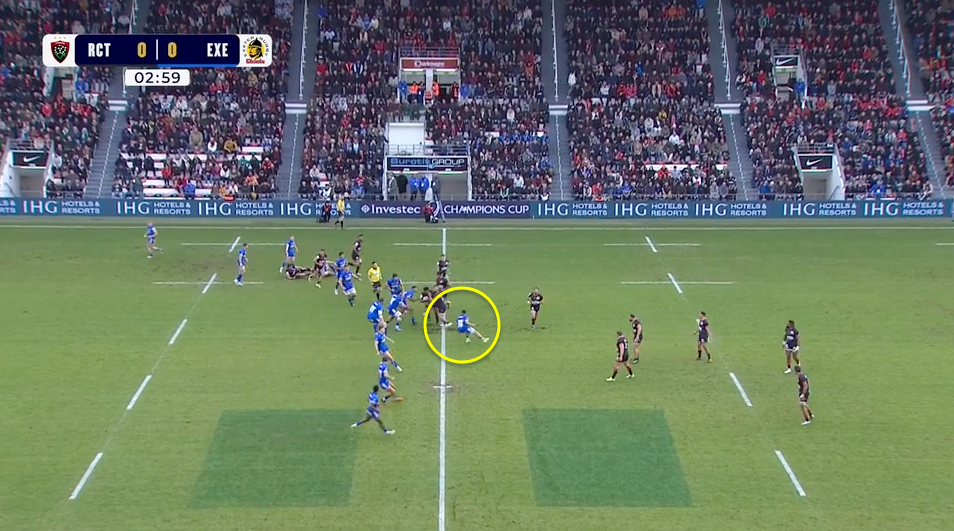
Exeter does this to stymie the transition of the ball across the field so they can keep a tight, narrow blitz on the outside edge. It’s a variant of South Africa’s high-edge blitz but with an even more aggressive inside section. On maul breaks, they will literally shoot directly up into any layered screen.
It’s all empowered by their speed at 10, 11, 12, 13 and 14. What they lack in traditional midfield brawn, they make up for a hyper-aggressive press when they have the whole pitch to work with.
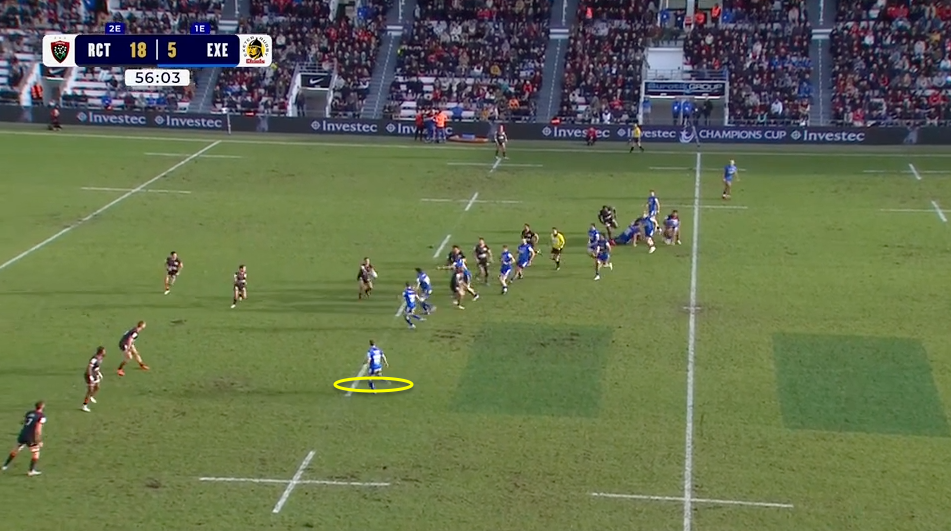
But if they can’t blitz up the middle of the field on that first screen, it does leave them exposed to a pinch move at the edge where they then have to blitz incredibly aggressively. You can see Vermuelen trying to make up for the allowed transit by hitting the last passer late – this is what we have to watch.
Exeter’s defensive narrowness empowers the blitz because it basically says you have to float the ball over the top to get around them. In this sequence, you can see how compressed they are on a centre-field ruck. All of their primary line defenders are between the 15m lines. This allows them to double tackle freely but look at the first carry – there’s half a blitz there to cut off the pass to width.
The real blitz comes on the next phase and it’s as aggressive as you’ll see in the game right now. If this pass goes beyond the edge blitz, it’s a try but… it’s an intercept instead.
What kills this defence? Many things.
Air raid cross-field kicking off a disguised screen move towards the tramline where you have a 6’9″ edge forward that can finish from the halfway line.
Short, accurate tip-ons thrown into half your pass action so the screen blitzer has to worry about the gap he leaves behind.
An offloading midfield that can soak a tackle and pass beyond the last blitzer to a looping winger.
A #10 that can sell a good pump fake before breaking himself into space with a tight runner buzzing an offload line.
It’ll be complex so we need to be accurate. We’ll need forward parity or better, and our lineout has to work but if we can nail their blitz – and we have the firepower on the field to do it – we’ll score tries and plenty of them.
