


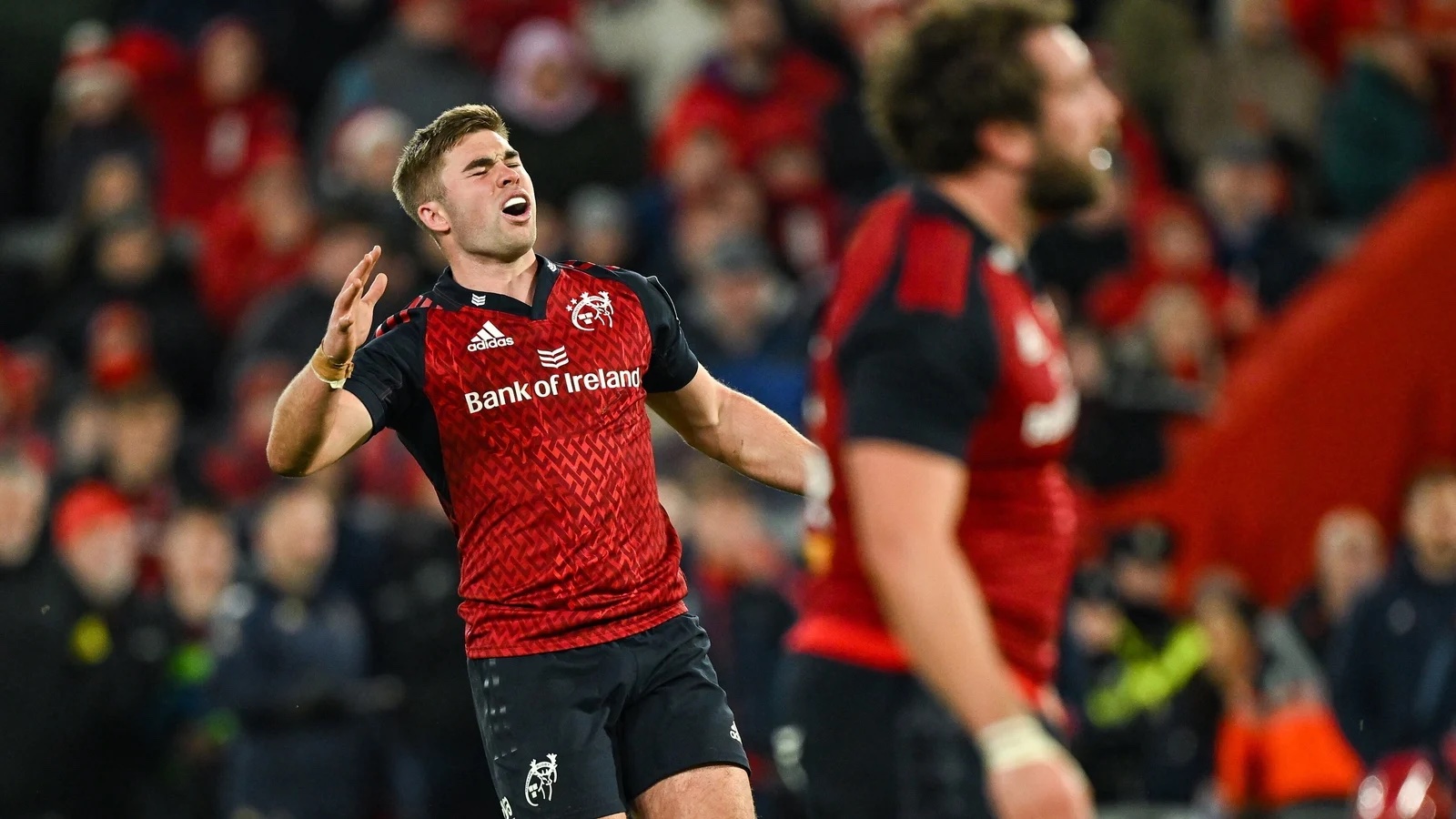
There’s no two ways about it – this was a horrible result.
Before the game, we were rightly thinking of bonus point wins, even with our rotation from the previous week due to injuries, guys who are pretty much injured and could be injured but we’re minding them. Bayonne rotated too, and quite a bit from the previous week, but they brought this Munster team’s kryptonite; overwhelming size and weight.
What we saw from Munster last season on the run to the URC title was, for the first time in nearly 10 years, what we would look like with the team we’d planned to play in big games playing in big games.
It’s why we won the title.
Earlier in that season, we went through long spells of key players being unavailable. Remember Kiran McDonald? He was brought in because, at one stage, we were missing RG Snyman, Jean Kleyn, Thomas Ahern and Fineen Wycherley. Remember John Ryan coming back in because Keynan Knox, James French and Stephen Archer were all injured?
We’re in the same place now, except the red and orange-level injuries are spread throughout the lines of the team. Munster are a system team.
While all of that is an objective fact, we still should have beaten Bayonne – comfortably.
That we drew and, in truth, could have lost this despite leading 14-3 for much of the game is a real concern because it felt that we were unable to read how the story was going.
In the second half, it felt like we were chasing for a bonus point that wasn’t on, especially as the weather conditions returned to the IT’S RAINING SIDEWAYS stuff we know and love in Thomond Park.
This was the ideal game for a team with a big lineout maul and a heavy, well-drilled pick-and-go game but we don’t have that right now. In part because we didn’t have the horses on the field against a limited but physically massive Bayonne pack.
The conditions forced the game to narrow – also, in part, due to the inaccuracy of our work in the backs along with a bucket of unforced passing errors – and that narrowing exposed a fundamental truth; Bayonne, even a rotated Bayonne, considerably outsized the rotated and injury ridden pack we had out on Saturday night.
As the game went on, Bayonne got bigger and we stayed more or less the same size. If everything was firing behind the pack, this wouldn’t be as glaring an issue but everything we did in this game seemed to gift Bayonne energy and momentum.
So you ask, how do we draw to Bayonne at home? Let me show you.
First – a blown opportunity to put Bayonne away right before halftime. This was a big energy drop right before halftime. What’s the first thing you notice?
Yep, the bump on Coombes by the counter-jumper on his way down. A penalty, technically, but there we go. That means Coombes is too high on the touchline side which means we get turned infield. We planned for this to happen to allow us to surge towards the touchline but we needed forward momentum to “hinge”. John Ryan, the other lifter, was looking to add to the movement in and towards the touchline side but when we lost the initial engagement on Coombes’ side, he essentially stood up and, as a result, he couldn’t guard Bruni from swimming through the gap right onto Buckley.
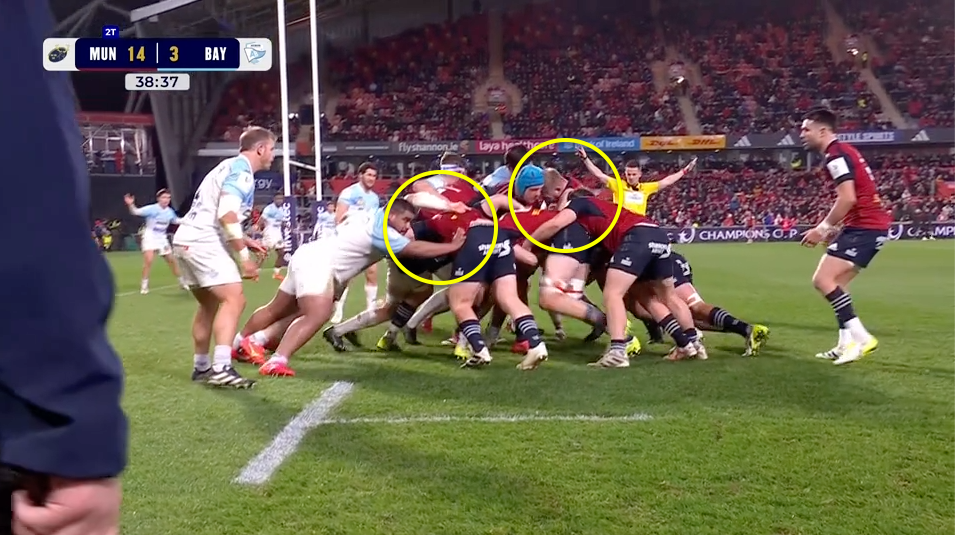
Buckley is in the middle section of the maul because the intent here was to hinge around Coombes and propel him forward with the momentum coming from the infield side of the maul but we started bad and the bad cascaded from there.
In the second half, we had multiple opportunities to convert 5m opportunities but we found ourselves running into bigger men repeatedly. How do you fight against that? By latching and driving. A good, well-timed latch game can help you overpower a man-on-man size advantage.
We tend to use a late latch system close to the try line. This system spaces out our runners – and the defenders – with the threat of the tip-on pass keeping the defence from clustering on a tight drive. In theory, it opens up lanes to run into where we can hit one on one.
The runner hits contact, matches the collision and then our late latchers arrive after the momentum has stalled to drive through the contact. This is a good example in the build-up to Coombes’ try.
John Ryan rides out the contact, and Loughman arrives at speed to drive Ryan through the defender. This is good latch work.
In the second half, when the kill shot was right there for us, our latching work degraded quite a bit.
Munster’s “tighter” pick-and-drive routine looks to have a pre-bound latch from one player on the carrier with the forward passing from the base adding his weight as a third latcher once the latching pair make contact with the defence in line with the new latching laws brought in a few years ago which says you can’t have two players pre-bound on a carrier before contact.
What do you see wrong with this latch by Scott Buckley on Tadhg Beirne?
Beirne gets stopped by 135kg of Junior Tagi with Marchois adding his 6’6″ frame after the first contact like a scud missile. Beirne does well to ride the contact but Buckley’s latch completely fails to put any forward pressure on our carrier. Buckley is applying no pressure to Beirne here that can realistically drive him forward.
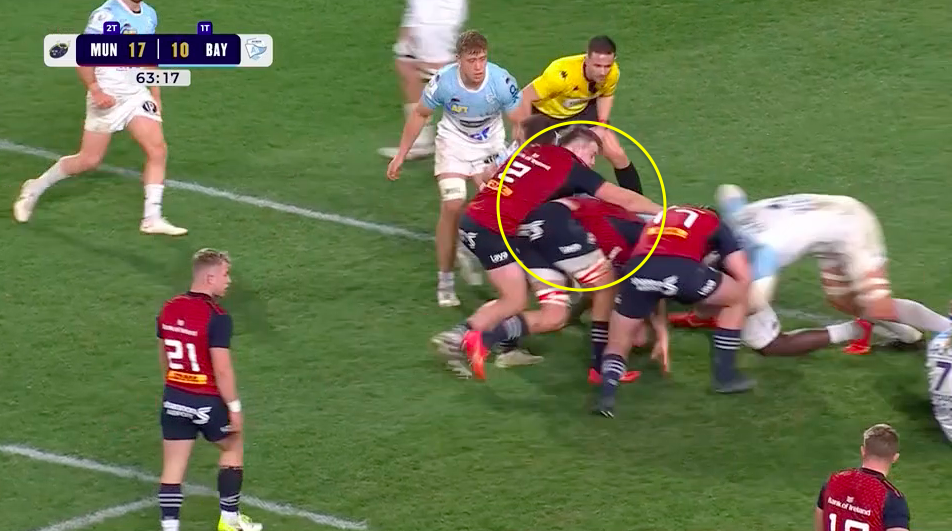
So Beirne doesn’t go forward – the entire unit gets stopped dead three on three – and Buckley and Wycherley are left scrabbling around to secure the ruck.
The next phase showcases the same thing but with a different problem. Kendellen and Wycherley are set up as the pick option off the base of the ruck. Wycherley can, and should, pre-bind on Kendellen here to add his weight to the drive. If they can hold in the contact, they’ll get a look at hitting the Bayonne scrumhalf.
Kendellen gets stopped here two-on-one before Fineen Wycherley can latch him. Hodnett arrives after but he would always be the second arriving latcher in this scenario.
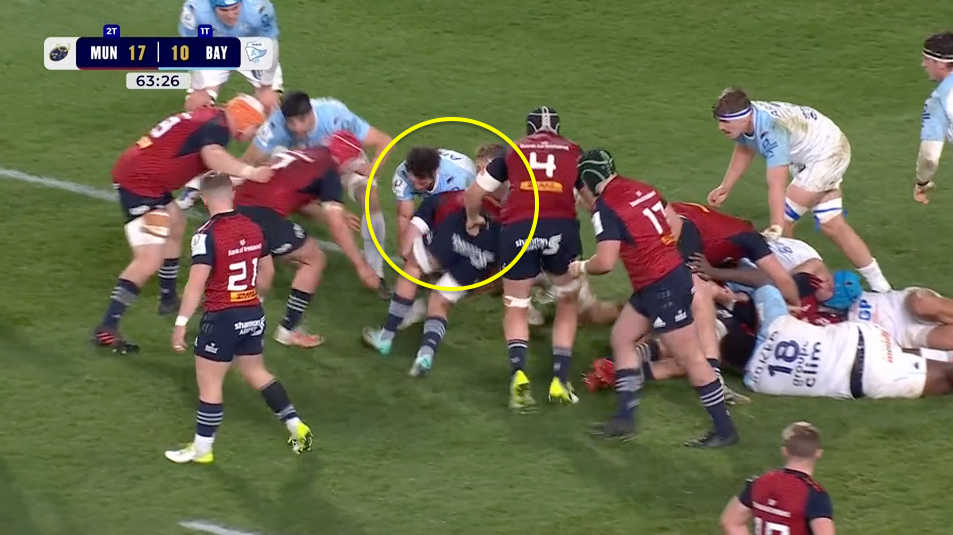
Kendellen and Wycherley weren’t on the same page here and we lost another opportunity to get a good drive on against a potential mismatch on one of their defenders. That kind of missed latch was present through these phases before Beirne slung the ball into the stands with a miss pass attempt that Craig Casey would have thought was tricky.
But we were losing collisions and out of sync – Beirne just wanted to do something, anything to crack Bayonne open.
Earlier in the game we were making a better attempt to latch and drive in this manner, even if the quality of the inside latch was deeply inconsistent. Have a look at this long sequence to see;
We won a penalty on this sequence but you can see for yourself that the quality and consistency of our tight work was up and down here.
If we were as sharp as we needed to be, this team, rotated as it was, would have converted one of these sequences as a try and killed off Bayonne’s interest in the game. But we weren’t.
This kind of forward play meant that our size counted for less against Bayonne, who were already bigger and heavier than us coming into the game.
When you also add our lineout completion in the low 80s and a scrum completion rate close to 50/50 on seven scrums on our put-in, you can see how we struggled to pull away. Ultimately, without elite size on the pitch, everything we do has to be complex and incredibly accurate. We had far too many poor passes, blown screen balls to no one and even here, good moments ruined by poor inside balls.
Did complacency sink in? Did we assume – as I did, to be fully frank – that the tries would come eventually if we kept up the pressure and Bayonne would slip off into the night?
It’s impossible to know.
What we do know is that we’re a good team but we need much closer to our full Category A selection to make it work against a limited but physically massive opponent. Bayonne picked a four-lock pack and managed to earn a draw from it in exactly the way you’d expect – heavy close in defence, excellent lineout defence and heavy maul work.
For Munster, the answer is simple; getting our elite size and power on the pitch as soon as possible and, failing that, we need to see a radical improvement in our tight work, our collision work and our lineout which is so rickety now, teams feel very comfortable counter-launching on it almost constantly.
A reaction is needed.
| Name | Rating |
|---|---|
| Jeremy Loughman | ★★ |
| Scott Buckley | ★★ |
| John Ryan | ★★ |
| Fineen Wycherley | ★ |
| Tadhg Beirne | ★★★ |
| Tom Ahern | ★★★ |
| John Hodnett | ★★★ |
| Gavin Coombes | ★★ |
| Conor Murray | ★★ |
| Jack Crowley | ★★★ |
| Sean O'Brien | ★★ |
| Rory Scannell | ★★ |
| Alex Nankivell | ★★★ |
| Shay McCarthy | ★★★ |
| Calvin Nash | ★★ |
| Eoghan Clarke | ★★★ |
| Josh Wycherley | ★★★ |
| Stephen Archer | ★★★ |
| Jack O'Donoghue | ★★★ |
| Alex Kendellen | ★★★ |
| Craig Casey | ★★★ |
| Tony Butler | ★★★ |
| Ben O'Connor | ★★★ |
