


I love games like this.
Fundamentally – and I know I’m wrong about this but it’s how I feel – high-scoring games that finish 34-33 or whatever are lesser value wins. When I see scores like that, I lose all interest in seeing the game. Does that make me a douchebag? Yes.
But I can’t help it.
Here’s a breakdown of my thoughts after doing this job for eight years now.
- One side wins by 30+ points? Worthless game, only watch it if I have to.
- One side wins 38-36? Defence optional, only watch it if I have to, not real rugby, go watch basketball.
- One side wins 9-6? Real rugby, authentic, now this I gotta see.
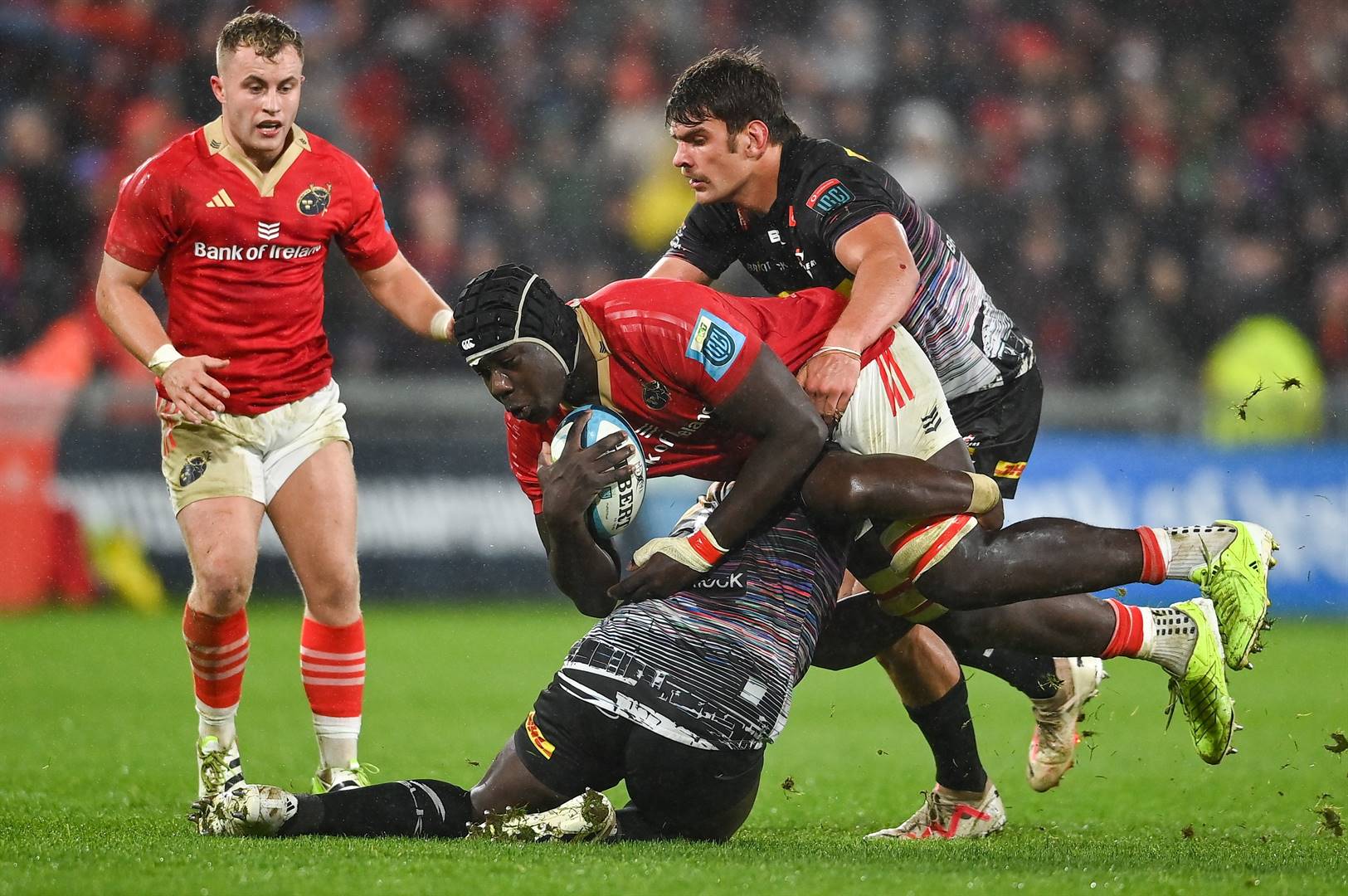
When I see a game like this one against the Stormers played out in conditions you wouldn’t leave a dog you don’t like out in and only featuring four scores – two penalties, a try and a conversion – that’s the kind of thing I have to see.
In a game where scores are coming easy, rugby becomes a game of execution.
In low-scoring games, it becomes a game about character.
And, when it comes down to it, I want to know more about a group’s character under pressure than I do about their ability to slip a few scores in against a defence half-assing it.
What did we learn about Munster this weekend?
- Our high-ball work has been an issue two games in a row, as has our escorting.
- Our scrum without John Ryan is vulnerable to heavy scrummaging opposition.
- Our attacking game is degraded by wet weather, breakdown pressure and wet weather breakdown pressure most of all.
- Jack Crowley can control a tight game with his boot.
- This team do not quit and has created a knack for dogging out games like this more often than not.
This game reminded me so much of Munster vs Saracens from the 2019/20 European Cup pre-pandemic. The final score was the same, the conditions were the same and the impact in the collisions was the same. That game was a high-intensity, low-scoring war and this game against the Stormers was the same.
It says a lot about the URC that this level of game was typically only available against the elite sides in the European Cup or in certain high-level interprovincial games against Leinster or prime versions of Ulster throughout the years.
Now we’re getting it in November in the league. And by “it” I mean “getting our chins checked in high-intensity, low-margin-for-error games”.
There’s a value there that goes beyond spectacle.
***
There are a few numbers that sum up this game.
The first is the Stormers kicking the ball once for every 3.6 passes in this game, which is verging on off-ball rugby. The second is their Pass Per Carry ratio – 1.18.
What does this tell us in simple, finger-paint illustration? The Stormers kicked to us early and often in their possessions and we tried to play out from that transition possession as much as the conditions allowed (1 kick every 5.6 passes with a PPC ratio of 1.17).
What did this mean in practice? A game of withering collisions where Munster retained the ball as much as possible in the conditions while the Stormers pack and Ruhan Nel in midfield teed off on our ball carriers with a volley of withering, two-man shots.
The Stormers saw the conditions and decided that they didn’t want to play much ball outside of our 22. This approach isn’t new or unusual for them, either, as they played almost identically in the second half of their recent game against Glasgow. They kick contestably in the mid-range, pressure the receipt, pressure the sequences after through their athletic, heavy-hitting pack and then soak up the excess with a very strong, penalty-winning scrum.
Were the conditions that bad to warrant such an approach, you ask? To that question, I will show you this clip.
In those conditions, rugby becomes a game won and lost on where and how it’s played; so kicking, chasing, lineout, maul and scrum are even more important than usual.
The Stormers kicked well and chased well. We didn’t necessarily handle their kicking all that well, certainly in the first half, where we spilt a good few contestables, as well as shipping some heavy leather from their forward chasers.
As a result, we endured a lot of scrummaging and did well, for a time, before Stormers’ power started to tell and then really tell.
Essentially, the conditions produced more scrums as a by-product which we’re typically happy enough to work with. We play an on-ball style which generates more scrummaging than normal – we expect this. The problem here was that we were coming up against a side that would not be tired out by our normal phase play burnout strategy because the conditions (along with their own tactical choice in how they would use possession pre-game) allowed them constant breathers that wouldn’t exist on a dry night.
That Stormers’ pack build, on a dry night, would feel the burn if they kicked at that volume – and even if they didn’t – but with a purely defensive focus encouraged by the rain, they stuck in the fight to the end. In this game, in these conditions, attacking with the ball in hand is far more energy-sapping than defending for long stretches.
In the same vein, our defensive lineout and our defensive system as a whole prevented them from gaining any kind of momentum from the successes they had at the scrum and the kicking game.
It was an exercise in one side wanting to play defence primarily, and another side looking to tax them for giving up the ball so readily – and the attacking side just about edged it.
That said, we’ll be disappointed that we didn’t add to our lead when the chances arrived. We pressed them really well at the start of the second half and should have killed the game off there and then.
Note the simplicity of this throw to the tail – no cutouts, no feints, no cycling pods, just a flinch throw to a static target with a good jump, a good lift and a great throw.
When the break comes, we’re flowing around the corner and finding runners in space. We did everything right – up until the finish.
We were pressing inside the 5m line, we were engaging the Stormers and keeping them under pressure.
If Archer can snap into place on top of Edogbo, Scott Buckley scores under the posts on the next phase at best. Instead, he flies off his feet, misses the target and paints a picture that the Stormers’ have won the engagement, even though they’re illegal all the way through with not rolling away and/or getting onside before winning that jackal turnover.
We made it easy to reward them.
Getting into the 22 was so difficult in this game that an opportunity like that to make it 17-3 was costly.
But we dug out the win. At times it looked like every single knock-on would lead to a Stormers penalty but we dug in there too and just about kept the scrum out of the game.
I’ll be looking at the scrum in more detail later this week but we showed real character to make sure any penalty lineouts they got off the back of those scrums were defended and any breaks got held up and turned over.
That’s desire. That’s showing character in a moment that probably should have tied the game up at 10-10 with twenty minutes to go.
Character on its own doesn’t get you a bonus point or win you a trophy but it does show that you’ve got a bedrock of players who show up for you when the heat comes on.
That’s valuable all on its own, as are the hardwon four match points we took from this game.
Sometimes, that’s all that matters.
| Name | Rating |
|---|---|
| Jeremy Loughman | ★★★ |
| Scott Buckley | ★★★★ |
| John Ryan | ★★★ |
| Edwin Edogbo | ★★★★ |
| Tadhg Beirne | ★★★ |
| Peter O'Mahony | ★★★ |
| John Hodnett | ★★★★ |
| Gavin Coombes | ★★★★★ |
| Craig Casey | ★★★ |
| Jack Crowley | ★★★★ |
| Shay McCarthy | ★★★ |
| Alex Nankivell | ★★★ |
| Antoine Frisch | ★★★ |
| Calvin Nash | ★★★ |
| Shane Daly | ★★★ |
| Chris Moore | DNP |
| Josh Wycherley | ★★ |
| Stephen Archer | ★★ |
| Tom Ahern | ★★★ |
| Jack O'Donoghue | ★★★★ |
| Conor Murray | ★★★ |
| Rory Scannell | DNP |
| Alex Kendellen | ★★★ |
