


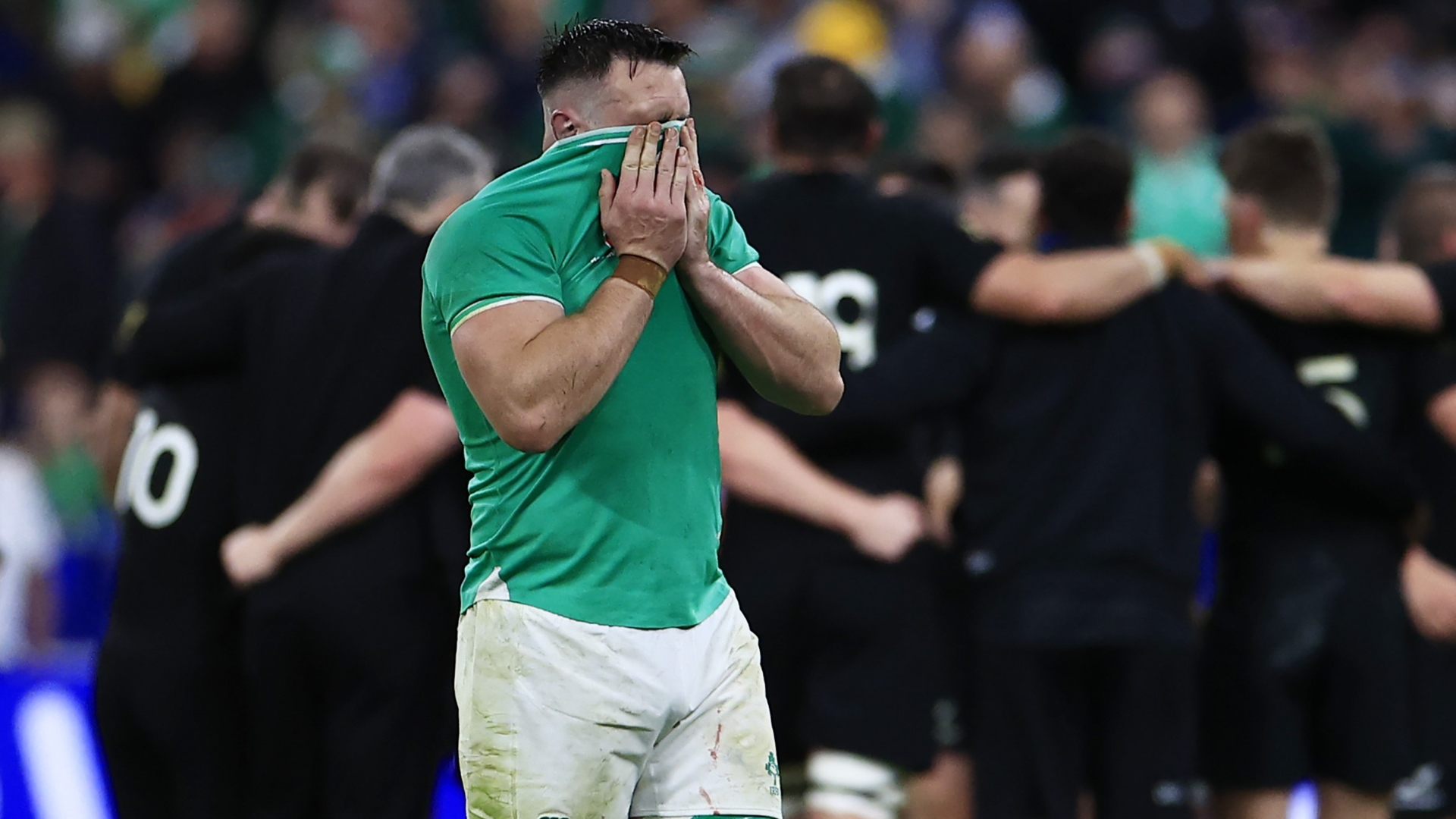
One of the last things you have to do before becoming a true Big Team in this sport is shedding the way an underdog thinks.
Big Teams demand success and examine failures furiously because they know that failures don’t just happen by chance. Underdogs console themselves with excuses.
Coming into this World Cup, I contended that Ireland could and should be winning the entire thing.
There is absolutely no reason whatsoever why Ireland should not expect to, at the very least, contest the final in this year’s tournament. I don’t want to hear about the quarter-final hoodoo. What happened four years ago has no relevance to today[…] In the last 24 months, this Irish team have beaten everyone they could realistically be expected to beat in this tournament.
Scotland, South Africa, France, New Zealand, England, Australia, Argentina and Wales.
If we can get through our nightmare mode pool and quarter-final draw – a big If – we’ll be playing, in all likelihood, one of England, Argentina, Australia or Wales. If I told you last year that we had to play any of those teams in a one-off game, Ireland would be the red-hot favourites. Win that game and we’ll be looking at New Zealand, France or the Springboks in a World Cup final.
We’ve beaten all of those teams in the last 12 months. You’re telling me we can’t do it again?
I don’t buy it.
So here we are a few months later. The Springboks are the World Champions – again – and we’re the lads nursing our wounds after going out in the Quarter Final to the All Blacks. Again.
If we take the line that this quarter-final loss was different to the others in so far as the margins of defeat were so small, I’d agree to an extent. We lost by a score to a good team. That happens. But why does it keep happening to us?
At a certain point, we’ve got to look at this objectively. Ireland came into this World Cup as the #1 team in the world and Grand Slam champions with guys you’d argue are top three players in the world in almost every position all playing a system that was so well embedded into the group that they could nearly play blindfolded.
Yet we somehow lost to the worst All Blacks side in the professional era when it mattered the most. That isn’t opinion, by the way, Ian Foster’s All Blacks have the worst winning record of any All Blacks side in the professional era. From a win percentage perspective, Foster’s All Blacks sit with the likes of Laurie Mains and Tom Morrison. “Who?” you might ask, and to that I’d say, “Exactly”.
With all that being true, Ian Foster’s All Blacks made a World Cup final, we didn’t, and they made that final at our expense.
In 2021/22, I wrote a fairly withering Anatomy of a Season review on Johann Van Graan’s last season in charge of Munster where I wrote the following;
A far greater problem is a growing feeling that I can’t seem to shake, which is that a large group of the senior squad have become so accustomed to falling short on the big day that it no longer motivates them in a real sense pre-game. Why would it? Genuinely. It sounds like I’m sticking the boot in here but, realistically, how long can any group of senior players spend losing finals, semi-finals, quarter-finals and big, yardstick games against Leinster before it becomes easier to accept it as the reality and that anything different is a bonus?
That’s just human nature. If you keep losing – especially to Leinster, against whom we are consistently judged – how long is it until it just becomes a formality? Everyone talks about making a statement and righting wrongs ahead of those big InterPro games but anything you say or do sounds a bit hollow when, regardless of what was said or done in the build-up, you lose. Over and over again.
When I read it back, much of what I said here applies to this Irish team. Are we a little too comfortable falling short on the biggest day? Before the World Cup, I didn’t buy the idea of “generational hoodoos”. Why should a team in 2023 feel pressure from something that happened four, eight or twelve years ago? But we have to look at it as a possibility. Is there a collective rugby memory that beds itself into a group, almost by osmosis? Is that why certain teams – like England, South Africa and New Zealand – find ways to win while we always seem to find a way to lose?
As we’re speaking about feelings and generational curses, I might as well say this; I’ve watched that 24-28 defeat back six times now for a few different articles, including this one, and I think that game only goes two ways.
Either we win by 15 points or lose by less than a score. Nothing else seems to be possible for this team.
When I went back and watched this Ireland squad develop over the four-year cycle, a few key trends popped up when it came to close games.
The Fast Start
One of the biggest criticisms that have sprung up around Ireland’s exit is “bottle” and Ireland’s supposed lack of it. When held up next to the Springboks progressing to the final based on winning three knockout games by a point, it does look bad but I don’t think it’s a fair reflection on the quality of this team.
Firstly, under Farrell, Ireland have had seven games end within a score before this World Cup since the last World Cup. Ireland won four of those tight games and lost three. Of the games we won, two were against Scotland (and can be safely ignored in that light) but the other two were interesting in that they happened relatively late in the cycle against South Africa and Australia. We won both of those November internationals in the Aviva Stadium by 3 points but, in both games, we led for significant segments of the match. That “buffer” of points from a position of strength seems to be quite important to this Irish team winning tight games. Against South Africa and Australia, we had a buffer of a score or more heading into the final quarter that we used to see out the win, with the most “clutch” performance being against Australia.
In all of our tight wins across the last four years, we never closed out a game from a losing position in the last quarter until the pool game against South Africa in the World Cup.
Essentially, if we weren’t leading for key segments of tight games over the last four years, we lost almost every time against elite opposition.

That tracks against Wales in 2021, France a week later in the 2021 Six Nations and then the season after in the 2022 Six Nations. Critique of this team’s mentality after that narrow loss to the All Blacks is a little unfair but it is rooted in some uncomfortable truths. We never held a significant points buffer in that game – we never led on the scoreboard at all – and that made it very difficult for this team to chase down a win with our primary style of play.
If you watch Ireland and Leinster – Ireland have been mapped on from a conceptual and personnel perspective since the summer of 2021 – you’ll notice the fast start as a key point in their game. It’s a vital part of playing counter-transition rugby. If you start at a high pace and get five or seven points on the board early, you can settle into the patient, unbalancing kicking game that counter-transition relies on. To give it a boxing analogy, counter-transition teams start with a flurry in the early rounds to force their opponent to over-extend in the middle and later rounds, making it easier to pick them off with accurate, sharp counter-punches. They make you chase the game and, if you chase too hard or too recklessly, they kill you off.

I spoke about a points buffer earlier but it’s way more specific than that – if Ireland don’t win the opening quarter against elite opposition, we lose almost every single time.
When you look at this Ireland side’s statement wins in this cycle, what do we see?
- March 2021: Ireland 32 England 18 – Ireland won the opening quarter
- November 2021: Ireland 29 New Zealand 20 – Ireland won the opening quarter
- July 2022: New Zealand 12 Ireland 23 – Ireland won the opening quarter
- July 2022: New Zealand 22 Ireland 32 – Ireland won the opening quarter
- November 2022: Ireland 19 South Africa 16 – Ireland won the opening quarter
- February 2023: Ireland 32 France 19 – Ireland won the opening quarter
- September 2023: South Africa 8 Ireland 13 – Ireland lost the opening quarter 3-0.
If you go back and watch the statement losses this Irish team have suffered in this World Cup cycle where we’ve lost by more than a score, there’s something in common with almost all of them;
- October 2020: France 35 Ireland 27 – Ireland lost the opening quarter
- November 2020: England 18 Ireland 7 – Ireland lost the opening quarter
- February 2021: Ireland 13 France 15 – Ireland won the opening quarter 3-0, but were down on the scoreboard by the 30th minutes
- February 2022: France 30 Ireland 24 – We lost this by six but I’ve included it because we also lost the first quarter here and also went 22-7 down at one point.
- July 2022: New Zealand 42 Ireland 19 – We lost the opening quarter.
- October 2022: New Zealand 28 Ireland 24 – We lost the opening quarter.
The only two outliers here are the win against South Africa in 2023 where we lost the opening quarter 3-0 and the loss against France in 2021 where we won the opening quarter 3-0.
What does this tell us? That our style of play demands a start where we win the opening quarter, ideally by scoring a try in that time. You can see this Irish team hunting for that score early in every game we play with that high Pass Per Carry, high kicking volume start that usually tries to start with a lineout strike play if we get the impetus to kick first.
Is it any surprise that our shocking opening quarter against New Zealand in the latest quarter-final cost us the tournament? Counter-transition demands control of the scoreboard to play with the kicking volume it requires. When we have that early scoreboard control, we dictate the game and our ability to win comfortably hinges on that early dominance. The more we score in the first 20 minutes, the more comfortable we win. When we don’t control the opening 20 minutes, it’s almost always a close game and, usually, a loss against top-five opposition.
This is a side effect of our style and the core personnel of our team. By October 2023, we were the most analysable and analysed team in the game.
